Hoping this makes the panickers out there feel more at ease:
Here's some of my highest conviction portfolio names today:
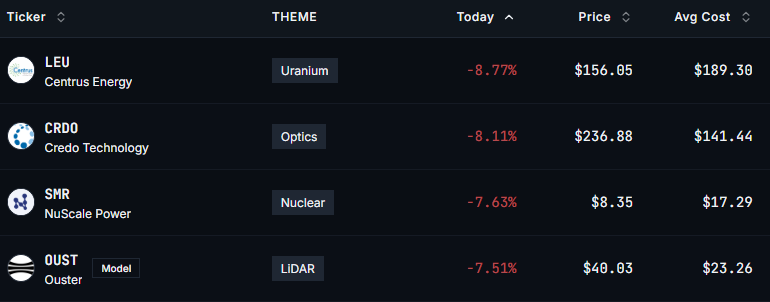
$LEU -8.8%
$CRDO -8.1%
$OUST -7.5%
$USAR -6.9%
$AAOI -6.7%
$NBIS -4.2%
$TEM -3.9%
Pretty much all these names I'd be happy to hold for the next 3+ years based on current fundamentals.
Thankfully, some of the losses today were offset by:
$TMDX +6.3% and software holding up like $LMND, $PATH, and $ZETA.
This is the time to focus more, learn more, stay disciplined, and start to *think* about getting more aggressive.
I suspect I'll talk a lot about $ZETA here below the 200 daily just like I did with $LMND back in March 2025.
$ZETA now trades at 2.7x FY26 revenue whilst growing at 34%.
They also trade at 11.2x EBITDA whilst growing EBITDA at +40%.
That flashes up as Very Bullish on my spreadsheet.
Other companies that compete with these growth to multiple ratios are:
1. $VISN
2. $SANM
3. $AMCR
4. $SW
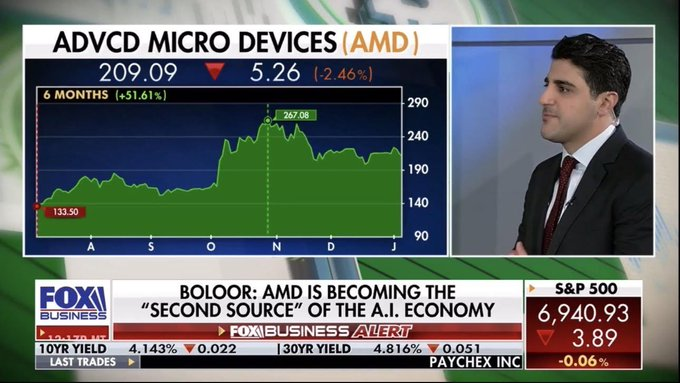
3 REASONS $AMD EARNINGS REACTION WENT NEGATIVE
1. The stock is trading on 2027
AMD’s quarter was objectively strong but the stock is being valued on what AMD might look like once MI450 + rack-scale systems are in full production. When a stock is priced on a future inflection then anything that doesn’t directly pull that inflection closer tends to get discounted. Data center growth near 40% is impressive but it’s still below the 60% CAGR management is targeting longer term.
2. The real payoff is still gated on MI450 execution
AMD’s AI story is now about MI450 + the Helios rack platform. Management is being explicit that this is the hinge point for AMD becoming a systems-level AI infrastructure player rather than a component supplier. That upside is large but it’s also back-half loaded into 2H2026 & 2027 & market is becoming less willing to underwrite long-dated ramps that depend on complex system deployments rather than incremental volume of existing products.
3. AI sentiment has shifted from “good news” to “prove the path”
The AI trade is no longer in a phase where beats & guides are enough on their own. The market is less willing to pay today for revenue that is supposed to arrive in size a year or two out, especially when it depends on hyperscaler buildouts & capital-heavy system ramps. AMD showed that its core CPU + current-gen GPU engine is working but it also reinforced that the largest upside sits ahead. In a more fragile risk environment, that combination tends to produce sell-the-news reactions.
@alc2022 If Dudum did not deliberately used X in late 2025, we probably would now being hyping LAB and Peptides, instead of blaming the management selling shares and manipulating the stock price. I believe this is the opportunity with $HIMS right now.
$JD In January 2026, JD established the "Chameleon Business Unit" to lead the commercialization of its in-house AI products like
"JoyAI & joynside" : A large-model ecosystem that powers AI-enabled consumer products and "intelligent agents".
$JD
As of early 2026, the company is prioritizing "Embodied Intelligence"—merging AI "brains" with physical robotic hardware—to achieve a 100% automated logistics network.
$JD Hardware Integration: The focus is on supply chain scenarios, such as the Moz1 humanoid robot, which uses multimodal foundation models to navigate and manage complex warehouse tasks.
$JD Embodied Intelligence & Robotics:
In late 2025, https://t.co/VB77pWGw8h significantly accelerated its investment in humanoid and logistics robotics:
Strategic Investments: In July 2025, JD invested nearly 2 billion yuan ($280 million) in three embodied intelligence startups.
@investingwithac Im really interested in their AI integration. The CEO said multiple times that their platform is far ahead compared to their competitors. I would ask if he could tell us more about that, to really understand their competitive advantage. Thanks
From Seats to Software Labor: Why CRM Stocks Sold Off
CRM and workflow software stocks sold off hard in 2025. $HUBS –46%, $ASAN –41%, $MNDY –39%, $TEAM –39%, $NOW –32%. Even category leaders felt it: $CRM –23% and $ADBE –23%. Only $SAP –4% showed defensive resilience, while $MSFT +11% and $ORCL +18% diverged on AI-driven narratives. Demand held up, cash flow remained solid, yet valuations compressed as investors questioned the durability of growth models.
The reset was not about execution misses. It was about structural doubt. AI reframed the CRM equation from adding seats to removing labor. Efficiency replaced expansion as the dominant use case, and multiples adjusted faster than reported fundamentals.
The uncomfortable question sits at the center of every CRM model. If one AI agent replaces five human users, who replaces the lost seat revenue? IDC expects pure seat-based pricing to be obsolete by 2028, forcing vendors toward consumption and outcome-based models. A revenue valley emerges if seat compression arrives before agent monetization reaches scale.
Risks stack quickly. Data governance becomes the primary failure point as autonomous agents amplify bad inputs rather than correct them. Vendor lock-in deepens as data schemas and agentic workflows raise switching costs, strengthening moats while increasing regulatory risk. Macro sensitivity persists. Seat reductions are immediate, while AI budgets face approval friction. Capital intensity separates winners from laggards, with $ORCL’s rising CapEx highlighting execution risk when infrastructure growth outruns utilization.
Street opinion remains constructive but divided. Goldman Sachs views AI as a structural tailwind, citing triple-digit growth in $CRM Data Cloud and AI ARR alongside margin potential toward 35–40%. Morgan Stanley frames $CRM as the best risk-reward in large-cap software due to pricing and cash flow leverage. J.P. Morgan positions the sector as ground zero for labor-to-software substitution.
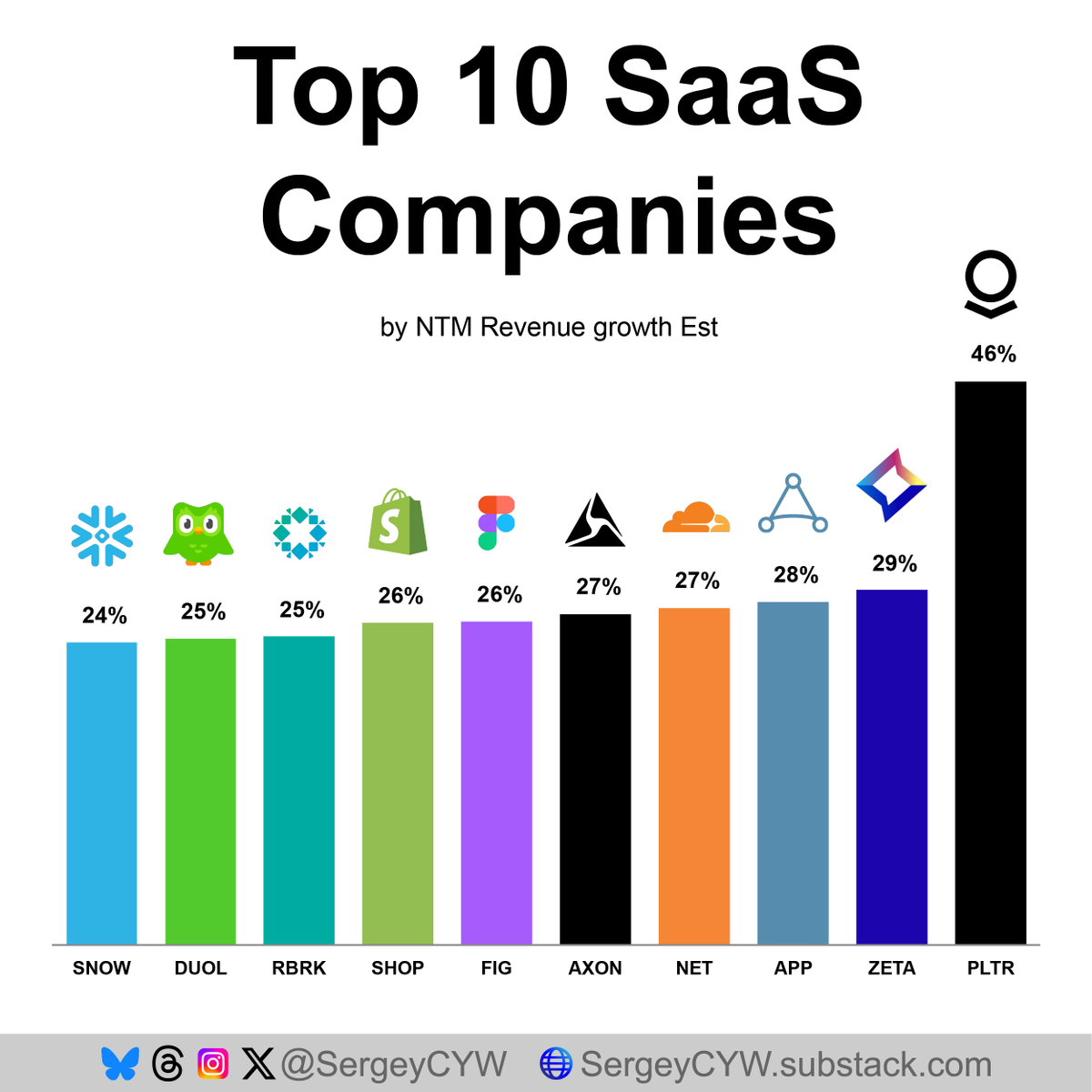
Top 10 fastest growing SaaS companies:
$PLTR Palantir Technologies operates as a mission-critical SaaS operating system for enterprises and governments, with AIP embedding AI directly into core workflows and creating high switching costs through production-grade deployments.
$ZETA Zeta Global competes as an AI-native SaaS platform replacing legacy marketing stacks by unifying identity, data, and activation to monetize complexity under privacy constraints.
$APP AppLovin is a high-margin SaaS monetization platform where proprietary AI models drive conversion efficiency, giving it a defensible position in performance advertising infrastructure.
$NET Cloudflare functions as edge-based SaaS infrastructure, turning global network traffic into a programmable cloud for AI, security, and performance with strong enterprise lock-in.
$AXON Axon Enterprise dominates public safety SaaS by embedding AI into legally and operationally critical workflows, resulting in long-duration contracts and low churn.
$FIG Figma is the collaborative SaaS standard for digital product design, with browser-native workflows and AI tools creating deep ecosystem lock-in across designers and developers.
$SHOP Shopify serves as the neutral SaaS operating layer for global commerce, combining software, payments, and services to scale merchants without capital-intensive logistics.
$RBRK Rubrik positions itself as cyber-resilience SaaS, providing subscription-based recovery and security that has become non-discretionary amid rising ransomware risk.
$DUOL Duolingo leverages data-driven SaaS economics where massive engagement trains AI models, supporting durable differentiation and ARPU expansion through premium tiers.
$SNOW Snowflake anchors enterprise SaaS data infrastructure by keeping AI workloads close to data, increasing stickiness through long-term commitments and high switching costs.
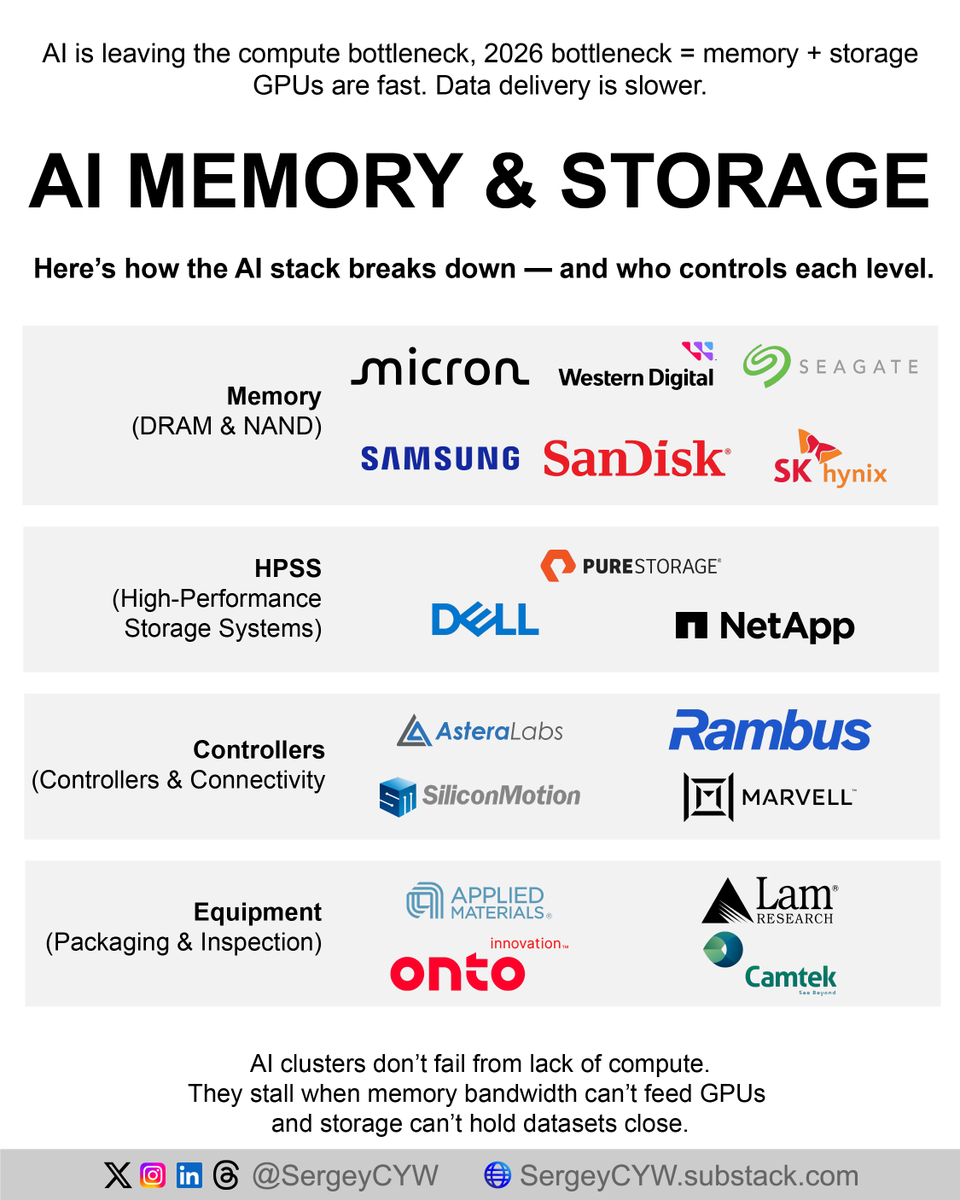
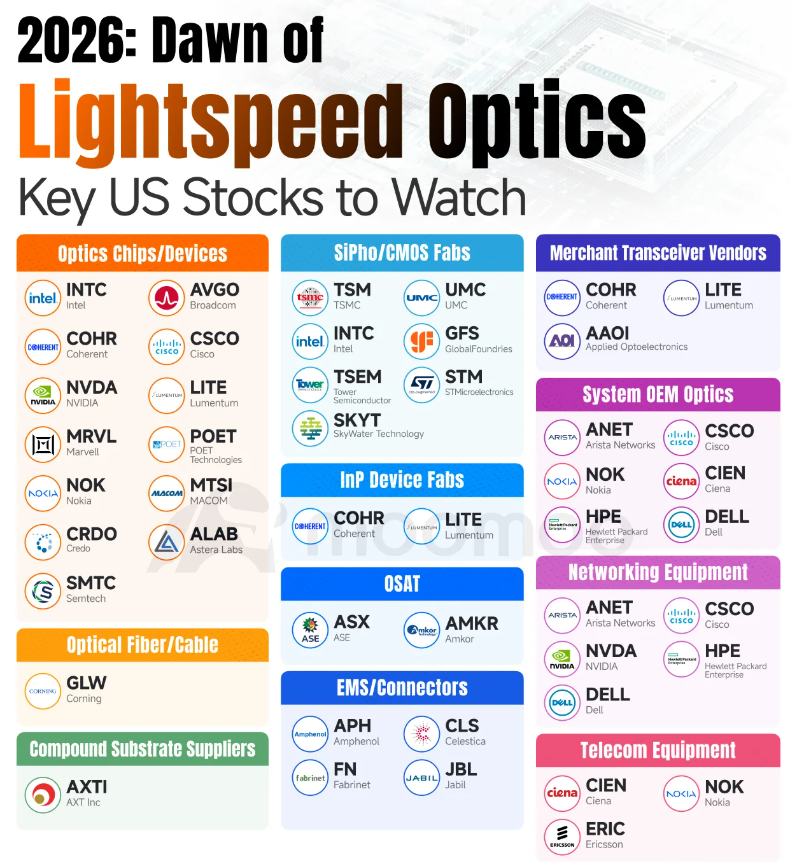
OPTICS WILL BE A DEFINING THEME OF 2026
AI has turned data movement into the bottleneck and at scale only photons can move information efficiently enough.
The ecosystem breaks down like this:
• Companies That Package Advanced Chips | $ASX, $AMKR
• Hardware That Sends Data as Light | $COHR, $LITE, $AAOI
• Networking Gear That Connects AI Clusters | $ANET, $CSCO, $HPE, $DELL
• Factories That Build Optical Silicons | $TSM, $INTC, $GFS, $STM, $SKYT
• Chips That Process Light | $INTC, $AVGO, $NVDA, $MRVL, $CRDO, $ALAB, $CSCO, $NOK, $LITE, $POET
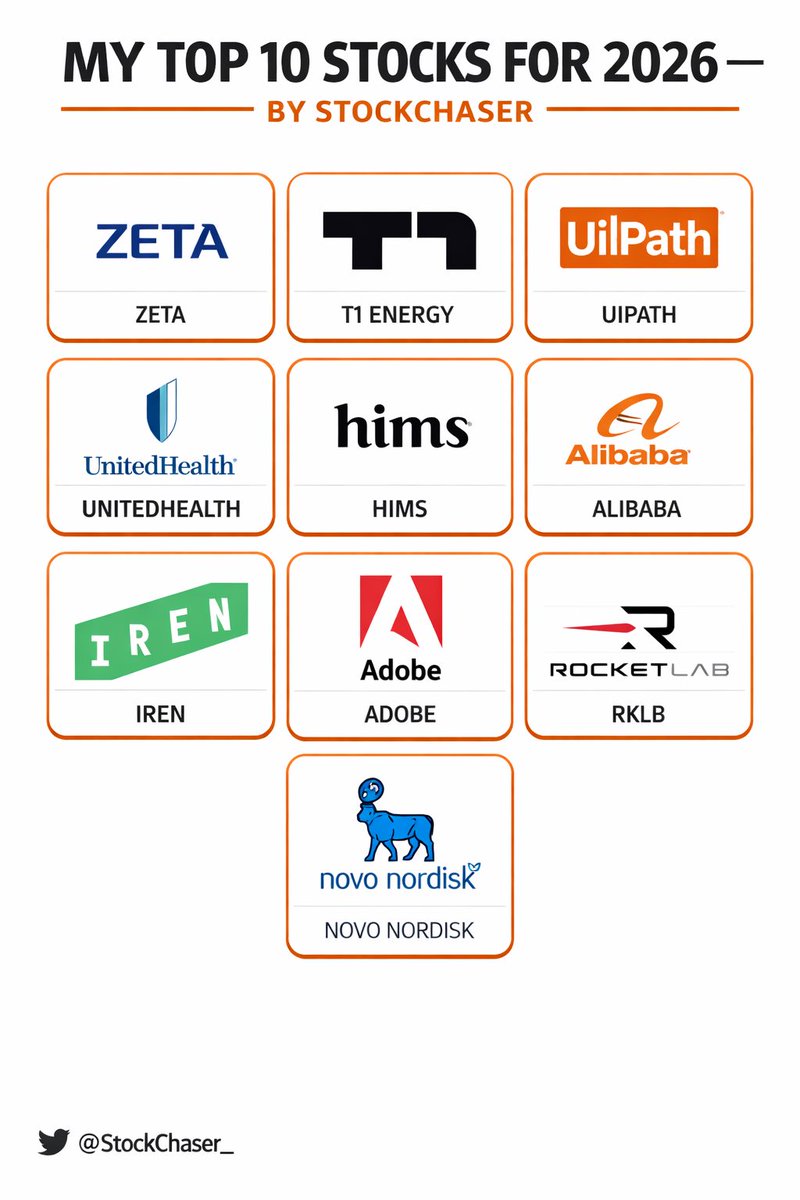
My top 10 stocks for 2026:
1. $ZETA – Customer data & marketing tech
2. $TE – U.S. solar & battery manufacturing
3. $PATH – Enterprise automation leader
4. $UNH – Healthcare insurance giant
5. $HIMS – Digital healthcare platform
6. $BABA – Global e-commerce leader
7. $IREN – AI & digital infrastructure
8. $ADBE – Creative software powerhouse
9. $RKLB – Space launch innovator
10. $NVO – Obesity & diabetes leader
A mix of value, growth, and speculative companies for the year ahead.