2/6 What if the future is a mix of central banks, commercial banks, tokenized deposits, stablecoins, private ledgers, public chains, regulators, and jurisdiction-specific rules?
In that world, interoperability becomes the bottleneck and where @FusionLayer25
lives.
1/6 $QNT / $LINK I think this comes down to a simple question:
If everything ultimately converges into a fully open, globally shared financial system, then Chainlink's decentralized verification model may prove superior. That's a legitimate shouldn't be dismissed.
But what if..
Why Chainlink is (significantly) superior to Quant:
$LINK $QNT
1. This article is comparing Quant's full platform to Chainlink CCIP. The correct comparison is Quant Overledger/Fusion vs Chainlink CRE, the Chainlink Runtime Environment, which is Chainlink's full orchestration platform (which includes CCIP).
2. The main reason CRE has significantly more adoption than Overledger, despite Overledger launching ~6 years prior, is the following:
As the article states, Quant is closed-source software. You need to trust Quant. Chainlink is an open-source, fully auditable protocol, and CRE is a decentralized runtime environment, which means that it orchestrates workflows in a fully verifiable, tamper-proof way at every single step.
- Because Chainlink is based on the use of Decentralized Oracle Networks, it means that every capability Chainlink CRE has is fully verifiable and tamper-proof:
- The workflow itself
- Off chain data
- Any privacy requirements
- Any Compliance requirements -Interoperability with other chains (CCIP)
- Connectivity to any legacy systems (SWIFT, DTCC, etc.)
Once you realise just how much there is to orchestrate in a fully verifiably way, you see how much less of a solution Quant is compared to Chainlink.
(Just look at Chainlink Confidential Compute and the Automated Compliance Engine as examples for an idea of how much goes into creating even these relatively small elements of the grander CRE platform.)
- Quant is API-based and has no way of producing verifiably tamper-proof consensus about anything in a workflow. Trust is placed in Quant's closed-source software, Quant's Firewall, API serves, etc. The only thing you don't need any trust in is the blockchains themselves.
3. The whole point of using blockchain is verifiable security. The Oracle Problem is something that most people think they understand, but actually don't:
The Oracle Problem is not just figuring out how to connect blockchains to real world data. The actual problem in a more broad definition is:
How do we connect blockchains to every else that is needed in highly complex workflows in a way that matches the same level of security the blockchain itself offers.
Once you realise that there's little point using blockchains if the other, non-blockchains things in the workflow don't also have the highest level of security, you realise why Chainlink and CRE are so important.
Every single capability, every single step in a CRE workflow is Byzantine Fault Tolerant.
The same is not true for Quant Overledger. It is a much less elegant, much easier thing to build, because it's much easier to orchestrate workflows when you don't need to worry about matching the same level of security as the underlying blockchains.
This is why Quant is a more niche, enterprise-focused middleware, and why Chainlink CRE is significantly more suited as a global standard for orchestrating workflows with the highest security.
And this is why The DTCC a few weeks ago integrated Chainlink CRE and the Chainlink Data Standard into its Collateral Appchain recently.
Chainlink has significantly more adoption in both TradFi and DeFi. It's demonstrated its elite security with its track-record of securing value. Quant has demonstrated anything even remotely close to that.
SWIFT, DTCC, and many of the largest financial institutions are actively working with Chainlink. If Quant "solved interoperability in 2018" as their CEO claims, why have SWIFT been working with Chainlink for 8 years?
There's a reason the CEO said that, because Quant solved interoperability in a simple but effective way for enterprise connectivity to blockchain usecases, but it's not anything like a truly secure, truly trustless and complete orchestration layer that can be adopted as a global standard like CRE.
3/6 Chainlink is optimizing for trust-minimized verification across systems. Quant is optimizing for connecting systems that were never designed to work together in the first place.
The question isn't whether Chainlink's architecture is more decentralized. It is.
6/6 Universal Ledger, Besu, GoQuorum, XRPL, Stellar, Bitcoin, and dozens of public and permissioned networks, I think the future looks brighter for $QNT.
LINK and QNT aren't mutually exclusive. They seem to be solving different problems in the new emerging financial system!!
5/6 then Quant's interoperability layer becomes extremely valuable. @OverledgerDev
Personally, after looking at the BIS work, tokenized deposits, RLN, Murex, Dentsu, Fusion, and the recently launched connector architecture (Hyperledger Fabric, R3 Corda, Canton, Oracle, Google..
4/6 The question is whether the future financial system ends up looking like one giant open network, or a collection of interconnected networks, institutions, and regulatory silos.
If it's the former, Chainlink likely has the edge.
If it's the latter.. which I'd expect then..
The #FusionRollup is live on mainnet.
The world's first multi-ledger rollup, purpose-built for institutions operating across multiple blockchains at once.
Learn more about the launch here: https://t.co/jAY6Y0KLF5
#QuantFusion#EnterpriseBlockchain#MultiLedger
Congrats crypto family. The first $100k took more than a decade and the next $100k will take less than a year. $btc #bitcoin
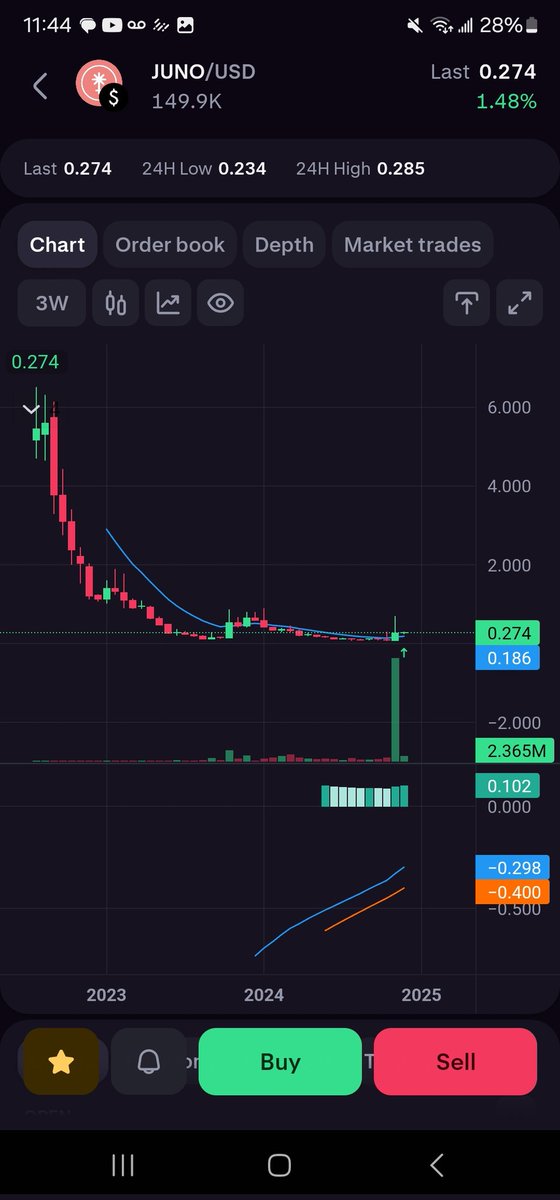
Been trading the markets 10+ years and here's a free gift for you. $JUNO entry here --
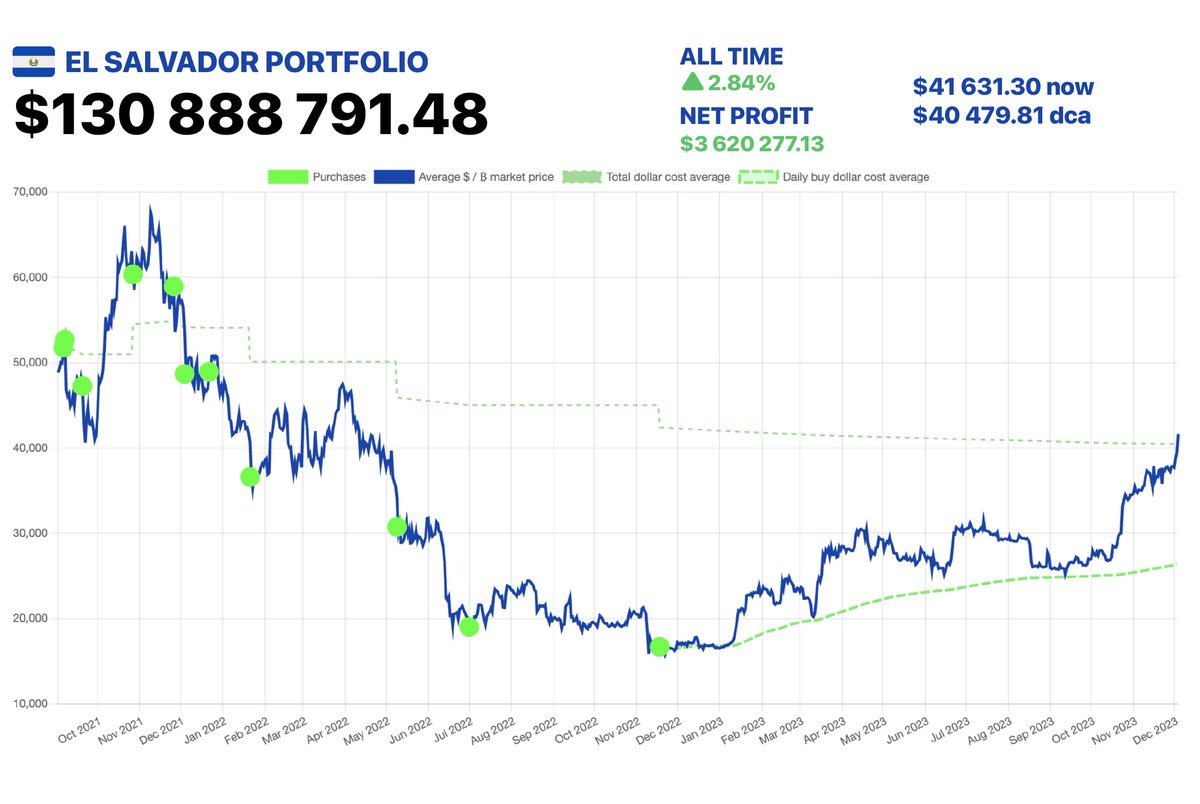
El Salvador's #Bitcoin investments are in the black!
After literally thousands of articles and hit pieces that ridiculed our supposed losses, all of which were calculated based on #Bitcoin’s market price at the time...
With the current #Bitcoin market price, if we were to sell our #Bitcoin, we would not only recover 100% of our investment but also make a profit of $3 620 277.13 USD (as of this moment).
Of course, we have no intention of selling; that has never been our objective. We are fully aware that the price will continue to fluctuate in the future, this doesn’t affect our long-term strategy.
Nonetheless, it is important that the naysayers and the authors of those hit pieces take back their statements. The responsible thing to do would be for them to issue retractions, offer apologies, or, at the very least, acknowledge that El Salvador is now yielding a profit, just as they repeatedly reported that we were incurring losses.
If they consider themselves true journalists, they should report this new reality with the same intensity they reported the previous one.
We’ll see… Stay tuned!
Been accumulating some $SEI on 10x. They are a newer L1 token that just announced a strategic investment from USDCs Circle Ventures. The crypto world seems to prefer newer projects.
Find me on BingX Copy Trading and use the ratio setting as opposed to the fixed asset copy mode for best results based on my trading style and leverage adjustments. @BingXOfficial $btc