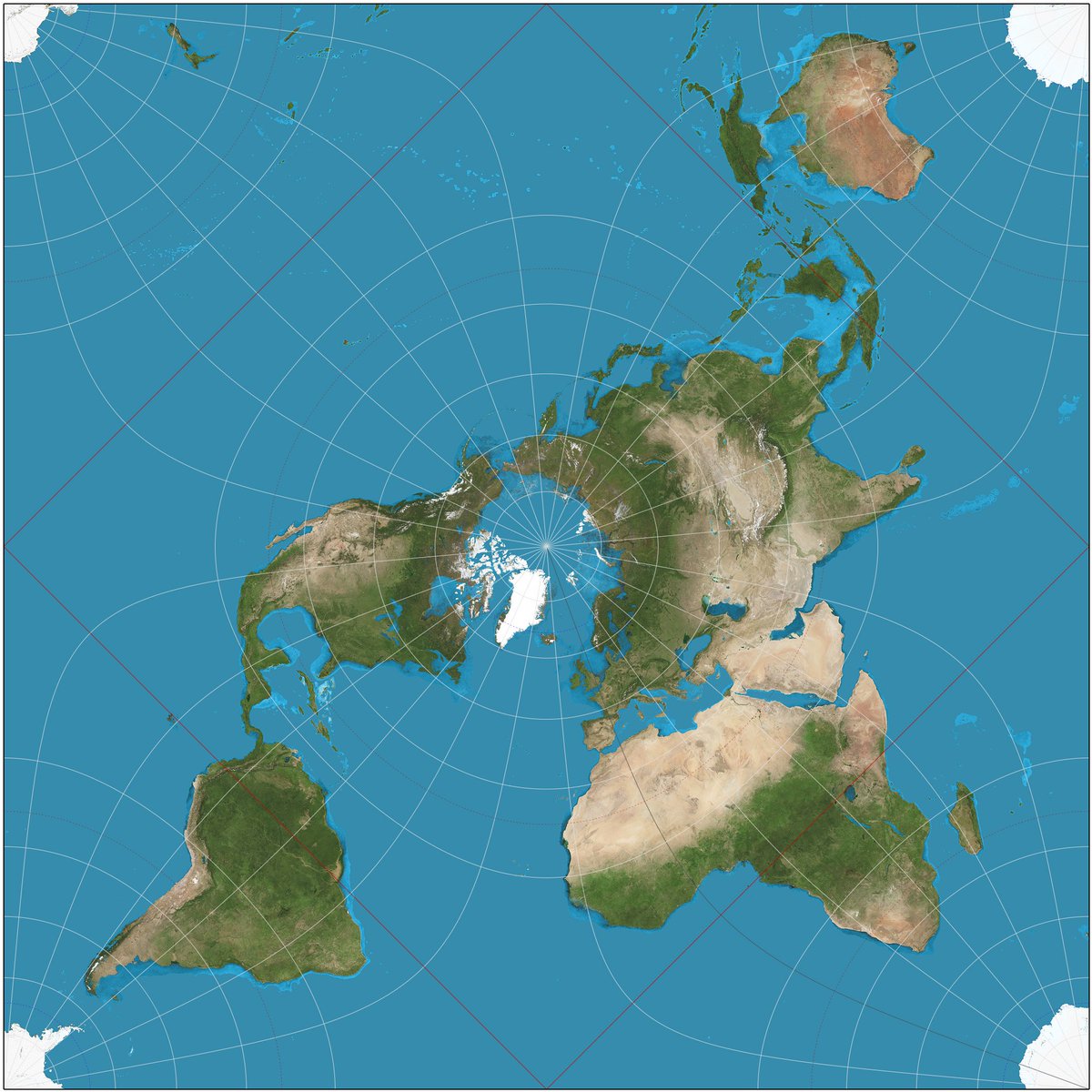
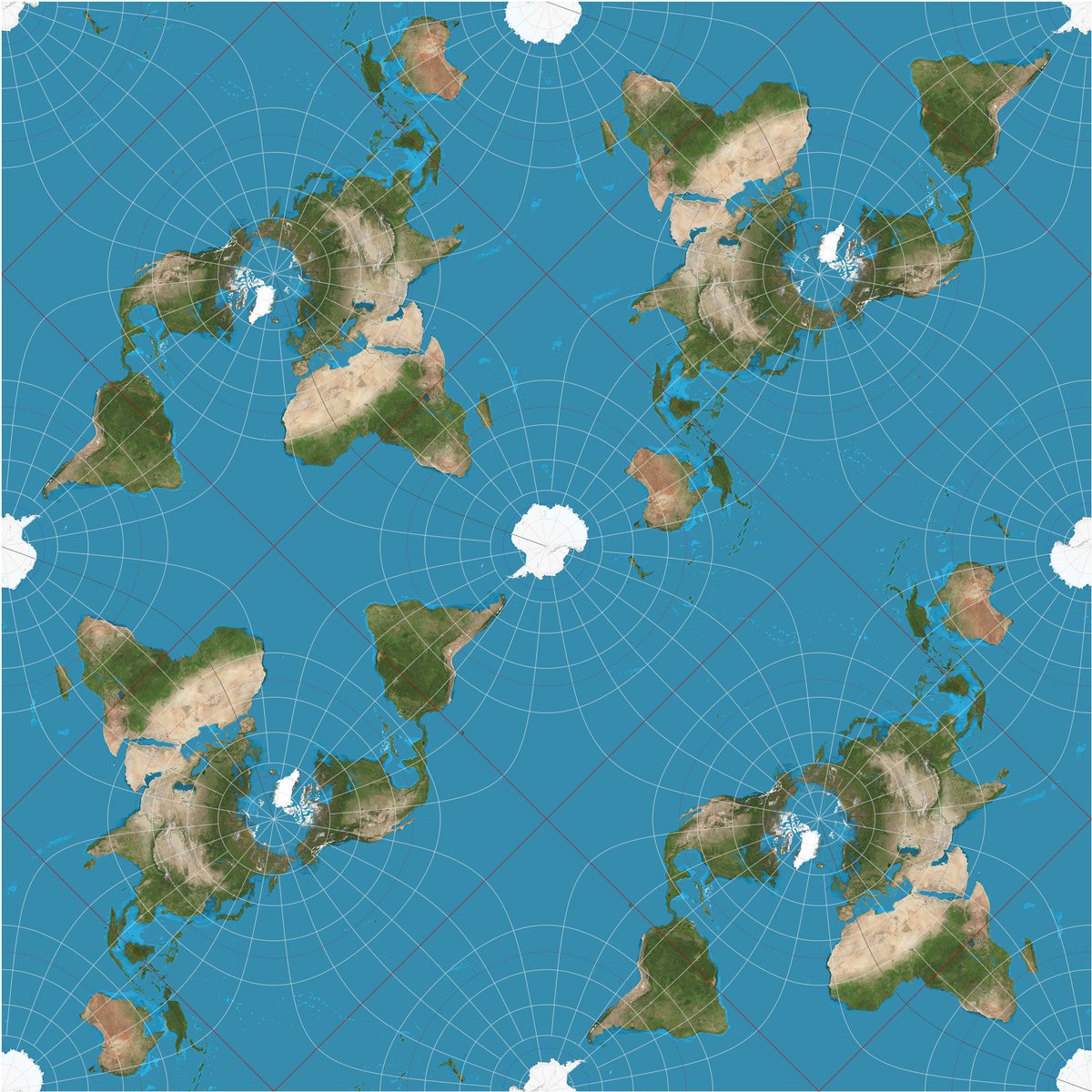
@Civixplorer The Peirce Quincuncial projection is one of my favorites.
Not only is it polar-centric with relatively little distortion of the land (so long as the four points of maximum distortion are chosen well), but it can be tiled indefinitely.
@br1anth3dawg420@Civixplorer Hence the dotted border (just as the Unitarian Universalists have).
Most Christians (including myself) would say that Mormons are outside the bounds of Christianity, but they do have a Christian lineage.
Similar things could be said for Baháʼí and Islam.
@TheCavalier44@AndrewForFaith@AndrewesFish Rejoining isn't quite accurate.
They've been coming from the charismatic, WO-mandated Diocese of Churches for the Sake of Others (C4SO), which originated out of the Vineyard Movement, with a heavy emphasis on church planting.
So these churches had never been in TEC before.
@EVRYTHNGFATIGUE@oomficide@captive_dreamer Californians who move to Texas tend to vote more Republican than Texas as a whole. Naturalized foreigners, on the other hand, vote strongly Democrat.
A timelapse of 1,962 Greek cities, from 1400 BC to today, on the Earth seen from space in 3 min 20 sec.
Greek cities as they appear (or are first recorded, at least), persist, flourish, end, or remain still.
1/2
@VaxxedWegovy@Andercot This is incorrect.
We have been in an ice age since the beginning of the Pleistocene a bit over 2.5 million years ago, when the permanent northern ice cap formed. The Antarctic one formed closer to 35 million years ago, but most of Earthʼs geologic history has been much warmer.
@AndrewesFish The parish in which I was baptized wanted to use the traditional prayer book and was sued out of existence. It went from a 1200 soul parish in the heart of Denver into a nightclub called, "The Church".
@zagrebbi Makes sense why it’s low , a treaty saying that Ukraine will give up its claim in actual language than saying they won’t actively contest it and will still claim them as occupied but set up a dmv shows why it is such a low chances
A lot of supposedly smart people are revealing their ignorance in saying that the issues discussed in this video are either heresy or demonstrate an unfamiliarity with Christian theology.
But the view described is simply traducianism: held in one degree or another by Tertullian, Gregory of Nyssa, the later Luther, John Milton, Jonathan Edwards, Samuel Hopkins, Augustus Strong, Gordon Clark, Millard Erickson, and Norman L. Geisler, just to name a few. So it’s not a fringe belief, even if not the dominant one (i.e., creationism).
Traducianism believes that both the body and soul come into existence by the generative powers of the human zygote. The zygote does not just have biological potential but soulish potentialities as well—and that God has designed it this way. This is not to say that God is not involved: God is the primary cause of the creation of a new person, body and soul, and the parents are the secondary cause. But the relationship of these two causes is one of divine concurrence, not occasionalism: God concurs with the procreative sexual act of the mother and father and the generative powers of the combined sperm and egg. So even on traducianism, God knits us together in our mother’s womb.
Traducianism has the advantage of explaining the corruption of the soul without positing that God is responsible for creating a fallen (defective) soul, or resorting to the proposition that it is the body which corrupts the soul when the two meet (which of course would naturally lead to a form of ascetic gnosticism, i.e., the body is evil and material desires must be shunned). Traducianism also has the advantage of explaining why children are like their parents *in non-physical ways.* There is a spiritual likeness, not just physical.
Finally, one of the fascinating consequences of traducianism is that of origin essentialism, which holds that each person is a unique expression of their parents’ genetic material at a specific moment in time such that had you been born a month earlier or a month later, you wouldn’t be you—you would be a different person. Now, on creationism, God’s special act creates a soul and places it in the body during conception and early gestation. Since on Christianity the essence of the person is their soul, not their body, this means that on creationism you could have been born at any time, to any parents, in a totally different body, in a different culture, etc. On creationism, alternative possible worlds are not just mental exercises but worlds with you in it that God could have actualized. On traducianism, there is only one possible world history in which you exist: the one that currently is. This means that the chances of your existence are staggeringly unlikely—virtually zero—yet here you are. You could not have been born to any other parents; you couldn’t have been born at any other time; you couldn’t have any other body or spiritual/mental qualities. You are utterly unique, a true miracle. It’s mind-blowing, but also a testament to God’s awesome power and wisdom.
Anyway, if you’re curious to learn more, read my analysis on pp. 68-83 in the text linked below.
@ReformedToRome@VincentianYT@Craig_Truglia In the Old Testament, προσκύνησις is used to translate shaħah, bowing down, and λατρεία is used to translate ʿavad, service.
The mediæval concepts of veneration and adoration are respectively derived from these words, but come with additional conceptual baggage.
@UntoldFortune What is the basis of this?
Some sort of semi-Docetism whereby Jesus is a clone of Mary who only appears as a man due to divine intervention?
@ReformedToRome@VincentianYT@Craig_Truglia To address, Revelation 3:9, the most straightforward meaning is that Christ is telling the Church in Philadelphia that their enemies (likely Judaïzers) would grovel before them. You supplied the “in heaven”.
And of course, groveling is very different than looking at something.
@ReformedToRome@VincentianYT@Craig_Truglia The link between προσκυνήσις and veneration is found at Nicæa II, where the word was front and center and προσκύνησις of images was mandated.
Since προσκύνησις is the topic at hand, your raising of the bronze serpent was a non sequitur, since no προσκύνησις was ordered there.
@ReformedToRome@VincentianYT@Craig_Truglia The word venerate corresponds to προσκύνησις, which is indeed used in the Greek Old Testament, but not concerning the bronze serpent.
Those bitten by serpents were to see (ἰδών) the serpent, and when they looked upon it (ἐπέβλεψεν), they were healed.
@jaylen437gh@Joshua4570 Possibly, but Arab Christians have existed longer than Arab Muslims and Yasūʕ is etymologically correct even including the final ʕ that most languages drop.
ʿĪsā, on the other hand, bears little resemblance with his name, especially with the initial ʕ (which is what the ʿ is).
@jaylen437gh@Joshua4570 Arab Christians have a different name for Jesus than Arab Muslims.
Muslims use ʿĪsā, while Christians use Yasūʕ, the latter of which is much closer to his original name. The Muslim name is arguably closer to Esau than to Jesus.