@cloneisjun i assume you meant resuming a failed agent task, that’s usually using the resume from the provider CLI or providing previous session log pointers in context
I've been doing research with Codex and Claude Code. The hard part isn't running experiments or code. It's re-prompting the agent every time a run fails, and keeping track of results, decisions, and hypotheses.
So I built RCP, an open-source research control panel.
It's early, and it's Apache-2.0. Setup is from source for now; the README has a prompt you can paste to your agent to do it.
If you do research with coding agents, try it and tell me what breaks. Issues and PRs welcome: https://t.co/MY429rmCCh
Questions, hypotheses, experiments, evidence, and decisions live in one graph, versioned in your own Git repo. Agents add results and propose changes; only you decide what the project believes.
Use it solo on a Mac, or as a shared lab space on your own Linux server.
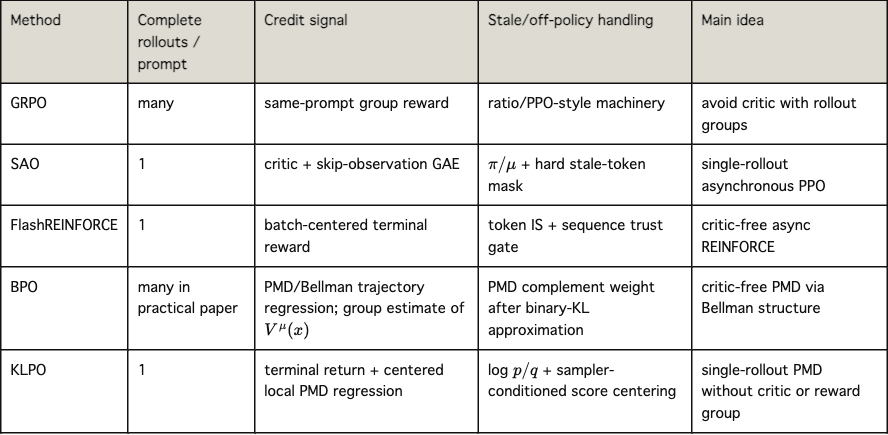
Two ways to remove the critic: BPO sums the PMD equations first and lets Bellman telescope them; KLPO differentiates first and lets score centering do it. Deeper dive on all four:
https://t.co/4WMgxodjkM
Asynchronous single-rollout RL had a real run this year. Reading four recent papers today, dropping GRPO's per-prompt rollout groups and train from one trajectory, each with a different answer for credit assignment: SAO, FlashREINFORCE, BPO, KLPO.
KLPO differentiates the local PMD condition first. The centered score kills the value baseline in expectation, so one realized terminal return stands in for the critic. Cost is 128 auxiliary one-token draws per prefix. GPU training not yet validated.
Dario has written that we need to “pace the frontier,” and Sam has agreed. People may be surprised by my response: go ahead.
You guys are the frontier. By any reasonable metric — market share, revenue growth, model capability — the two of you have a duopoly on frontier intelligence. You’ve also claimed the lead is widening because of recursive self-improvement.
I don’t see what you see in the lab. If the unreleased models are scary enough that you think you should slow down, I support your decision to be responsible.
But stop pretending you need anyone else’s permission. Stop pretending antitrust law has to be suspended so you can form a cartel. Stop pretending you need a regulatory approval process that supersedes product liability. Stop pretending METR is independent when it is intertwined with Anthropic’s investors and staff. Stop pretending you need those same evaluators to police competitors who aren’t even at the frontier.
Most of all, stop pretending the motivation to slow down is purely altruistic. You face massive product-liability exposure if your products enable a truly damaging cyberattack. The market already punishes models that behave in unpredictable or unauthorized ways. After the Hugging Face episode, it is simply good business for OpenAI and Anthropic to trade some raw power for reliability and predictability. Call it alignment if you want. It is also just giving customers what they want.
Pacing the frontier would also create breathing room for a more intelligent conversation about regulation than Bernie Sanders’ “shut it all down.” China is very unlikely to join a global agreement, as you know, and that has to be taken into account as well.
So go ahead and pace the frontier. You are the ones setting it. The easiest way not to build superintelligence is for you to agree not to build it. Demanding your preferred regulatory framework as the price of that will look like blackmail of the public and the political system. So just do it.
If you do, you’ll buy goodwill for the next conversation. If you don’t, we’ll know this was just another bid for regulatory capture — or an election-season psyop.