What's @SenJonHusted reading today? Looks like “The Prayers of Peter Marshall,” a 1954 collection of the former Senate chaplain's prayers, compiled by his wife Catherine.
https://t.co/nW5Fk6Im3N
https://t.co/vl8ak9zBXc
The DOL is proposing to raise the minimum wage for H-1B visas. The rationale for the proposal is to reduce abuse from IT outsourcing firms, but @jasonhehehe found that these IT firms get slightly more H-1Bs under the administration's proposed rule! https://t.co/T9gTPH13dF
CAISI's current operating budget is only $15 million.
CAISI needs at least $84 million annually to fulfill all AI Action Plan taskings related to AI readiness.
In other words, for the cost of a single F-35A joint strike fighter jet, the US government can gain situational awareness on the most strategically important technology of this century.
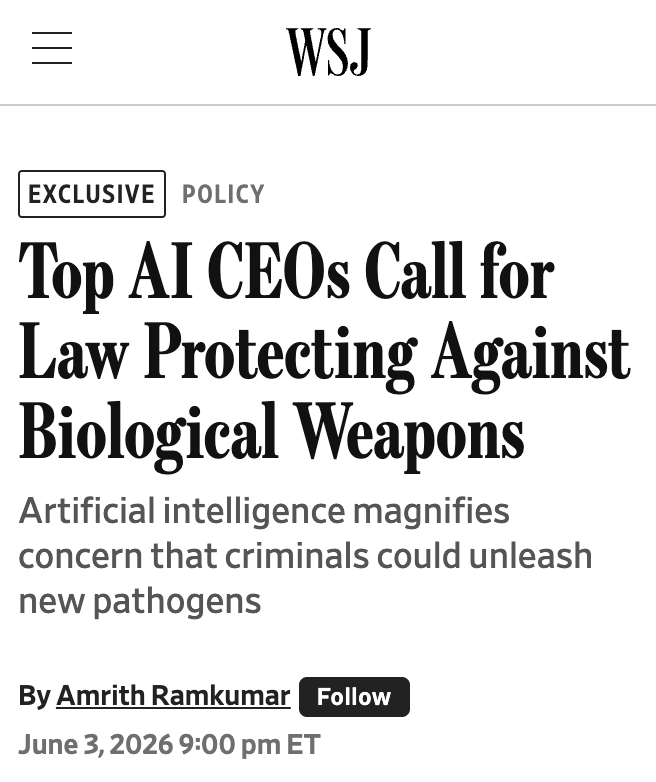
Today, @IFP and @JoinFAI released an open letter calling for mandatory screening of orders for synthetic DNA.
Signatories include Demis Hassabis, Sam Altman, and Dario Amodei.
The AI focus of the letter is intentional. We're rapidly approaching a world where bad actors could use AI design tools and custom-built DNA to cause the next pandemic.
But even with mandatory screening policies, the challenge is far from solved. Founders and technical experts need to build technologies that actually enable effective screening, and philanthropists are needed to support them.
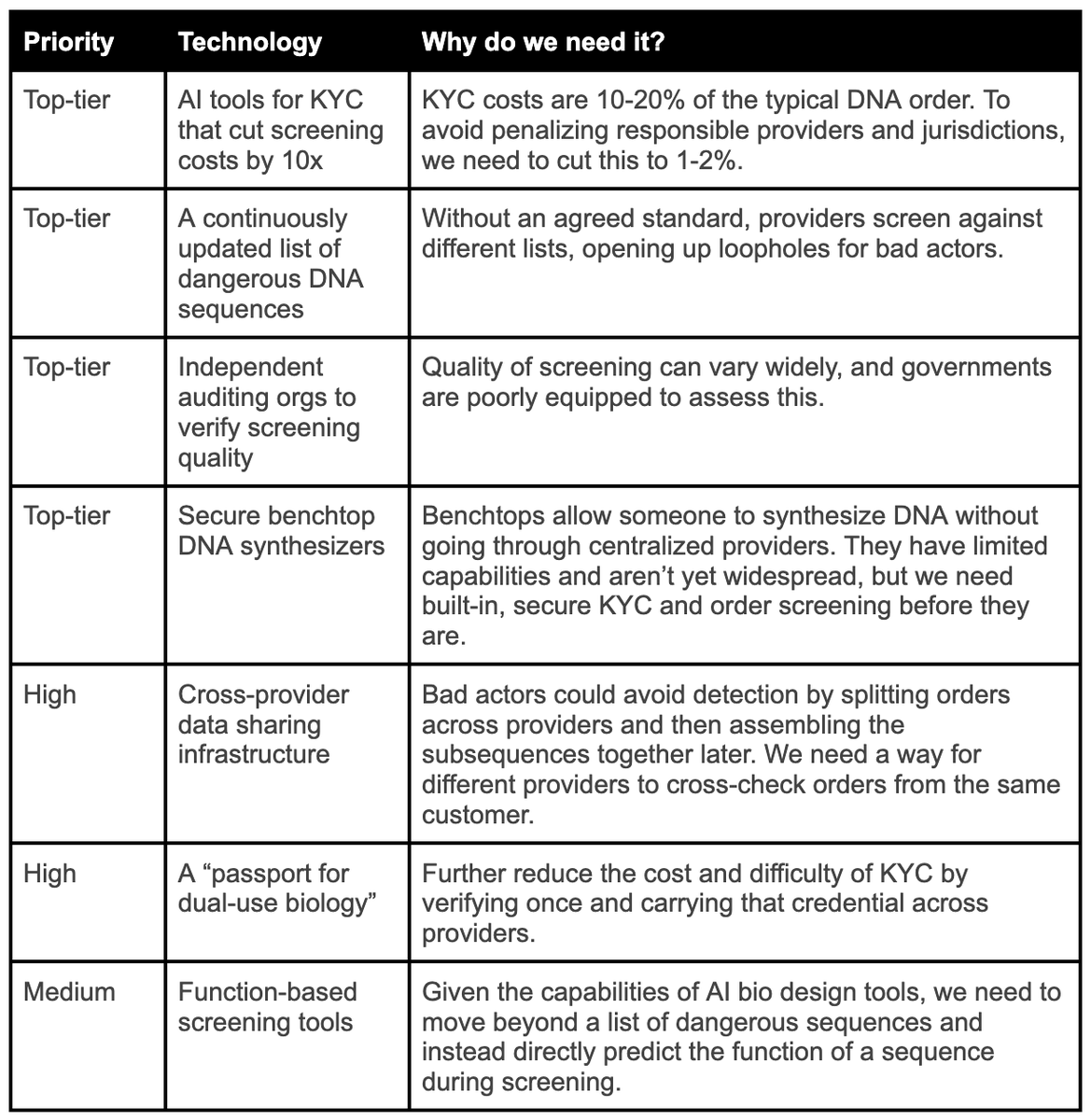
That’s why today, we’re releasing a field strategy authored by @JanikaSchmitt and @jtmonrad.
It's a list of what needs to be built to fully secure the DNA supply chain, and why.
You can read it here: https://t.co/jI8OtYiHCG
If you want to work on or fund one of these problems, please reach out!
AI is an exciting tool for accelerating innovation, but it’s also exposing risks in our biotech industry.
Requiring supply chain safeguards to stop bioweapons from ending up in the hands of bad actors should be a no-brainer.
It’s great to see AI leaders like Sam Altman, Dario Amodei, and Demis Hassabis calling for mandatory DNA synthesis screening, which is a no-brainer policy for preventing (AI-enabled) bioterrorism.
But fewer than 50 people in the world currently work on DNA security full-time.
We need a comprehensive plan and at least 5x as many people to secure the DNA supply chain before AI and biotech outpace us.
@jtmonrad and I spent the past two years developing a field strategy for how to do it.
Successfully defending against this risk (while still capturing innovation benefits) requires four things:
1. Coverage: More than 80% of synthetic DNA providers screen both orders and customers
2. Strategic ambiguity: a bad actor can’t easily tell which providers will screen their order
3. Access: legitimate customers can still order DNA cheaply and easily
4. Effectiveness: 90% of providers reliably catch dangerous sequences when red-teamed
We’re already seeing real momentum. Many DNA providers screen voluntarily, and governments in several countries are moving toward mandates. But that doesn’t mean the problem will be solved in time by default.
Our guide lays out exactly which projects we need to launch. We’re looking for founders, operators, and technical experts to own pieces of the solution. We’re also hiring a Senior Program Officer at Sentinel to drive this work. Get in touch if you or someone you know would be a strong fit! (links for EOI form and JD below)
Read our full field strategy in @IFP's Launch Sequence: https://t.co/zzTYZaFMoM
Hugely important open letter from IFP, FAI, the heads of every frontier lab, + many others on the importance of mandating DNA synthesis screening and recordkeeping. It's a total bipartisan layup to stop mail-order bioweapons
No one should be able to order a bioweapon through the mail.
@IFP & @JoinFAI are proud to co-lead an open letter calling for mandatory DNA synthesis screening & recordkeeping.
Signatories include:
- Sam Altman, CEO & Co-Founder, OpenAI
- Dario Amodei, CEO & Co-Founder, Anthropic
- David Baker, Director, Institute for Protein Design; 2024 Nobel Prize in Chemistry recipient
- Patrick Collison, CEO & Co-Founder, Stripe
- Paul Graham, Founder, Y Combinator
- Demis Hassabis, CEO, Google DeepMind; 2024 Nobel Prize in Chemistry recipient
- Emily Leproust, CEO & Co-Founder, Twist Bioscience
- Lawrence Lessig, Roy L. Furman Professor of Law and Leadership, Harvard Law School
- Gerald W. Parker, former Special Assistant to the President for Biosecurity and Pandemic Response
- Mustafa Suleyman, CEO, Microsoft AI
- Alex Tabarrok, Professor of Economics, George Mason University
- Alexandr Wang, Chief AI Officer, Meta; Founder, Scale AI
- Christine E. Wormuth, President & CEO, Nuclear Threat Initiative; 25th Secretary of the Army
Read the letter and see the full list of signatories: https://t.co/BwZiJXw3JT
Many DNA synthesis companies voluntarily screen orders to mitigate biosecurity risks, but no law requires them to do so.
Leaders in AI, biotech, life sciences, national security, and the nucleic acid synthesis industry agree that Congress should act to strengthen safeguards against biological threats.
@deanwball put it well in the WSJ:
“If you’re synthesizing the stuff that yields biological life and viruses, we’re asking you to screen to see whether it is dangerous in some way. That seems like a reasonable thing for society to insist upon.”
When policymakers want to spend $$ to accelerate innovation in some area, they frequently reach into a proverbial grab bag to decide what mechanism to use.
Some days it's an innovation prize. Right now Advanced Market Commitment are hot. If you're feeling cheeky maybe a new ARPA program? Perhaps a loan guarantee, or a research grant, the list goes on and on...
But the process for choosing between these mechanisms has been very ~vibes based~
@IFP and @UChi_MSA pulled together a group of the top economists in the world working in this area and we mapped out the whole landscape of innovation financing mechanisms so that policymakers have a more developed framework to start with when approaching these questions.
This letter on the DOL prevailing wage rule says we should prioritize H-1Bs with the highest pay, the best proxy for skills (citing me for this claim).
Yet it endorses the proposal in the NPRM that would result in *lower* average salaries than its secondary proposal, per PWBM.
This new research on US unicorn startups is really interesting.
Some key facts from the report:
1. Immigrants founded or cofounded 455 of America’s 775 privately held billion-dollar startups, equal to 59% of all US unicorns.
2. 66% of all US unicorns were founded or cofounded by immigrants or the children of immigrants.
3. 79% of US unicorns have either an immigrant founder or an immigrant in a key leadership role.
4. The 455 immigrant-founded US unicorns have a combined valuation of $5 trillion.
5. That $5 trillion valuation is larger than the total stock-market value of companies listed in all but 7 countries.
6. Including immigrant-founded unicorns that went public since 2016 pushes the total value above $5.8 trillion.
7. The number of immigrant-founded US unicorns rose from 50 in 2018 to 455 in 2026.
8. 24% of US unicorns have a founder who first came to America as an international student.
This is a no-brainer, but it's worth making the case from first principles.
CAISI is the government agency charged with: conducting assessments of advanced AI systems, producing independent analysis on these systems' performance/capabilities to inform lab and government stakeholders, and developing standards to productively shape AI development and deployment.
It's an organization housed within the Department of Commerce's National Institute for Standards and Technology, an agency responsible for assessing, shaping through standards-setting, and advising government leadership on various technologies.
It is not a member of the national security firmament, it does not have an regulatory authority, it is not a license raj, and it's relatively small. It's new, hungry, energetic, and hardly entrenched within the deep state.
If you believe that AI is the transformative technology of the age, you should want an organization that is informed, technically expert, and data-driven to advise the president, cabinet secretaries, and the federal bureaucracy -- collectively, the most powerful government in the history of the world -- as to the performance, progress, power, and, yes, risks associated with this technology.
You shouldn't want this powerful institution operating blind, reliant on their own prejudices and priors, media, or underresourced and unaligned third-parties. Nor should you want them reliant on state institutions that treat this transformative technology as subordinate to a particular mission or operational sphere, e.g., the national security apparatus.
You should want a staff of neutral technical experts that partner closely with the frontier AI labs to conduct independent evaluations of their technology, viewing them simultaneously as partners, customers, and independent objects of assessment. You should want this staff to be relatively empowered to conduct the evaluations that we need to generate the data required for effective policymaking but not so powerful that this agency evolves into an overweening or captured regulator like the Civil Aeronautics Board. And you should want this staff to possess legitimacy in the eyes of the body politic, democratic institutions, bureaucracies, and the AI labs.
CAISI represents the closest we have to that ideal: its imperfections do not belie this reality. There is, put simply, no other viable game in town. We can't rely on METR, AVER, and Artificial Analysis alone because their benchmarks aren't optimized for informing policymaking; we can't rely on institutions like the NSA or DOE national laboratories, which fundamentally view AI as a risk, threat, or enabler of a narrow technical field rather than a transformative form of *intelligence*; we can't rely on foreign AISIs, which are unaccountable to our political authorities; we can't simply let political and bureaucratic authorities fly blind, even if we prefer a generally light-touch approach to AI policymaking -- a hands-off approach must still be informed and observant, else one risks negligence, backlash, and thrashing when politics inevitably intervenes; and we can't rely on the AI labs' own assertions and assessments for all the classic reasons of private political economy.
Statecraft and policymaking in technical domains should be undertaken with caution, humility, and care; they must be informed by as deep a technical understanding of technology as possible; and they must be performed in partnership with a variety of stakeholders. CAISI, especially if appropriately sized, enmeshed more deeply with the labs, and authorized to more directly communicate and take direction from senior USG leadership, has the right culture and institutional design to support these functions.
On some level, the decision here has already been made. It's now June 2026; if not here already, AGI is imminent. We don't have time to design a new institution from scratch that's better equipped to accomplish CAISI's functions; we don't have the state capacity to improve a new solution to the thorny problem of tracking omni-directional AI progress across multiple complex institutions; and no one has the political hegemony or omniscience required to actively steer this technology and its originating institutions in a progress-ive direction.
The best we can hope to do is adapt the current organizations we have to align various actors' incentives in a salutary orientation: improving the state's and private sector's understanding of the technology that they're building, each other's intentions, and the economy that they're creating should be our collective goal, one that we pursue through flexible and continuous adaptation.
CAISI is one biological mechanism within a highly dynamic ecology. We don't need it to engineer or organize the environment, but we do need it to nourish symbiotic relations and sustain pro-social equilibria between the labs, the larger set of economic actors that will transform in the AI era, the USG, and foreign states.
OpenAI just put out a report in response to yesterday's AI EO.
In just 9 pages, CAISI is mentioned 33 times.
This is a big show of support. But while yesterday's EO was good, it left CAISI's involvement somewhat unclear.
This is kind of crazy, given the capabilities that exist there that are directly relevant to the EO:
- CAISI is already working with US frontier labs on a voluntary basis to evaluate models for cyber and biological capabilities, and has wide support from the US AI industry
- It has built solid technical teams who are already working on model evals, cybersecurity, and agent security
- It can interface with national security agencies, but sits within NIST, which is explicitly not a regulator
An @IFP@matthewesche move: There's a problem, do the complex analysis to explore it, share the data in the public square that will help make progress on solving the problem. Boom!
At @IFP, we’ve spent the past 3 years thinking about all the different ways the US government & philanthropy fund R&D.
Until now, R&D funders haven’t had a systematic way to match the innovation problem to the right funding tool.
We built THE ATLAS OF INNOVATION to fill that gap.
https://t.co/XZshJ7pr1f
Alongside @UChi_MSA, we’ve boiled down thousands of hours of research into a handful of questions covering how much the R&D funder knows about:
- the problem they want to solve
- the solution it should have
- the team that should build the solution
Why the Atlas matters:
The US government spends close to $200 billion every year on R&D. And after the Anthropic and OpenAI IPOs, there will be hundreds of billions of dollars in new philanthropic giving.
Choosing the correct funding approach to the social problems they’re trying to solve will mean the difference between success and failure.
For example, NSF research grants have helped seed breakthroughs from MRI machines to search engines, but grants aren’t built to deliver the kind of industrial speed and scale that a project like Operation Warp Speed required.
Picking the wrong funding approach can leave programs behind schedule, over budget, or without anything to show for all the money they spent.
How we built the Atlas:
1. We began by creating a matrix of dozens of considerations that a thoughtful policymaker or funder would ideally weigh before deciding how to fund a project.
2. We looked at every major funding approach, from grants to R&D tax credits to advance market commitments, analyzing when they work well and when they fail to meet the mission.
3. We spent months deep in the weeds of contract theory and incentive design, looking at historical examples and the state-of-the-art research in innovation economics.
4. We then worked to turn that research into a tool that time-strapped policymakers and philanthropic funders could rely on at the start of an innovation funding cycle.
5. Three years later, we are launching just that: a new (and visually stunning) website to help funders decide how to best incentivize innovation. And all they have to know… is what they currently know about their innovation goal! The Atlas takes care of the rest.
How to navigate the Atlas:
Answer questions about your goal to find the funding approach aligned with the information you have.
Each funding mechanism has its purpose for particular technologies and specific moments in development.
There shouldn’t be an ARPA for every field, just like we don’t need a prize or AMC for every innovation. The Atlas helps you navigate those tradeoffs.
> be @matthewesche
> read more about innovation policy than anyone else in DC
> come up with unique scholarly contribution to contract theory and innovation economics
> present it as the best IFP microsite yet: https://t.co/nUGedHGREq
At @IFP, we’ve spent the past 3 years thinking about all the different ways the US government & philanthropy fund R&D.
Until now, R&D funders haven’t had a systematic way to match the innovation problem to the right funding tool.
We built THE ATLAS OF INNOVATION to fill that gap.
https://t.co/XZshJ7pr1f
Alongside @UChi_MSA, we’ve boiled down thousands of hours of research into a handful of questions covering how much the R&D funder knows about:
- the problem they want to solve
- the solution it should have
- the team that should build the solution
Why the Atlas matters:
The US government spends close to $200 billion every year on R&D. And after the Anthropic and OpenAI IPOs, there will be hundreds of billions of dollars in new philanthropic giving.
Choosing the correct funding approach to the social problems they’re trying to solve will mean the difference between success and failure.
For example, NSF research grants have helped seed breakthroughs from MRI machines to search engines, but grants aren’t built to deliver the kind of industrial speed and scale that a project like Operation Warp Speed required.
Picking the wrong funding approach can leave programs behind schedule, over budget, or without anything to show for all the money they spent.
How we built the Atlas:
1. We began by creating a matrix of dozens of considerations that a thoughtful policymaker or funder would ideally weigh before deciding how to fund a project.
2. We looked at every major funding approach, from grants to R&D tax credits to advance market commitments, analyzing when they work well and when they fail to meet the mission.
3. We spent months deep in the weeds of contract theory and incentive design, looking at historical examples and the state-of-the-art research in innovation economics.
4. We then worked to turn that research into a tool that time-strapped policymakers and philanthropic funders could rely on at the start of an innovation funding cycle.
5. Three years later, we are launching just that: a new (and visually stunning) website to help funders decide how to best incentivize innovation. And all they have to know… is what they currently know about their innovation goal! The Atlas takes care of the rest.
How to navigate the Atlas:
Answer questions about your goal to find the funding approach aligned with the information you have.
Each funding mechanism has its purpose for particular technologies and specific moments in development.
There shouldn’t be an ARPA for every field, just like we don’t need a prize or AMC for every innovation. The Atlas helps you navigate those tradeoffs.