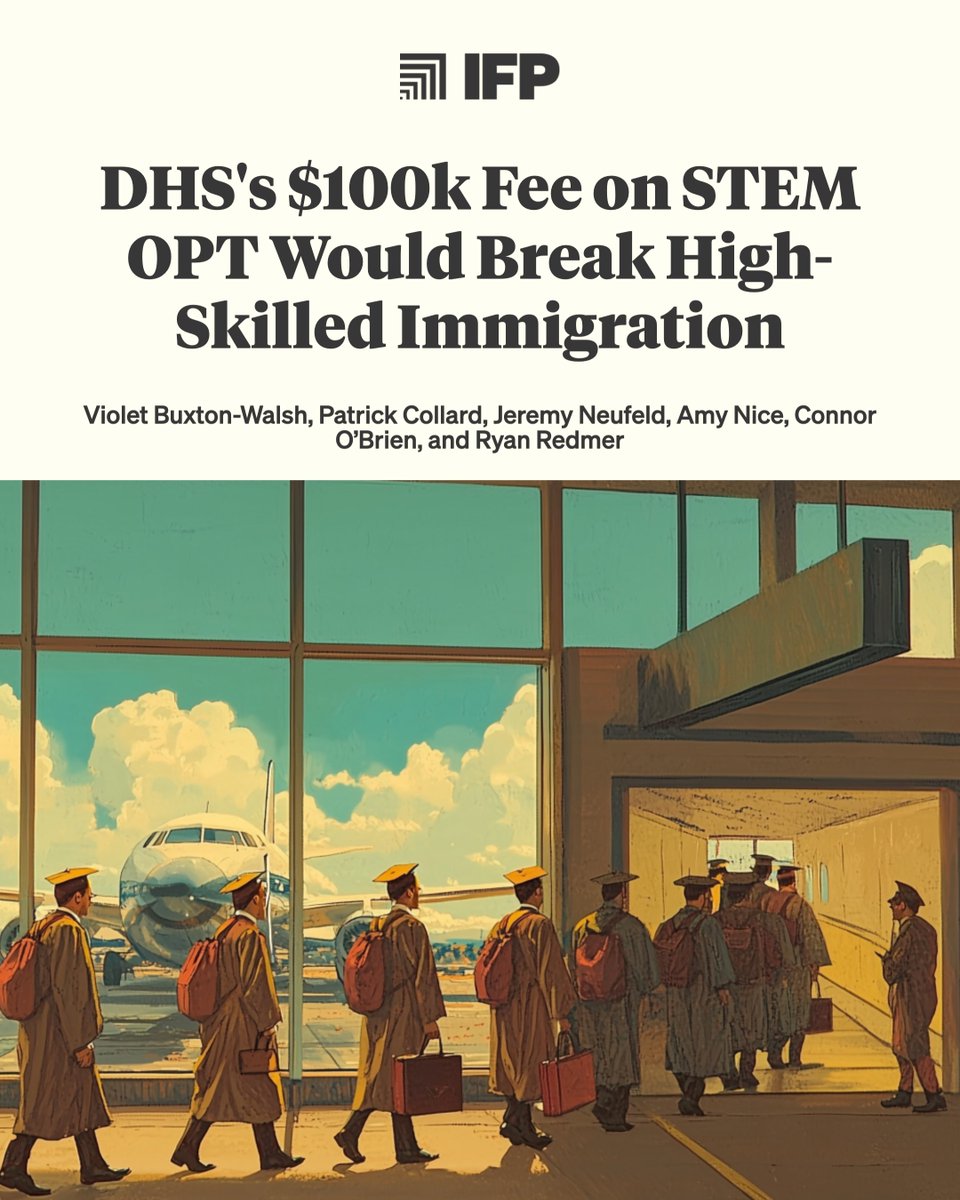
You may ask yourself, what is going on with each of these policy shifts that seem to be *designed* to discourage and deter the ability of foreign-born STEM experts to contribute to America making scientific progress? My colleague @cojobrien explains all in Macroscience @IFP, including how policies that reduce international STEM PhDs' access to OPT (Optional Practical Training) is not good for Americans or American science. Footgun indeed.
New for Macroscience @IFP: The last two years have seen an unprecedented crackdown on the visa pathways that enable current and future scientists to come to the United States.
I break down all the changes underway and why they matter to US science here:
https://t.co/ql26Zom0z2
@GrantKidwell@PrestonCooper93 There was an Inside Higher Ed article recently (I think?) that broke down enrollment data, showing for AY26-27 Masters way down but PhDs holding.
I agree with @ckuck and @GrantKidwell that DHS doesn't have it 'em to make this change in a legally sufficient way, but just point out that I believe the *timelines* for many of the premium processing services are *permissive* and could be changed if done based on actual data. Those timelines identified in the 2020 USCIS Stopgap funding legislation, passed with approps, are stated as "if you charge this fee for this timeline of premium processing service you don't have to engage in notice and comment rulemaking." That would mean USCIS could propose a rule based on the best available evidence (the first hurdle DHS won't satisfy, as Chuck and Grant are pointing out...) that there should be a different time period for premium processing.
It can be difficult to keep track of all the different barriers the admin has thrown in front of foreign scientists and inventors who want to work in the US (there are now three different flavors of $100,000 fee!). Very helpful summary here from @cojobrien https://t.co/6Cdo0lae4h
@slapout9@SkinnerPm But in those states you _must_ pass the bar exam. That’s what the big deal is. If you don’t pass the bar, you’re not a lawyer.
Virginia is one of the states where you don’t have to go to law school to sit fir the bar exam.
The proposal to tax Optional Practical Training (OPT) out of existence is terrible for American students, American innovation, and American leadership in making progress in critical and emerging fields. We all should care about these *national* interests. And, we should care that when a policy shift requires rulemaking, it does *not* come with an "anything goes" permission slip.
As my IFP colleagues @buxwal@PatrickCollard6@JeremyLNeufeld@cojobrien@Ryan_Red13 and I detail in the explainer we released this week, the reality is:
1/ DHS has no authority to ignore the fact that Congress has passed a flotilla of laws governing when immigration-related fees can be charged by the federal government, including *specific* congressional mandates regarding fee-setting authorities related to fraud prevention in immigration adjudications and for international student programs.
2/ DHS has very limited authority to adopt extremely costly rules, and is not permitted to ignore the reality that a $100k OPT tax will generate lost STEM talent that will cost about $362 billion in annual GDP after ten years. That is the average estimate of a number of scenarios. After a decade, the high-skill STEM workforce will shrink by 6.3% and GDP will be 1.2% smaller.
3/ DHS authority to engage in rulemaking governing the integrity of the program on the books since 1947 to allow international students post-graduation employment experience in their field does *not* include the ability to claim there will be *no* effect (zero!) on international STEM student enrollment in the US when economic analysis says otherwise as do recent survey results where 70% of STEM-eligible F-1 students reported that they would not have enrolled in a US program had the proposed fees been in place.
4/ DHS authority to devise means to address abuse in the Student and Exchange Visitor Program does *not* permit the agency to ignore far less burdensome means than $100k fees or ignore the reality that such fees will hurt American students and workers DHS says it is protecting.
Read all about the specific evidence on all these points and more in IFP’s OPT explainer. https://t.co/Ah3eVlK8S1
@notanastronomer@DanielDiMartino Ha! Well I know he was one of Daniel’s PhD advisers and he is one of the giants of immigration economics, so I wanted to flag…
@notanastronomer@DanielDiMartino Lauren - the critical thing is that Msft does not underpay; that’s why Daniel said including Msft was baffling. (Also, the Borjas wage gap calculation is itself just wrong - see Clemens comment in 103k fee proposed reg.)
https://t.co/dAq5BffYut
Agree re FDA being less restrictive in certain ways but (respectfully) don’t think that makes Gates *example* of the FDA inapposite. In the context of the interview (and the clip) Gates is saying relying *solely* on liability for safety is not what we do, “for example we have an FDA.”
It is calculated in the beginning of the FY but can’t be officially confirmed with exact count of fall across usually (these days, and yes under Biden too, but not historically) until end of FY. Unless IV Control at State no longer functions, there should be a calculated estimate right now of the fall across from family- to employment-based for FY27 that both State and DHS know and are operating under. This was the case in FY22, for example when it was known for October 2021 that the EB limit would be about 280,000 for FY22. As a matter of logic, you can see it would be impossible for State and DHS to process cases starting in Q4 to try to use all EB numbers when there is anything other than an incidental fall across from FB to EB. So even though the official confirmation and *reporting* of annual EB limits comes late in the FY (for FY22 I believe the official EB limit was 281,507, not announced till Q4) that is not when *calculation* done by State of official estimate to be used for IV processing.
Daniel - the fall across was confirmed by State *last year* toward end of FY but that was not standard and it is supposed to be calculated *early* in each FY. What other FYs did you specifically look at where it was calculated toward end of FY when known to be more than incidental?
A new report from @CSETGeorgetown highlights why the Trump administration's National Security Science and Technology Strategy is exactly *right* that a top priority for the US must be "attracting and retaining top-tier global talent in critical national security science and technology fields."
Yet this administration is meanwhile doing all it can to discourage, dilute, and deter the ability of international students, scholars, and researchers to come to or remain in the US - by trying to eliminate through proposed regulations: duration of status to allow completion of degrees and programs (rule finalized but currently enjoined), access to Optional Practical Training after graduation (new ~100k fees to be proposed), access to H-1B sponsorship (new ~100k fees proposed).
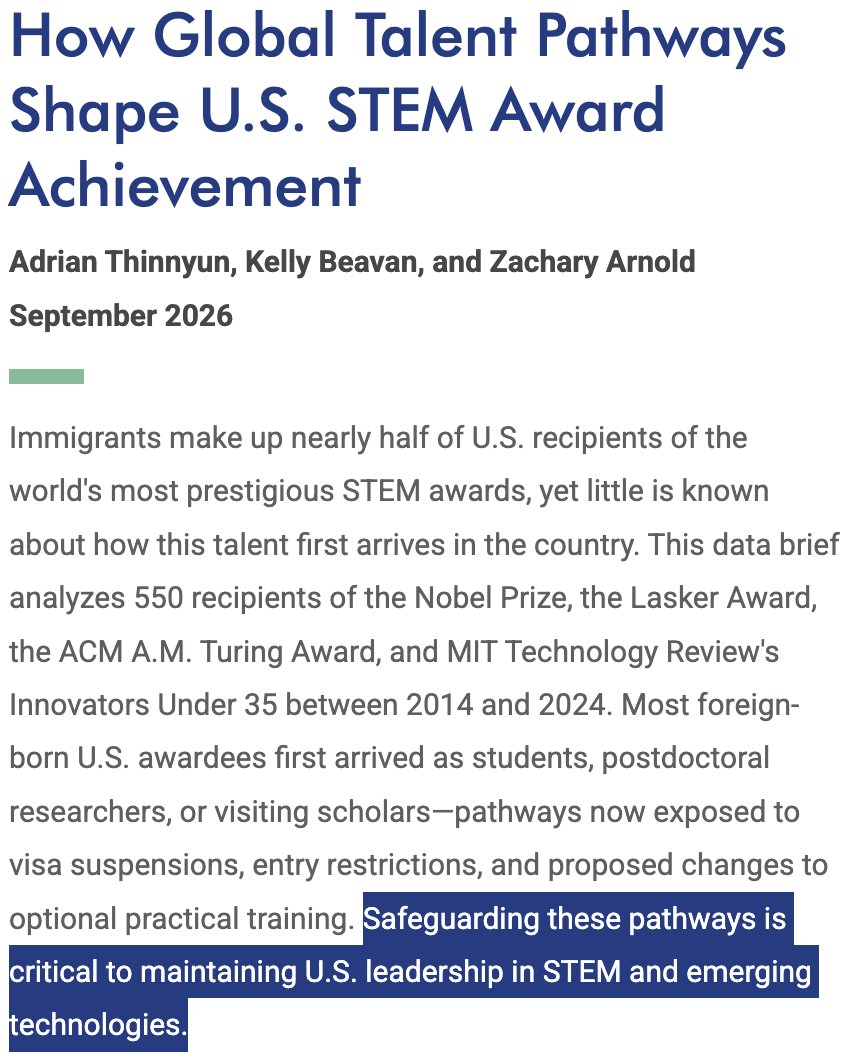
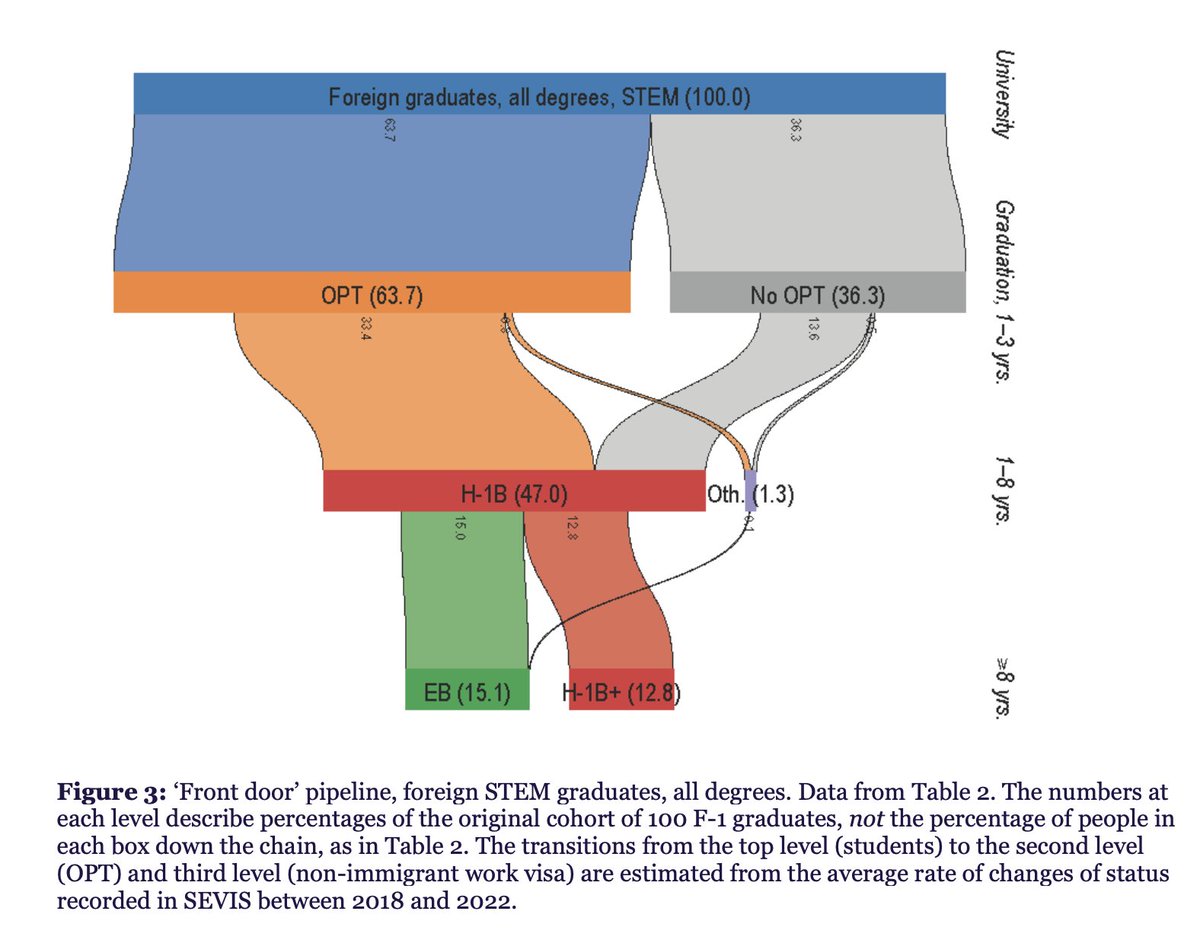
These sorts of restrictions lead to significant, negative economic impacts to America and Americans, as analyzed by @m_clem@JeremyLNeufeld and me in a working paper on the "front door" international STEM talent pipeline.
See https://t.co/AVO9Btpz8L (CSET report) and https://t.co/rgHwfhnCTA (WH S&T strategy report) and https://t.co/d2MWenoaD2 (working paper)
@kreighbaum@AttyStevenBrown@cojobrien In the Global Nurses case DHS filed a dec. on 3/5/26 that said during the period 9/21/25 to 2/15/26 there were 85 petitions for which a $100k fee was paid.
Also, when you go to the Jewish quarter/ghetto you need to go to this one particular bakery - make it happen! Boccione - 2 items you must have (even though they have gluten) : the Hebrew pizza (or that's what our friends in Rome called it) and the ricotta-cherry tart - can you have just a bite ? - if not then good enough for you to pick up something for Rachel https://t.co/vS33dVPXFn
@DanielDiMartino@cremieuxrecueil Typo - meant to say: did *not* need to prove anything else
This new rule will undo many longstanding practices:
Since the HW Bush admin it was legacy INS view that any EB1, 2, 3 adjustment applicant *need not* prove anything beyond job offer and salary confirmation
After glancing at the examples, I doubt the new totality of the circumstances authority and process explained by the PM examples are creating a standard that likely can be operationalized in a consistent and *un*cumbersome way, but I don’t have time to really look into it right now. For example, since the HW Bush admin it was legacy INS view that any EB1, 2, 3 adjustment applicant needed to prove anything beyond job offer and salary confirmation; so this new policy will be much more time-consuming and burdensome for EB immigrants. I see what you’re saying, though, about the new rule appearing to be rational.
@DanielDiMartino@cremieuxrecueil Glad to hear re 3, as I couldn’t follow the logical outgrowth of what you were saying. (And was hoping it wasn’t thinking we could differentiate between naturalized and native-born citizens.)
Will look when I get a chance at the scenario you id re 1,2.