OpenAI, Anthropic, and >1,300 employees at all the major AI companies think the US government should prepare to “pace” automated AI R&D.
The problem: “pacing” is pretty vague, and could be pretty bad.
To fix this, we pulled our team together and developed 23 low-regret policy ideas to understand and manage the risks of automated AI R&D.
Here they are:
1. Frontier AI companies and relevant industry bodies should publicly share information relevant to trends and risks in AI R&D automation
2. Congress should legislate transparency about automated AI R&D risk management, incident reporting, whistleblower protections, and model behavior specifications
3. Congress should resource the Center for AI Standards and Innovation (CAISI) with a budget of at least $84 million per year and empower it to directly advise senior government officials and frontier AI companies
4. The White House should set clear roles and responsibilities of US government agencies to increase specialization across AI policy
5. Intelligence agencies should improve their collection and analysis on foreign AI development and counter threats targeting US AI companies
6. CAISI should develop guidelines for managing the risks of rapid AI capability improvement
7. CAISI should co-lead an AI Verification Consortium (AIVEC) with industry to prototype and deploy verification technologies
8. AIVEC should coordinate the creation of AI hardware testbeds and make them available to government, industry, and nonprofit partners
9. AIVEC should launch philanthropically funded prize competitions for AI verification headed by CAISI
10. AIVEC should coordinate the construction of a fully verifiable data center
11. DARPA and the NSF should set up AI verification R&D programs
12. Intelligence agencies should develop and operationalize unilateral means of AI compute monitoring
13. NSA, CAISI, CISA, and ONCD should further invest in cybersecurity resilience
14. Congress, OSTP, and the CDC should invest in biosecurity resilience
15. Congress and the Bureau of Industry and Security (BIS) should strengthen controls on US and allied semiconductor manufacturing equipment
16. Congress and BIS should close gaps in AI chip controls
17. The Federal Trade Commission (FTC), Department of Justice (DOJ), BIS, CAISI, and Congress should help industry counter adversarial distillation of US AI model capabilities
18. BIS should maintain visibility into sales of US chips
19. DOW, the IC, CAISI, and relevant Federally Funded Research and Development Centers (FFRDCs) should establish consensus security guidelines for protecting model weights from theft and prototype them in a government facility
20. Congress should ensure the US has sufficient electrical capacity to sustain AI leadership
21. Congress should ensure data centers can be constructed in America
22. The US government should use its bilateral AI dialogue with China to jointly develop guidelines for managing risks from rapid AI capability growth and prepare verification measures
23. Countries with national AI institutes should collaborate on automated AI R&D risk management guidelines and technical capacity for AI verification
You can read an intro to the report over at @Noahpinion’s Substack: https://t.co/cVHkBRgZUz
And read the full report here, which has a bunch more detail on each recommendation: https://t.co/L3NUqgHm7R
"We need to run the experiment!"
Exciting to hear more about incoming metascience units from @mkratsios47 -- I've been very excited to see this development, see our @IFP piece on metascience units here: https://t.co/6HkNu3g0x9
Since 2022, @IFP has hosted the Economics of Ideas, Science and Innovation online PhD course. It includes lectures from luminaries of innovation economics like @ChadJonesEcon, @KRoyMyers, @inaganguli, @pierre_azoulay, @Afinetheorem, and others.
Until now, the only way to see those lectures was to be an econ PhD student and join the course live.
We think the insights and ideas included in this course are so important, though, that this year we recorded the lectures and will be publishing all of them on Macroscience.
In our launch essay, @mattsclancy lays out five reasons to study the economics of innovation. Find out what they are, and watch the first lecture - Ben Jones providing a framework for thinking about the economics of ideas - here: https://t.co/3yNKmqlhic
No one likes the H-1B lottery.
But what system would be better?
To answer this question, I FOIAed the US government to get never-before-seen data on H-1B petitions and modeled what different H-1B reform proposals would actually do.
Here’s what I found…🧵
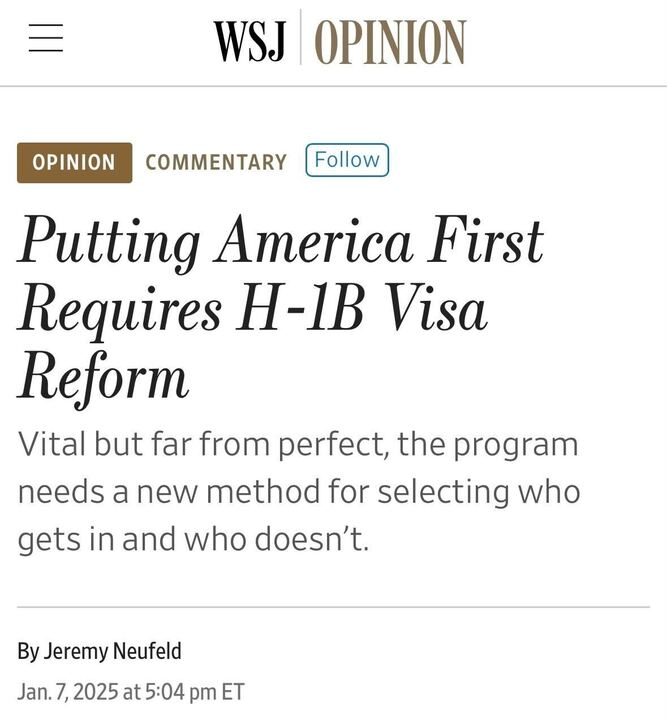
New op-ed from me in the @WSJ.
Why are we still awarding H-1Bs by lottery?
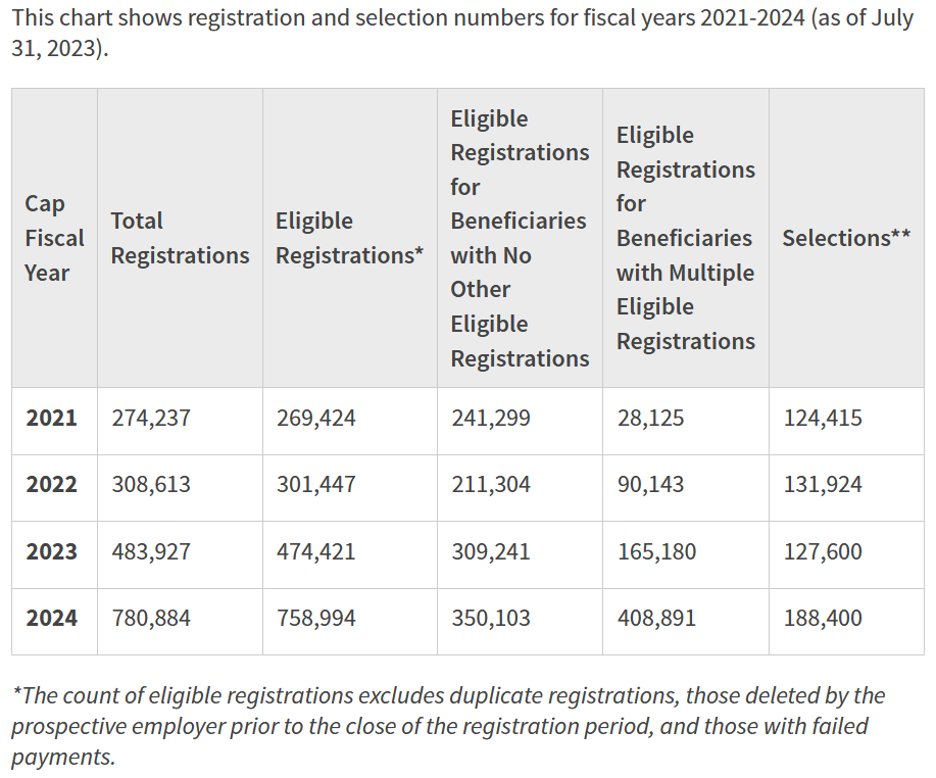
400k+ applications are filed for 85k slots, so companies offering higher pay can lose out to others undercutting Americans.
Ditch the lottery, award H-1Bs by salary, and turn it into a growth engine.
Re-posting this call for applications targeting PhD students and early career researchers (PhDs 2014 or later) doing research on the fiscal and economic effects of three productivity policies: R&D, permitting, and immigration.
Applications due at midnight on Thurs January 16.
Congress could dramatically improve the H-1B program with a simple, one-sentence change that could likely pass in a reconciliation bill.
Here’s the case…
1. High-skilled immigration is critical if you want America to win.
2. Our immigration system should be a meritocracy that prioritizes talent and hard work.
3. On net, the H-1B program has been positive, but it could be reformed to maximize upside and stop gaming of the system.
4. Currently, if companies employ too much of their workforce on H-1Bs, they are subject to extra rules and requirements, unless they pay $60,000+/year.
5. In 1998, $60k was significant ($116k today) — today, it's far below the average H-1B salary.
6. One sentence changing this floor from $60k to $120k (with automatic increases using CPI or 3x national median income) would transform H-1B usage.
7. Most of the top 20 H-1B filers are outsourcing firms paying relatively low wages — this change would increase their compliance costs dramatically.
8. This change would help prioritize our limited H-1B slots for higher-value work and employers — and likely make it too expensive for companies whose business model is to use H-1Bs to outsource jobs.
9. Finding a change that can pass through reconciliation is key — that way, you only need 50 votes in the Senate.
10. This revision could work because, while it can have a significant budgetary impact, it makes no new policy. It is simply updating a policy Congress enacted into law 26 years ago.
11. Raising the floor would lead to an additional $11+ billion in federal payroll taxes over 10 years (with zero effect on federal spending).
12. There are other reforms that could also improve the H-1B program (like moving away from a lottery system).
13. But this one-sentence change is the simplest, most straightforward improvement that would be eligible for inclusion in a reconciliation bill.
14. Consider it a large downpayment on a better H-1B system.
Update: this fellowship program is accepting applications for a second cohort!
Deadline to apply is midnight on Monday, January 5, 2025.
Details available here: https://t.co/LSjhPEGaaA
Today, the window for capped H-1B registrations comes to a close & petitions registered by employers will be in a lottery this coming week.
Yet, the H-1B is failing to keep up with the needs of the American STEM ecosystem.
Fortunately, there are other tools available! 🧵
We're doing this again! And like any good franchise, the sequel is bigger than the original.
Version 2.0 is a (free) 10-week online course being held this spring, again taught by fantastic scholars. 🧵
Next week I'm going to send out a post of PhD job market papers related to innovation. If you're going on the job market this year and want to be included, send me an email! Details here. https://t.co/zfRcRSz3Rf
Re-posting this job opportunity for anyone interested in applying economic policy research to encourage scientific progress, innovation, and economic growth.
https://t.co/QHuIRocqNv
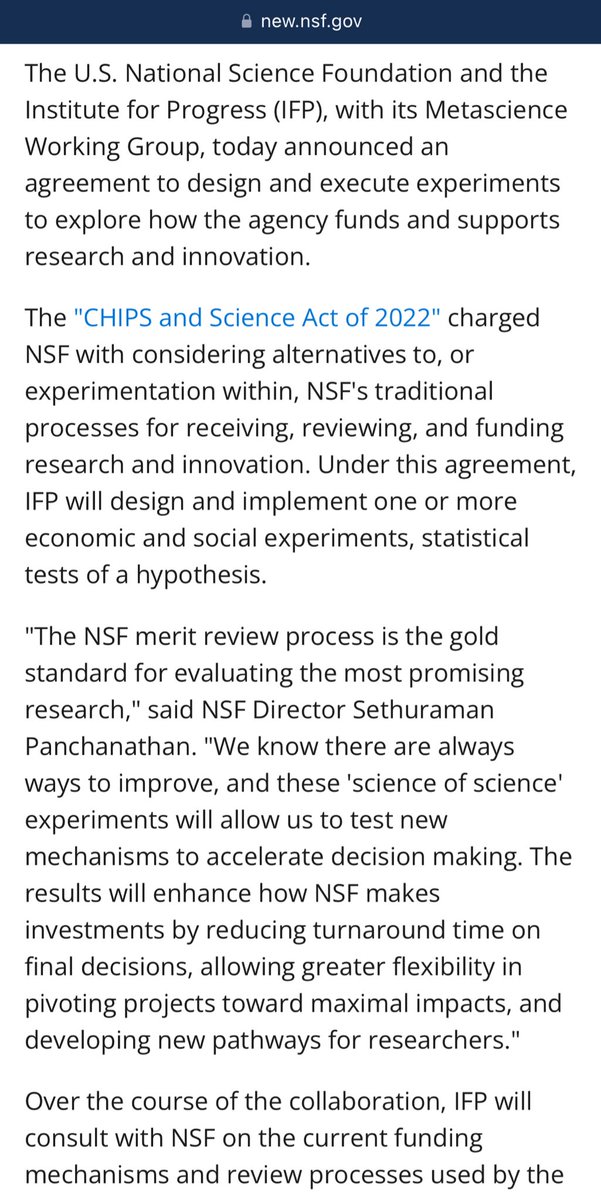
Huge milestone for our metascience team at @IFP.
The leadership at @NSF is committed to using experiments to improve how the agency funds research and innovation.
We’re honored to support their work.
If you’re not familiar with @omzidar's research on taxes & inequality, this is a great primer on his work studying:
- How the richest Americans make their $$
- What’s driving inequality
- How tax policies at the local, state & national levels can help
https://t.co/zIXmdK7WQ7
Congratulations to 2022 PD Soros Fellow @os_delossantos! Oscar will represent LD 11 in the Arizona House of Representatives.
Born in Los Angeles, CA, Oscar is the child of Gregorio and María Dolores—immigrants from Tenamaxtlán, Jalisco, México.