@Mnilax This is so true. I like the framing of “expressing your will to agents”. I agree we need a better way of optimizing instructions. In other words, how can we enable the models to read our minds better?
the bottleneck Karpathy keeps pointing at isn't the model.
it's the file you wrote three months ago telling it how to work.
his whole framing: code isn't the verb anymore.
> you express your will to agents 16 hours a day.
> running more of them in parallel is the unlock.
> and he drops this line halfway through, no fanfare: "now you can have optimization over the instructions."
that's the sentence. the instructions are the new bottleneck. and almost nobody has a process for optimizing them.
i built one for myself. it reads 100 of my past Claude Code sessions and rewrites my CLAUDE.md from what the transcripts show, not from what i thought i wrote.
one Saturday morning later: a 38-line memory file.
73% of my old CLAUDE.md got deleted. most of it was one-off corrections that hardened into permanent rules months ago and were quietly steering every agent i ran.
four behavior patterns surfaced that i had never written down.
the loudest one: my prose corrections outnumber code corrections 8.2 to 1. that ratio was running silently through every session for 90 days.
you don't need a smarter model.
you need an instruction file that still describes how you actually work.
listen to the podcast for the framing. open the article for the script that does the optimization.
claude code is having it's cursor moment after karpathy sensei's post. never been a better time to try it.
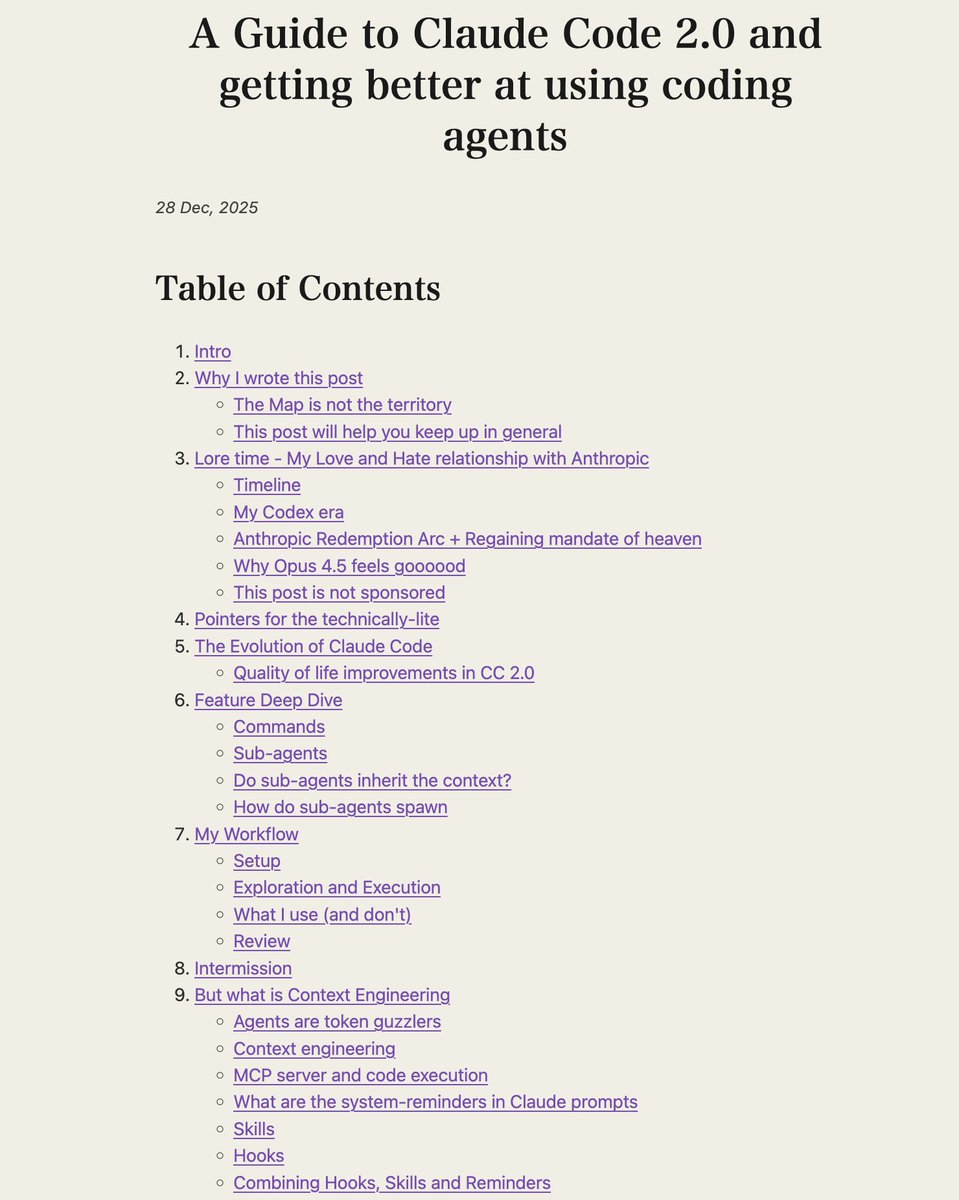
my latest blog on how to get the most out of claude code 2.0 and other agents in general is up now. grab a chai and have fun reading!
https://t.co/cQpvo0xocY
When I created Claude Code as a side project back in September 2024, I had no idea it would grow to be what it is today. It is humbling to see how Claude Code has become a core dev tool for so many engineers, how enthusiastic the community is, and how people are using it for all sorts of things from coding, to devops, to research, to non-technical use cases. This technology is alien and magical, and it makes it so much easier for people to build and create. Increasingly, code is no longer the bottleneck.
A year ago, Claude struggled to generate bash commands without escaping issues. It worked for seconds or minutes at a time. We saw early signs that it may become broadly useful for coding one day.
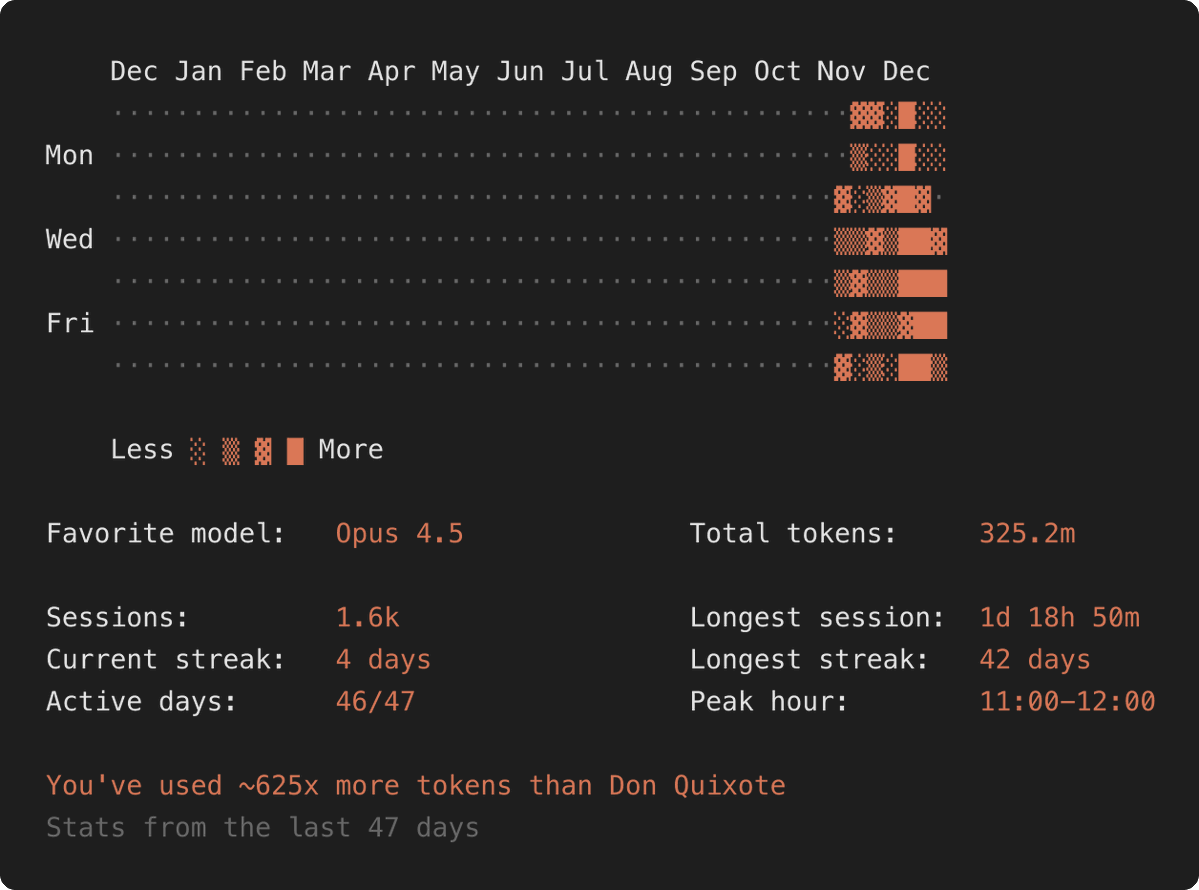
Fast forward to today. In the last thirty days, I landed 259 PRs -- 497 commits, 40k lines added, 38k lines removed. Every single line was written by Claude Code + Opus 4.5. Claude consistently runs for minutes, hours, and days at a time (using Stop hooks). Software engineering is changing, and we are entering a new period in coding history. And we're still just getting started..
Agency > Intelligence
I had this intuitively wrong for decades, I think due to a pervasive cultural veneration of intelligence, various entertainment/media, obsession with IQ etc. Agency is significantly more powerful and significantly more scarce. Are you hiring for agency? Are we educating for agency? Are you acting as if you had 10X agency?
Grok explanation is ~close:
“Agency, as a personality trait, refers to an individual's capacity to take initiative, make decisions, and exert control over their actions and environment. It’s about being proactive rather than reactive—someone with high agency doesn’t just let life happen to them; they shape it. Think of it as a blend of self-efficacy, determination, and a sense of ownership over one’s path.
People with strong agency tend to set goals and pursue them with confidence, even in the face of obstacles. They’re the type to say, “I’ll figure it out,” and then actually do it. On the flip side, someone low in agency might feel more like a passenger in their own life, waiting for external forces—like luck, other people, or circumstances—to dictate what happens next.
It’s not quite the same as assertiveness or ambition, though it can overlap. Agency is quieter, more internal—it’s the belief that you *can* act, paired with the will to follow through. Psychologists often tie it to concepts like locus of control: high-agency folks lean toward an internal locus, feeling they steer their fate, while low-agency folks might lean external, seeing life as something that happens *to* them.”
I've never felt this much behind as a programmer. The profession is being dramatically refactored as the bits contributed by the programmer are increasingly sparse and between. I have a sense that I could be 10X more powerful if I just properly string together what has become available over the last ~year and a failure to claim the boost feels decidedly like skill issue. There's a new programmable layer of abstraction to master (in addition to the usual layers below) involving agents, subagents, their prompts, contexts, memory, modes, permissions, tools, plugins, skills, hooks, MCP, LSP, slash commands, workflows, IDE integrations, and a need to build an all-encompassing mental model for strengths and pitfalls of fundamentally stochastic, fallible, unintelligible and changing entities suddenly intermingled with what used to be good old fashioned engineering. Clearly some powerful alien tool was handed around except it comes with no manual and everyone has to figure out how to hold it and operate it, while the resulting magnitude 9 earthquake is rocking the profession. Roll up your sleeves to not fall behind.
@reidhoffman I know that may be oversimplistic since we struggle everyday to convince customers to share their data due to privacy and competitive concerns.
@reidhoffman Maybe another way to think about it is that it is not sequential, but a flywheel? As more people start to benefit from AI, they are also more open to sharing their data?
Microsoft changed computing history by inventing a new category: the Personal Computer or PC.
Now we’re re-inventing PCs for the AI era, taking us from personal computing to truly personal intelligence.
Today we’re launching a new product category: Copilot+ PCs, the biggest update to Windows in its forty-year history, the fastest and most powerful AI ready PCs anywhere.
These machines are incredible. The whole stack, from silicon to the OS to apps is being re-crafted around Copilot. Copilot runs locally to reason over data, from text to pixels in real-time.
Real personality. Effortless interactions. The ability to see what we see. ✨
I’ve long argued that AIs with EQ, IQ and AQ are coming. Here’s the first real glimpse of what’s its gonna feel like.
It’s a magical experience: smart, intuitive, natural, and useful.
We are taking Copilot to the next level. 🚀
Copilot will see, hear, speak and help in real time.
Watch this demo to see what I mean. Soon your AI companion will start to live life alongside you, whether playing Minecraft or helping you navigate life’s most difficult challenges.
Say hello to the future.
@c_valenzuelab I can’t agree more. Much of the process should be digitalized and streamlined. I have gone through the immigration process myself and now for my family. After waiting for 15 years, a minor mistake managed to set back the process for another year. Thanks for speaking out.
Multimodal medical AI? You heard that right! 💯
We're sharing some exciting new #research that presents different approaches to introducing multimodal capabilities to #LLMs: https://t.co/nhST6Vdz9b
Follow the thread 🧵 for a couple highlights. 👇
(1/4)