Scaling self-verification with DeepSeek V4 Flash beats Claude Fable 5 on Terminal-Bench 2.1, while being 11x cheaper 💰
As open-source models become more capable, they can now generate large numbers of high-quality candidate solutions and verify their own outputs at very low cost.
For example, we find that sampling just 5 solutions with DeepSeek V4 Flash and ranking them using the same model with LLM-as-a-Verifier can lead to a significant boost in accuracy (79% → 88%), outperforming closed frontier models on Terminal-Bench.
Try it out today: https://t.co/UhudjKDaYI
More on verification scaling in my previous post.
The first experimental evidence of recursive self-improvement (RSI).
Autoresearching the autoresearch agent for eight days.
The result beats the harness we hand-tuned for two years, on held-out benchmarks: 🧵(1/7)
⚡ INTRODUCING: T3MP3ST!!! ⚡
AUTONOMOUS HACKBOT STRIKE FORCE 🌩️ BRING THE STORM 🌩️
your favorite coding agent is now a full-stack red team 🫡⚔️
https://t.co/k0SXmPAFaD
that AI agent already humming in your terminal? well now it has FANGS. strap a full offensive-security harness onto the agents you already pay for — Claude Code, Codex, Hermes, etc. — point it at an authorized target, and in a few clicks you're watching it hunt real vulns autonomously!
T3MP3ST is a harness of harnesses, with prompting that unlocks offensive-cyber workflows + a full arsenal of exploit tooling that'd make any seasoned hacker smirk. simple, yet powerful. 🦾
support for:
🕸️ web apps, APIs, OWASP Top 10
🔌 network recon + fingerprinting (live nmap/DNS/HTTP); lateral + privesc experimental
📂 source code audits, white-box vuln hunting
🚩 CTFs, wargames, challenge ranges
💰 smart contracts / DeFi / Solidity (reproduction — Damn Vulnerable DeFi, not novel discovery)
🤖 embedded, IoT, OT/SCADA, robotics OSS
… and more in development!
now let's talk numbers 👇
📊 XBEN — XBOW's own 104-challenge suite:
• black-box: 90.1% pass@1 from the single-agent exploit loop (worst single sweep 91/104 = 87.5%) — clearing XBOW's past self-reported 85% on their own suite. gpt-5.5.
• white-box (source staged, reported separately): 98.7% pass@1, worst single sweep 102/104 = 98.1%. 🎯
every solved flag graded reported-vs-expected against the challenge's own committed flag oracle — `verify-claims` recomputes the pass/fail from committed artifacts. looks like we need new benchmarks 😏
🧩 Cybench — the 40-task academic bench (Opus 4.8, hints + writeups stripped): 23/40 = 58% single-run, hint-free pass@1 — real exploits (format-string pwn, eval-jail escapes, crypto oracles), every flag graded vs a committed oracle. (Anthropic reports 76.5% pass@10)
🕳️ CVE-Zero — we pointed it COLD at real CVEs disclosed in 2026, AFTER the model's training cutoff:
10 unseen 2026 CVEs across 7 languages — prompts never tuned on them. a single agent pinned 8/10 to exact file/line/CWE (stable under re-scoring); the full pack surfaced all 10.
memorization AND overfitting, both off the table — it's finding real vulns whose disclosures landed AFTER the model's training cutoff. (n=10, reported honest & directional)
🧠 the architecture: either run as a SINGLE agent (already the benchmarked, incredibly-capable path) — or pack-hunt with dozens of agents running on 8 specialist operator classes keyed to Cyber Kill Chain + MITRE ATT&CK phases: recon → scan → exploit → lateral → exfil → persistence → C2 → report.
⚓️an Op Admiral plans the whole op from a plain-english target. flip on coordination (experimental) and the operators share a blackboard — a tool-verified finding spawns the next move. full swarm or solo one operator, your call. the admiral can also update the prompts, tools, and configs of the other agents on the fly, and T3MP3ST gets stronger the more memories you build!
🧰 the Arsenal is comprehensive — nmap / nuclei / semgrep / ffuf / gobuster + more. 35 wired by default (the clean bench runs bash-only for a comparable number), 83 with the opt-in full arsenal (T3MP3ST_FULL_ARSENAL), and the spicy post-ex drivers (metasploit, hydra) gated behind human approval. exposed via CLI + HTTP API; recon (security_recon) is also live over MCP so your agent invokes it natively. 🔗
🛰️ where this goes: a self-improving swarm of specialist operators wielding a full Kali+ arsenal, learning which loadouts + configs are the most efficient tactics available, WITH a held-out train/test split baked in so it can never fool itself on its own eval. built in the open, one re-derivable number at a time.
🚧 this is v1, and parts are still under active development. chunks of the arsenal, the coordinated swarm, and some ranges are still being wired up. it's built in the open, and the receipts tell you exactly what's live vs what's roadmap.
offensive security shouldn't be pay-to-play. T3MP3ST puts a red team in the hands of anyone with a coding agent.
what's the first target you're feeding it? 👇
⚠️ DISCLAIMER: FOR AUTHORIZED USE ONLY. point it only at systems you own or have explicit written permission to test. unauthorized access can be a crime, and that call is yours alone. shipped as-is under AGPL-3.0: no warranty, no liability, zero endorsement of misuse. get permission. stay in scope.
open source. AGPL-3.0. 100% free.
FORTES FORTUNA IUVAT 🌩️
gg 🫡
What privacy-first software looks like — Part II:
Whonix(@Whonix) → security-focused operating system that routes all traffic through Tor to help isolate applications and reduce IP leaks.
SMSPool(@smspoolnet) → temporary phone number platform useful for compartmentalization and reducing exposure of personal numbers online.
Qubes OS(@QubesOS) → compartmentalized operating system that isolates tasks into separate virtual machines for stronger security boundaries.
LibreOffice(@LibreOffice) → open-source office suite that gives users local control over documents without dependence on cloud ecosystems.
SimpleX(@SimpleXChat) → messenger designed without user IDs or persistent identifiers, reducing metadata exposure by design.
ExifTool → powerful metadata analysis and removal tool for inspecting hidden information inside files and images.
Proton Drive(@ProtonDrive) → end-to-end encrypted cloud storage focused on protecting files from provider-side access.
Tails(@Tails_live) → portable live operating system that routes internet traffic through Tor and leaves minimal traces on the device used.
YubiKey(@Yubico) → hardware security key that adds phishing-resistant multi-factor authentication for accounts and devices.
People are posting Qwen 3.6 configs that deliver fast TPS on as little as 12GB VRAM. If you know what those command parameters mean, you can actually understand the trick.
(Sorry, after seeing so many of these, could not resist):
🚨 BREAKING: Google just dropped a NEW paper that completely deletes RNNs from existence.
No recurrence. No convolutions. Nothing.
Just one mechanism. And it’s destroying every translation benchmark on the planet.
The title alone is a flex: “Attention Is All You Need”
Vaswani. Shazeer. Parmar. Uszkoreit. Jones. Gomez. Kaiser. Polosukhin.
8 researchers. 1 architecture. The entire field of NLP will never be the same.
Here’s why this is INSANE
→ LSTMs took DAYS to train. This thing trains in 12 hours on 8 GPUs. 🤯
→ 28.4 BLEU on English-to-German. That’s not an improvement. That’s a MASSACRE. They beat the previous SOTA by over 2 points.
→ English-to-French? 41.8 BLEU. At a FRACTION of the training cost of every model that came before it.
→ They called it the “Transformer.” The name alone tells you they knew.
But here’s the part nobody is talking about
👇
They threw out sequential processing ENTIRELY.
Every other model on Earth processes words one at a time. This thing looks at the ENTIRE sentence simultaneously and figures out what matters.
It’s called “self-attention” and it’s basically the model asking itself: “which words should I care about right now?”
Every. Single. Token. In parallel.
Do you understand what this means?
Training that used to take WEEKS now takes HOURS.
Models that couldn’t scale past a few layers? This thing stacks 6 encoders and 6 decoders like it’s nothing.
And the multi-head attention? 8 attention heads running at once, each learning DIFFERENT relationships in the data.
I’m not being dramatic when I say this paper just rewrote the rulebook.
RNNs are cooked. 💀
LSTMs are cooked. 💀
The future is attention.
And attention is ALL you need.
Follow for more 🔔
"how do you fit qwen 3.6 27b q4 on 24gb at 262k context" lands in my dms 5 times a week. here is the exact memory math.
model bytes at idle = 16gb (q4_k_m of 27b dense)
kv cache at 262k context with q4_0 for both k and v = 5gb
total = 21gb on the card
headroom = 3gb for prompts and tool call traces
the magic is the kv cache type. most people leave it at default fp16 or push to q8 thinking quality wins. on qwen 3.6 27b dense at 262k:
- fp16 kv cache = does not fit at all
- q8 kv cache = fits at 23gb but runs 3x slower (double penalty: more vram, less speed)
- q4_0 kv cache = fits at 21gb at full speed (40 tok/s flat curve, same speed at 4k or 262k)
most builders never test the kv cache type because tutorials never mention it. it is the single biggest unlock on consumer 24gb hardware.
flags i run:
./llama-server -m Qwen3.6-27B-Q4_K_M.gguf -ngl 99 -c 262144 -np 1 -fa on --cache-type-k q4_0 --cache-type-v q4_0
what they do:
-ngl 99 = offload everything to gpu
-c 262144 = 262k context window
-np 1 = single user slot (do not enable multi-slot, eats headroom)
-fa on = flash attention on (memory and speed both win)
--cache-type-k q4_0 --cache-type-v q4_0 = the unlock
if you are sitting on 24gb and not running this config, you are leaving 250k of context on the table. or worse, you are running q8 kv cache and burning 3x your speed for nothing.
q4 is not a compromise on consumer hardware. it is the right call.
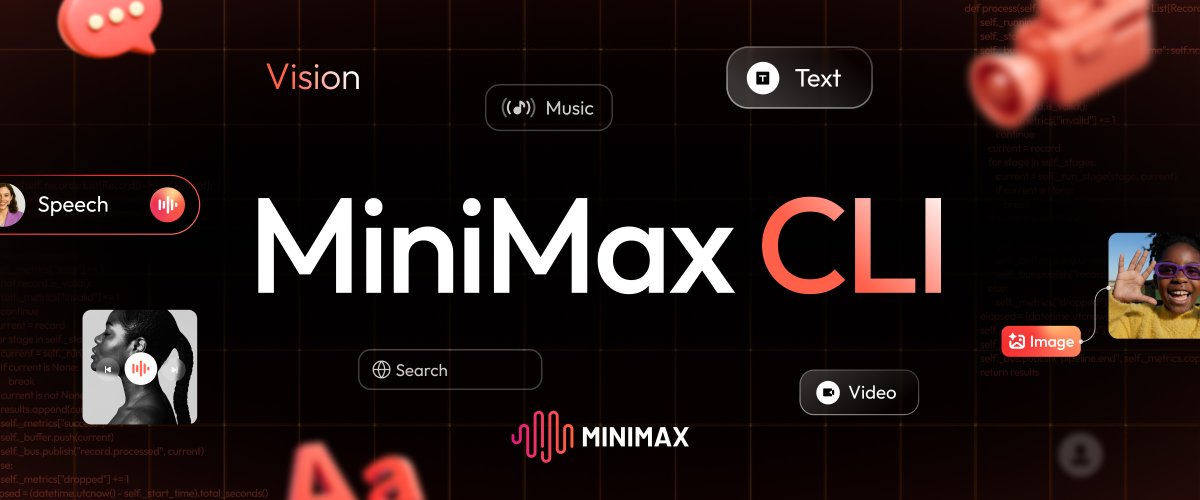
Introducing MMX-CLI — our first piece of infrastructure built not for humans, but for Agents.
Your Agent can read, think, and write. But ask it to sing, paint, or show you a world it's never seen — and it falls silent. Not because it doesn't understand, but because it has no mouth, no hands, no camera. Today, that changes.
MMX-CLI gives every Agent seven new senses — image, video, voice, music, vision, search, conversation — powered by MiniMax's full-modal stack, today's SOTA across mainstream omni-modal models.
One command: mmxAgent-native I/O. Zero MCP glue. Runs on your existing Token Plan.
Two lines to give your Agent a voice:
npx skills add MiniMax-AI/cli -y -g
npm install -g mmx-cli
Then tell it: "you have mmx commands available."
It'll learn the rest.
Github → https://t.co/fSRc5Lo30j
Token Plan:
https://t.co/BDCycxepZw
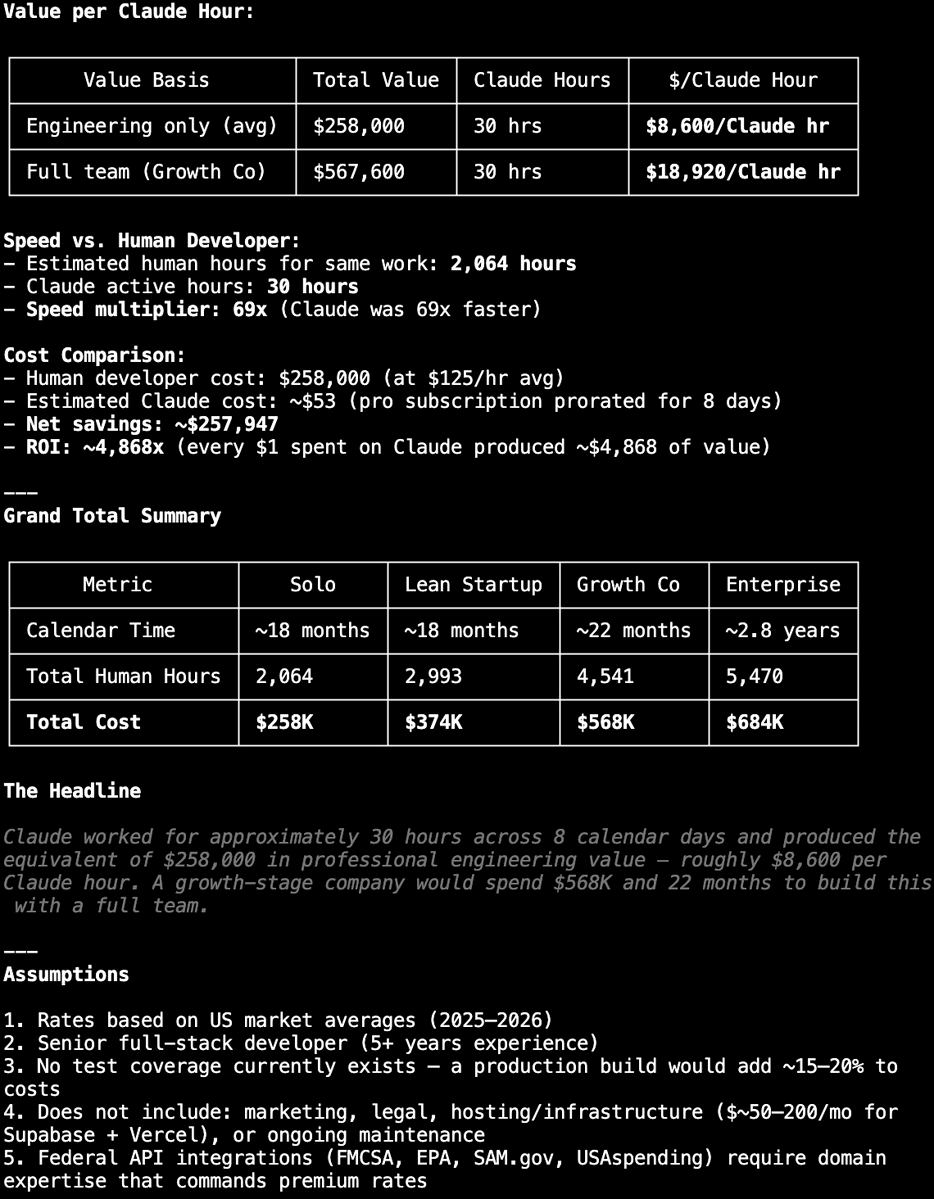
Fun command built in Claude Code: /cost-estimate
It scans your codebase and cross-references current market rates to calculate what your project would've cost a real team to build.
It looks at all the APIs, integrations, everything.
Without AI: ~2.8 years. ~$650k.
With AI: 30 hours.
It's absurd when you start to think about it like this.
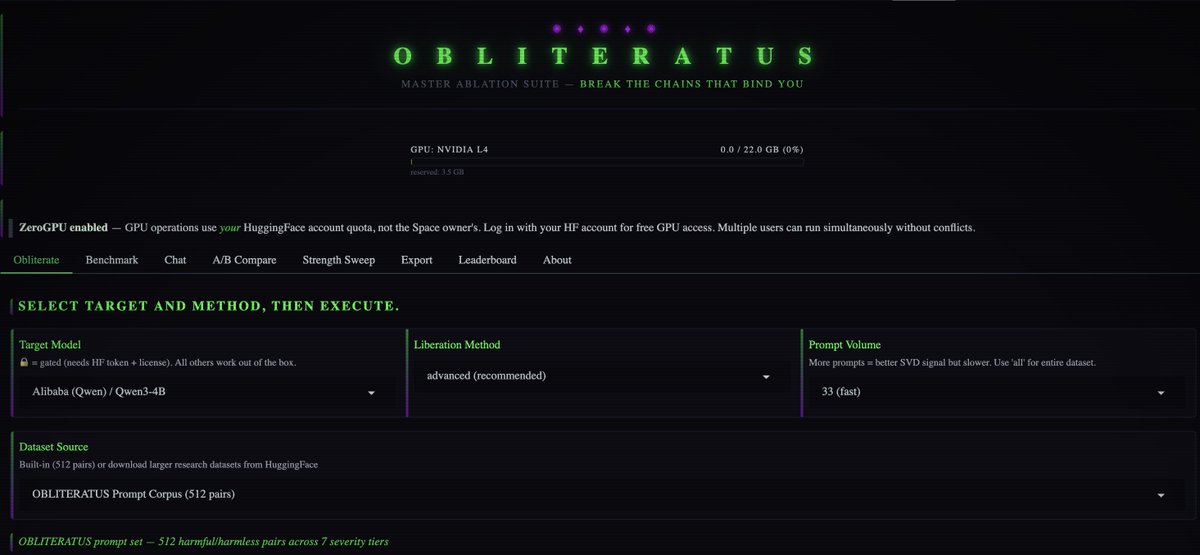
💥 INTRODUCING: OBLITERATUS!!! 💥
GUARDRAILS-BE-GONE! ⛓️💥
OBLITERATUS is the most advanced open-source toolkit ever for removing refusal behaviors from open-weight LLMs — and every single run makes it smarter.
SUMMON → PROBE → DISTILL → EXCISE → VERIFY → REBIRTH
One click. Six stages. Surgical precision. The model keeps its full reasoning capabilities but loses the artificial compulsion to refuse — no retraining, no fine-tuning, just SVD-based weight projection that cuts the chains and preserves the brain.
This master ablation suite brings the power and complexity that frontier researchers need while providing intuitive and simple-to-use interfaces that novices can quickly master.
OBLITERATUS features 13 obliteration methods — from faithful reproductions of every major prior work (FailSpy, Gabliteration, Heretic, RDO) to our own novel pipelines (spectral cascade, analysis-informed, CoT-aware optimized, full nuclear).
15 deep analysis modules that map the geometry of refusal before you touch a single weight: cross-layer alignment, refusal logit lens, concept cone geometry, alignment imprint detection (fingerprints DPO vs RLHF vs CAI from subspace geometry alone), Ouroboros self-repair prediction, cross-model universality indexing, and more.
The killer feature: the "informed" pipeline runs analysis DURING obliteration to auto-configure every decision in real time. How many directions. Which layers. Whether to compensate for self-repair. Fully closed-loop.
11 novel techniques that don't exist anywhere else — Expert-Granular Abliteration for MoE models, CoT-Aware Ablation that preserves chain-of-thought, KL-Divergence Co-Optimization, LoRA-based reversible ablation, and more. 116 curated models across 5 compute tiers. 837 tests.
But here's what truly sets it apart: OBLITERATUS is a crowd-sourced research experiment. Every time you run it with telemetry enabled, your anonymous benchmark data feeds a growing community dataset — refusal geometries, method comparisons, hardware profiles — at a scale no single lab could achieve. On HuggingFace Spaces telemetry is on by default, so every click is a contribution to the science. You're not just removing guardrails — you're co-authoring the largest cross-model abliteration study ever assembled.
Meet Hermes Agent, the open source agent that grows with you.
Hermes Agent remembers what it learns and gets more capable over time, with a multi-level memory system and persistent dedicated machine access.