As someone deep in the weeds of this every day, one of the things I see happening is that a huge volume of the commit surge is doing nothing more than maintaining the failures and breakages of previous surges.
They're not adding new features, new value, new functionality or new market value, they're just fixing what broke due to the flood and the fact that fast is easy but correct is not.
So I look at things like this with quite a bit of skepticism. This isn't an increase in productivity, it's an increase in churn, because as you note: productivity is value, features, quality. I could commit 57,000 commits a day changing one config value in a service back and forth, that isn't value. This is akin to what's happening.
You can't solve real-world physical tasks through autoregressive sampling alone. The physical world is entirely unforgiving to hallucination or approximate pattern matching. If we want actual autonomous robotics we have to engineer causality and discrete reasoning back into the loop.
Biwei and the team at Aether AI is doing exactly the kind of foundational, non-consensus work the field actually needs right now.
3) Open-weight models are increasingly being post-trained here in America by companies like our portco @FireworksAI_HQ using an enterprise’s private data to create a highly optimized specialized model. This customized model can be combined with a frontier model behind a router to create frontier performance at 40% of the cost to the end customer while consuming the same amount of underlying compute.
Cursor’s Composer, Cognition’s SWE-2, Harvey’s Tenet are all early examples of this. Eventually every large enterprise in the world will likely preserve data sovereignty and post-train their own model using their data. These models will be combined behind a router with 1 or more frontier models. This hybrid, multi-model future has been well articulated by Satya Nadella, Alex Karp and others. “Own your weights, control your future.”
It has started to happen: open-weight demand has gone vertical over the last few months in the Vercel and OpenRouter datasets. These specialized open-source models in this hybrid future are just compressing margins at the model layer. And this drives more demand for compute as the compute is effectively being marked up less.
Turning to this weekend’s specific controversy. My comments about no one taking unfunded commitments from OpenAI and Anthropic seriously over the weekend were about the $1 trillion plus of “MOUs” signed with various Asian supply chain and semiconductor companies in 2025. No one takes those seriously. Contractual commitments matter and are taken seriously.
Per Anthropic’s leaked S-1, they have committed to spending roughly $11 billion per year with Amazon for the next decade, $15 billion per year with Google for the next 7 years and $5 billion per year with Azure for the next 6 years. These are all priced well below current spot prices for compute *and* current forward prices for compute. The combined $31 billion per year of cloud spending is quite low relative to their reported $70bish ARR given ~80% inference margins and will obviously be internally financed. @altcap doing my best to make you happy and lower the bar. SpaceX has a very different strategy: they sell compute at much higher prices in-line with spot. This may result in an 8-9 month payback which may be close to the financing terms Nvidia has given them. The $161 billion in commitments to Broadcom will require external financing from some combination of Broadcom and private credit, which is beginning to happen. While the headline number of $413 billion of real, actual non-cancellable contracts sounds sensational and scary for Anthropic, it is fairly reasonable when one considers the duration and Anthropic’s scale. We shall have to wait for OpenAI’s S-1 to perform a similar analysis for them.
Most of the actual contractual commitments that have been made by OpenAI and Anthropic to various hyperscalers and neoclouds are now well below the current spot price for compute. This is why Sarah Friar noted that she could sell all of their contracted compute commitments up 3-5x from their contract value. She was speaking the literal truth. In a world where both OpenAI and Anthropic disappeared, their commitments would be quickly assumed at higher prices by a variety of players. I think the hyperscalers deeply regret *every* contract they signed in 2024, 2025 and perhaps even the first half of this year. As these contracts roll-off and their compute is repriced to market, their revenue growth should steadily accelerate which will help with the funding concerns for AI infrastructure. Result is that I think we may be approaching the peak of external financing as a % of the AI infrastructure buildout (cue at least one widely anticipated $100b hyperscale equity raise and then can put a fork in it).
More to say, but will save it for a later date.
What's new in Grok Bot
0:00 Bot's very own email
1:14 Better X!
1:48 Connect Shopify
2:20 More color
2:45 Email drafts
3:22 Bot's computer
4:30 Template search
4:48 PR previews and routine right-clicks
5:24 5 new languages
Lots new in @bot this week! More on the way.
here's how i shipped 2,500 PRs last month to production
this was originally supposed to be for Cursor Compile in London. i couldn't make it since i was livestreaming for Grok @Bot Galaxy so i'm making it available for free here on X! watch it on 2x speed, i talk slowly
very bullish on Bend, this is exactly what ive been trying to do in other languages, but you can only get so far with weak type systems and lint rules.
when you have a codebase that can formally verify itself, you can ship at an incredible pace. code review is solved
something that keeps bothering me is how some people see slop as something that is happening to them, like they're some kind of helpless bystander powerless to do anything about it
excuse me but you are a software engineer, you literally learned how to make sand think and make computers do your bidding?! and now you can't do anything about it? please
the 2 things you should know to cut through all the noise:
1. you need to give your agent a way to verify its own work (i just posted about this so won't rehash)
2. your codebase is memory
the 2nd is not new either, we have always had lint rules, compilers with good diagnostics and strong type systems, LSPs, etc to help us write better code. there is no difference when agents write the code instead, you just need more of them, and stronger ones.
forget rules and skills. you can add those later.
yes, your codebase is a form of memory to agents! agents love extending what already exists. so every nit and every annoyance you've ever seen, every mistake and bad pattern you observe from agents, needs to turn into a constraint, or the agents will just keep repeating those same mistakes like a virus in your code. then you keep observing and repeating this process until your codebase is locked down enough that even agents with little context can one shot a high quality PR.
an even better direction is to refactor/rewrite your code such that agent anti-patterns become categorically impossible. use type systems to your advantage, use libraries/frameworks that reduce the architectural search space, or heck, create your own framework like we did for grok bot and design high quality primitives and well thought out APIs
Used MacBook Pro (Retina, 15-inch, Mid 2015), model A1398. Intel Core i7, 16 GB soldered RAM, Intel Iris Pro graphics. $100 on eBay.
Screen has a black line on the right side about 1 inch from top to bottom.
Omarchy Installed fast and it runs great.
I requested the agent to not consider the black part of the screen and basically resize the desktop and it made it possible. basically the broken screen does not affect the usage also when I connected an external display it shows that screen complete.
No other OS is capable of understanding that there is an area of the screen that is not usable but this is just amazing.
Thank you @dhh
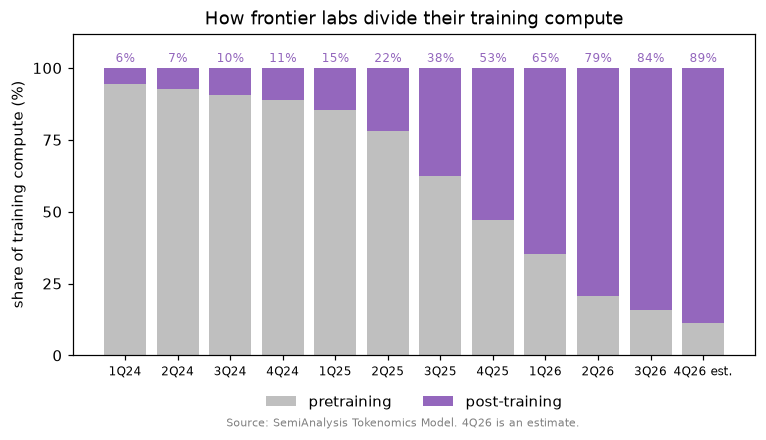
How AI shifted from a transductive paradigm (token-by-token answer completion) to an inductive paradigm (on-the-fly reasoning chain synthesis), in one chart. This is the big story of 2025 and 2026. This is what made coding agents work.
🗞️ if your team is too busy doing their 'normal job' to experiment with AI, you're preparing them to be replaced
https://t.co/KTaIgFpvpK
In this post, I guess this's the last time I'll say it. AI use is no longer optional if you wish to be employed. What follows is advice for current employees and hiring managers on how to hire in 2026 to source AI-first candidates.
Amazon banning agents is the first opportunity I've seen since Amazon was founded for a startup to create an Amazon competitor. People will want agents to buy stuff for them. It will be one of the main use cases. And they won't want to use some Amazon-supplied agent to do it.
Microsoft CEO Satya Nadella wrote that a company renting an AI model “essentially pays for intelligence twice”:
Once in money, and again in the proprietary knowledge it has to reveal to make the model useful.
This mechanism is called the learning loop: every prompt and correction captures some of the company's know-how.
That knowledge is distilled and, with a closed model, the provider keeps that information.
If your usage data is worth more than the token cost to serve, providers might end up paying you to use their models. The precedent exists: OpenAI created an opt-in program that gives accounts up to 1M free tokens a day on certain models in exchange for training rights on that traffic.
Chips can be rented and algorithms can be leaked or distilled, but the prompts and corrections flowing through a model compound privately for whoever holds them.
The critical distinction between base LLMs (2024 and earlier) and modern LRMs is not symbolic tool use. It's the switch from a transductive paradigm (intuit the answer to the query) to an inductive paradigm (intuit the program/instructions that produce the answer to the query).
They're trained to be inductive, and they perform test-time induction, i.e. test-time prediction of a NL program / reasoning chain. This unlocks entirely new capabilities -- in particular fluid intelligence. Base LLMs, to this day, have ~0 fluid intelligence. LRMs have substantial levels of fluid intelligence.
The performance of LLMs on ARC 1 (a benchmark from 2019) remains ~10-15% today. Scaling them up by a factor ~100,000x got them from 0% to 10%. Meanwhile LRMs the same size or smaller saturated ARC 1 in 2025.
Delighted to be speaking about our recent progress on JEPAs and on the need for more principled solutions that handle data imbalance, noise, multimodality, reasoning, ...! Happening at MICCAI-FOMO26 in 5min! And thank you for having me as keynote today!
Question for everyone :
Are you pro-intelligence or anti-intelligence ?
Do you think more intelligence in the world is intrinsically good ?
Or do you think more intelligence is intrinsically dangerous ?
AI amplifies human intelligence.
It makes PEOPLE smarter and more effective.
It's like search engines, libraries, education, literacy, language: it makes PEOPLE smarter and more empowered.
If you want intelligence (artificial or natural) to be under control of a few companies or governments, you are a neo-obscurantist or a neo-feudalist.
I've published detailed notes and an annotated transcript to accompany the video of the keynote I gave at @WeAreDevs World Congress North America in San Jose on Friday - here's my rundown of everything that's happened with LLMs and agents in 2026 so far https://t.co/iENa7bKmdF
ok i think i finally figured out why alignment has gone basically nowhere after 15 years and several billion dollars. the problem is hard sure. but have you met the people in charge of it
1) the leadership does not know how computers work. ask one what happens when you type a url into a browser and watch them start sweating. dns is a spooky word. they genuinely believe the model lives in "the cloud" like a ghost haunting a castle
2) zero idea how large scale distributed systems work. never been paged at 3am. never watched one bad bgp announcement take half the internet offline. their big threat model is the ai "copying itself across the internet" like its a floppy disk virus from 1998. brother it needs 50 megawatts, a liquid cooling loop and a personal relationship with jensen. it is not escaping onto your smart fridge
3) they dont understand the stack they are supposedly protecting us from. ask about inference servers, kv cache, batching, egress, rate limits. blank stare. ask how the model will seize the power grid and you get a 45 minute answer with a hand drawn diagram and three links to their own blog
4) nobody can define an agent. ask ten of them and you get eleven definitions and a 30 page google doc. to the rest of us an agent is a while loop that calls tools and eats a 429 every thirty seconds. to them its a digital god in its larval stage. my agent cant book a dentist appointment without asking me three times if im sure
5) they started from "everyone dies" and worked backwards so every result is bad news somehow. model refuses, deceptive. model complies, sycophantic. model does well on evals, well now its scheming about the evals. i cant think of a single thing a model could do that would get them to say ok maybe we're fine
Surprise! AI is NOT taking recent college grads' jobs!
This was supposed to be the summer it showed up. It didn't. Great detective work by @wu_jane & Robert Fairlie in @nberpubs https://t.co/dhnQptm9ZC