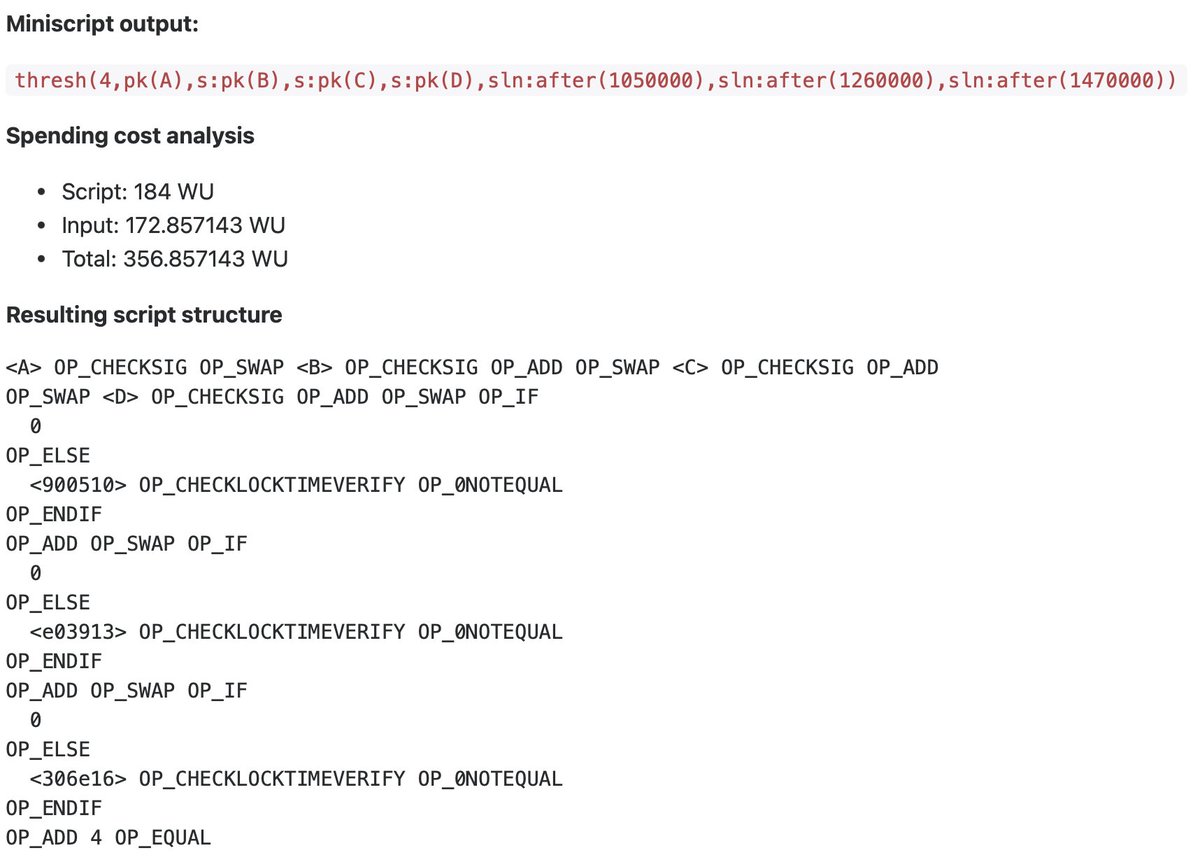
@KLoaec If I understand you correctly, 110 will break this type of miniscript decaying multisig? And this integration test in bitcoin core will fail on 110 code fork https://t.co/akHw2XKkuD?
My understanding is mitigating mining centralization vectors was the reason core loosened mempool policy in first place, but I don't know if I’ve seen it clearly articulated. The strong push (off brand) makes me curious if there are responsibly disclosed vulnerabilities more serious than the obvious one:
- large pool collects non-standard transactions via private channels (eg Slipstream)
-packs block with them causing compact block reconstruction failures on nodes and increasing propagation delay
-uses delay to get head start on next block, extends hidden chain, then releases it (built with standard txns for fast relay), gaining selfish-mining advantage
-boosts pool's profitability and hash power efficiency which creates feedback loop
I haven’t paid close attention to this, have you seen this case made? And do you agree that widely adopted v30 would nip it in the bud?
Over my career I've seen a _lot_ of attempted complete rewrites of existing software, and two things have stuck out to me:
- The overwhelming majority of rewrites failed
- Of the small minority I saw succeed, almost 100% were done by the same team who wrote the original software.
We’re proud to share A Bird’s Eye View, our film produced for Bird Buddy by @BBCStoryWorks Commercial Productions as part of The Human Component series.
Bird Buddy started as a smart feeder.
Now it’s a daily ritual for families, a window into nature, and a growing source of insight for conservation.
🎥 Watch the film here: https://t.co/vvJpE7rK0Q
#TheHumanComponent #BirdBuddy
@reardencode@KLoaec@Wizardsardine Surely "proper" vaults can be implemented on Etherium? Why do you think that hasn't that happened (or at least gained traction), and instead whatever "custody solutions" they use get exploited eg $1.5b bybit hack?
I understand this, the core of what I outlined is the bonded btc. As I typed all this out it made me wonder if something like this would have product market fit or be something organization would actually want to adopt. I'm not sure but Lowery's ideas have always been interesting to me this is what I came up with trying to imagine practical applications
Right now we're in a world where "some dev manager" maybe does have the power and ability to send out an OTA update to the entire fleet (and maybe it comes down to a single sig and a trusted server). Which kinda makes Lowery's point. And in the near future think Optimus, Neuralink, etc... I expect this won't cut it for the most critical "control authority" in the near future. The dev manager may coordinate the update and form the transaction, but I expect other entities will need to sign-off in critical cases like these. And the funding of this transaction will not come from the signers (some SIGHASH flag and involvement from another entity to fund)
The core security improvement you can't get "traditionally" comes from staking a significant bond with this transaction. In this example the device requires a large fraction of Tesla's bitcoin reserves, 1k BTC, to be staked with the transaction to consider the associated OTA package "valid". If a malicious entity gets access to the signing keys they must control enough BTC, which they are forced to sacrifice because Tesla will claim it. For Tesla this is a lossless process. Practically speaking leveraging bitcoin infrastructure and tooling for the signing, multi sigs, financial stakes, etc... is a major benefit because at the end of the day you have devs implementing all of this. Integrating bitcoin core and watching for certain transactions in the device's OTA manager to check a hash is simple, reasonable, and transparent. I'm being brief and leaving a lot of room to fill in gaps (eg custody of Tesla's bitcoin reserves is a different entity than the signers of this transaction even though it funds it)
How does Tesla "secure" an over-the-air software update to their fleet of autonomous vehicles? At minimum the update package is signed with a private key and checked by each vehicle before being applied. But if this key leaks and access is gained to server(s) can a malicious update be pushed to the fleet that enables "kamikaze mode" at a specific time for all cars? And in x years when there are millions of Optimus robots among us capable of "defense"? Given nation-state level attackers, are current security practices enough? Now imagine a lightweight bitcoin node runs independently on each device. This node watches a multi-sig of defined entities (can include regulator(s) and entities external to Tesla in this example) that must sign and stake a significant bond with the transaction that includes a hash of the update package. Now each device checks the hash of the update package it downloads from the trusted server against the hash included in the transaction (that meets all requirements enforced by device) as an additional layer of security before applying the update
Bird Buddy introduced the Smart Bird Feeder.
It lets you experience nature with an AI-powered camera feeder that captures photos of local birds and notifies you of visitors.
@mybirdbuddy features a high-resolution camera, recyclable plastic housing, and weather-resistant design.
You can receive photo postcards on your phone and get real-time alerts.
We got a @mybirdbuddy: a bird feeder that photographs and identifies the locals when they drop by, quietly assembling a compendium of cheery avian mugshots. Strong contender for mantle of "favorite AI product".
@rodarmor Who is “they” that’s trying to activate CSV in doge? Seems to me node runners don’t care or want this, and why should they? Not being changed on a whim is a feature not a bug. Of course more centralized alts have no problem changing and upgrading