Recent discussions about open-sourcing make me feel that I should go back and revisit these important open-source works in representation learning that pushed the field forward and eventually made vision foundation models so useful in applications.
These are the papers that come to mind. Feel free to correct my opinions and share any important papers that I may have missed.
MoCo v1 (2019-11) – ResNet
Method: contrastive loss + a queue of samples from previous batches for negative pairing + EMA-based weight updates
# of training branches: 2
Effect: EMA-based weight updates became an important training paradigm in later representation learning algorithms, but this work used EMA only to produce stable embeddings for negative samples.
SimCLR (2020-02) – ResNet
Method: contrastive loss + more augmentations + an MLP projector to capture the effects of augmentations
# of training branches: 2
Effect: An MLP projector became the gold standard in representation learning algorithms.
BYOL (2020-06) – ResNet
Method: positive pairs only + an asymmetric architecture + stop-gradient + SimCLR augmentations + EMA
# of training branches: 2
Effect: Probably the first representation learning method without negative pairs. It inspired DINO and probably JEPA in terms of architectural design.
SwAV (2020-06) – ResNet
Method: global/local views + SimCLR augmentations + class prototypes
# of training branches: 2
Effect: Its global/local-view training became the standard setting in later representation learning methods.
SimSiam (2020-11) – ResNet
Method: BYOL without EMA + a constant learning rate for the predictor
# of training branches: 2
Barlow Twins (2021-03) – ResNet
Method: global views + SimCLR augmentations + batch-level covariance optimization
# of training branches: 2
Effect: The optimization target changed. Previous works used cosine similarity, but this work uses covariance, which explicitly regularizes the latent space.
MoCo v3 (2021-04) – ViT
Method: MoCo v1 - memory bank + SimCLR augmentations and an MLP + a frozen first layer
# of training branches: 2
Effect: The first work to show that ViT can be used for representation learning.
DINO (2021-04) – ViT
Method: BYOL - the predictor + global/local views + softmax distillation + centering + temperature sharpening
# of training branches: 2
Effect: Enabled the era of large-scale vision foundation models.
VICReg (2021-05) – ViT
Method: Barlow Twins → branch-level covariance + variance + sample-level invariance
# of training branches: 2 or 1
Effect: The first representation learning method to support stable one-branch training without EMA, centering, layer freezing, temperature sharpening, or stop-gradient.
MAE (2021-11) – ViT
Method: learning representations through pixel reconstruction
# of training branches: 1
Effect: A simple, simple, and simple training strategy that is widely used in medical imaging, from what I have heard.
I-JEPA (2023-01) – ViT
Method: learning representations through latent prediction
# of training branches: 2
Effect: The first representation learning method in the spirit of JEPA. It is also the basis of V-JEPAs, VL-JEPA, and so on.
DINOv2 (2023-04) – ViT
Method: DINO v1 + SK centering + KoLeo + LayerScale
# of training branches: 2
Effect: The first large vision foundation model to show superior performance across a wide range of downstream tasks.
DINOv3 (2025-08) – ViT
Method: DINO v2 + Gram anchoring + flattened schedules
# of training branches: 2
Effect: The first large vision foundation model to show superior performance on fine-grained tasks, such as segmentation and depth estimation, and to achieve accuracy comparable to supervised learning methods on ImageNet-1K.
LeJEPA (2025-11) – ViT + others
Method: VICReg → full-distribution regularization. It provides mathematical proofs of why an isotropic distribution is the ideal target for the latent space and proposes SIGReg, a method that is linear in the scaling factors.
# of training branches: 1
Effect: No heuristics are needed for training stability. It provides a simple solution for various tasks, including world models, such as the LeWM series; multimodal learning, such as LeVLJEPA; drone applications, such as SkyJEPA; and so on.
VISReg (2026-06) – ViT
Method: SIGReg → a faster and stronger anti-collapse method that can form an isotropic Gaussian distribution more efficiently. It decomposes the regularization into center, variance, and shape losses, allowing the model to begin introducing isotropy at an early stage of training.
# of training branches: 1
Effect: It is too new to summarize concretely.
Anthropic just released a free course on loop engineering with Fable 5
00:00 - how Claude Code works under the hood
05:01 - the agentic loop explained
16:21 - the function that 99% of devs ignore
19:01 - why voice beats writing
32:34 - automatic code review with draft PRs
58:39 - Fable 5 for work that's not code
This free course replaces any paid Claude Code tutorial.
Bookmark it for later.
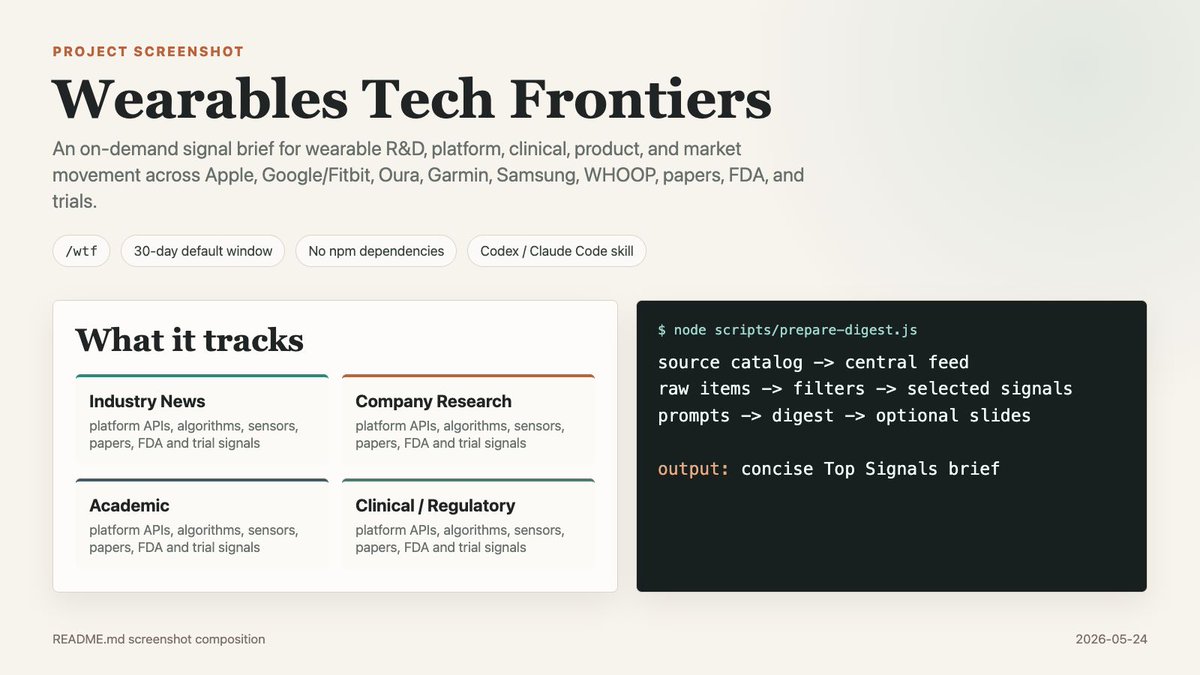
1,010 wearable health signals → 42 that matter.
Built /wtf to cut through FDA updates, arXiv papers, SDK changes & trials from Apple/Oura/Garmin/WHOOP — weekly.
Open-source ↓
https://t.co/UjVznfqXkD
#Wearables#DigitalHealth#HealthAI
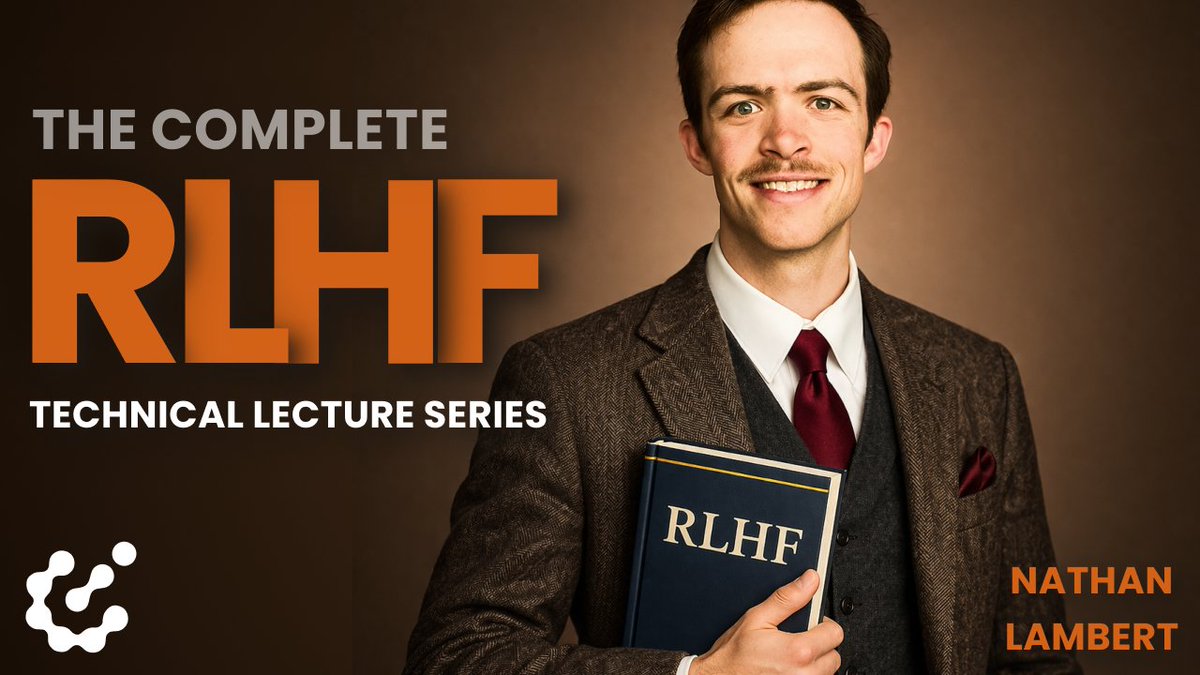
Excited to launch the accompanying free RLHF Course for my book. To kick it off, I've released:
- Welcome video
- Lecture 1: Overview of RLHF & Post-training
- Lecture 2: IFT, Reward Models, Rejection Sampling
- Lecture 3: RL Math
- Lecture 4: RL Implementation
I'm going to add question & answer videos throughout the lecture to go deeper on topics that need it, and potentially cover some topics that are too recent and in flux to go in print. I expect 10-15 videos in total over the next few months.
At the same time, development around the code for the book is picking up. It's a great time to build the foundation for post-training methods.
YT playlist and course landing page below.
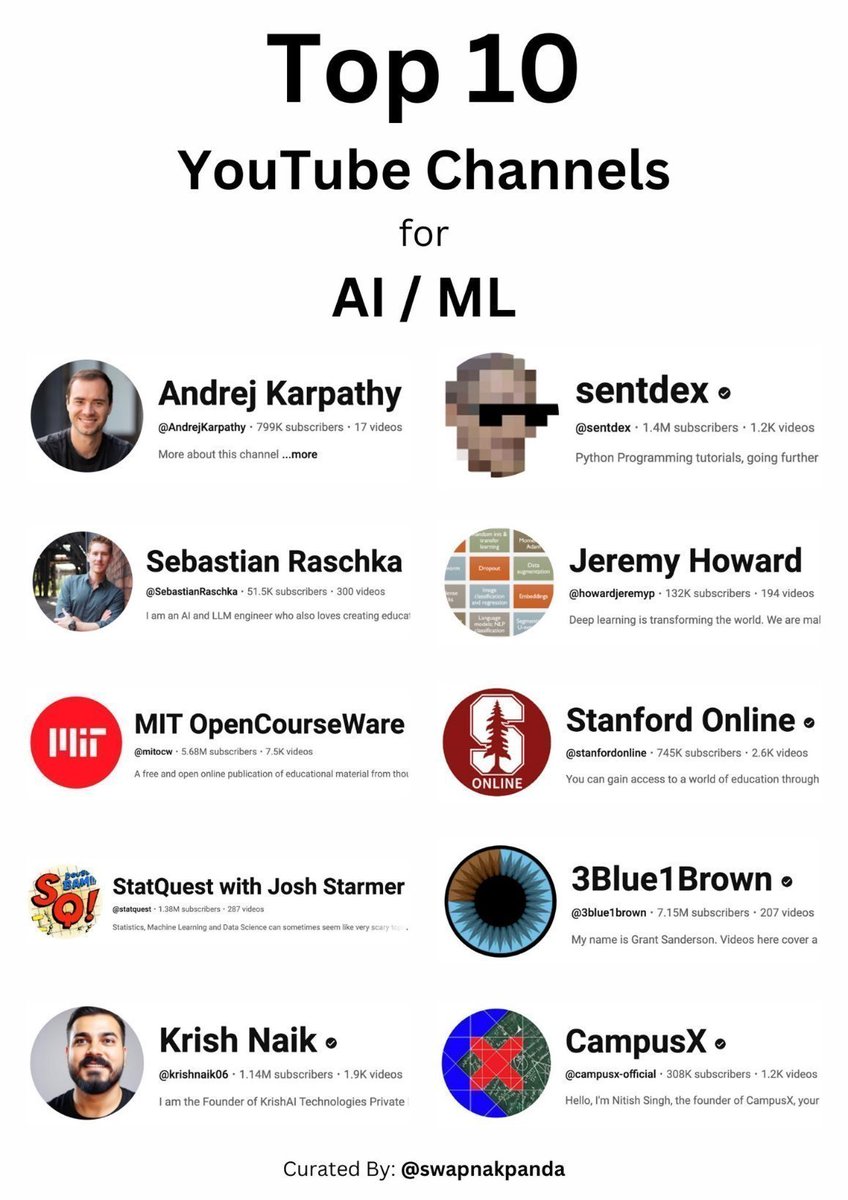
Top 10 YouTube channels to learn AI & ML in 2026
1. Andrej Karpathy
https://t.co/RSFn4tYrqk
2. Sebastian Raschka
https://t.co/vfqkB8Jq4O
3. sentdex
https://t.co/x69pFN1N7k
4. StatQuest with Josh Starmer
https://t.co/ASoicNjyWO
5. Jeremy Howard
https://t.co/LkT5a7C3T4
6. Krish Naik
https://t.co/bWbXwJc22I
7. CampusX
https://t.co/4n4mzA2TLo
8. 3Blue1Brown
https://t.co/izVnMMzyKD
9. MIT OpenCourseWare
https://t.co/8aWGE5Fr8v
10. Stanford Online
https://t.co/RAtD6d4q1w
Planning to learn AI & ML in 2026?
You SHOULD subscribe to these 10 YouTube channels.
1. Andrej Karpathy
https://t.co/zERhSHF5jp
2. Sebastian Raschka
https://t.co/ZFL0omfWuI
3. sentdex
https://t.co/yuQEYdyyiV
4. StatQuest with Josh Starmer
https://t.co/ss5szaEe7E
5. Jeremy Howard
https://t.co/4yNWhmjZzz
6. Krish Naik
https://t.co/wiGkeAkkwz
7. CampusX
https://t.co/pK9hutMcnO
8. 3Blue1Brown
https://t.co/2UxZFKneV1
9. MIT OpenCourseWare
https://t.co/NA6WstSs3y
10. Stanford Online
https://t.co/4GWPFbEGJs
Add any other channels if you find them great.