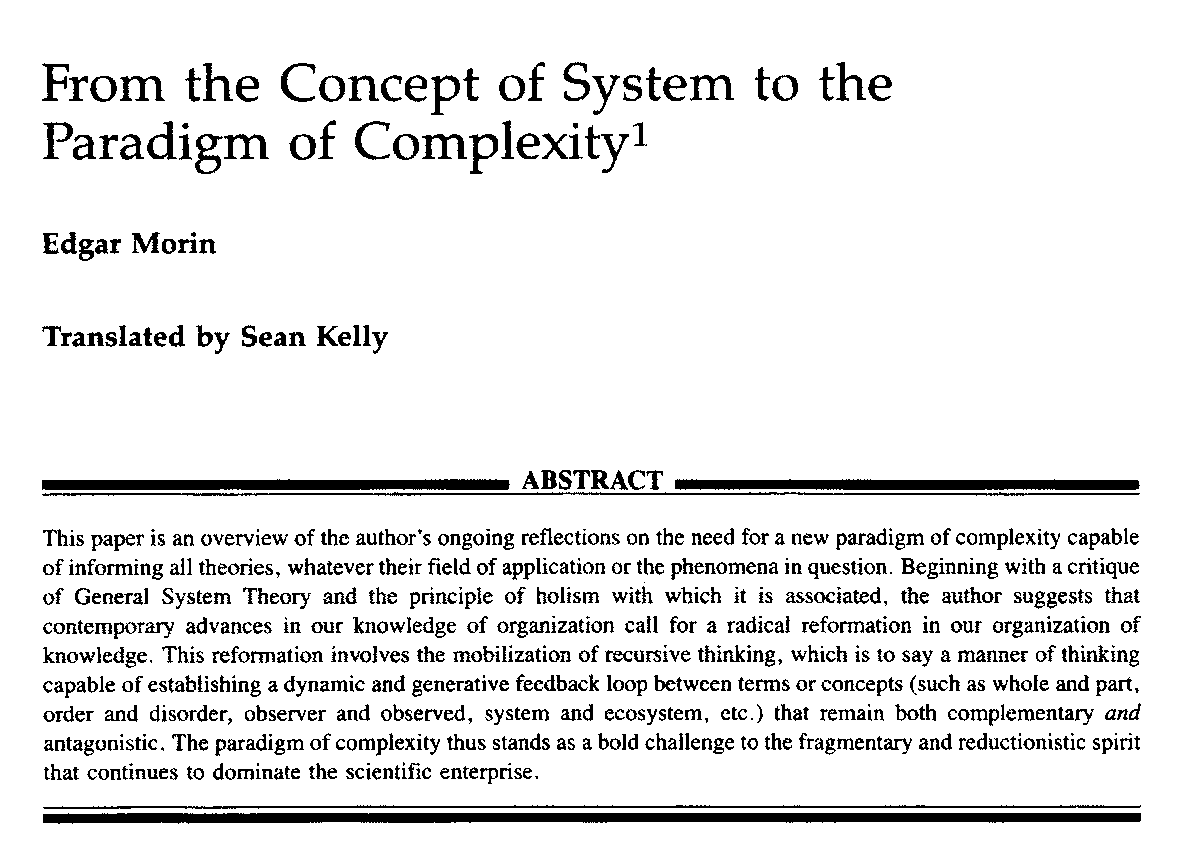
Systems and Complexity
Interesting ideas in this paper including the important warning of the allure of both reductionism and holism: "holism becomes a new kind of reductionism by reducing everything to the whole."
https://t.co/1hAQALrWo2
@engineers_feed 60 is the correct answer ✅
Total (red)🟥= 10+10= 20
Total (green)🟩= 12+12= 24
Total (pink) 😈= 8+8= 16
Total perimeter = sum of all sides
= 20+24+16
=60✅
Today marks the release of my book, *Teaching One-Pagers*. It represents 18 months of hard graft, distilling important edu-research and honing my design skills. Super grateful to everyone who has supported my one-pagers—your engagement is the driving force behind this project! 🩵
Inspired by a long tradition of impossible objects, this 'impossible portal' created by coded loop artist @jn3008 challanges your mind leaning toward you or away from you according to the point of the portal you focus on.
This seems kinda...radical? ASU makes its courses available to anyone for $25/course. After you take the class, if you want the grade you got added to an official transcript with a credit you can use, +$400. These are real college credits. 8 year olds are getting college credits!
I've been working on my own version of the memory/learning model. You can download and use the animated model in Slides or PPT as you wish. You can edit the animation order to suit your needs. Just be sure to credit my work if you use it.
https://t.co/33VcknyhqH
The old Slănic salt mine in Prahova county, Romania.
Closed for extraction purposes, it's now open for visitors, featuring a microclimate with natural air-conditioning and constant temperature and atmospheric pressure throughout the year.
https://t.co/5Vf0sgeo1L
Are you using the correct type of argument to make your point?
3 forms of argumentation, according to Peirce's Triangle:
Abduction: Likeliest explanation from the evidence.
Induction: Broad conclusion from specific instances.
Deduction: Applying a general rule to a case.
Cognitive linguistics, which emerged in the 1980s, has been significantly influenced by Ferdinand de Saussure's ideas about language as a system of signs.
https://t.co/PZDIYmGGg1
While cognitive linguists view the relationship between a word's form and its meaning as motivated by cognitive factors rather than being purely arbitrary, they have still built upon Saussure's foundational concept of the linguistic sign.
Various theories within cognitive linguistics have elaborated on the idea of the linguistic sign by exploring how signs are organized, understood, and used to construct meaning. Prototype theory, for example, has investigated how related meanings of a word are categorized based on their similarity to a central, or "prototypical," meaning. Frame semantics has examined how linguistic signs are understood within the context of structured knowledge about the world. Conceptual metaphor theory has looked at how abstract concepts are understood through systematic mappings from more concrete, embodied domains of experience.
More recent cognitive theories, such as the Lexical Concepts and Cognitive Models (LCCM) theory, have aimed to bridge the study of the abstract language system and its everyday use, reflecting Saussure's distinction between "langue" and "parole." LCCM theory also aligns more closely with Saussure's notion of social convention, recognizing the role of convention alongside cognitive motivations in shaping linguistic meaning.
Although cognitive linguistics has moved beyond Saussure's idea of the arbitrary sign to focus on the cognitive underpinnings of language, Saussure's thinking still provides a fundamental starting point. His insights about language as a system of signs and the nature of the linguistic sign continue to inspire and inform ongoing developments in cognitive linguistics. In this way, Saussure's influence remains highly relevant even a century after his groundbreaking work.
"This is not about isolated facts. In fact I'm arguing for the opposite. Isolated facts are what you end up with if you don't deliberately plan a curriculum around progression and knowledge."👏 So much brilliance in this talk from Lucy. A must-watch ⬇️
I personally like dabbling in the dark arts of behaviorism, but it’s simply not true that Zig was a behaviorist. This is well known by anyone who has read the surrounding literature… he believed that children construct their own inferences when presented with examples. @NIFDI
So apparently Plato used his dying breath to raise a nit-picky objection to the music that a slave girl was kindly playing for him.
his status as the father of analytic philosophy is now beyond dispute
https://t.co/C8nKeOo7Ow
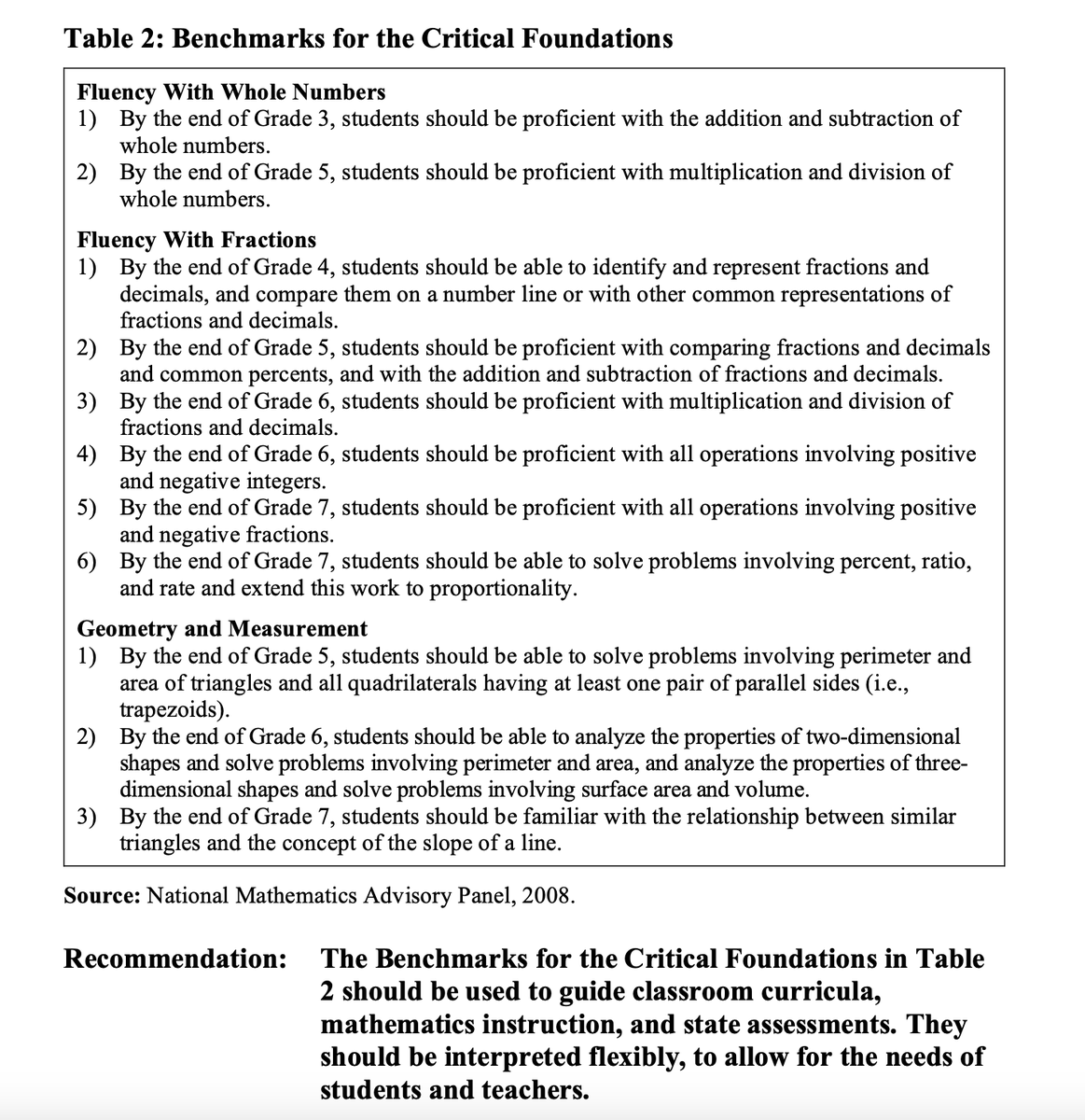
These are the Benchmarks for the Critical Foundations from the National Math Advisory Panel report that @tomloveless99 and I discussed in my latest episode. The panel recommended these be used to guide math curricula. Link to the full report is here: https://t.co/02CF3V4mj5