$qure $clpt
New paper by Tabrizi
Across 4.8 years, bilateral caudate- and putamen-seeded analyses revealed early, region-specific FC alterations despite the absence of motor and clinical symptoms,9, 10 supporting the view that functional network changes precede clinical motor diagnosis.
We observed a significant main effect of group involving the putamen, but not the caudate.
These findings provide the first longitudinal evidence of early cortico-striatal and cerebellar functional network changes in adult HDGEs decades before clinical motor diagnosis, alongside possible compensatory processes in key hubs of the default mode network. These early FC changes likely reflect a dynamic interplay between neurodegenerative processes and adaptive reorganization, a balance that may ultimately fail as pathology progresses.
The HD-Young Adult Study (HD-YAS) cohort consists of deeply phenotyped adult HDGE individuals approximately 24 years from predicted clinical motor diagnosis at baseline,9, 10 which constitutes the furthest-from-onset genetically confirmed adult cohort ever studied. This cohort offers a unique opportunity to investigate FC decades before predicted clinical motor diagnosis. Prior work revealed subtle biofluid and structural changes involving putamen and caudate without clinical decline, highlighting its value for identifying early biomarkers.9, 10
In this study, we examined longitudinal FC changes over ~4.8 years in HDGE individuals before clinical motor diagnosis compared with matched controls from the HD-YAS cohort, using bilateral caudate and putamen seeds. Based on prior evidence,16, 21, 22, 26, 28 we hypothesize reduced FC in striatal-motor circuits and potential compensatory increases in striatal-frontal and parietal networks in response to neurodegeneration. Given the exceptionally early disease stage, analyses were exploratory.
Our study aimed to extend existing structural and rsfMRI evidence to better characterize the early FC changes in HD and inform the design of future clinical trials targeting very early, premanifest stages.
@peter_mantas@Tim_Corr
https://t.co/f3tzMUQYPi
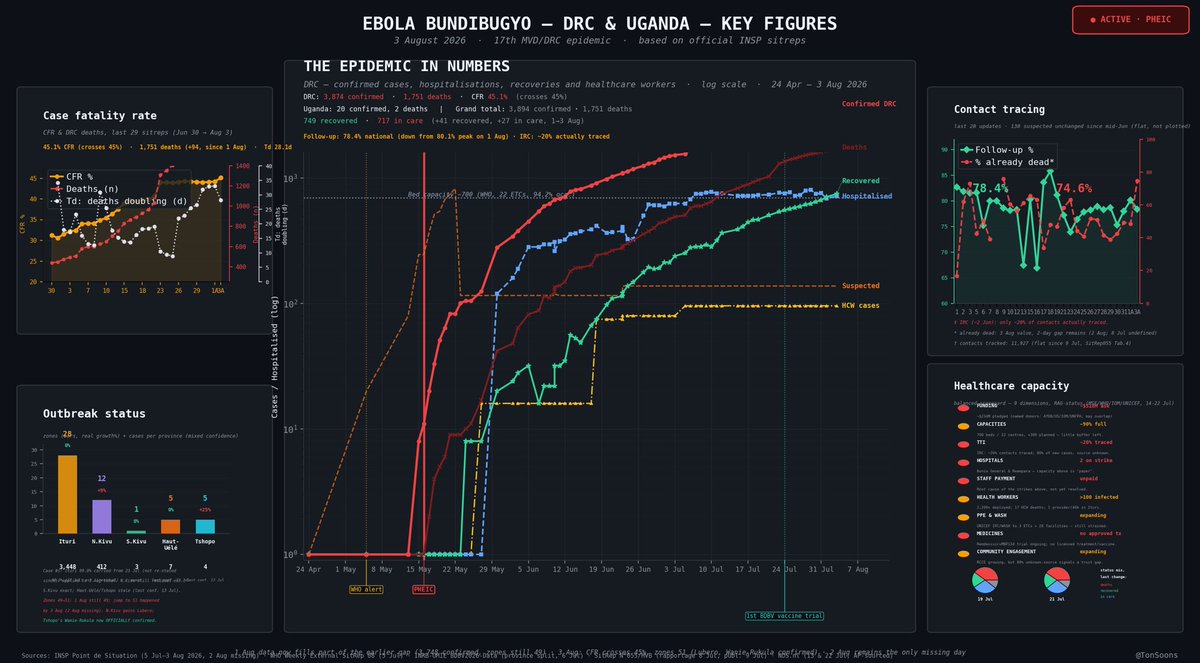
EBOLA BUNDIBUGYO - DRC & UGANDA
Waarom indamming nog niet lukt
1. CONTACTOPVOLGING: GOED OP PAPIER, ZWAK IN WERKELIJKHEID
- Gerapporteerd: 75-80%
- Werkelijk (IRC-schatting): ~20%
- ~80% van nieuwe infecties heeft onbekende bron
- Transmissieketens worden niet gevonden
2. CONFLICT BLOKKEERT TOEGANG
- Tedros (WHO): "catastrofale botsing van ziekte en conflict" (Ituri)
- Transmissie stoppen hangt volledig af van humanitaire toegang
- Gewapend conflict beperkt bereikbare zones
3. STERFTE GROTENDEELS BUITEN DE ZORG
- Groot deel overlijdt in de gemeenschap, niet in behandelcentra
- Risico op onveilige begrafenissen -> verdere verspreiding
- Verklaart mede CFR-stijging: ~31% (juni) -> 45%+ (nu)
4. AANHOUDEND WANTROUWEN
- "Résistances résiduelles" in vrijwel elke sitrep genoemd
- RCCE-inspanningen (huisbezoek, causeries, radio) onvoldoende
- Leidt tot late presentatie en verborgen transmissie
5. ZORGCAPACITEIT ZELF ONDER DRUK
- Stakingen wegens onbetaalde salarissen (Bunia, Rwampara)
- Structuren "sous forte pression": vooral Nord-Kivu, Haut-Uélé
6. GEEN GOEDGEKEURD VACCIN/MEDICIJN
- Ervebo (Zaïre-vaccin) afgeraden: onvoldoende kruisbescherming
- Eerste Bundibugyo-vaccin (ChAdOx1 BDBV): eerste dosis 24 juli
- Nog Fase I - maanden van inzet verwijderd
7. GEOGRAFISCHE GROEI ONDANKS "STABIEL"-TAAL
- Zones: 48 -> 49 -> 51 in enkele weken
- Nieuwe zones na 3+ maanden: Kabondo, Wanie-Rukula, Lubero
- Wijst op aanhoudende verspreiding, niet op controle
--------------------------------
KERN VAN DE ZAAK
--------------------------------
De factoren versterken elkaar in een vicieuze cirkel:
conflict beperkt toegang
-> contactopsporing faalt
-> onbekende transmissieketens
-> late/geen zorgtoegang
-> hogere sterfte buiten instellingen
-> wantrouwen groeit
-> nog moeilijker om cases te vinden
Bron: INSP Point de Situation (juli-augustus 2026), WHO/Tedros
#StopEbola #EbolaRDC #SantéPubliqueRDC #Bundibugyo #Ituri #NordKivu #WHO #INSP #PublicHealth #Epidemiology #ContactTracing #VaccinDevelopment #DRCongo #Uganda #GlobalHealth
@NOS
https://t.co/NSWSb6ziYC
$qure $clpt grace science
Wilsey detailed a regulatory rollercoaster: communication with FDA senior leadership "went to zero" during the Makary-Prasad era, then fully rebounded under new leaders.
The drug appears to work. But the FDA, Wilsey says, was never designed for a disease this small. "The FDA is not set up for ultra rare," he told STAT's The Readout Loud. "They need more people, they need new tools, and then they need new pathways."
Wilsey's prediction, delivered with measured confidence, is stark: the FDA will not be able to handle the coming wave of ultra-rare disease therapies without creating a fundamentally new regulatory pathway, possibly requiring Congressional action. There are roughly 20,000 human genes, and each one is associated with at least one rare disease. If gene therapy succeeds for even a fraction of them, the agency will face hundreds or thousands of applications with tiny patient populations, limited natural-history data, and no feasible path to placebo-controlled trials. The current framework cannot scale to that reality.
The period under then-FDA leaders Marty Makary and Vinay Prasad was particularly damaging. "It went to zero," Wilsey said of senior leadership communication. The review team remained responsive at the staff level, but without leadership access, decisions stalled. That changed dramatically when Chris Klump, Lowell Zeta, Grace Graham, and Kareem assumed leadership roles. "It has been a 180 since they came on board," Wilsey said. The re-engagement echoes the collaborative dynamic that existed under Peter Marks, whose START program had provided critical early support for regenerative medicine therapies.
https://t.co/ZRqKrvB9pH
Ebola Bundibugyo — waarom zorgcapaciteit, TTI en gemeenschapsvertrouwen nu samen de kern van het probleem vormen
DE ONDERLIGGENDE KETEN: ÉÉN PROBLEEM MET VIER GEZICHTEN
Wat er nu in Ituri gebeurt is geen losse verzameling incidenten (stakingen, lage tracinggraad, uitbraak die “uitbreidt”) — het is één samenhangend mechanisme. Zorgcapaciteit, TTI en gemeenschapsvertrouwen houden elkaar in een vicieuze cirkel gevangen, en Ituri’s specifieke geografie en economie (mijnbouw, conflictgeschiedenis) versterken elke schakel.
STAP 1: ZORGCAPACITEIT ONDER DRUK — DE BASIS WANKELT
Op papier is er capaciteit: 2.200+ MSF-medewerkers, ~800 ondersteunde MoH-staf, ~700 bedden in 22 centra. Maar drie dingen ondermijnen dat cijfer direct:
•Stakingen bij Bunia General Hospital en Rwampara Hospital wegens onbetaalde salarissen — de kern van het respons-apparaat in het epicentrum zelf ligt gedeeltelijk stil.
•Zorgpersoneel wordt zelf slachtoffer: 100+ besmet, 17 overleden. Iedere zieke of overleden zorgverlener is niet alleen een persoonlijk drama, maar een direct capaciteitsverlies in een systeem dat al krap is (1 zorgverlener per 40.000 inwoners in delen van Ituri).
•Bedden zitten op ~90% bezetting — de buffer om een piek op te vangen is vrijwel nul.
Dit is geen achtergrondinformatie bij de uitbraak — dit ís de uitbraak, want zonder werkend zorgsysteem heeft geen enkele epidemiologische maatregel houvast.
STAP 2: WAAROM DIT TTI DIRECT KAPOTMAAKT
TTI (Testing, Tracing, Isolation) is geen aparte pijler naast zorgcapaciteit — het draait er volledig op:
•Tracing faalt (~20% van contacten daadwerkelijk gevolgd, IRC) omdat er te weinig betaalde, veilige, aanwezige veldteams zijn. Een gestaakt ziekenhuis levert geen contactonderzoekers. Bij 80% van de nieuwe infecties is de besmettingsbron inmiddels onbekend — de keten is grotendeels onzichtbaar geworden.
•Isolation is formeel beschikbaar (753 in isolatie) maar 92,3% van de sterfgevallen gebeurt in de gemeenschap of vóór ziekenhuisopname. Dat cijfer is het hardste bewijs dat de meeste zieke mensen het systeem nooit bereiken — isolatie helpt niet als mensen er niet in terechtkomen.
•Testing/triage-infrastructuur bestaat, maar instroom wordt beperkt door onveiligheid, transport en dezelfde stakingen.
Kortom: een zwakkere zorgbasis vertaalt zich één-op-één in een zwakkere TTI, niet als bijeffect maar als direct mechanisme.
STAP 3: GEMEENSCHAPSVERTROUWEN — DE SCHAKEL DIE HET SYSTEEM MOET DRAGEN
Contactopsporing en tijdige isolatie werken alleen als gemeenschappen meewerken — melden, laten testen, contacten opgeven, zich laten isoleren. Drie signalen wijzen op een ernstig vertrouwenstekort:
•Het 92,3%-cijfer (sterfte buiten formele zorg) is net zo goed een vertrouwens-indicator als een capaciteitsindicator: mensen zoeken de formele zorg niet op, of te laat.
•80% onbekende besmettingsbron duidt op weerstand tegen (of onmogelijkheid van) openheid over blootstelling — mensen die bang zijn voor stigma, quarantainegevolgen voor hun inkomen, of wantrouwen richting buitenlandse/nationale responsteams.
•Stakend personeel dat zelf al maandenlang niet betaald wordt, is geen sterke ambassadeur voor “vertrouw het systeem” — het ondermijnt het narratief richting de bevolking net zo hard als richting de zorgverleners zelf.
ITURI-SPECIFIEKE PROBLEMATIEK: WAAROM JUIST HIER
Ituri is niet zomaar het epicentrum — het heeft structurele kenmerken die dit hele mechanisme verergeren:
•De mijnbouwcorridor (Mongbwalu, goudwinning): informele, mobiele mijnwerkersgemeenschappen zijn notoir moeilijk te bereiken met gezondheidszorg en contactonderzoek. Mensen die van mijnsite naar mijnsite trekken voor werk, zijn per definitie een lastige populatie voor tracing — ze zijn morgen ergens anders, vaak zonder vaste verblijfplaats of formele registratie.
https://t.co/z34qui1Yql #ebola #BUNDIBUGYO @nos@MarionKoopmans@mkeulemans
deel 1 van 2
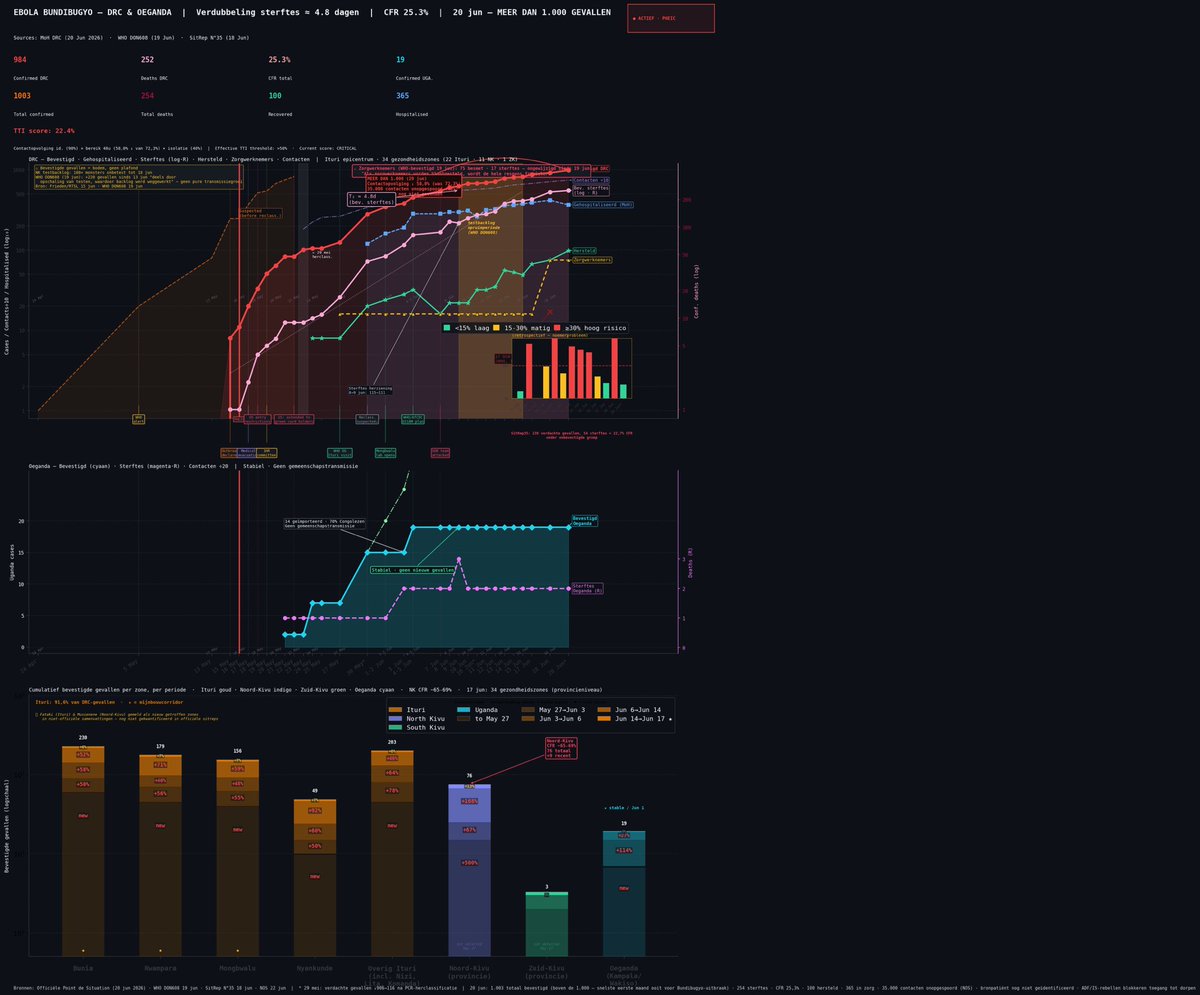
Ebola Bundibugyo — DRC & Oeganda | 20 juni 2026
Bron: Officiële Point de Situation, 20 juni 2026 · WHO DON608, 19 juni 2026
Conclusie
De combinatie van een dalend contactopvolgingspercentage en een teller die net door de psychologische grens van 1.000 is gegaan, is het signaal dat het scherpst gevolgd moet worden. Herstelcijfers en de verlengende T₂ blijven positieve signalen, maar de TTI-score van 22,4% laat zien dat de uitbraak nog ver verwijderd is van structurele controle.
samenvatting
1.003 bevestigd · 254 sterftes · CFR 25,3% · T₂ 4,8 dagen · TTI-score 22,4%
De kerncijfers
984 bevestigd in DRC, 252 sterftes. 19 bevestigd in Oeganda, 2 sterftes, stabiel sinds 1 juni. 100 hersteld, 365 momenteel in zorg. 34 gezondheidszones getroffen — 22 in Ituri, 11 in Noord-Kivu, 1 in Zuid-Kivu.
Contactopvolging stort in op het slechtst mogelijke moment
Het percentage gevolgde contacten daalde van 72,3% naar 58,0% — de scherpste daling in deze uitbraak tot nu toe. Dat gebeurt precies op het moment dat de teller de grens van 1.000 gevallen overschrijdt. Dit is exact het noemerprobleem dat de TTI-score blootlegt: hoe groter de uitbraak wordt, hoe meer capaciteit nodig is om bij te blijven — en die capaciteit groeit niet mee.
TTI-score blijft kritiek
Met contactidentificatie op 90%, bereik binnen 48 uur op 58,0% en isolatie op 40% komt de samengestelde TTI-score uit op 22,4% — ver onder de drempel van 50% die nodig is voor effectieve uitbraakcontrole.
Gezondheidswerkers blijven zwaar getroffen
75 besmet, 17 overleden — ongewijzigd sinds de WHO-bevestiging van 19 juni. Dat is 8% van alle gevallen en 6,9% van alle sterftes geconcentreerd in de mensen die de respons dragen.
Noord-Kivu: kleiner in aantal, hoger in sterfte
76 bevestigde gevallen, CFR rond de 65-69% — fors hoger dan het landelijke gemiddelde. Dat patroon wijst erop dat patiënten daar vaker overlijden vóórdat ze zorg bereiken.
Het testbacklog-voorbehoud blijft relevant
WHO DON608 (19 juni) bevestigt dat een deel van de stijging tussen 13 en 19 juni het gevolg was van het wegwerken van een testachterstand in Noord-Kivu, niet van pure transmissiegroei. De grafiek toont dit nu als een gearceerd venster (9–15 juni).
Het noemerprobleem in cijfers
Op 13–14 juni was tot 44% van de “nieuwe gevallen” eigenlijk al overleden bij bevestiging — die transmissieketens waren onzichtbaar tot de persoon dood was. Dat patroon is sindsdien afgenomen naar enkele procenten.
https://t.co/d5zLlX8Np5
@NOS
Today feels like a victory for the entire #HuntingtonsDisease disease community.
After months of uncertainty, difficult conversations, and tireless advocacy, we received the news that uniQure will be able to move forward as originally planned.
For many of us, like myself, this is deeply personal. We know what it means to watch the clock in HD. We know what it means to live with the reality that time lost cannot be recovered.
That's why this moment matters so much.
It's also important to acknowledge that this happened because people spoke up - patients, families, caregivers, researchers, clinicians, and advocates came together and REFUSED to let our voices go unheard.
We shared our stories. We signed petitions. We met with lawmakers and regulators. We educated others about what delays mean in a progressive, fatal disease where every day matters.
Today is a reminder that patient voices matter. Lived experience matters. Advocacy matters.
To everyone who signed, shared, spoke out, listened, supported, and stood beside this community: THANK YOU.
Let's take a moment to celebrate what we accomplished together.
Today, it feels like we were finally heard.
#TimeMatters #StandUpSpeakUp4HD #DelayIsDamage #RareDisease
@Help4HDI@FDA_KyleD@US_FDA@HDYOFeed@hdfcures@HDBuzzFeed@FDACBER@RepAuchincloss@houmanhemmati@JRenz0418@Christina4HD@rachelreising96@BrittanyMegan10@POTUS@senronjohnson @flsenrickscott
@4ernst Rond 1990 bereikte de overbemesting in Nederland een historisch hoogtepunt. Door massaal gebruik van dierlijke mest en kunstmest ontstonden er enorme stikstof- en fosfaatoverschotten in de landbouw. Dit leidde destijds tot zware milieuschade.
$qure $clpt
While we all wait for the update on the type b meeting this article shows the complete saga over the last 12-24 months. This amt-130 situation could be made into a 2 hour movie or a Netflix documentary with the insane drama that has occurred. What is even more crazy about this saga is that you have all this drama and this is only the publicly available side of the story. Can you imagine one day when you get the behind the scenes views of Uniqure, Tabrizi/Sung, internal fda members, patients in the trial, it will get much more crazy.
Don’t think I saw this article before, it was on May 5th, one of the better recaps of the entire Uniqure situation that I have seen. Hopefully for the HD community we get an update soon that is considered fair by them. Some of the interesting passages in the article below. Really shows the devastation that Prasad has occurred, history likely will look very bad on Prasad, mainly due to his intense desire to try to bury this program.
“The cost is measured in patient-years - in the people for whom every additional regulatory month is a measurable, irreversible loss of cognitive and motor function, and in the people who will reach the end of their statistical disease horizons before the trial the FDA is now requiring is even completed. Those people exist. They are named. They have families. They have read the same data the FDA read. They have read the same agreement the FDA signed and unsigned. They are asking what changed. They deserve an answer.”
“What the FDA has not addressed publicly is that uniQure used a sham control in approximately 10 patients earlier in the AMT-130 program and then stopped using it, precisely because of ethical concerns about asking patients with a fatal disease to undergo a procedure with no therapeutic benefit. According to a clinical analysis published by chemistry blogger and longtime industry observer Derek Lowe at https://t.co/gN8Qm2VsDH, roughly 10% of those original sham-arm patients developed a blood clot during the procedure, which involved 10 to 12 hours of general anesthesia.”
“Bioethics professor Holly Fernandez Lynch of the University of Pennsylvania, asked about the FDA's practice of attacking uniQure on background calls with reporters, said: "The fact that you are sharing information with the press without standing behind it either suggests that you know you should not be talking to the press or that you don't really stand behind your opinion. Why are we debating this in the court of public opinion? The stakes are too high."
“Several other companies have publicly requested adcomm meetings, and at least three have said the FDA initially told them to prepare for a meeting and then retracted that guidance. On the same March 5 background call where the senior FDA official attacked uniQure and singled out Woodcock by name, the official also dismissed the broader pool of outside scientists who serve on FDA advisory panels, saying they "do not do their homework" and may be motivated by financial conflicts of interest. The agency's position is that an advisory committee is unnecessary. The agency's former Acting Commissioner, multiple senators, the rare disease community, and at least three other companies that have requested adcomms believe an advisory committee is precisely what is required.”
“The agency has granted four expedited designations to AMT-130 specifically: Fast Track in 2019, Orphan Drug, RMAT in 2024, and Breakthrough Therapy in 2025. Each designation is supposed to mean the FDA recognizes both the unmet need and the substantial preliminary evidence of effectiveness. Each was granted on the same data the agency now describes as unable to demonstrate "any therapeutic benefit."
https://t.co/n1oKPCcxs7
Drones, among other new technologies, are reshaping chemical security. Experts from various organisations gathered for a workshop in the Hague.
https://t.co/Jt2EyqPQqF
Ebola Bundibugyo — DRC & Uganda | Update 7 June 2026
563 confirmed cases · 90 deaths · CFR 16.2%
The outbreak is still in active exponential growth. Confirmed deaths are doubling every 3.6 days — the single most alarming indicator. DRC added 31 new cases and 6 deaths in the last 24 hours, all from Ituri province.
Three things that stand out:
A safe-burial team was attacked at Nyamurongo Cemetery on the night of June 6. Two people seriously injured, two vehicles destroyed. Safe burials are one of the few proven tools to break Ebola transmission. Attacks directly translate into unsafe burials and new infections.
Community fear is collapsing routine healthcare at Bunia General Referral Hospital. People are missing HIV, TB, and antenatal appointments with no catch-up plan. This secondary mortality — people dying of treatable conditions because they avoid healthcare — is a hallmark of Ebola outbreaks and kills beyond the case counts.
Contact tracing is improving but still insufficient. Of 5,313 listed contacts, 3,350 (63%) are being followed up. That means 37% of known contacts are not being monitored daily — in an outbreak with a 3.6-day death-doubling time, that gap matters.
What is holding: Uganda remains stable at 19 confirmed cases with no new additions. The WHO/Africa CDC $518M response plan announced June 5 is in place. The Mongbwalu lab opened June 4, improving local testing capacity.
Bottom line: the numbers are getting worse, the security environment is deteriorating, and the healthcare system in Bunia is under stress. The outbreak is not under control.
Source: Africa CDC Sitrep #21, 7 June 2026
@nos@WHOAFRO@who
https://t.co/d5zLlX8Np5
#EbolaDRC #Bundibugyo #PublicHealth #Outbreak #GlobalHealth
**Hoe SARS-CoV-2 door onder de radar te blijven voet aan wal kreeg in Noord-Brabant — februari 2020**
The good part of AI…
Op 30 januari 2020 riep de Wereldgezondheidsorganisatie een Public Health Emergency of International Concern uit — de hoogste internationale alarmfase voor volksgezondheid.
Carnaval vond plaats op 23-25 februari. Op dat moment was er in heel Nederland nog geen bevestigd geval. Vier dagen later, op 27 februari, viel de eerste positieve test in Noord-Brabant. Het signaal dat het virus lokaal circuleerde.
De grafiek reconstrueert met behulp van AI waarom SARS-CoV-2 bijna onzichtbaar in Noord-Brabant kon toeslaan. De paarse lijn toont de geschatte werkelijke infecties op basis van latere seroprevalentiedata van het RIVM. De gele lijn toont wat het systeem op dat moment kon zien. Het gat ertussen is de maat voor hoe snel een nieuw virus buiten de reikwijdte van een bestaand detectiesysteem kan opereren.
De vier panelen tonen o.a. infecties, IC-bezetting per leeftijdsgroep, sterfte en de opbouw van de uitbraak in de tijd. Door alle panelen loopt een rode verticale lijn: de datum van de Public Health Emergency of International Concern, 30 januari 2020. De publicatiestrip toont welke wetenschappelijke inzichten over transmissie op welk moment beschikbaar waren.
#covid19 #sarscov2 #epidemic #brabant #surveillance
@MarionKoopmans@mkeulemans
Bronnen: RIVM · NICE · LCPS/LNAZ · ETZ/NTvG · PIENTER seroprevalentiestudie · Rijksoverheid
@MarionKoopmans Dit verhaal kende ik (nog). Is dit wijd verbreide kennis of een echte scoop en ook nieuws voor vakspecialisten op het gebied van zoknisen zoals u?
Ebola? Hier wordt zeker over nagedacht. Ik zit zelf in het WHO spoedcomissie dat de WHO adviseert. Belangrijke bottleneck is diagnostiek omdat bestaande testen die ter plekke gebruikt worden niet werken. Met collegas internationaal wordt gekeken wat alternatieven zijn …
Ebola in DRC is far from under control. 741 suspected cases. Each of these need to be tested and interviewed to find who they were in contact with. One key metric for outbreak control is which % of contacts has been reached. That currently is around 25% https://t.co/7nB3cHsUKe