4 papers on arXiv today studying the tensions on H0 and S8: https://t.co/UGOxQXxRGE, https://t.co/8XjRtW1ZML, https://t.co/TrWRqWsIrc, https://t.co/T2uIusKy0l. Looking forward to Euclid data to shed some new light on these tensions!
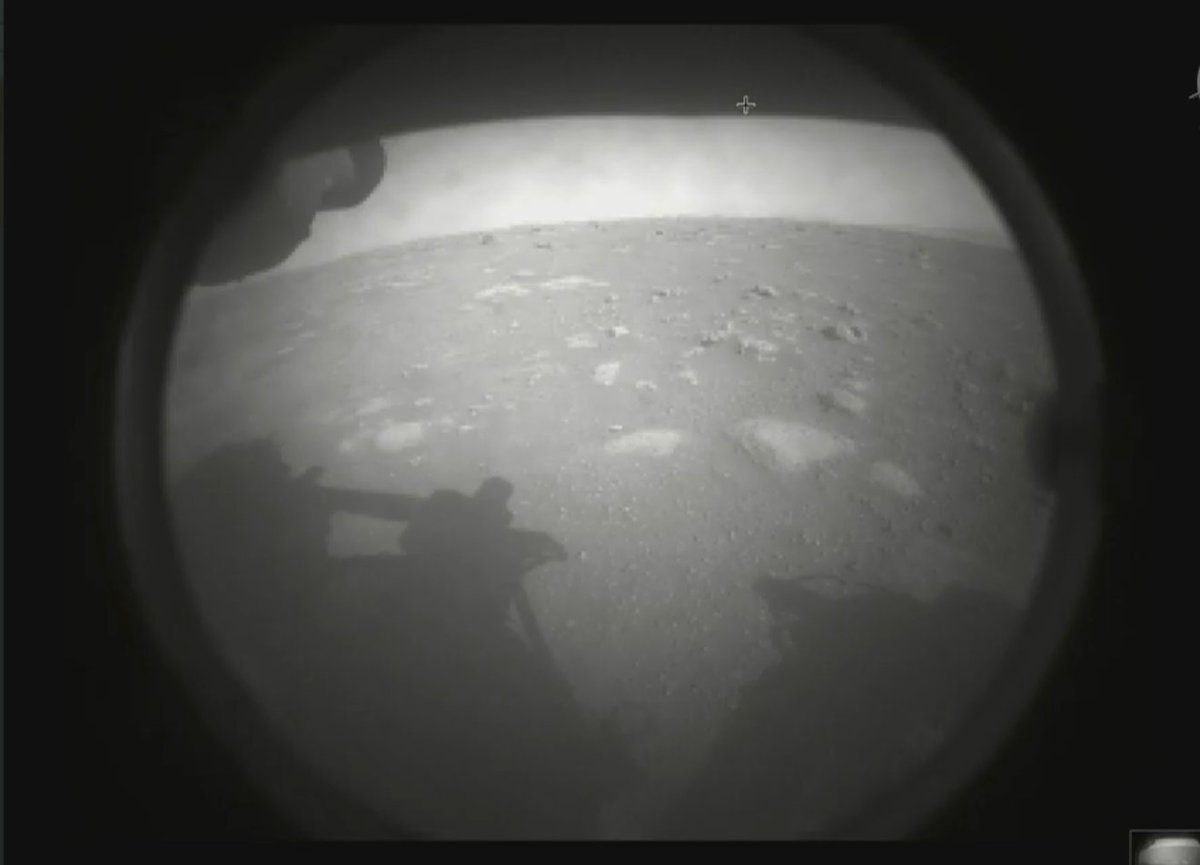
It’s go time. The team is watching from Mission Control at @NASAJPL. Join LIVE for the final #CountdownToMars. Touchdown in just over 90 mins: https://t.co/4oCQB6bBcz
The @ESA_Euclid optical and infrared instruments are now fully integrated into the spacecraft!
This is an important step for #Euclid, which is scheduled for launch in 2022 to investigate dark matter, dark energy and the expanding Universe 🚀
📸👉https://t.co/qKd3vBGgad
Constraining cosmological parameters with the most recent cosmic shear analysis of the Kilo-Degree Survey (KiDS-1000), https://t.co/mmuXtLNje1. Find out more about how cosmologists are pushing the boundaries of knowledge on the current understanding of our Universe! #weaklensing
Cosmic shear is a category of weak lensing, weak lensing is a category of gravitational lensing, and a type of macro lensing. We're interested in cosmic weak macro gravitational lensing; but most people will also just use "shear" :)
Machine learning is promising and rapidly growing area of research for #weaklensing . The first paper that mentions that such methods could be important, that we can find, was in 1996 https://t.co/l40ZbrhI88 Can anyone find an early reference?
#weaklensing doesn’t just affect galaxy observations. Here is a recent paper looking at lensing of the Cosmic Microwave Background https://t.co/iUwceaoQfA
The Dark Energy Survey has made public a catalog of nearly 700 million astronomical objects! The full data release is online and available to explore:
https://t.co/JY8tEcQ8Ko
@theDESurvey@NCSAatIllinois@NOIRLabAstro#AAS237#DESDR2
The 2020s astronomy data revolution is coming! SPHEREx, @VRubinObs@NASARoman, @SimonsObs, @ESA_Euclid, and @eROSITA_SRG will be imaging much of the sky. With modern data science tools, it will be a decade of discovery!
k-cut 3 x 2 point statistics to reduce sensitivity to small poorly modeled scales and forecasts for #Euclid.
Let's find it out! 🤓🧐🤟
https://t.co/08X7HbGZJJ
The #EuclidMission is designed to map Dark Matter (DM) with weak lensing. But it shall also discover more than 100,000 strongly lensed galaxies.
A recent study with #Hubble data suggests that there could be an ingredient missing from current DM theories.
https://t.co/2bJns9LCjw
Deep learning to predict the non-linear behaviour at small scales https://t.co/amNo8YZHF8. These approaches could significantly reduce the computational needs in simulations for future weak lensing surveys
A new emulator for baryonic effects has appeared today on the arXiv: https://t.co/akRk1HY3sn. This kind of emulators will be crucial to extract the maximum amount of information from next-generation weak lensing surveys!