UK Financial Planning & Investment Advisers. Using technology, principles and education to help savers achieve their objectives. Tweets are not advice.
If you tax something too much, people alter their behaviour because the incentives have changed.
If you tax people who work and give money to people who don’t work then it’s obvious that less people will work and more people won’t work. That is the incentive structure.
If you make something more expensive fewer people will buy it.
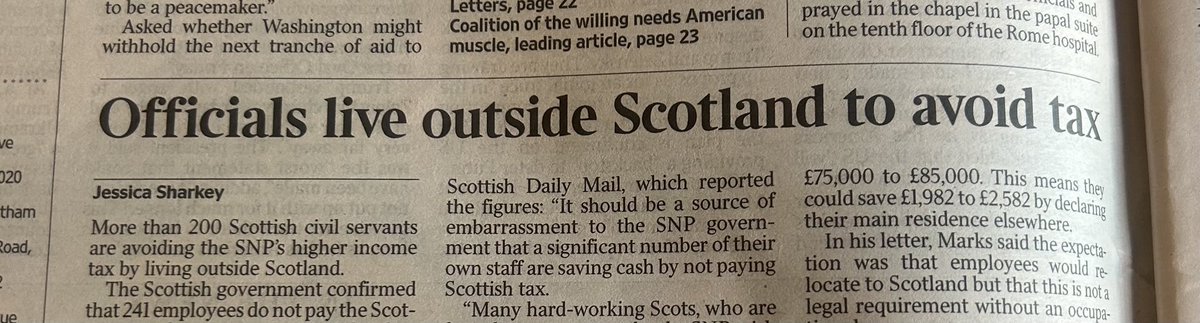
If you make it expensive to earn over £100K, then fewer people will bother doing it. If you make it more expensive to hire people, fewer companies will be hiring.
If a nation taxes wealth, it will have a less wealthy nation.
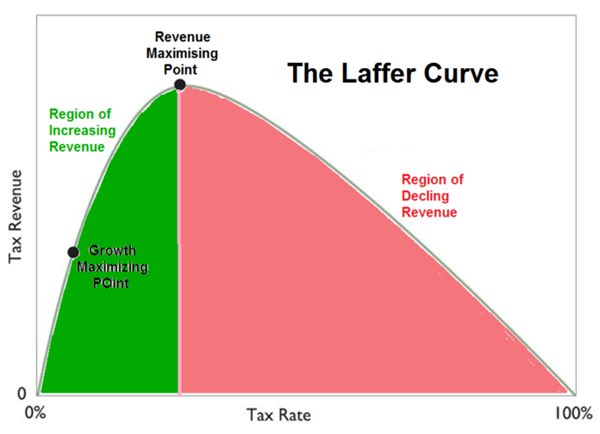
This is summed up in the Laffer Curve (below) - the economic principle that at a certain point, higher taxes reduces the overall taxes collected. There are 4 principles that economists have learned about when to raise taxes or not to:
1. If a country has relatively low taxes, raising taxes will likely result in collecting more.
2. If a country already has high taxes, raising taxes will likely result in raising LESS.
3. If a country has a wide tax base, raising taxes will likely result in collecting more.
4. If a country has a narrow tax base, raising taxes will likely result in collecting less.
The UK currently has high taxes on a narrow tax base (of very mobile people) so the established economic theory says that when Rachel Reeves raises taxes in her next budget, it will actually do more harm than good - less will be collected.
It seems counter intuitive but LOWERING taxes has a higher chance of collecting more money.
Anyone who runs a business knows this. There comes a point where if you put your prices up and a few clients leave you can crash your business. If you can find a way to reduce your prices, your total revenue will grow.
Walmart, McDonald’s, Amazon and Toyota became dominant because they were committed to keeping prices down not putting them up. They understood the Laffer Curve but it would seem that the UK needs to learn this lesson through painful experience every 50 years or so.
If anyone doesn't believe in the Laffer curve, here is a good example of Laffer in action:
Labour increased tax on oil and gas production to 78% last year - despite warnings from the industry that it would decimate investment and cost thousands of jobs.
New data shows that the UK's North Sea revenues have now fallen from £9.9billion in 2022/23 - when the Energy Profits Levy (EPL) was introduced - to £4.5billion in 2024-25, the year the tax was increased.
Revenue from the EPL - which is one of three taxes levied on the sector - has itself fallen from £4.2billion to £2.7billion over the same period.
The figures - which were published in the Scottish Government's Expenditure and Revenue Scotland (GERS) report - also show decommissioning expenditure rising, which will accelerate the UK Government's near £11billion bill for the removal of North Sea infrastructure.
@realartlaffer
https://t.co/GwFc5tTCsQ
Most of what drives major market outcomes is how the macro economy plays out relative to what is priced in. Mastering that approach creates significant alpha opportunities over time that is not reliant on markets going either up or down.
https://t.co/l4VMaGN6pg
Big differency between being a "trader" and a professional Risk Manager of Core Asset Allocations...
Buy-and-hold is as old a marketing gimmick as the Old Wall itself. Bitcoin is no different.
The S&P Global UK Construction PMI dropped to 44.6 in February 2025 from 48.1 in the previous month, missing market expectations of 49.5.
https://t.co/igWERwLp39
"That's an absolute farce."
Octopus Energy CEO reveals to @Tomswarbrick1 that the UK has spent 250 million this year shutting down wind farms on windy days 'because the energy cannot be sold cheaply'.
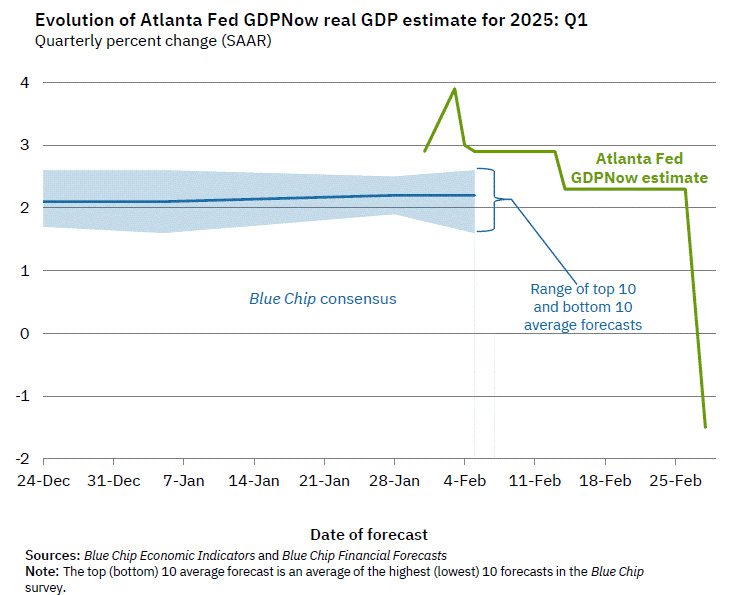
On February 28, the #GDPNow model nowcast of real GDP growth in Q1 2025 is -1.5%: https://t.co/T7FoDdgYos. #ATLFedResearch
Download our EconomyNow app or go to our website for the latest GDPNow nowcast: https://t.co/NOSwMl7Jms.
I've had a change of heart on federal income tax. On the surface, it's just a way for the government to generate revenue—it has to get its funding from somewhere. But I now see that the method of taxation itself fundamentally alters the relationship between the government and its people.
When the government relies on taxing individual income, it shifts from serving its citizens to exploiting them as a revenue source. This dynamic creates an inherent friction, where the government no longer answers to the people but to the system that extracts from them. And if you look around, it's clear—whatever our tax dollars are funding, it’s not serving us.
This is what modern economists fail to grasp when they dismiss tariffs, sales taxes, or luxury taxes as harmful. The structure of taxation matters, not just the amount collected. The income tax distorts governance itself—and it needs to go.
“A more accurate measure of GDP would exclude government spending.
Otherwise, you can scale GDP artificially high by spending money on things that don’t make people’s lives better”
That’s exactly what Biden did to fabricate GDP “growth” to hide US economic recession since 2022
⚠️US Job numbers have been revised DOWN by a whopping 600,000 for 12 months ending March 2024:
The BLS reported in February job numbers were overstated by the most since 2009, the last year of the Great Financial Crisis.
Expect more revisions to come.👇
https://t.co/0oLEuZ777r
"The data we've been seeing has been a warning."
James Reed, CEO of the Reed employment agency, says job vacancies are at their lowest rate since the 2008 crash.
#Newsnight
Zealously arguing for cuts right before the election and then aggressively putting on the brakes just after it may not be motivated by political preference but it sure looks like it.
‼️Retail investors have NEVER been buying so much of Magnificent 7 stocks:
Mom-and-pop investors bought a record $12 BILLION in US equities over the last week.
70% of these flows went to Magnificent 7.
On the other hand, institutional investors have been selling Mag 7.
Wild.
🚨US job downward REVISIONS are massive:
In August, a preliminary revision showed that jobs have been OVERESTIMATED by 818,000 for 12 months ending March 2024.
During today's job report at 8.30 AM ET these revisions will be finally announced by the BLS.
This is a 2nd largest negative revision in history.
Absolutely insane.
⚠️There may be some excitement about the US job report for January.
BUT:
1) Jobs numbers for 2024 WERE revised DOWN by ~600,000.
2) Average Weekly Hours worked by Americans fell to 34.1, the LOWEST since the Great Financial Crisis when excluding the 2020 Crisis low.
People work fewer hours as firms reduce working time to avoid layoffs and cut costs (for now).
The US job market is in a mess.