Join me at #Devcon8 for a session on Formal Verification of Consensus Protocols in Lean!
We'll explore how to correctly model and specify distributed protocols to formally prove their correctness.
Looking forward to seeing you there!
https://t.co/yvcXjrjKVD
Recordings and slides from Cambridge are online:
https://t.co/71Ir0XVJsx
17 hours of talks and open sessions on Decoupled Consensus, networking, PQ, one-round finality and formal verification!
If you only watch one: @fradamt on (codename) Goldilocks
It’s a wrap! It was an honor to help organize the Fast Finality workshop in Cambridge.
There have already been some great recaps, but here’s my quick overview of the main topics we covered:
1. Deep-diving DC: Decoupled Consensus is a super ambitious upgrade we hope to ship in I* (h/t @benjaminion_xyz). @robsaltini gave a great overview, and @fradamt unveiled his impressive recent breakthroughs, e.g. achieving short-term async resilience through local locks.
2. Shipping DC: Sessions on critical research and engineering, including networking benchmarks & devnets (@sukunrt & Csaba), rewards & incentives (@weboftrees), and specs & testing (@mkalinin2, @jtraglia, @tcoratger).
3. Securing DC: Formal verification meets fast finality. We explored exciting new AI-enabled opportunities (@fradamt & @robsaltini), building on years of great FV work (@alexanderlhicks).
4. Future of Fast Finality: Aligning DC with future needs. This covered PQ networking (@kamil_abiy & @kevaundray), finality in tens of seconds with PQ validators (@barnabemonnot), lean clients & prototyping (@pablodeymo, Mega, Mihir, Locky, @adust09, @ladislaus0x), and one-round finality & other future research (shoutout @alranpe, @jneu_net, @ittai & Neil).
Huge thanks to everyone who made this workshop a success! Special thanks to @benjaminion_xyz for all the help and guidance, and of course to @justindrake and @willcorcoran for making it possible!
EIP-8046, Uniform price auction over inclusion lists (UPIL), has been updated to support frame transactions via VOPS profiles, as well as the two gas dimensions of EIP-8037. UPIL lets FOCIL work together with a more expansive multidimensional fee market, provides censorship resistance even in full blocks, and improves fairness.
https://t.co/7gYybOe7BU
One step closer to 4-8x faster Ethereum finality!
It took some time and lots of tokens, but we now have a formally verified proposal for a decoupled consensus protocol in I* (a future Ethereum upgrade)! Not yet a full spec (up next), but it includes all the key consensus-relevant details to become one.
Since Ethereum aspires to be live without most of the stake online, the protocol involves many more components than a normal BFT protocol, and its correctness involves much more than standard safety and liveness. Those nuanced properties are now verified!
What's more, I came away convinced that all protocol design will involve AI-assisted Formal Verification in the future, both for correctness and iteration speed.
The work wasn't limited to just:
Design the protocol -> Formally verify it
Instead, the loop became more like:
Design -> Formal Model -> Find exactly what breaks and why -> Redesign it.
For a fairly complicated protocol like this one, I think having the Lean model be part of the design loop played a big role in accelerating the process.
A future with agents paired with formal models is a superpower for Ethereum development, because they can then use those models to find exactly where an argument breaks down, formalize counterexamples, test proposed fixes, iterate on the protocol.
Many details that would slip under the radar when asking agents (and indeed, humans) can now be specified exactly and checked by the Lean kernel. This then forces agents to be more precise and lets them make verifiable progress on their own. It's been incredible to see this play out, seeing agents find gaps and propose protocol changes to fix them.
In other words, autoresearch can speed up protocol design, formal verification is here to stay, and Ethereum Finality will get faster.
Two suggestions for EIP-8141 Frame transactions: specify state limits in bytes, and use a single unified max fee. Plus a discussion of how the frame-by-frame gas accounting relates to EIP-7999.
https://t.co/yYblSkvCmM
Relevant other EFers working on the topic are @VitalikButerin, @misilva73, @omw_to_the_moon, @nero_eth and intern @xzhvyr.
We are also trying to analyze related concerns, such as how to preserve CR if BAL data is added to EIP-7999.
https://t.co/MnpF9MIg3O
We are trying to settle on a design for the EVM gas accounting under a multidimensional fee market (e.g., EIP-7999) and would like to engage with developers in the autumn. Please reach out to us or engage with the relevant research posts. https://t.co/Jy1w24Se9R
In practice, the EIP implements this by measuring the state gas used in normalized units.
A dynamic implementation of the design is EIP-8075, which lets the cost per state byte and the relative state-gas limit float with demand. EIP-8372 is much simpler, but also less flexible.
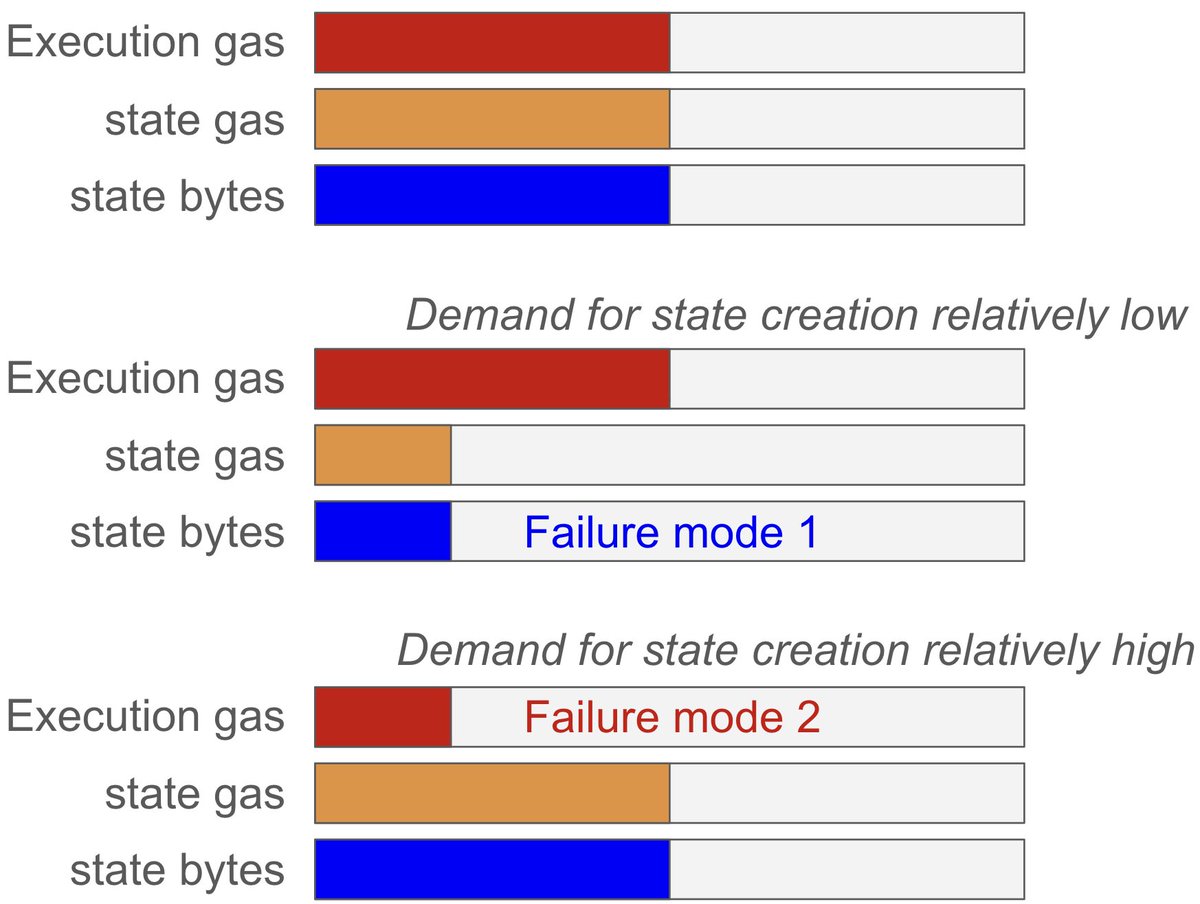
I will present EIP-8372 on ACDE. We don't know whether users will spend 50% of their gas budget on state creation after Glamsterdam. There are two Failure modes:
(1) <50% = we will create too little state;
(2) >50% = we will suppress execution via the 8037 max metering function.
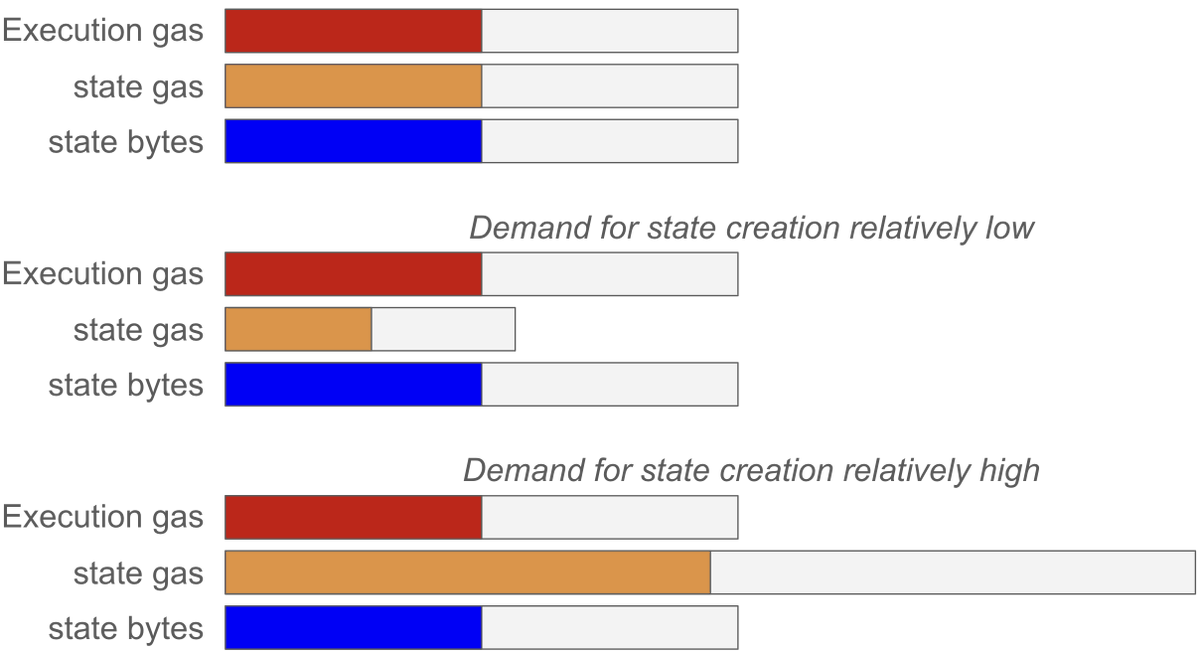
In essence, we normalize the state gas limit:
(1) If demand for state creation is too low, the cost per state byte is reduced together with the state gas limit.
(2) If demand for state creation is too high, the cost per state byte is increased together with the state gas limit.
Thank you for your many many contributions to Ethereum while at the EF! Having your input on research projects and EIPs have been a great blessing. I know many people who feel the same way.
My "Francesco exception" is to never take anything for granted when studying a blockchain design problem.. unless Francesco says so. We're lucky that you remain in the Ethereum ecosystem!
Status update: I am moving from the Ethereum Foundation to Ethlabs @ethlabs_org, joining the team to accelerate protocol work in the age of Ethereum adoption.
In 5 years at EF Research, I have worked on research and specification of a wide range of Protocol R&D: mev, consensus, data availability sampling, execution layer pricing. In every workstream, I am grateful to have found talented, principled, passionate colleagues.
Leaving that behind is hard, but after 5 years this time of great change seems right for a new beginning. Thankfully, I am not going far! For the first time since I have been working on Ethereum research, there is a credible shot at some of it (and more) happening outside the EF.
I'll be joining long time EF colleagues at Ethlabs to make this a reality, building a world class team to bring new talent into the ecosystem and make a real impact on Ethereum's chances to move economic activity to an open, global, censorship-resistant substrate.
Besides helping Ethlabs to grow and find its footing as a contributor to protocol R&D, I'll continue much of my work. In particular, I intend to continue focusing a lot of my effort on making Ethereum finalize much faster, as soon as possible.