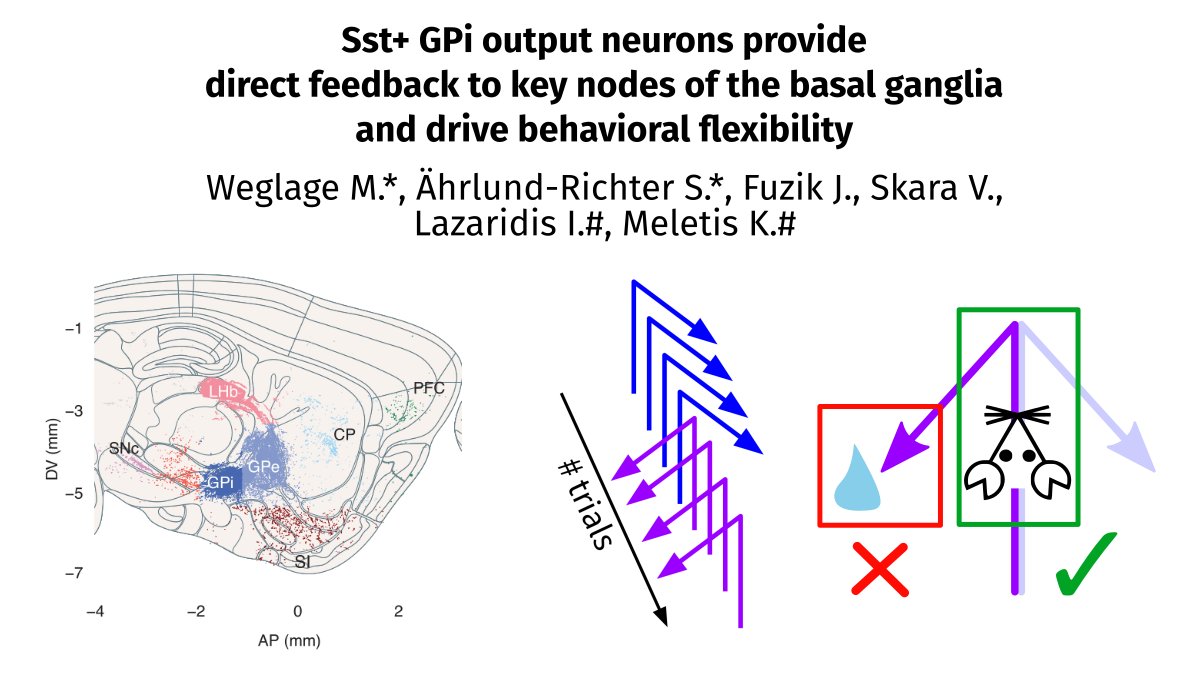
In our new preprint, we show that Sst+ GPi is more anatomically complex than previously described, and that its role in behavioral flexibility is in action execution, not outcome evaluation. w/ @sahrlund @SkaraVasiliki@fuzikjanos@iaklaz @meletislab https://t.co/Phti2ARs7Y 1/8
Book the day!
The 2nd SWEBAGS basal ganglia conference will be next November 30th, 2022.
The registration is already open!!
If you want to present your research either orally or as a poster, the abstract submission is open until September 30th, 2022.
https://t.co/LT81IFFRm4
Thrilled to share my graduate work with PI @BOlveczky and co-authors @Jack_W_Lindsey & @seanescola: 'piano playing' rats!
tl;dr - striatum is needed to produce automatic but not flexible sequences, but it codes for & controls low-level kinematics for both
https://t.co/rxLr5rTW5L
@BOlveczky @CarlenLab@karolinskainst @meletislab Thanks so much! I very much enjoyed your introduction and our discussion. Couldn't have hoped for a better opponent!
Right now: Moritz Weglage @wegmor in the Meletis lab @meletislab to nailing of his thesis ’A critic in action? A functional examination of the striato-pallido-habenular circuit’!! 💥. Defence: June 10. @karolinskainst @StratNeuro Great work Moritz!!
Very happy to share @AnTokarska Ania’s PhD paper, just published @CellReports! We used Chrna2-Cre mice (K Kullander @UU_University) to study striatal interneurons expressing the nicotinic α2 receptor subunit. Inspired by work from @JTep & @Maxime_Assous
https://t.co/93CM6qyQbm
Very excited to share our new preprint! Using whole-cell patch-clamp in awake mice, we reveal that sensory responses in the dorsolateral striatum are modulated by motor activity in a dopamine-dependent manner. @RobertodelaTor, Maya Ketzef, @SilberbergGilad https://t.co/QZV8VxttKr
Sst+ GPi output neurons provide direct feedback to key nodes of the basal ganglia and drive behavioral flexibility. https://t.co/Ss1qNzUtVo #biorxiv_neursci
@neuroecology While Occam's razor is a useful tool in the physical sciences, it can be a very dangerous implement in biology. It is thus very rash to use simplicity and elegance as a guide in biological research. — Francis Crick
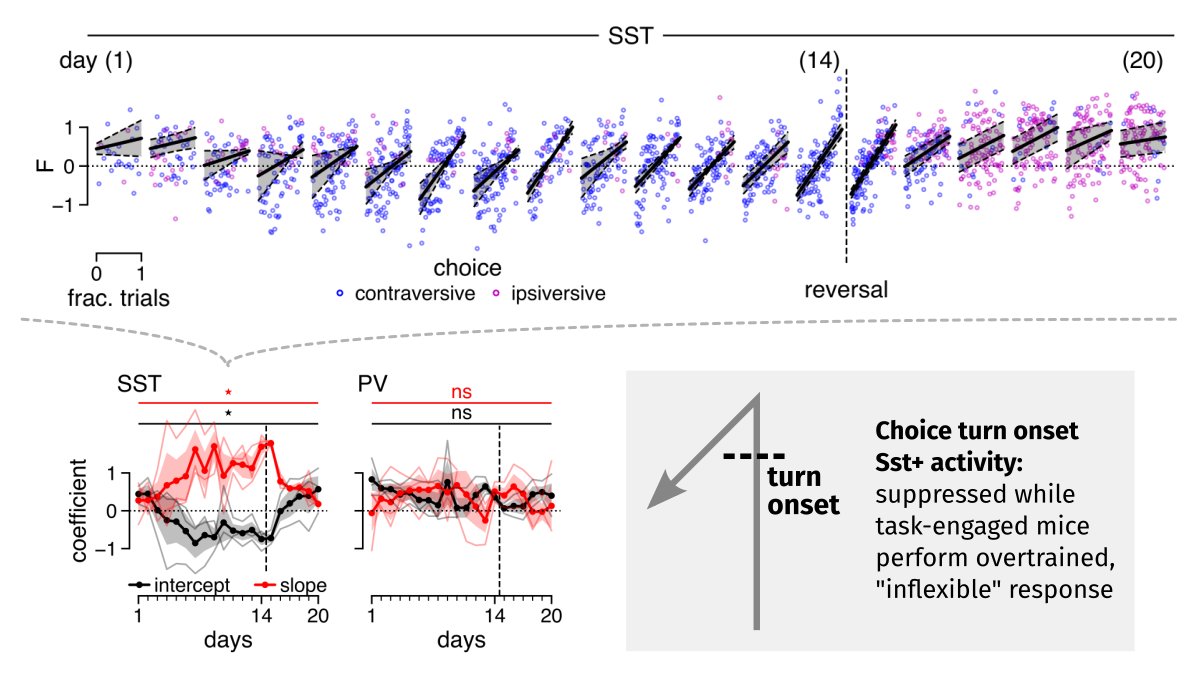
We propose that the Sst+ GPi neurons drive behavioral flexibility by counteracting habitual or compulsive choices, and that this function emerges via GABA/Glutamate feedback to key nodes of the behavioral control circuits of the basal ganglia and the LHb. Thanks for reading! 8/8
In our new preprint, we show that Sst+ GPi is more anatomically complex than previously described, and that its role in behavioral flexibility is in action execution, not outcome evaluation. w/ @sahrlund @SkaraVasiliki@fuzikjanos@iaklaz @meletislab https://t.co/Phti2ARs7Y 1/8
Instead, in task-engaged expert-level mice, Sst+ GPi activity became suppressed during the choice phase. After reversal, as mice returned to a more flexible behavioral state and adapted to the reversal, Sst+ GPi activity became elevated in the choice phase. 7/8