DeFi United demonstrated first class risk management and recovery in DeFi! We are still in early age of formation of a new financial system, poor to be affected economically but glad to witness this futurism.
The first set of steps in the rsETH technical recovery plan are complete, including burning the exploiter's rsETH on Arbitrum. Progressively refilling the LayerZero OFT adapter and reopening rsETH operations will follow over the coming days.
Now, the quantum resistance roadmap.
Today, four things in Ethereum are quantum-vulnerable:
* consensus-layer BLS signatures
* data availability (KZG commitments+proofs)
* EOA signatures (ECDSA)
* Application-layer ZK proofs (KZG or groth16)
We can tackle these step by step:
## Consensus-layer signatures
Lean consensus includes fully replacing BLS signatures with hash-based signatures (some variant of Winternitz), and using STARKs to do aggregation.
Before lean finality, we stand a good chance of getting the Lean available chain. This also involves hash-based signatures, but there are much fewer signatures (eg. 256-1024 per slot), so we do not need STARKs for aggregation.
One important thing upstream of this is choosing the hash function. This may be "Ethereum's last hash function", so it's important to choose wisely. Conventional hashes are too slow, and the most aggressive forms of Poseidon have taken hits on their security analysis recently. Likely options are:
* Poseidon2 plus extra rounds, potentially non-arithmetic layers (eg. Monolith) mixed in
* Poseidon1 (the older version of Poseidon, not vulnerable to any of the recent attacks on Poseidon2, but 2x slower)
* BLAKE3 or similar (take the most efficient conventional hash we know)
## Data availability
Today, we rely pretty heavily on KZG for erasure coding. We could move to STARKs, but this has two problems:
1. If we want to do 2D DAS, then our current setup for this relies on the "linearity" property of KZG commitments; with STARKs we don't have that. However, our current thinking is that it should be sufficient given our scale targets to just max out 1D DAS (ie. PeerDAS). Ethereum is taking a more conservative posture, it's not trying to be a high-scale data layer for the world.
2. We need proofs that erasure coded blobs are correctly constructed. KZG does this "for free". STARKs can substitute, but a STARK is ... bigger than a blob. So you need recursive starks (though there's also alternative techniques, that have their own tradeoffs). This is okay, but the logistics of this get harder if you want to support distributed blob selection.
Summary: it's manageable, but there's a lot of engineering work to do.
## EOA signatures
Here, the answer is clear: we add native AA (see https://t.co/YD9nIpsxcC ), so that we get first-class accounts that can use any signature algorithm.
However, to make this work, we also need quantum-resistant signature algorithms to actually be viable. ECDSA signature verification costs 3000 gas. Quantum-resistant signatures are ... much much larger and heavier to verify.
We know of quantum-resistant hash-based signatures that are in the ~200k gas range to verify.
We also know of lattice-based quantum-resistant signatures. Today, these are extremely inefficient to verify. However, there is work on vectorized math precompiles, that let you perform operations (+, *, %, dot product, also NTT / butterfly permutations) that are at the core of lattice math, and also STARKs. This could greatly reduce the gas cost of lattice-based signatures to a similar range, and potentially go even lower.
The long-term fix is protocol-layer recursive signature and proof aggregation, which could reduce these gas overheads to near-zero.
## Proofs
Today, a ZK-SNARK costs ~300-500k gas. A quantum-resistant STARK is more like 10m gas. The latter is unacceptable for privacy protocols, L2s, and other users of proofs.
The solution again is protocol-layer recursive signature and proof aggregation. So let's talk about what this is.
In EIP-8141, transactions have the ability to include a "validation frame", during which signature verifications and similar operations are supposed to happen. Validation frames cannot access the outside world, they can only look at their calldata and return a value, and nothing else can look at their calldata. This is designed so that it's possible to replace any validation frame (and its calldata) with a STARK that verifies it (potentially a single STARK for all the validation frames in a block).
This way, a block could "contain" a thousand validation frames, each of which contains either a 3 kB signature or even a 256 kB proof, but that 3-256 MB (and the computation needed to verify it) would never come onchain. Instead, it would all get replaced by a proof verifying that the computation is correct.
Potentially, this proving does not even need to be done by the block builder. Instead, I envision that it happens at mempool layer: every 500ms, each node could pass along the new valid transactions that it has seen, along with a proof verifying that they are all valid (including having validation frames that match their stated effects). The overhead is static: only one proof per 500ms. Here's a post where I talk about this:
https://t.co/rAUSJjW7WL
https://t.co/EtXpkaDll5
@Teslaconomics As a parent, I feel exactly the same. The syllabus in school is kinda outdated. Maybe we should not treat this system as a knowledge input. What I expect my kids to do in school would be to:
1/enjoy her social life
2/be curious to new knowledge
3/compete and experience failure
There have recently been some discussions on the ongoing role of L2s in the Ethereum ecosystem, especially in the face of two facts:
* L2s' progress to stage 2 (and, secondarily, on interop) has been far slower and more difficult than originally expected
* L1 itself is scaling, fees are very low, and gaslimits are projected to increase greatly in 2026
Both of these facts, for their own separate reasons, mean that the original vision of L2s and their role in Ethereum no longer makes sense, and we need a new path.
First, let us recap the original vision. Ethereum needs to scale. The definition of "Ethereum scaling" is the existence of large quantities of block space that is backed by the full faith and credit of Ethereum - that is, block space where, if you do things (including with ETH) inside that block space, your activities are guaranteed to be valid, uncensored, unreverted, untouched, as long as Ethereum itself functions. If you create a 10000 TPS EVM where its connection to L1 is mediated by a multisig bridge, then you are not scaling Ethereum.
This vision no longer makes sense. L1 does not need L2s to be "branded shards", because L1 is itself scaling. And L2s are not able or willing to satisfy the properties that a true "branded shard" would require. I've even seen at least one explicitly saying that they may never want to go beyond stage 1, not just for technical reasons around ZK-EVM safety, but also because their customers' regulatory needs require them to have ultimate control. This may be doing the right thing for your customers. But it should be obvious that if you are doing this, then you are not "scaling Ethereum" in the sense meant by the rollup-centric roadmap. But that's fine! it's fine because Ethereum itself is now scaling directly on L1, with large planned increases to its gas limit this year and the years ahead.
We should stop thinking about L2s as literally being "branded shards" of Ethereum, with the social status and responsibilities that this entails. Instead, we can think of L2s as being a full spectrum, which includes both chains backed by the full faith and credit of Ethereum with various unique properties (eg. not just EVM), as well as a whole array of options at different levels of connection to Ethereum, that each person (or bot) is free to care about or not care about depending on their needs.
What would I do today if I were an L2?
* Identify a value add other than "scaling". Examples: (i) non-EVM specialized features/VMs around privacy, (ii) efficiency specialized around a particular application, (iii) truly extreme levels of scaling that even a greatly expanded L1 will not do, (iv) a totally different design for non-financial applications, eg. social, identity, AI, (v) ultra-low-latency and other sequencing properties, (vi) maybe built-in oracles or decentralized dispute resolution or other "non-computationally-verifiable" features
* Be stage 1 at the minimum (otherwise you really are just a separate L1 with a bridge, and you should just call yourself that) if you're doing things with ETH or other ethereum-issued assets
* Support maximum interoperability with Ethereum, though this will differ for each one (eg. what if you're not EVM, or even not financial?)
From Ethereum's side, over the past few months I've become more convinced of the value of the native rollup precompile, particuarly once we have enshrined ZK-EVM proofs that we need anyway to scale L1. This is a precompile that verifies a ZK-EVM proof, and it's "part of Ethereum", so (i) it auto-upgrades along with Ethereum, and (ii) if the precompile has a bug, Ethereum will hard-fork to fix the bug.
The native rollup precompile would make full, security-council-free, EVM verification accessible. We should spend much more time working out how to design it in such a way that if your L2 is "EVM plus other stuff", then the native rollup precompile would verify the EVM, and you only have to bring your own prover for the "other stuff" (eg. Stylus). This might involve a canonical way of exposing a lookup table between contract call inputs and outputs, and letting you provide your own values to the lookup table (that you would prove separately).
This would make it easy to have safe, strong, trustless interoperability with Ethereum. It also enables synchronous composability (see: https://t.co/9jy6v1X6Fw and https://t.co/gZmu3YjebM ). And from there, it's each L2's choice exactly what they want to build. Don't just "extend L1", figure out something new to add.
This of course means that some will add things that are trust-dependent, or backdoored, or otherwise insecure; this is unavoidable in a permissionless ecosystem where developers have freedom. Our job should make to make it clear to users what guarantees they have, and to build up the strongest Ethereum that we can.
Today @jpmorgan, the world's largest bank by market cap per @WSJ, announced they're launching their first ever tokenized money market fund—MONY—on Ethereum.
The firm is seeding the fund with $100M of its own capital before opening to outside investors on Tuesday.
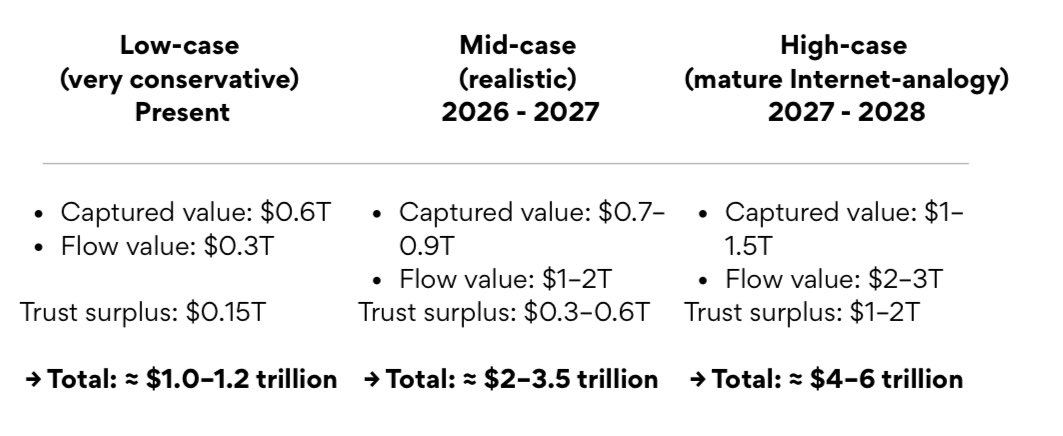
Longtime Ethereum / ETH investor @wmougayar has a new report out arguing that ETH is fundamentally mispriced because markets value Ethereum as a for-profit company rather than as a public good.
“Like the Internet’s base protocols (TCP/IP), Ethereum’s true economic power lies not in the fees it extracts (revenue), but in the vast ecosystem of value it enables (externalities) . Traditional financial metrics fail to capture this “invisible” infrastructure value.”
“By aggregating these layers, the report places Ethereum’s current intrinsic valuation at the $2–6 trillion range. As the platform matures into the “Global Trust Underlayer” for institutional finance—mirroring the Internet’s historical trajectory, the model projects a long-run valuation of $10–20 trillion by 2035.”
A great product is like air.
You use it seamlessly every day without realizing, feeling the pain only when it is gone.
Examples: smart phone, internet…what else?
If you are a Solana maxi, you should be advocating for Solana to become a rollup.
Right now they’re spending hundreds of millions of dollars in inflation just to pay validators, while their decentralization is collapsing exactly as expected given their trade-offs for scaling.
They can’t scale enough to compete with L2s because they have consensus overhead. Their decentralization is collapsing, and they also can’t compete with Ethereum L1 because to scale they need to raise hardware requirements - which destroys decentralization even further. At the same time, they keep printing SOL just to maintain this decentralization theatre (no slashing, no real security).
They are currently in a death spiral, and becoming an Ethereum rollup is the only real fix. But the problem is that they positioned themselves in such a way that they can’t do that anymore - they’ve already made too many major strategic mistakes.
Ethereum is for shipping.
Here are 29 things the Ethereum ecosystem launched, upgraded, and announced over the past month.
0/ Fusaka, Ethereum’s latest upgrade, went live on December 3rd. Fusaka included 13 Ethereum Improvement Proposals (EIPs) that boost blob capacity, improve user experience, and introduce data availability sampling to securely scale the network and set the stage for future L1 upgrades.
Ethereum is securely scaling.
1/ @aave introduced the new Aave App, a smarter interface for saving and interacting with the protocol.
Better UX and clearer pathways into DeFi help bring more users onchain and strengthen the financial layer built on Ethereum.
2/ Devconnect (@EFDevcon), the largest Ethereum gathering of the year, occurred in Buenos Aires, Argentina. It marked the ‘First Ethereum World’s Fair’ with 75+ projects demoing on site and 20k+ registrants, making it the largest Devconnect ever.
3/ @Amundi_ENG, Europe’s largest asset manager, launched the first tokenized share class of an existing euro-denominated money market fund on Ethereum.
4/ @AbstractChain announced that @Disney coming to @Cryptoys, bringing iconic brands and their millions of fans onchain.
5/ @jpmorgan's USD deposit token JPMD is now live on @base. Institutional settlement on Ethereum L2s demonstrates real-world adoption and builds bridges between traditional finance and public infrastructure.
6/ @ElizaEcoFund, an open-source framework for deploying AI agents, migrated its native $ELIZAOS token to Ethereum. Teams choosing Ethereum for AI-agent infrastructure highlights Ethereum’s strength as a programmable base layer.
7/ The @EthereumFndn@EFDevcon team announced that Devcon 2026 will be hosted in Mumbai, India.
8/ The Ethereum Protocol Advocacy Alliance launched as a coordinated policy effort by @aave, @AragonProject, @CurveFinance, @LidoFinance, @sparkdotfi, @graphprotocol, & @UniswapFND. The Alliance aims to protect Ethereum’s neutrality and ensure global regulation supports open, permissionless innovation.
9/ @Starknet activated S-two, a high-speed prover now securing every Starknet block. Faster proofs strengthen the rollup ecosystem and advance Ethereum’s ZK future.
10/ @aztecnetwork released Ignition, a fully decentralized L2 consensus layer that advances private, programmable onchain activity on Ethereum.
11/ The @ethereumfndn introduced the Ethereum Interop Layer (EIL). EIL aims to make Ethereum’s L2 ecosystem feel like one unified chain, without new trust assumptions.
12/ @usxcapital, a privacy-preserving stablecoin on Scroll and LayerZero, went live. It brings gasless, private transfers and new stablecoin rails to Ethereum L2s.
13/ @aplus introduced a turnkey solution for banks to issue GENIUS-compliant stablecoins on Ethereum. This makes it easier for smaller institutions to issue stablecoins and compete collectively with larger players in the market.
14/ @nillion is extending its Blind Computer infrastructure to Ethereum, unlocking new possibilities for decentralized computation without revealing underlying data. As Ethereum becomes an ecosystem of many chains that settle on the L1, Nillion provides shared, decentralized, private computation compatible with both L1 and every L2.
15/ @StartaleGroup released the Startale App, a SuperApp for @soneium's rapidly growing network on Ethereum. With 10M+ weekly transactions and 90K+ daily users, it offers a clean, secure way to explore the ecosystem.
16/ wARS, a new Argentine peso–pegged stablecoin, launched on Ethereum, @Base, and @world_chain_, making it easier to move local value in Argentina and latAm to the blockchain.
17/ @1inch launched 1inch Aqua, a new liquidity protocol designed to defragment liquidity for market makers and improve execution across the DeFi ecosystem.
18/ @renegade_fi went live on @arbitrum. Renegade aims to make DeFi more private. Trade privately with dark pools, zero MEV, slippage, or price impact.
19/ @RobinhoodApp_EU tokenized nearly 1,000 stocks on @Arbitrum, for their EU app.
20/ Japan's largest idol & fashion festival @idolrunwaycolle is going onchain via IRC APP—developed by @YOAKEofficialEN, powered by @record_protocol on @soneium.
21/ Ethereum hit 34,000+ TPS, a new all-time high, showing that rollups are scaling Ethereum in practice and proving the network can support global, real-world demand.
22/ The @sharexyz app launched on @base and Ethereum. It’s an easy way to share transactions, follow any wallet, and earn rewards for trades.
23/ @eigencloud launched EigenZero with @LayerZero_Labs, bringing a decentralized verifier network backed by cryptoeconomic guarantees.
24/ @Celo and @ensdomains introduced Celonames: human-readable identities make it easier for everyday users to engage with Ethereum applications on Celo.
25/ @Uniswap launched Continuous Clearing Auctions, enabling permissionless token auctions with automatic liquidity bootstrapping, designed to curb unfair launches.
26/ @Spire_Labs launched Full Send, a free RPC with MEV protection and safe inclusion guarantees. Better user protection improves trust and reduces hidden costs for Ethereum users.
27/ @graphprotocol announced Amp, a blockchain-native database for building and remixing smart-contract datasets locally. This improves data access for developers and expands Ethereum’s data tooling ecosystem.
28/ @DefiLlama shipped LlamaAI, enabling prompts to generate charts, analysis, and insights. Better analytics deepen transparency and understanding of onchain financial activity.
There have always been casinos in crypto.
The first viral application on Bitcoin was Satoshi Dice (2012). The first viral smart contract on Ethereum was King of the Ether Throne (2015), which was basically a hot potato ponzi scheme.
Once you have programmable money, the first thing people will do is gamble and play stupid games. It's human nature.
There's always been a hot casino in crypto. Always. The ICO casino, the DeFi food coin casinos, the NFT casinos, and now the memecoin casino. It evolves over time, but gambling is deeply ingrained in human nature. Literally as soon as humanity invented writing (ancient Sumeria in 3000 BC), there's records of people gambling.
The casino is shiny and gets a lot of attention on social media (it's where fortunes are quickly won and lost, and it's easy to convince yourself that this is your lucky break), but if you only pay attention to the shimmer of the casinos, you're missing the bigger story.
The story I originally got into this industry for, that sounded like sci-fi to me ten years ago—that crypto is a better substrate for finance, that it will forever alter the nature of money, and that the balance of power between individuals and governments will be permanently changed—that story is actually happening.
Bitcoin is challenging nation states. They are now buying it on their own balance sheets. Stablecoins are bending monetary policy. Central banks are scrambling to respond. Permissionless smart contracts like Uniswap and AAVE are now bigger and more valuable than unicorn fintechs. The world is warping around crypto.
Maybe it took longer than you thought, but transformative technologies almost always take longer to diffuse than you think. I thought generative AI would completely transform the job market within a couple years, but three years after ChatGPT, it still doesn't show up in GDP or employment stats.
It's hard to change the world. Takes work. The industrial revolution began with the commercialization of the steam engine in 1781, but even the industrial revolution didn't have any impact on productivity, employment, or wage growth until 1830—that's 50 years later. The Internet, as we all know, took 20+ years. Did you think we'd be displacing all of finance, the most regulated and governmentally sensitive industry in the world, in the span of just 5 years?
If you're despondent that you were working on a memecoin L2 or whatever and didn't get rich, take a deep fucking breath. This industry doesn't owe you that.
And yet, all this spiritual capitulation on the timeline, believe it or not, is healthy.
A forest only stays robust when it periodically sheds the deadwood. Without occasional fires to clear it out, decay spreads and the whole forest rots. It's a harsh reality, but the only way to keep growing is to clear out whatever's no longer contributing.
All this negativity on the timeline needs to flush out one way or another. Let people keep shuffling out, and the air will clear. Either these people must change their minds and refocus on the future, or they need to leave so the rest of us can do our jobs.
Because the job is not yet done.
Cathie Wood at 1:37 of this clip:
"The more Layer 2's that evolve, the more important the underlying [ETH] becomes, right [she then laughs as if this should be obvious]"
Great clip. This should be obvious, but it's not yet, which is part of why ETH is massively undervalued.
-Enterprises or even Nations compete to accumulate ETH as they need a stake in this POS system
So, more L2s -> bigger community -> network effect -> value of ETH ⬆️
Shortsighted-yes L2s are parasitic
Longsighted-L2s are bringing more people on board
For those who still arguing L2s corrode Ethereum's value:
Blockchain is all about COMMUNITY - whoever gain the biggest community of users, developers, nodes, clients, relayers, validators (etc) will win🏆
Its non-sense to claim fees are eaten by L2s and no value accrue to $ETH
#Ethereum is building a truly credibly neutral system, where thats the ONLY solution we have in the planet if everyone need a distributed ledger.
The value of ETH will eventually reveal when:
-App chains need ETH as reserve to stablize its own token, as they pay blob fees in ETH