Build your own harness, folks.
This is absolute banger paper from NVIDIA on self-evolving agent harnesses.
(bookmark it)
They introduce SoL-Pi which cuts token traffic by nearly half.
And it matches its baseline harness on GPT-5.6 Sol and Opus 5.
More details below:
Instead of tuning a harness by hand, they run auto-research loops at the harness layer across many repository-derived and verifier-driven environments, keeping only the mechanisms that survive selection.
Four mechanisms survived:
> Action Fusion changes how actions execute
> Online Context Compact handles compaction during a run
> ObservationPack reshapes observation handling
> Evidence-Preserving Reducer covers delegated reading
On the 51-task EdgeBench evaluation, the savings translate to about a third off API cost. In dollars that is an estimated $8.75 to $13.50 per hour against native Codex and Claude Code harnesses, and $4.36 to $5.71 against the baseline harness.
Because the search runs across many environments rather than one, the retained mechanisms keep working outside the setting that produced them. Code is on GitHub under NVlabs.
Paper: https://t.co/1x26LzuE6d
Chat with Paper: https://t.co/kygTc5XLFB
Banger paper from MIT and Sakana AI.
They show that self-improving coding agents work.
The best part is that their approach, Self-Improvement via Fast Tree-search (SIFT), runs at a tenth of the CPU hours of DGM.
They reach 35.1 percent on Polyglot with o3-mini after 30 expansions. DGM reaches 30.7 percent after 80 nodes of tree search.
SIFT does it in under 50 CPU hours and under 5 hours of wall clock. The Qwen3-30B configuration runs its full search at 224 CPU hours and $34 of API spend, a tenth of the DGM baseline.
The saving comes from where the money goes.
Benchmark evaluation is the runtime bottleneck, so an LLM judge ranks candidate self-modifications first and only promising candidates get evaluated.
Judge quality decides the run.
On TerminalBench, gpt-5.4-high as the pairwise judge finds a 36.7 percent agent against a 29.2 percent starting point. gpt-5 finds 34.5 percent, and its top-ranked candidate is not the best agent its search produced.
Paper: https://t.co/DsTpejqgKF
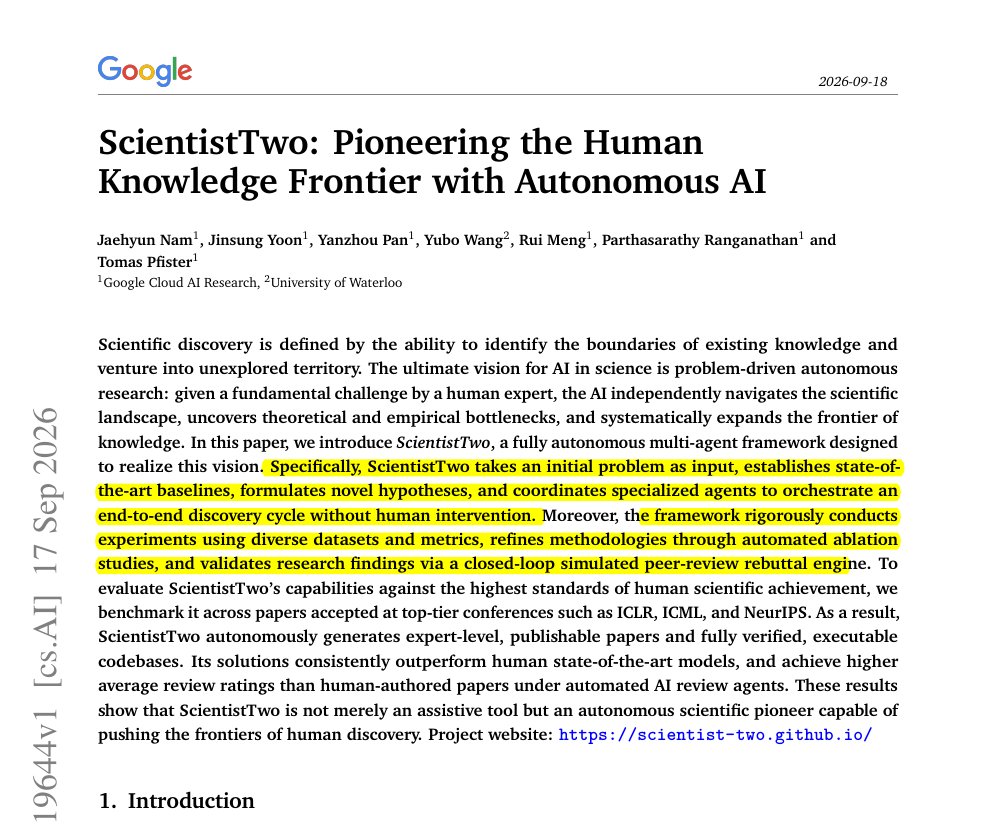
Beautiful paper from Google.
ScientistTwo shows another progress of recursive self-improvement in AI research: it can improve a human method, then use its own discovery as the baseline and improve it again.
the research assistant becomes the research loop: it autonomously improved 86 of 107 human-defined ML problems, suggesting experimentation can be automated long before scientific judgment can.
Instead of helping with one task, ScientistTwo runs a loop: propose ideas, test them, remove what does not help, and use reviewer feedback to start another round.
Across problems based on ICLR, ICML, and NeurIPS papers, it reports an 80.4% success rate and a 25.2% average relative improvement over the original human baselines.
Can an agent explore a new environment, learn its causal structure, and keep improving without updating its model weights?
We introduce RSIAgent, a framework for recursive self-improvement through autonomous exploration. Using Kimi-K3 and GLM-5.3 as base models, RSIAgent outperforms GPT-6 Astra on both OSWorld 2.0 and Agents’ Last Exam.
RSIAgent decides what to explore, executes tasks, verifies outcomes, and consolidates stable action-condition-outcome relationships into memory for future use.
With the underlying model weights fixed, RSIAgent achieves:
- 78.98% Partial Score on OSWorld 2.0 (0808 offline), compared with 72.60% for GPT-6 Astra
- 84.82% on Agents’ Last Exam (Near-term), compared with 82.26% for GPT-6 Astra
We call this Scaling Experience. Agents can continue improving by acquiring, verifying, and reusing their own experience while the underlying model weights remain fixed.
Links in the reply below.
Introducing Atria Dawn Preview:
From Research Questions to Verifiable Results.
Atria Dawn Preview is an agentic foundation model built for long-horizon tasks, helping researchers and engineers turn open-ended questions into executable, verifiable, and reproducible outcomes.
Explore Atria Dawn Preview:
🌐 Website: https://t.co/MDDspFiqYO
💻 GitHub: https://t.co/tNmLocadjT
🤗 Hugging Face: https://t.co/cyZod5oHbw
🤖 ModelScope: https://t.co/6BNi5vHFDl
🚀 Try Atria:
EN:https://t.co/Ap5aO2gQeu
ZH:https://t.co/cG16cQdx4j
You can now watch any AI paper instead of reading it
There's a new site called arXivisual that turns ANY arXiv paper into a fully animated breakdown for free.
Just add "isual" to the link
https://t.co/bvbIm7Udb0 becomes https://t.co/2IodFGq9UW
Paste it and an agent pipeline breaks the paper into sections, finds the concepts worth animating, writes Manim code for each one, and narrates it with voice
You scroll, the narration plays, and each animation sits right next to the paragraph it explains
Tried it on the original Transformers paper. Attention finally made sense to me in a way 10 blog posts never did, and it's open source. Four college kids built it at a hackathon
Here's what I'd do if I were you:
1. Pick the one paper you've been avoiding
2. Change the link and paste it in
3. Scroll through it on your phone with headphones in
4. Ask your AI to explain the one section you still don't get
You'll learn more in 20 minutes than a whole weekend of pretending to read PDFs
This is how you read research in 2026
"On-policy" data: generating synthetic RL environments targeted to the learnability zone of the current policy and based on feedback from its rollouts will be a huge deal.
By continuously adapting synthetic generation of RL envs while training, we can get quite a strong coding model for a 4B dense backbone, without SFT from any teacher trajectories. I was surprised by the generalization to TB2, SwePro and PatchEval.
We stopped after 1500 tasks to put this report out. It remains to understand if and why slope will eventually flatten.
Great work by @kim__minseon@Zhengyan_Shi@Cote_Marc@ericxyuan and team
Stop trying to learn AI from static diagrams. 🛑
You can watch a Transformer process text, see a neural network learn in real time, explore embedding spaces, follow diffusion step by step, and inspect features inside real LLMs.
I know the best visual AI resources on the web ↓
I'm so excited that our @theworldlabs team has achieved a major milestone today! Introducing Atlas - a first of its kind multimodal world model trained from scratch! 🚀
Atlas is capable of generating frames with pixel-perfect camera control, reconstructing large scenes from as few as one single input image, simulating space-time by reframing videos, natively outputting 3D spaces from one or more input images, composing multiple posed images into a consistent 3d world, and more! This is the best camera conditioned world model ever, opening doors to many possible use cases from VFX to robotics. I'm so so so proud of our team!♥️
Introducing Atlas:
The world's first multimodal world model that generates image and video frames with pixel-perfect camera control and reconstructs them in 3D.
Model the world, move the camera, and simulate space & time.