At Agentic Learning AI Lab, the best part of our research is working with the incredible students. They are the ones writing the code, running the experiments, and solving the hard problems in AI today.
As we approach the end of the year, we are fundraising to ensure these students have the resources they need to thrive in 2026.
Unlike big industry labs, we rely on grants and gifts to keep our research independent and open. If you’d like to support the next generation of AI researchers of our lab at NYU, please visit the link below!
I have a new blog post about the so-called “tokenizer-free” approach to language modeling and why it’s not tokenizer-free at all. I also talk about why people hate tokenizers so much!
FAIR is hiring interns for 2026!
If you're interested in a stint doing fundamental AI research with us @AIatMeta, interested students enrolled in a PhD program can apply below👇:
https://t.co/PrG9L625bY
🎓If any of the work below resonates with you, and you are interested in doing a postdoc with me---let's connect & feel free to email or DM me! I'm also happy to chat at the conference.
I'm not going to be at #emnlp2025 but check out my co-authors' presentations!
meta-learning teaches LLMs to learn new words faster (@wentaow10) https://t.co/eP2oZ1h3oU
multilingual prompting increases the cultural diversity of LLM responses (Qihan Wang) https://t.co/5nvDpGAlVQ
My team at FAIR at Meta is recruiting interns for next summer! If you're a PhD student interested in questions around theory of mind in language models for social, multi-agent settings, and have relevant background and/or experience: https://t.co/kc8Sh2hdKz
I’m recruiting PhD students for 2026! If you are interested in robustness, training dynamics, interpretability for scientific understanding, or the science of LLM analysis you should apply. BU is building a huge LLM analysis/interp group and you’ll be joining at the ground floor.
Does vision training change how language is represented and used in meaningful ways?🤔 The answer is a nuanced yes! Comparing VLM-LM minimal pairs, we find that while the taxonomic organization of the lexicon is similar, VLMs are better at _deploying_ this knowledge. [1/9]
We also finetune Llama-3 8B with our method and find that finetuning improves the model's ability to discriminate between new words, identify syntactic categories of new words, and generate reasonable new usages and definitions for new words.
https://t.co/oMasD6JLf3
Can we make language models learn and use a new word as fast as children do? We meta-train models on many word learning episodes, each of which provides a few usage examples (sentences) of a new word for in-context learning.
Using this method, we train a model from scratch on a year’s worth of linguistic input for a child (CHILDES or BabyLM). We find that the trained model's few-shot learning of new words approaches that of the pre-trained Llama-3 8B, which was trained on vastly more data.
My take on the Mission: Impossible Language Models paper: Chomsky et al made an unsupported claim which is poorly phrased and likely incorrect. Yet, the paper does not actually do a good job in negating Chomsky et al's claim in a meaningful way.
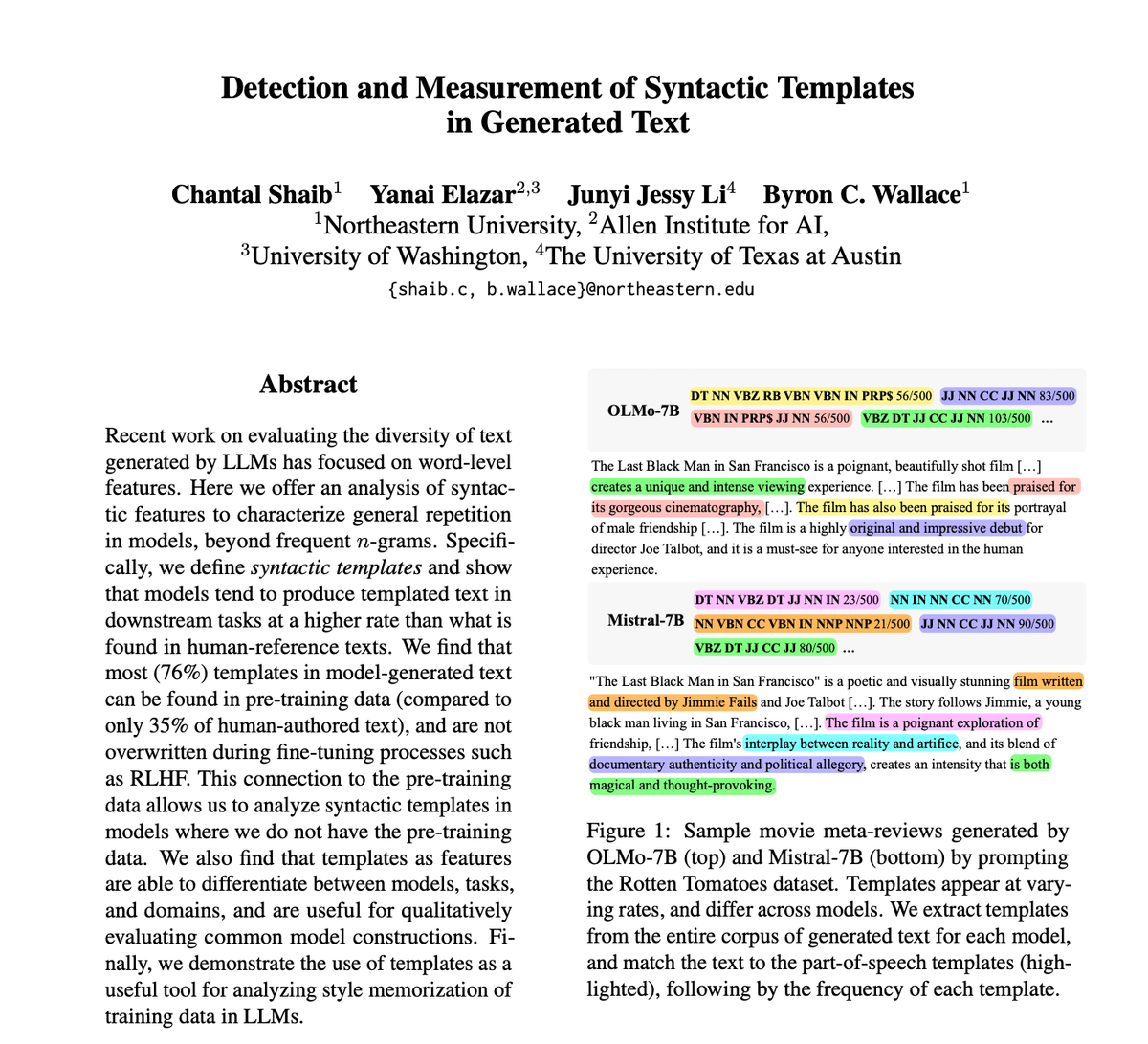
There's a general feeling that AI-written text is repetitive. But this repetition goes beyond phrases like "delve into"! We can actually characterize repetition at a structural level using syntactic templates... 🧵
https://t.co/TLQBsSqkId
(new preprint) LLMs live in a strange tokenized world. We find that LLMs learn to deal with the weirdness of tokenization by converting tokens into word-like representations and then "forgetting about" those tokens. Maybe this is why tokenization isn't an issue, until it is... 🧵
Fundamentally, high-level concepts group into categorical variables---mammal, reptile, fish, bird---with a semantic hierarchy---poodle is a dog is a mammal is an animal.
How do LLMs internally represent this structure?
https://t.co/HK2iFLUpte
📢 New Paper!
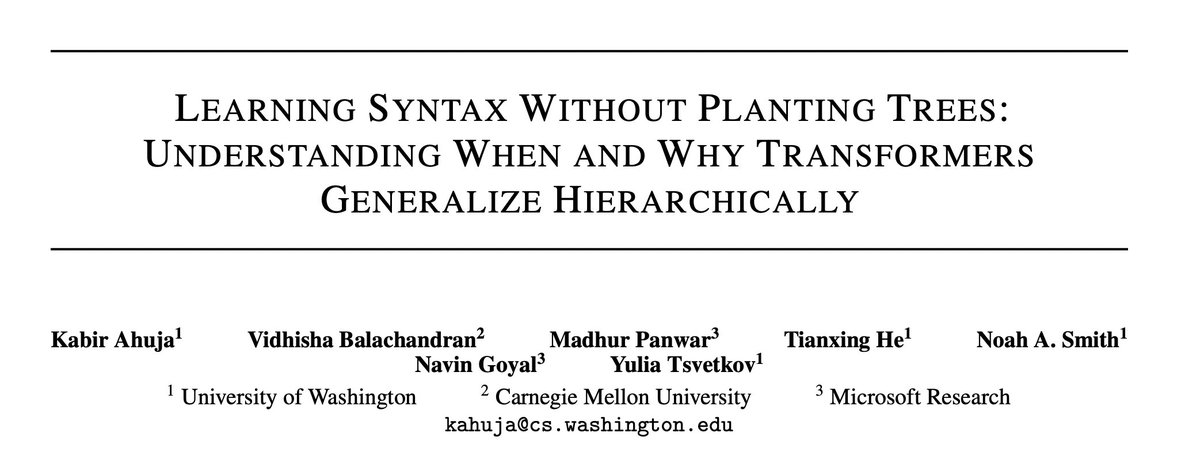
Ever wondered why transformers are able to capture hierarchical structure of human language without incorporating an explicit 🌲 structure in their architecture?
In this work we delve deep into understanding hierarchical generalization in transformers.
(1/n)
🚨 New paper on Subword Tokenization 🚨
- umLabeller, a new tool, classifies subword tokenization into morph 🤹 or alien 👽
- alien tokenization 🛸 leads to poorer generalizations than morphological tokenization for 3 downstream tasks. https://t.co/gsfLcb0blF (1/7)





![yulu_qin's tweet photo. Does vision training change how language is represented and used in meaningful ways?🤔 The answer is a nuanced yes! Comparing VLM-LM minimal pairs, we find that while the taxonomic organization of the lexicon is similar, VLMs are better at _deploying_ this knowledge. [1/9] https://t.co/pDm7AqKCfi](https://pbs.twimg.com/media/GwZPQE5WUAUeZkZ.jpg)