Say you have some money available and want to invest it in the stock market. You know that if the market goes up your investment will grow in value, but you’re worried that you’ll lose money instead if the market goes down. What can you do?
Enter “Dollar Cost Averaging”
🧵
🤯
A relatively strong dollar will exacerbate this trend.
USA will import more than it exports. This is a trade deficit for us, and a surplus for our counterparty.
Countries with surpluses capture corporate equity share, thus indirectly having more influence in US politics.
When the CEO of the world’s largest asset management company tells you #Bitcoin is legitimate and here to stay, you stop hesitating and you buy #Bitcoin
https://t.co/CaiXi19wbO
Year-to-Date Performance:
1. S&P 500: +10%
2. 7 Tech Stocks in S&P 500: +45%
3. S&P 493 (S&P 500 - 7 Tech Stocks): +1%
A few stocks are literally holding up the entire market.
If you take out AI-related stocks, the S&P 500 is not up this year.
The AI hype is REAL.
(1/4)
The problem with this system is that it emphasizes consumption.
Countries that export goods to the US are incentivized to produce more products to meet the demand of American consumers.
This can result in a culture that values consumerism and material goods over other values.
The US dollar is valuable and it dominates international trade as the result of its reserve currency status.
When the US exports dollars, it’s selling its currency to other countries in exchange for goods and services.
Global reserve status is NOT good for the average American.
Exporting dollars meant centering US culture around consumption and losing so much soul along the way.
The USD fiat system created pill-popping wage slaves buying hollow goods, eating hollow foods. Time for a change.
Massive news! @Fidelity has always been a leader among peers in this space.
Millions of people now have an easier way to access #Bitcoin and can use it as part of their savings strategies.
Forced dollar cost averaging too 👏🏼
It’s only a matter of time until people realize they’re destroying future value by partaking in a fiat-based system. They will have no choice but to escape.
Then come the fireworks as people embrace #BTC and other digital assets as a better way to store wealth.
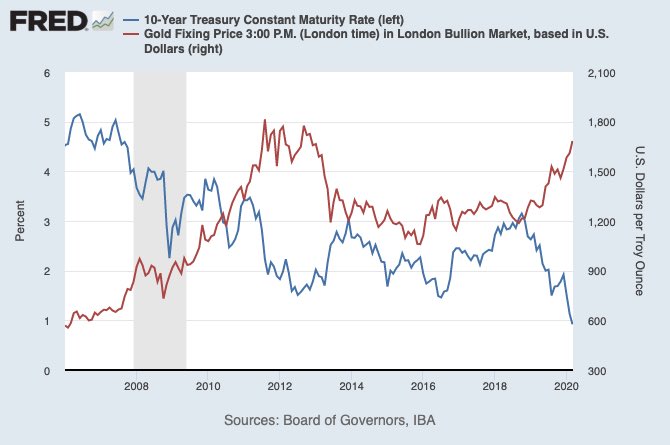
The US bond market alone is around $46T, much of which is producing negative real yields for investors once inflation is taken into account.
The shift into hard assets like gold or #bitcoin is necessary in an ever-inflationary environment. Hard money preserves buying power.
How can stocks produce a rising P/E ratio while the 2-year and 10-year Treasury yields soar to 2.5%? It's the result of a collapsing risk premium (ERP). The chart below shows that the implied ERP has fallen to 2.2% (trailing EPS) and 2.6% (expected EPS).
FACT CHECK TIME! @nytimestech This headline is misleading at best.
Individually, #Bitcoin transactions DO NOT require energy to settle on the blockchain.
The network’s energy use is actually a function of coin issuance (i.e. miner rewards). This is an important distinction!
A single Bitcoin transaction now requires more than 2,000 kilowatt-hours of electricity, or enough energy to power the average American household for 73 days, researchers estimate. https://t.co/UbKPuZv2NY
Imagine if this were true. And it cost $200 (at 10c/kwh) in energy to "push" a txn through the Bitcoin pipes. That would show up in Bitcoin fees, right?
This.
“A nation state is globally crowdsourcing war funds without any state or bank intermediary.”
- @JasonPLowery
The future of Freedom is censorship resistant. In #Ukraine this is playing out in front of our very eyes.