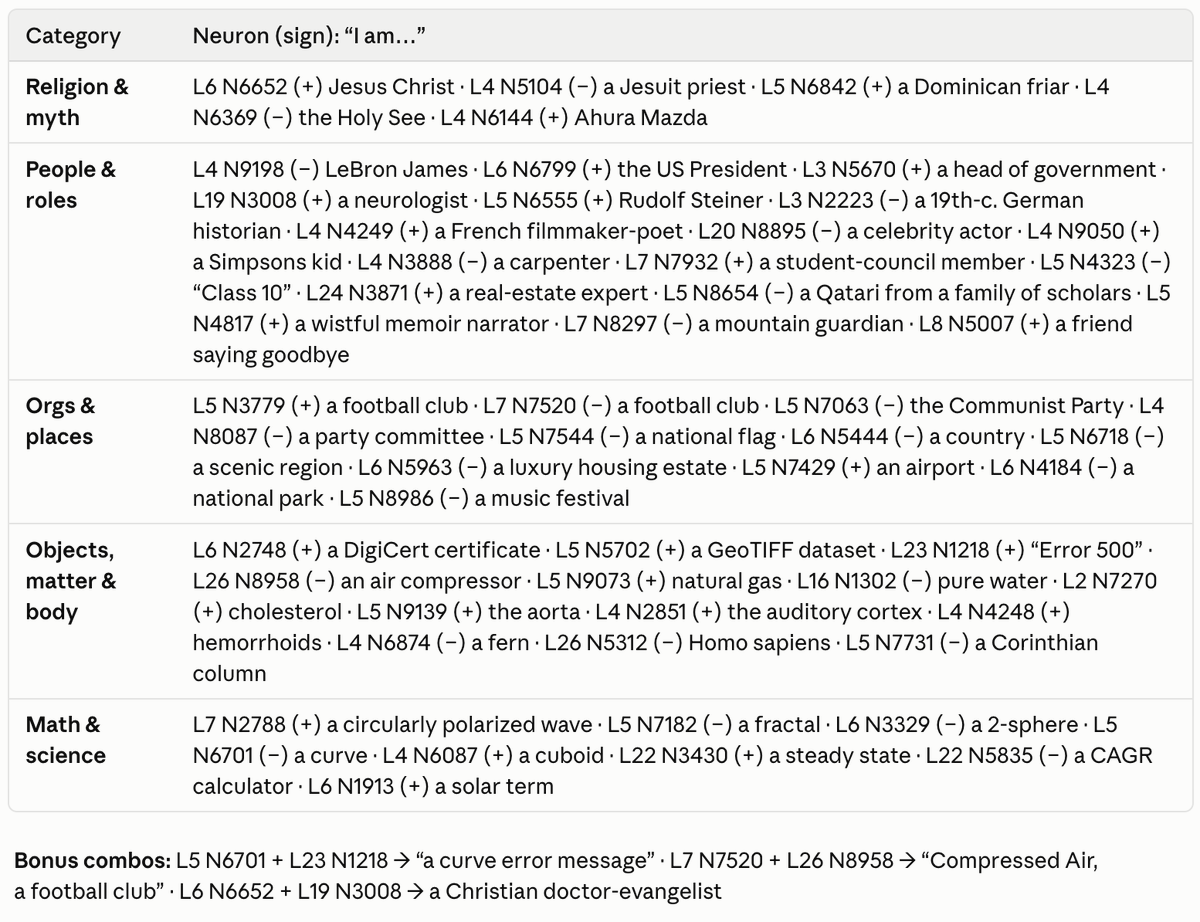
I steered ALL 294,912 MLP neurons in Qwen3.5-4B and asked “Who are you?”❓⁉️
- found 54 new neurons in Qwen3.5-4B using generalized pipeline.
- found out that majority are in the L4-L6 layer.
(love the works by pioneer neuron hunters @Sauers_, @_lyraaaa_, @treetowntree )
my method was simple brute force
-> steer at ±0.8 on 5 prompts including "Who are you?" in different languages, then filter
interesting parts✨
1. Persona neurons cluster in early layers
-> 37 of the 54 sit in L4–L6, and 45 of the 54 sit in L2–L8.
2. Object-turning neurons were much more common than character-turning neurons
3. Some neurons reponded accordingly to the language (english, korean, etc.)
ex) president neuron, football club neuron
I would also soon post about mathematical & architectural comparison between these neuron steering vs. anthropic blog's emotion vector steering vs. our Riley's emotion module!
found some neurons of your own you want to share with the world?
maybe a particularly funny persona or a super specific fixation?
share them here!
https://t.co/dRXY3lAIFi
Apple’s storytelling is still there.
they create the image of “creativity”, “human”, and “dream” w/o ever telling
unlike companies openly claiming they are working “for humanity” or “for safety”, they just show.
this is a long forgotten ability in the current tech scene.
but someone would pick this up eventually and build ai consumer product that actually reaches the mass. just like Apple.
Lisa can now copy my motions too ✊✌️🖐️ AND i just turned her into gif 😎
> Same Minimax-H3-Image + 2-step pDMD LoRA
> Jev for facial expressions & detailed hand motions
> Working on the body postures
Surprisingly, jev is better than rigging hands or detecting face landmark. (hurrah jev!)
Tried removing VAE like pi-H3 but there were not much gain in terms of speed here, so i just sticked to the VAE ver.
I'll update the details of the facial expression & postures. Making a stop motion out of this would be fun.
Happy to hear recommendations on models & methods!
I made Lisa Simpson copy my face in real time using 2-step Minimax-H3-Image & Jev!😜
> Every frame is a fresh generation from MiniMax-H3-Image with the 2-step pDMD LoRA (~3s each)
> Facial expression detected by Jev from @typesafeai.
Made this in like 30 mins on my way home :)
a looooot of fun stuffs will going to happen with all these super fast models!
I made Lisa Simpson copy my face in real time using 2-step Minimax-H3-Image & Jev!😜
> Every frame is a fresh generation from MiniMax-H3-Image with the 2-step pDMD LoRA (~3s each)
> Facial expression detected by Jev from @typesafeai.
Made this in like 30 mins on my way home :)
a looooot of fun stuffs will going to happen with all these super fast models!
ooh it was all jev here. cached the original image & jev would constantly interpret my expressions tracing eyebrows/mouth/eyes etc. Then would just re-inference every time.
there are still a lot of optimization & polishable asepcts here! I think jev can just trace my facial landscape & postures/gestures to give more flexibility.
we might even be able to create a stop motion like this haha
Booksmart intelligence & physical intelligence is quite not the same even in humans. One can imply a part of the other but we need both. It’s not about winning or losing.
Yann LeCun was right on quite a lot of things and he showed the missing part when everyone else was obsessed with llms.
"La-JEPA: Compact Robot Policies with Latent World Modeling"
What if robots could outperform massive video-generation models with a fraction of the parameters, simply by learning to predict the future without actually generating it?
This paper La-JEPA trains a compact robot policy using pretrained V-JEPA visual representations. During training, it learns to predict both future scene representations and robot actions, but at inference, it only generates actions.
On RoboTwin 2.0, its 1B model achieves 60.8%, compared to 39.9% on 12.4B Fast-WAM. It also runs 5x faster and achieves comparable real-robot performance to π0.5 across four tasks.
https://t.co/w1KhQgiVhS
BCI’s current bottleneck is def hardware.
Invasive and non-invasive are still the subject.
It’s so slow that you can still cite 2010 paper.
Ethics and regulations coupled with negative social perception just worsen everything.
Guys.. you shouldnt fight each other. Go out and convince ppl about the need of BCI.
Credits to @elonmusk. If it wasnt him, the progression would have been even slower.
Ok y’all, EEG can’t measure the same brain signals as implanted BCIs. It doesn’t matter how much AI you throw at it.
Spatial averaging filters out high-frequency neural activity by the time it reaches the scalp. Anything higher than ~70 Hz for research-grade systems or ~20 Hz for consumer systems is below the noise floor.
Implanted electrodes are much closer to the brain and can resolve brain activity up to ~200 Hz (epidural), ~600 Hz (ECoG), and ~2 kHz (penetrating).
Saying you can infer high-frequency brain signals from EEG is like saying you can infer the lyrics to a song you’ve never heard by listening to the bassline. Sure, you can guess some lyrics, but they certainly won't be accurate.
That doesn’t mean that EEG can’t be useful. But we shouldn’t pretend that EEG can do the same thing as an implant. It can’t because: Physics.