🚨 BREAKING
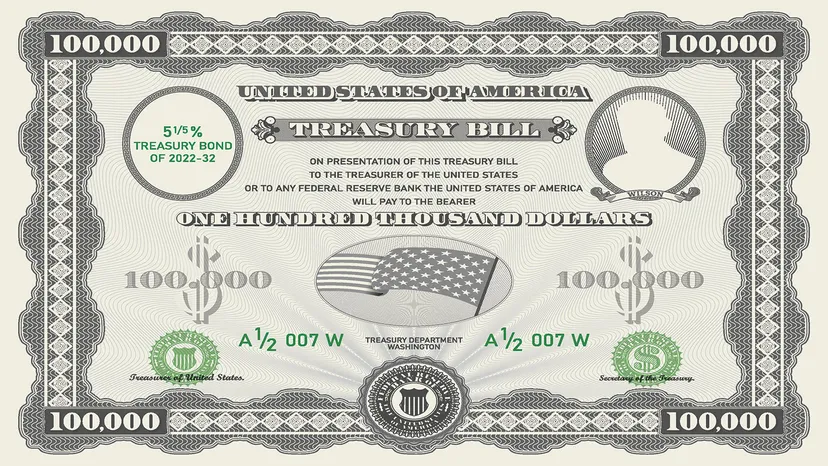
🇨🇳🇺🇸 CHINA WILL DUMP $147,000,000,000.00 IN U.S. TREASURIES TOMORROW AT 11:30 AM ET.
THIS WILL BE THE BIGGEST SELL-OFF IN THE LAST 20 YEARS, AND IT'S THEIR LAST ATTEMPT TO STOP THEIR LOCAL MARKET FROM COLLAPSING.
LOOKS LIKE ANOTHER MARKET CRASH IS COMING...
🚨 BREAKING
🇯🇵🇺🇸 JAPAN TO SELL $620,000,000,000.00 IN U.S. STOCKS AND ETFS TO SUPPORT THE YEN!
THE BANK OF JAPAN IS INVOKING LAST-RESORT EMERGENCY MEASURES TO PREVENT A MARKET COLLAPSE.
THIS DOES NOT LOOK GOOD FOR THE MARKETS...
THE BIGGEST BUYERS OF U.S. DEBT ARE WALKING AWAY.
Japan dumped $67 billion in U.S. Treasuries in a single month to defend the yen.
China has reduced its Treasury holdings by nearly $100 billion over the past year, while quietly building record gold reserves.
And this is happening exactly when US debt is almost at $40 Trillion.
If this continues, the US will find it very difficult to finance its debt, resulting in a debt crisis.
The alcohol industry has lost approximately $830 billion in market value over the past four years, largely because of a clear shift among Generation Z toward lower alcohol consumption and sobriety.
This decline has hit the sector about four times harder than the 2008 financial crisis, indicating that the long period of rapid, volume-driven growth in beer, wine, and spirits has ended.
A Bloomberg index that tracks roughly 50 of the world’s largest alcohol companies has fallen 46 percent from its peak in June 2021. Major firms including Diageo, Pernod Ricard, and Rémy Cointreau have seen their share prices drop to the lowest levels in a decade.
Analysts describe the change as a lasting structural shift rather than a temporary economic downturn. In the United States, recent surveys show that alcohol consumption has reached its lowest point since record-keeping began in 1939, with only 54 percent of adults reporting that they drink. For the first time, a majority of Americans view even moderate drinking as harmful, a view reinforced by public-health warnings that link alcohol to several types of cancer.
In response, large drinks companies are adapting rather than resisting the trend. Firms such as Diageo and Moët Hennessy have begun acquiring or investing in premium non-alcoholic spirits and wines in an effort to serve a growing wellness-focused market that prioritizes clarity and health over intoxication.
[Bloomberg reporting on the global alcohol sector’s market performance and consumer trends (2021–2025 data)]
🌽 #AgsThisWeek: Bearish seasonals + better U.S. weather are back in control. 📉🌦️ Hedge funds flipped into selling mode after five straight weeks of buying. 📊 U.S.-Iran headlines remain fluid. 🌍 Weather stays warm with scattered showers. 🌦️ Friday's U.S. jobs report is the week's biggest macro event. 💵 WASDE: August 12. 📅🌾 #commodities #agriculture
🌾 #Grain#exports from #Russia's #Black_Sea#ports could nearly come to a halt due to drone attacks
Russian wheat exports could decline by 30–35 mln tons this season, equivalent to about 15% of global wheat trade.
Read more 👉https://t.co/oqAJcGhsE7
🌾 Wheat: More pain in August? 📉
Spring Wheat futures have dropped in 12 of the past 14 years over the next 5 weeks. Average drop: -29 cents 🚨
Black Sea and Crude Oil will drive volatility, but seasonals say sell.
#grains#wheat#seasonals
🟢 July was a sea of green for #commodities.
Trade flow risks, threatening weather, solid demand, and the pull from higher energy prices lifted nearly the entire complex.
🛢️ Heating Oil +29.6%
🛢️ WTI +22.2%
🛢️ Brent +20.4%
⛽ RBOB +14.0%
🌾 Spring Wheat +13.7%
Energy swept the podium. Every Wheat market finished higher. 🚢📈
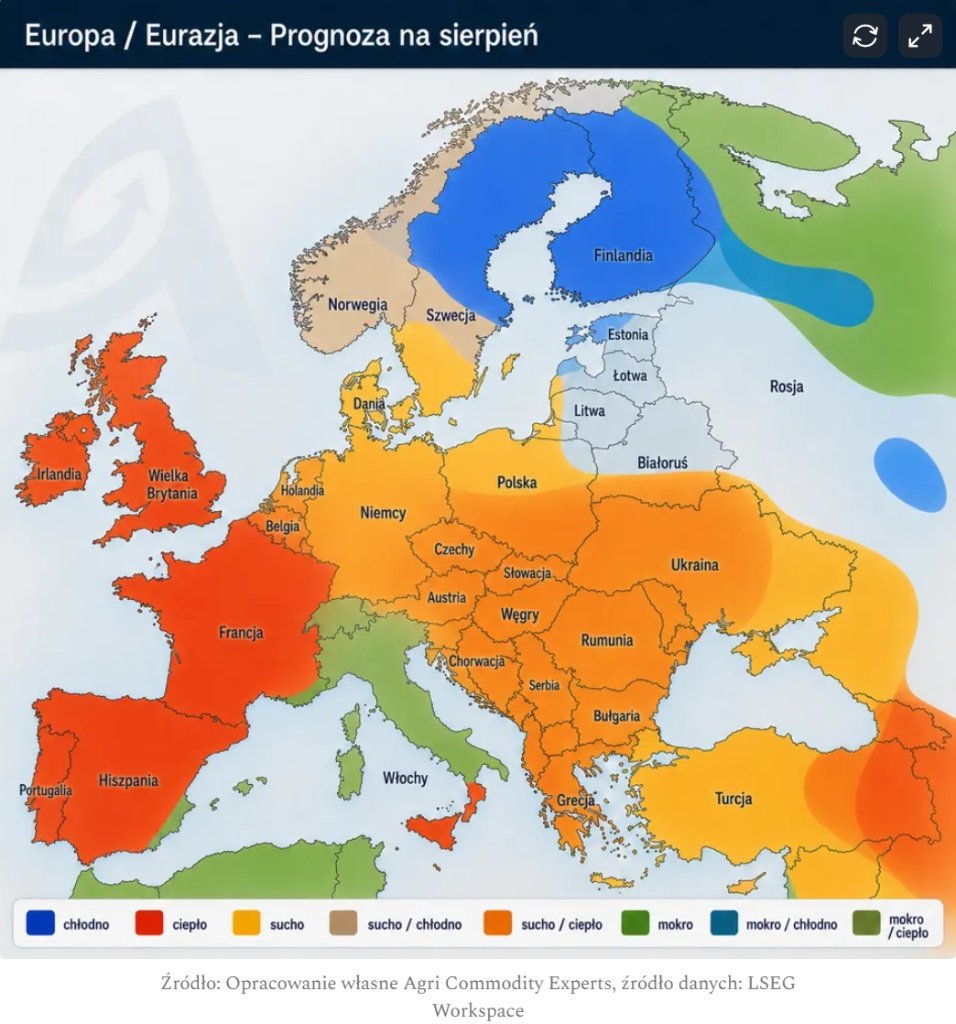
🇪🇺🌾 Pogoda dzieli Europę i uderza w zbiory! Co oznacza fala upałów i susza dla rynku zbóż?
Prognozy na sierpień przynoszą prawdopodobną kontynuację ekstremalnych warunków: chłodną Skandynawię i gorący, suchy zachód kontynentu.
1️⃣ Załamanie w kukurydzy: Upały trafiły w kluczowe fazy (kwitnienie/zawiązywanie kolb). MARS obniża prognozę plonu w UE do 6,93 t/ha (choć to bardzo konserwatywna ocena), a USDA szacuje unijną produkcję o ~11% poniżej średniej 5-letniej.
2️⃣ Francja: We Francji zbierze się zaledwie 10 mln ton kukurydzy (🔻26% r/r, najmniej od sezonu 1990/91). Lepsze warunki w Rumunii i Bułgarii nie zrekompensują strat.
3️⃣ Większy import: UE będzie musiała zaimportować 22,5 mln t kukurydzy (skok z 19,5 mln t), co nasili konkurencję o ziarno z Ukrainy, USA i Brazylii.
4️⃣ Wpływ na ceny: Wysokie koszty logistyki i frachtu utrzymają premię cenową w Europie. Słabsza podaż kukurydzy może przekierować popyt paszowy na pszenicę, wspierając jej ceny.
🌾 Pszenica i rzepak: Upały obniżyły potencjał plonowania, ale obecna sucha aura sprzyja sprawnemu przebiegowi żniw
U.S. spring #wheatharvest26 is underway with 2% of the crop harvested according to the July 27 @USDA Crop Progress report. Harvest is ahead of schedule in SD; ID, MN & WA are on track or slightly behind; MT & ND are yet to begin.
Analysis ⬇️
https://t.co/aty6nnxhIk
#USWheat
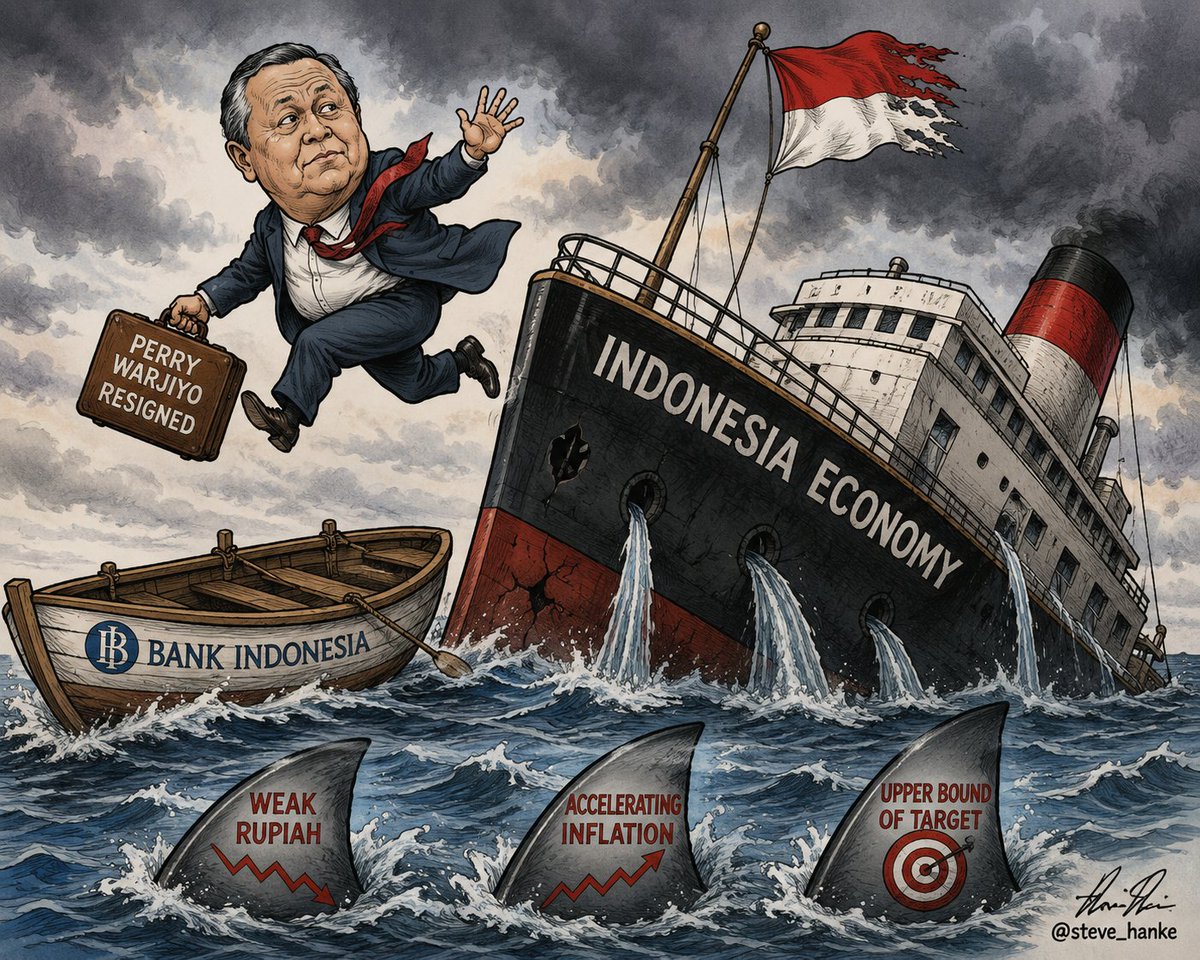
Saturday, Gov. of Bank Indonesia Perry Warjiyo resigned.
With the Indonesian rupiah weak and Indonesia's inflation accelerating and reaching the upper bound of its target, Warjiyo has ABANDONED SHIP BEFORE IT SINKS.
I’m standing in a downpour in the middle of a golden wheat field in Ukraine.
Right now, Ukrainian farmers are gathering the 2026 harvest: 80 million tons of grain and oilseeds.
That’s roughly 10 kilograms of food for every single person on Earth.
But that food might never reach the world's table.
Russia is systematically bombing Odesa’s ports and civilian cargo ships—deliberately targeting international vessels and American commercial interests.
This is a direct attack on global food security. It fuels inflation in every grocery store worldwide.
Protecting Ukraine’s port infrastructure isn’t charity.
It is defending global economic stability—and keeping the world fed.
🚢Ukraine's agricultural exports rose 11% YoY to $12.6B in H1 2026, accounting for 60% of the country's total export revenue.
The agricultural trade surplus widened to $7.9B, although Russian attacks on port infrastructure continue to weigh on logistics and export potential.
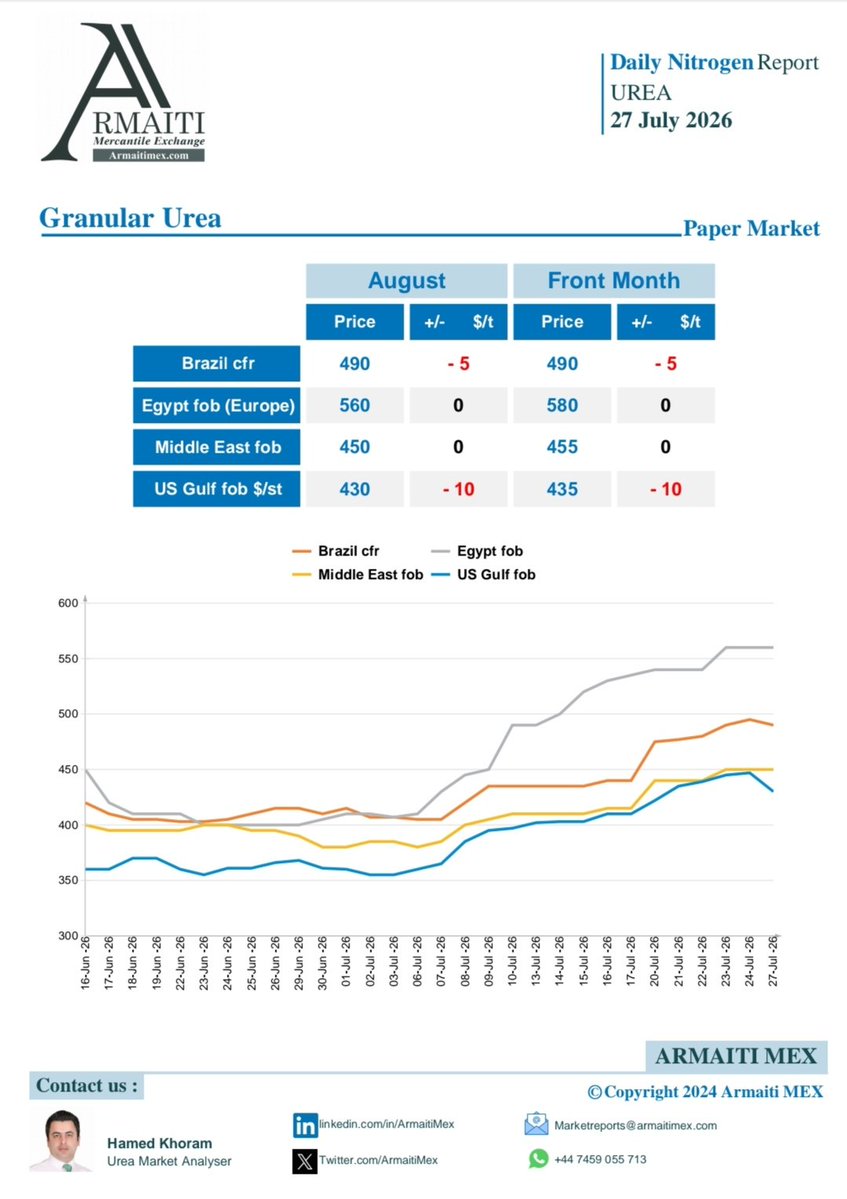
▪️ Paper Market Analysis: Physical Strength Supports Forward Curve
▪️ The urea paper market remained broadly stable despite weaker US derivatives.
🌀 Read the full report on our WhatsApp channel.👇https://t.co/44AB5mLn2Q
#urea#fertilizer#gübre
📊 JRC MARS (27/07) – Prévisions de rendement
🌾 Blé : la Commission européenne revoit son rendement à la baisse de 2 %, à 5,66 T/ha, un niveau conforme à la moyenne des cinq dernières années (M5).
🌾 Orge : les prévisions reculent de 1 %, à 5,02 T/ha, également en ligne avec la M5.
🌽 Maïs : la CE abaisse son estimation de 6 %, à 6,93 T/ha, soit 2 % sous la M5.
🥬 Betterave : le rendement est estimé à 76 T/ha, en baisse de 2 %, au niveau de la M5.
🌻 Tournesol : les prévisions chutent de 7 %, à 1,94 T/ha, soit 2 % sous la M5.
Pourquoi ça ralentit ? Ce n’est bien sûr pas la demande qui baisse. C’est l’accès qui se referme.
Sur la West Coast française, comme sur la West Coast californienne, le rêve du cadre de vie littoral ne s'essouffle pas, c'est la volonté et la capacité à accueillir qui coincent.
Alors les prix de l'immobilier sur le littoral s'ajustent légèrement, oui (-1,6 %), mais ils restent toujours très élevés par rapport au reste du territoire.
D'après Meilleursagents, tous biens confondus, au 1er juillet 2025 :
> 4 888 €/m² = le prix moyen du marché sur le littoral
> 3 108 €/m² = la moyenne nationale.
Ce sont les littoraux de Provence-Alpes-Côte d’Azur et de l’Atlantique qui tirent les prix vers le haut, avec respectivement
> 5 980 €/m² en PACA
> 5 380 €/m² sur l'Arc atlantique.
Si l'on est moins stricte sur la définition du littoral, et que l'on considère l'ensemble des départements littoraux (et non seulement les communes littorales) alors là, clairement, la Côte Ouest se détache, sur 10 ans (Pouvreau, Organic Cities 2, 2025) :
> +50% d'augmentation des prix sur la Côte Ouest,
> +23% dans le reste du pays hors IdF.
C'est très clair sur la carte : le gros sujet sur la Côte Ouest française (comme sur la West Coast californienne) c'est la capacité d'accueil et la résistance locale (NIMBY) face à la construction de nouveaux logements.
Friday's sell-off on Black Sea de-escalation rumours — overdone?
The deal talk is coming from Ukraine. From Russia? Silence. Hard to imagine a deal without Moscow at the table.
Things to watch this week: UN Security Council on the Black Sea (Mon), Zelensky-Trump meeting (Tue), and probably more attacks.
What you need to know as a #wheat trader: https://t.co/5DmLMqYE1x
#wheat #Russia #Ukraine #blacksea #sizovreport
🚜 Farmers in the eastern Kharkiv region have again received harvesting machinery from the Victory Harvest Foundation.
Average crop yields in the region as of 27 July:
▪️ wheat — 4.64 t/ha
▪️ barley — 3.78 t/ha
▪️ peas — 2.6 t/h
▪️ rapeseed — 2.7 t/ha
#crop26








![Rainmaker1973's tweet photo. The alcohol industry has lost approximately $830 billion in market value over the past four years, largely because of a clear shift among Generation Z toward lower alcohol consumption and sobriety.
This decline has hit the sector about four times harder than the 2008 financial crisis, indicating that the long period of rapid, volume-driven growth in beer, wine, and spirits has ended.
A Bloomberg index that tracks roughly 50 of the world’s largest alcohol companies has fallen 46 percent from its peak in June 2021. Major firms including Diageo, Pernod Ricard, and Rémy Cointreau have seen their share prices drop to the lowest levels in a decade.
Analysts describe the change as a lasting structural shift rather than a temporary economic downturn. In the United States, recent surveys show that alcohol consumption has reached its lowest point since record-keeping began in 1939, with only 54 percent of adults reporting that they drink. For the first time, a majority of Americans view even moderate drinking as harmful, a view reinforced by public-health warnings that link alcohol to several types of cancer.
In response, large drinks companies are adapting rather than resisting the trend. Firms such as Diageo and Moët Hennessy have begun acquiring or investing in premium non-alcoholic spirits and wines in an effort to serve a growing wellness-focused market that prioritizes clarity and health over intoxication.
[Bloomberg reporting on the global alcohol sector’s market performance and consumer trends (2021–2025 data)]](https://pbs.twimg.com/media/HOugtV0XsAAUrz4.jpg)