@0xB10C@bitgould to be double-super clear, both of them _can_ be run on NixOS, either by patching the binary (with patchelf) or using something like https://t.co/kykSLNetJj
I never thought this would be possible, but:
I built a bitcoind binary with Nix that is bit-by-bit identical to the Bitcoin Core v31.0 Guix-built release binary for x86_64-pc-linux-gnu. Big win for reproducible builds across different toolchains.
https://t.co/Ff1g6U8Hf9
> a bunch of buzzwords that most people would not follow, and will just tend to take it for granted that it is all somehow magically validating.
the same could be said about the buzzwords surrounding whether you and i will randomly generate the same private key (or not). or around hash collisions, or many other aspects of bitcoin to a layperson.
you forgot to respond though to where you think the new trust assumptions are?
bitcoin core does not maintain (this means backporting fixes) to any versions older than the last 3 versions. this has been so for … a decade perhaps?
of course we all _work_ on source code for the newer-than-current version; master branch.
what do you mean “drops support” for an older version? i think you (or whoever you quoted) is probably confused or misled. or perhaps i still misunderstand what exactly you are talking about here…
Fully-static, reproducible, release binaries for Bitcoin Core, have been a long-time goal of mine, and we are getting are closer to making them a reality. I've produced test binaries from a PR of mine (#25573), and am looking for feedback, questions, and hopefully testing on various systems or obscure platforms.
Node count ≠ independent support.
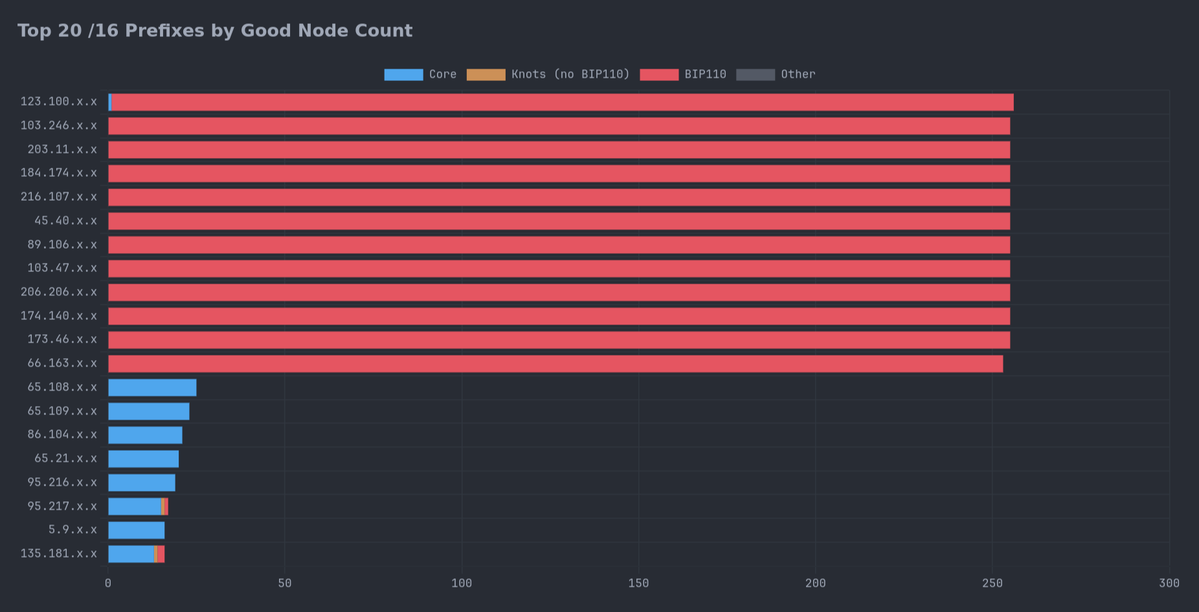
Data from my Bitcoin crawler shows that of 3,312 “good” (listening + connectable) BIP110 nodes, 3,058 are concentrated within just 12 /16 IP ranges (~255 per range), suggesting possible single-operator control.
Excluding them leaves 254 (listening + connectable) BIP110 nodes.
For comparison, applying the same method flags 1 Bitcoin Core node and 0 Bitcoin Knots nodes.
https://t.co/vhiYdGF39X
Node count ≠ independent support.
Data from my Bitcoin crawler shows that of 3,312 “good” (listening + connectable) BIP110 nodes, 3,058 are concentrated within just 12 /16 IP ranges (~255 per range), suggesting possible single-operator control.
Excluding them leaves 254 (listening + connectable) BIP110 nodes.
For comparison, applying the same method flags 1 Bitcoin Core node and 0 Bitcoin Knots nodes.
https://t.co/vhiYdGF39X
@_PyBlock_@fanquake i’d imagine so.
but in case you did not read more than the graphic, that is is showing >3k reachable (sybil) BIP110 nodes controlled by a single operator across 12 /16 ip ranges
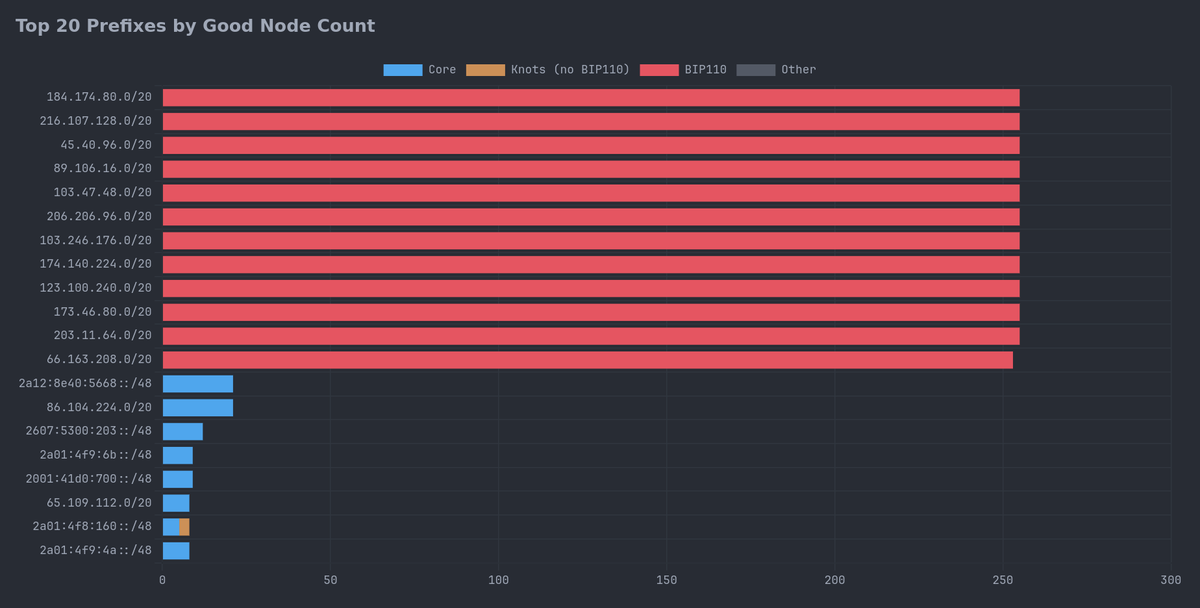
@philip_dath Thats a fair point! I switched it to use /24 and the pattern is still clearly visible (this drops the single lowly Core node caught up in a "sybil" /16).
Will push an upload to the GH pages site shortly
@snapolino@philip_dath you can see them on the chart source: https://t.co/6QNs5O7JHe
raw data is from https://t.co/R3tu3ynDZ5 if you want to run the numbers yourself
Updated the charts to use /24 for sybil "detection", instead of /16.
Also just noting here, the figures in OP (and all "sybil" charts) exclude Tor nodes.
See https://t.co/64WmfCzPDj
This is not run "for" (or "with") any version in particular. It's a custom dns seed/crawler which connects to a node, recieves it's version message, and asks for more addrs for its db to connect to next, maintaining a list of connectable "good" nodes as it goes.
@philip_dath Thats a fair point! I switched it to use /24 and the pattern is still clearly visible (this drops the single lowly Core node caught up in a "sybil" /16).
Will push an upload to the GH pages site shortly
@BitMEXResearch@fanquake The source charts are here: https://t.co/6QNs5O7JHe (and the raw data is from here https://t.co/R3tu3ynDZ5)
The fractions in the two pies are similar, but the absolute numbers are different.