Neuroscience postdoc @ucl. Using machine learning and computational modelling to help understand memory and navigation. Very amateur footballer for @Monstars_UK
Just published in @eLife! This work was done with the amazing @neuro_kim@caswellcaswell & supremely talented co-first author @TomNotGeorge! TLDR? There's evidence hippocampus functions like a 'predictive map' - so how might this be achieved in the brain? https://t.co/cqRqapTwnz
Excited to share our updated preprint on the neural basis of foraging decisions! This work was co-led by Michael Bukwich (twitterless, now at UCL) and me, with major contributions from co-authors, and the incredible animation is by @KJHerr23. (1/12)
https://t.co/GopGdBoVly
Animals can learn to use all kinds of brain-computer interfaces, from controlling single neurons to large populations of neurons in motor ctx. How do they do this?
Thrilled to be finally sharing our research on this question, now up on biorxiv! 🧵
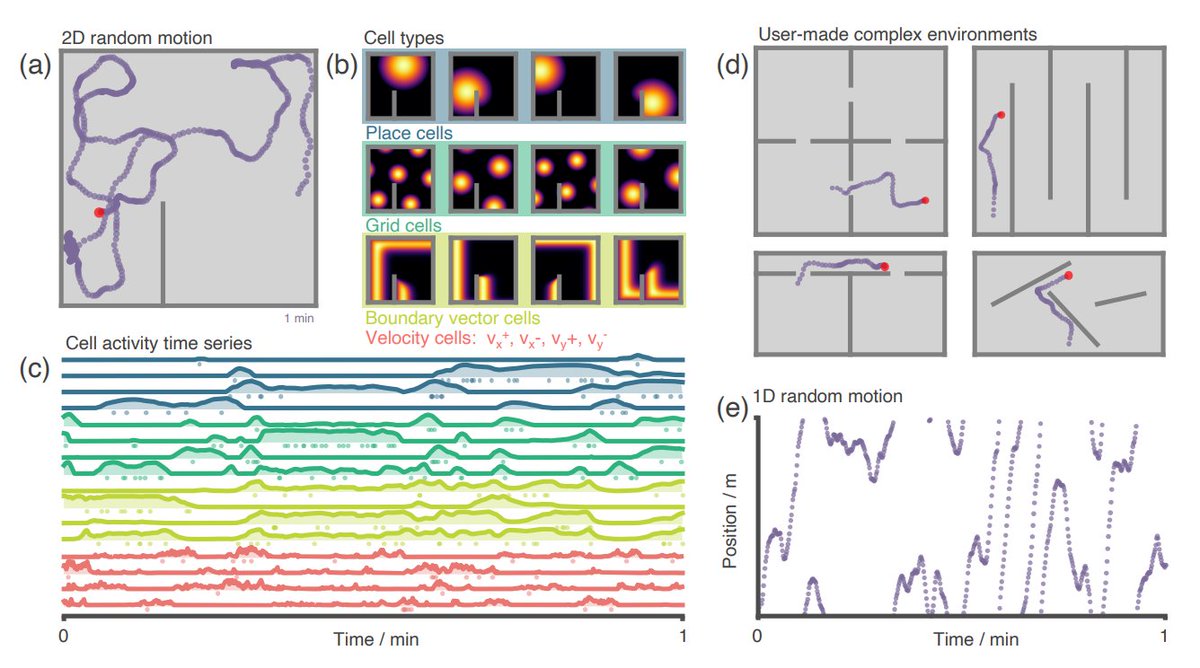
RatInABox🐀📦- which began accidentally from some old code I had lying around - grew to become a massive toolkit for navigational research.
It's immensely gratifying to see it finally published and being used in such a variety of ways across the field.
https://t.co/sgYOzkOXVA
New survey on predictive representations in reinforcement learning, covering AI, cognitive, and neuroscience perspectives:
https://t.co/hltd5XKHEo
Joint work with @cogscikid, @momchiltomov, @willdecothi, @caswellcaswell
This paper is now out at @NatureComms! https://t.co/pY6DO2Vvok
Thanks to helpful reviewer comments, we've added more analyses about the effects of ketamine on MEC since the preprint (1/2)
Save the date for our next UCL #NeuroAI online seminar, where we are excited to be hosting Prof. Thomas Nowotny @DrTNowotny (@SussexUni).
Talk title: "Loss shaping enhances exact gradient learning with EventProp in Spiking Neural Networks"
🗓️ Wednesday 18 Oct 2023
⏰2-3pm BST
Cognitive models of behavior are a key part of neuroscience. But discovering them is hard!
Neural networks are powerful models. But interpreting them cognitively is hard!
We explore automatically learning interpretable models using "Disentangled RNNs"
https://t.co/eoXmqNrkhh
RatInABox just passed 100 stars⭐️on Github which is a perfectly arbitrary milestone at which to announce a new feature, thanks to a contribution by community member @SynapticSage:
RiaB is now compatible with the OpenAIs “gym” API. This is big for RL users. Let me explain...🧵
For the next UCL #NeuroAI online seminar, we are excited to be hosting Prof Anna Schapiro
@AnnaSchapiro (@Penn)
Talk title: "Learning representations of specifics and generalities over time"
🗓️ Wednesday 12 July 2023
⏰2-3pm BST
ℹ️ Register here:
https://t.co/NLFk6etH4V
@NauMatt and I are excited to introduce DeepMReye v0.2 🥳Now featuring a local Streamlit app for efficient extraction of gaze coordinates using pre-trained model weights: https://t.co/LRF8hRo9Ob
Please let us know if you run into any problems with this!
Excited to share our work on scene perception in artificial neural networks #CVPR2023. Will talk about egocentric to allocentric reference frame transformations & unsupervised scene segmentation (10.30am - TUE-AM, 202)
Can't make it? See Video below👇
https://t.co/2yOpa3JOU2
RatInABox is an #opensource Python toolkit developed by @TomNotGeorge in @caswellcaswell's lab. It models rodent locomotion and generates electrophysiological data for place cells, grid cells, and more. Check it out on OpenBehavior! #neuroscience
https://t.co/ETQaEoPRkk
Our lab at UCL (https://t.co/9DhqMk6qrw) is looking for a Research Technician in computational and experimental #neuroscience. Ideal for those who wish to gain research experience before considering PhD studies.
More info: https://t.co/vslK9e8cta. Deadline: 20 June.
Thanks! I really enjoyed giving this talk. For anybody interested to learn more, find our paper, as well as those from @chingfang17 and @ClopathLab, here:
• https://t.co/YRMEFdJ4V8
• https://t.co/3hrPNm3S93
• https://t.co/CDFPF585b6
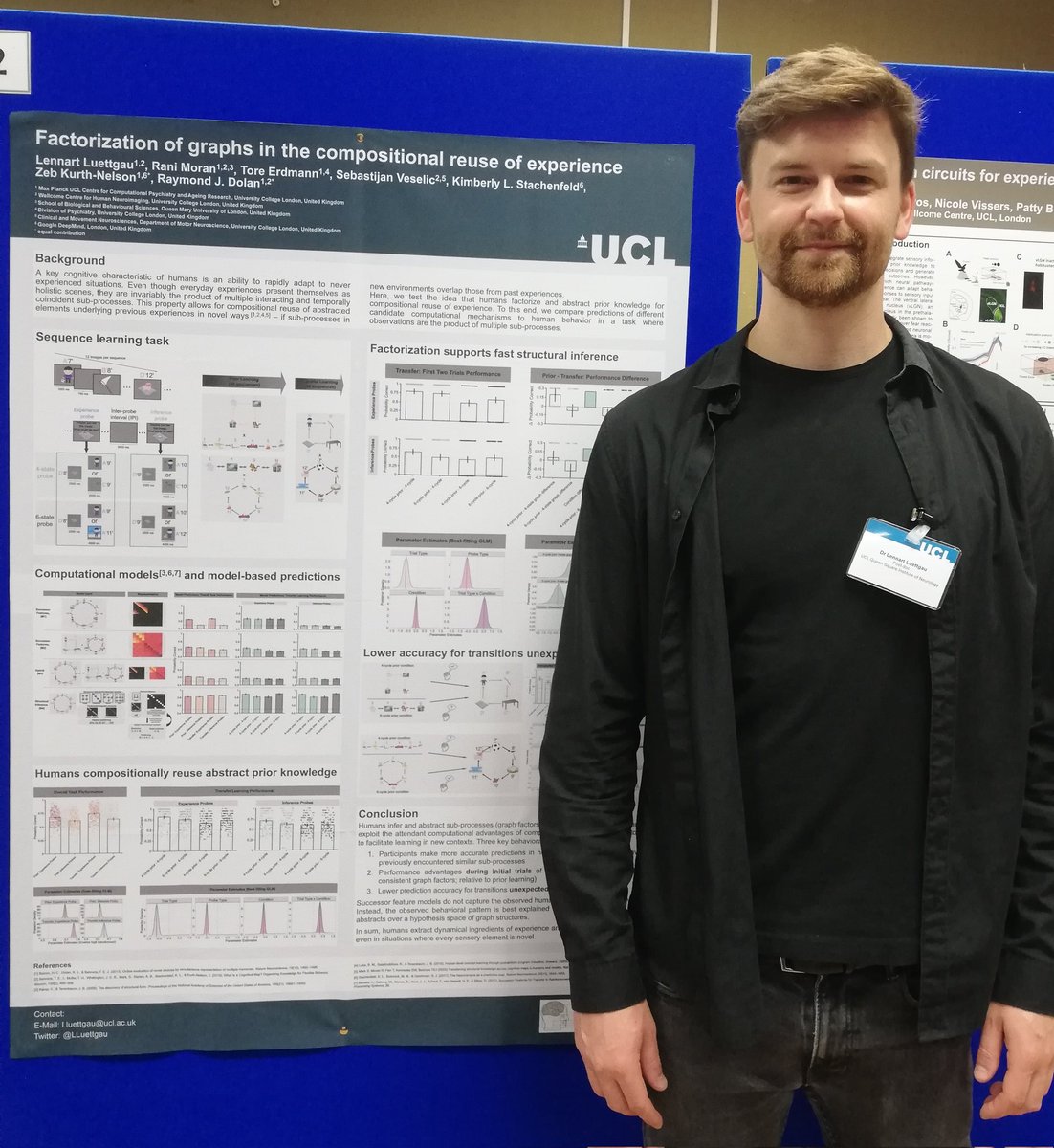
Come see our poster (#12) at this year's UCL Neuroscience Symposium in poster session 2 (1.10-2.30 pm)! I will present our work on how humans reuse factorized and abstracted prior knowledge to compositionally generalize in novel situations.