The U.S. weapons arsenal has been depleted and no longer has the capacity to deter a Chinese attack against Taiwan, a new CFR report says.
The U.S.-Israeli war with Iran has severely diminished stocks of critical munitions—including air defense interceptors and precision-guided munitions—and efforts by the government and industry to replenish them will take years to bear fruit.
To address this vulnerability, the United States must rapidly implement policy reforms to enable the production and fielding of precise mass systems—an emerging class of military capabilities that includes drones, sensors, and enabling technologies—which represent the only viable means of maintaining peace through strength in the Indo-Pacific, the report contends.
"Washington needs to immediately put production of precise mass on a wartime footing. Waiting until conflict begins will be too late."
Read the full report by CFR experts @RushDoshi, Erin D. Dumbacher, William Henegan, @mchorowitz, and Sam Henry Lazarus: https://t.co/ccsMr4buXt
🚨🚨🚨 New report alert on the future of defense! BLUF: To rebuild deterrence and the arsenal quickly, the US needs to sprint to scale precise mass capabilities in particular, and enable the defense industrial base to deliver! https://t.co/Drc4TEqnuk cc @RushDoshi@CFR_org
After a lot of lobbying by @jordanschneider, I am launching a substack. It will focus on international economics and a bit of geopolitics and US politics. No regular publication schedule, but it will be free! (You get what you pay for!). Link below.
“Trump’s reason for turning to hybrid economic warfare is simple: he has to, at least if he wants to impose economic pressure on Washington’s oil-exporting adversaries,” writes @petereharrell.
https://t.co/v6D6Fv2uoF
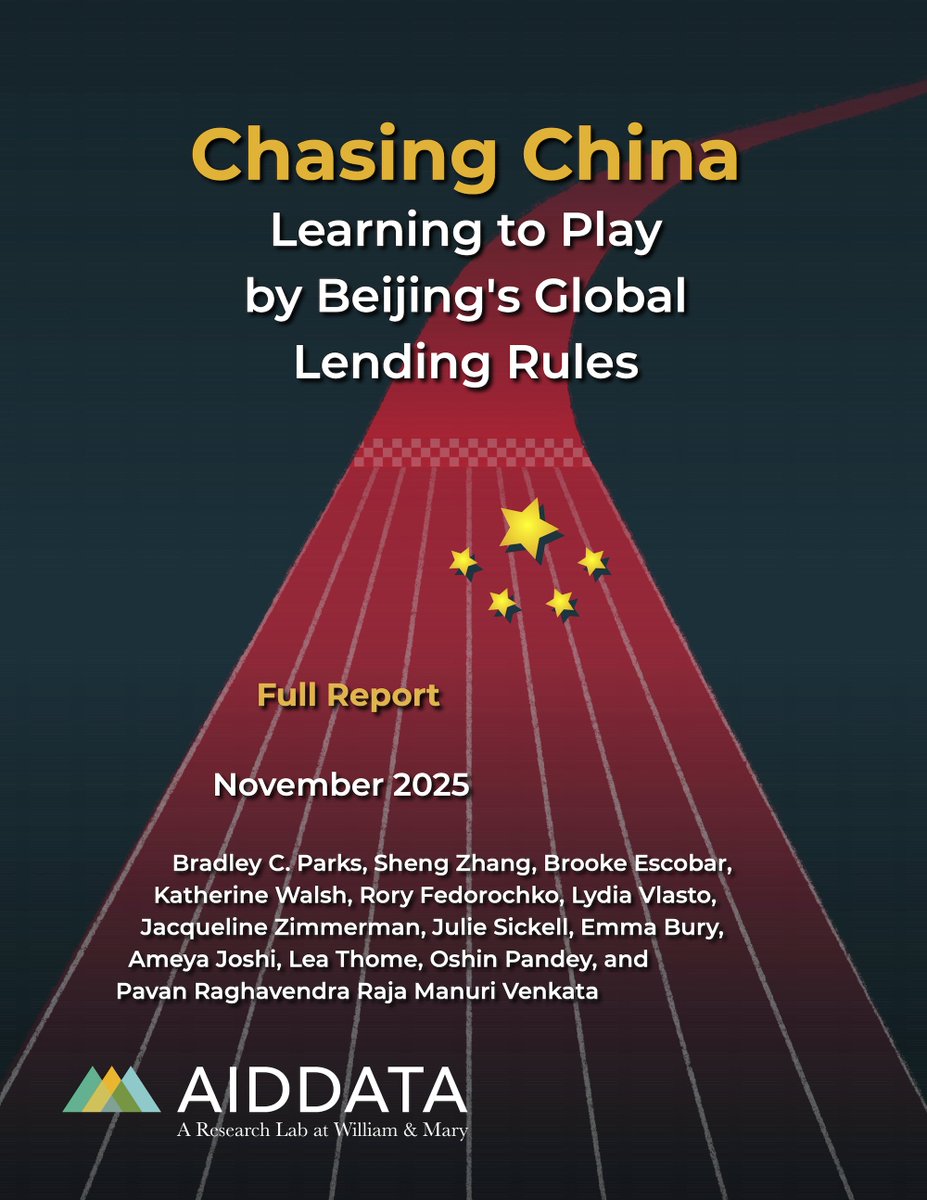
📢 Today, @AidData is thrilled to launch a new flagship report and dataset tracking trillions in China’s global lending and grant-giving—including, for the first time, in high-income countries.
🇨🇳 “#ChasingChina: Learning to Play by Beijing’s Global Lending Rules” sets the record straight on the true scale, purpose, and impact of China’s overseas financing, with a uniquely comprehensive source of evidence.
📌Our new global dataset provides granular detail on 30,000+ projects and activities financed by loans and grants from 1,193 Chinese official sector entities worth $2.2 trillion across 217 countries from 2000 to 2023.
🔗 https://t.co/whvPjwqOvO
CFR welcomes @ChrisRMcGuire as a senior fellow for China and emerging technologies. He is a leading expert in U.S.-China technology competition, export controls and other technology protection policies, artificial intelligence, and semiconductors. McGuire served as a career government official for over a decade, including as the deputy senior director for technology and national security at the National Security Council.
Read his bio: https://t.co/3PLU3OFf0W
As aid budgets tighten, the U.S. is rethinking how to align foreign assistance with strategic competition—particularly with China. @williamhenagan and Jon Finer argue that clearer objectives are key to restore support. https://t.co/wCAzZnz084
This new form of “American state capitalism” can be conceptualized through three distinct ways in which the United States is now intervening in specific firms—as an investor, as a broker, and as a rentier, write @williamhenagan and Ely Sandler.
https://t.co/h2HXZ9zjIA
What I’ll be watching for at Wednesday’s blockbuster Supreme Court hearing on Trump’s IEEPA tariffs, beyond the obvious vote counting:
(Brief case recap at the bottom of the post).
1. FIRST KEY ISSUE: Do (m)any Justices look for a compromise position?
My view remains that SCOTUS is most likely to decide either (a) IEEPA authorizes no tariffs at all because IEEPA’s power to “regulate” the import of property does not include the power to tariff; OR (b) that IEEPA provides a flexible tariff tool, because IEEPA’s power to “regulate” imports does include a tariff power, and IEEPA is a flexible statute. (IEEPA does not mention "tariffs" or "duties," but it does include the power to "regulate...importation or exportation of...any property..."). But Justices could look for a compromise position that IEEPA can be used to impose some tariffs by not others.
I see two potential compromises: (1) IEEPA authorizes tariffs for “geopolitical” reasons, such as the tariffs on Brazil and India, but not the “universal” or “reciprocal” tariffs, because when Congress enacted Section 122 in the Trade Act of 1974, which allows the President to impose 15% tariffs for 150 days, Congress made Section 122 the President’s only tool to impose “trade deficit” tariffs. (2) That IEEPA authorizes a wide variety of tariffs but that IEEPA tariffs must be subject to some kind of limits in scope, e.g., maximum rates and/or limits on duration. The problem I see with this second approach is that it is hard to discern WHAT those limits might be, particularly given how flexibly IEEPA has been used to impose sanctions in the past.
2. SECOND KEY ISSUE: How worried are Justices about the precedential impacts? Precedents could cut both ways. First, if SCOTUS upholds Trump’s tariffs, IEEPA could presumably be used to tax imports (and exports) not just of goods, but of other kinds of “property” as well, such as inbound and outbound FDI. Given that “services,” such as digital services, could as "property," could IEEPA tax services imports and exports? Are Justices worried about this precedent?
Second, on the other hand, if the Court sets limits on how IEEPA can be used, is it worried that any limits imposed on IEEPA *tariffs* might not just constrain tariffs, but other future uses of IEEPA, such as for sanctions? E.g., if the Court decides that IEEPA tariffs must be limited in duration or rate, does that mean future IEEPA sanctions programs would have to be limited in duration or severity? If so, that could have big future implications.
3. KEY ISSUE THREE: Refunds. If SCOTUS rules that IEEPA tariffs are unlawful, importers who have paid the tariffs should be legally entitled to a refund—just as if Trump had unilaterally raised my income taxes, and that was later thrown out, I’d get a refund the on taxes I was illegally forced to pay. But I also think that the Trump might not make it easy for importers to get refunds, e.g., he might only provide refunds to companies that bring suit seeking them. Will the Court get into this issue at all, e.g., will it consider mandating a refund process (as suggested in one amicus brief)? Or will this be left to the lower courts to sort out?
CASE RECAP: I continue to view the correct decision as being that IEEPA does not authorize tariffs at all, as we argued in the Congressional amicus brief that I was involved in.
The case involves three different lawsuits against Trump’s IEEPA tariffs. IEEPA is a 1977 emergency powers law that previous Presidents used to impose dozens of sanctions programs and other national security restrictions, but which no previous President has used for tariffs. IEEPA does not use the word “tariff” or “duty,” but the government argues that IEEPA's power to “regulate” the “importation” of “property" includes a power to “tariff.”
IEEPA is the legal basis for Trump’s E.O. 14257 “reciprocal” and “universal” tariffs; the “fentanyl” tariffs on China, Canada, and Mexico; the “Bolsonaro” tariffs on Brazil; and the “Russia oil purchases” tariffs on India. Trump’s “product” tariffs, on steel/aluminum; cars; trucks; copper; timber/lumber (and derivative products like cabinets); and various products to come (semiconductors, pharma, critical minerals, etc.) are done under a different statute and are not at issue in this SCOTUS case. I’ve seen estimates that, in dollar terms, perhaps 70% of Trump’s Term 2 tariffs are at issue in the case.
It’s a spooky time of year for recovering globalists.
Thanks for the inspiration @USTradeRep@RealPNavarro .
Disclaimer: This costume was made in India and tariffed accordingly.
This new form of “American state capitalism” can be conceptualized through three distinct ways in which the United States is now intervening in specific firms—as an investor, as a broker, and as a rentier, write @williamhenagan and Ely Sandler.
https://t.co/h2HXZ9zjIA
In the United States, Americans and their government must now reconsider what types of spending best advances America’s interest at home and abroad, write Jon Finer and @williamhenagan. https://t.co/uqgeVtpVg2
If the U.S. government cannot move its internal machinery to extend a popular agency’s basic ability to function, the United States will fail to outcompete its adversaries, writes @williamhenagan. https://t.co/nz9TC1VoDh
Multiple agencies and authorities that support the U.S. national security enterprise will expire unless Congress acts quickly, putting America's ability to outcompete China at risk, writes @RushDoshi and @williamhenagan.
The reauthorization clock is ticking for critical agencies and authorities like the @DFCgov and DPA - and failure to act could spell disaster for US investment tools at home and abroad. @RushDoshi@lawfare https://t.co/YXlEpA5iIM
After years of prolonged conflict and unnecessary death, there is a clear need to force Putin’s hand. President Trump’s instinct is right, but his approach is wrong. There’s still time to change course—and an urgent need to.
https://t.co/JgR4vv2PEr