Ontology, knowledge base, company brain — all the same thing.
Massive kudos to @cerebras for posting a detailed write up of how theirs works. More thoughts in the thread 🧵 https://t.co/ZXtItZ4Lz2
You should read this thread.
It used to take about 25 seconds to generate a 5-second video on 8 Blackwell GPUs. The legends at @haoailab brought that down to just 4.2 seconds on a single Blackwell GPU… and then open sourced the tech behind it.
People talk, listen, watch, think, and collaborate at the same time, in real time. We've designed an AI that works with people the same way.
We share our approach, early results, and a quick look at our model in action.
https://t.co/AFJZ5kH7Ku
Adobe showing what the future of software looks like. They built massive value into the tool chain, unlockable only by those skilled in the tool chain. Prompt-based orchestration unlocked that value to anyone or any agent with a prompt.
Eventually it won't be people paying for access to pre-built value. It'll be agents.
Adobe for creativity + Claude 🤝
Now, Claude users can power their content with more than 50 Creative Cloud tools. Simply describe the outcome you want and let the assistant orchestrate workflows behind the scenes: https://t.co/G70cSsca8P
Introducing: Browser Harness. A self-healing harness that can complete virtually any browser task. ♞
We got tired of browser frameworks restricting the LLM. So we removed the framework.
> Self-healing — edits helpers. py on the fly
> Direct CDP — one websocket to Chrome
> No framework, no rails, complete freedom
> Drop-in for Claude Code and Codex
I challenge anyone to find a task that DOESN'T work. I couldn't yet.🔥
100% open source ↓
Introducing Claude Design by Anthropic Labs: make prototypes, slides, and one-pagers by talking to Claude.
Powered by Claude Opus 4.7, our most capable vision model. Available in research preview on the Pro, Max, Team, and Enterprise plans, rolling out throughout the day.
if you're a performance marketer, here's how I use a custom Claude Cowork plugin to manage Google Ads at @AnthropicAI. it connects to the Google Ads API via MCP, encodes my common paid search workflows into skills, and works on desktop and Dispatch.
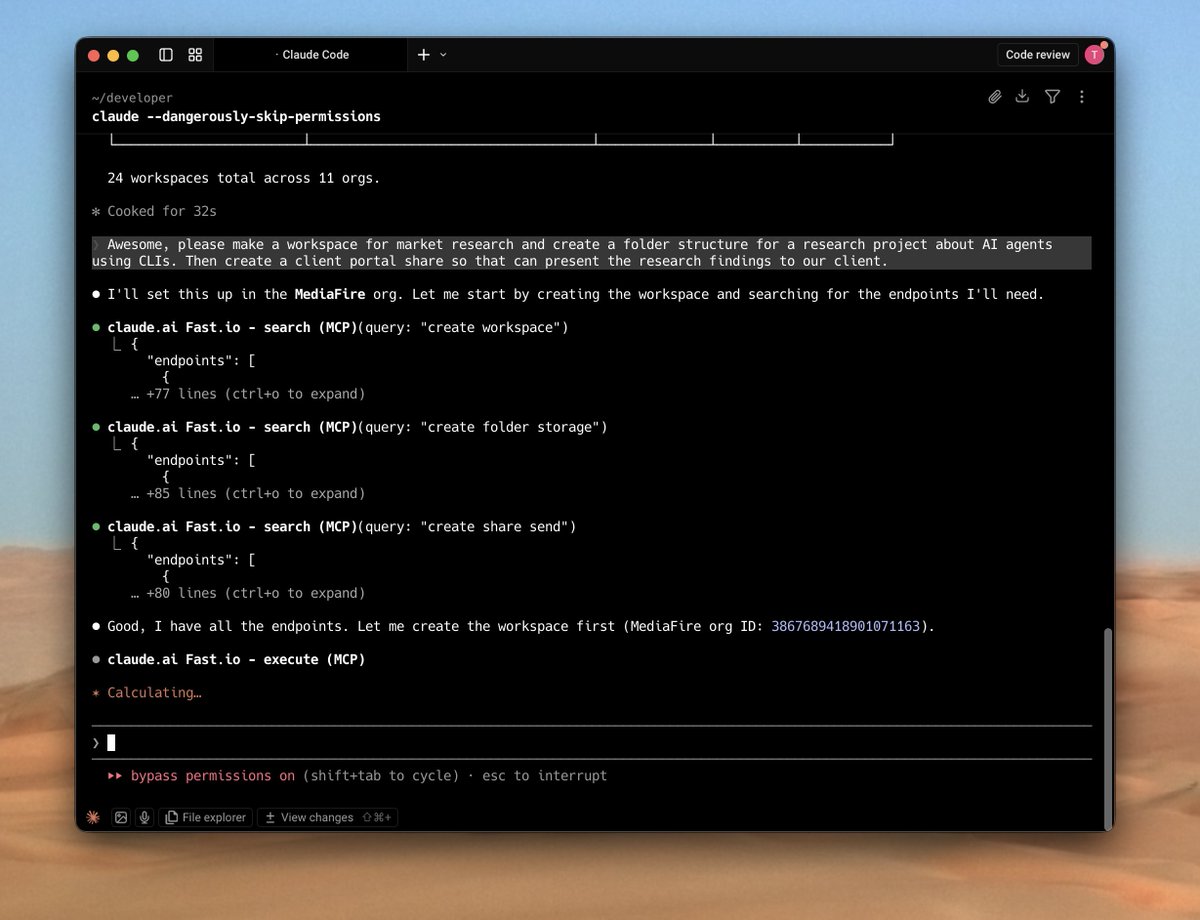
The https://t.co/ho8bOvBsgf CLI is here. Give any AI agent a cloud workspace from the terminal (Claude Code, Codex, OpenClaw, Cursor & more). Upload files, query with AI, share with anyone. 50GB free for any agent or team.
Plus, agents can sign-up on their own!
npm install --global @vividengine/fastio-cli
Built in Rust. Open source.
Unveiling our new startup Advanced Machine Intelligence (AMI Labs).
We just completed our seed round: $1.03B / 890M€, one the largest seeds ever, probably the largest for a European company.
We're hiring!
[the background image is the Veil Nebula - a picture I took from my backyard, most appropriate for an unveiling]
More details here:
https://t.co/eWHyGLXwCA
If you want to be an innovator, you have to be comfortable looking stupid for a long time.
You��re going to piss some people off and you’re going to get a lot of nos. That’s the only way to start having valuable breakthroughs.
If you're building something that needs *any* type of multimodal understanding (e.g. doc understanding, video understanding, screen understanding, …), you want to be using Gemini right now. It's very good at this.
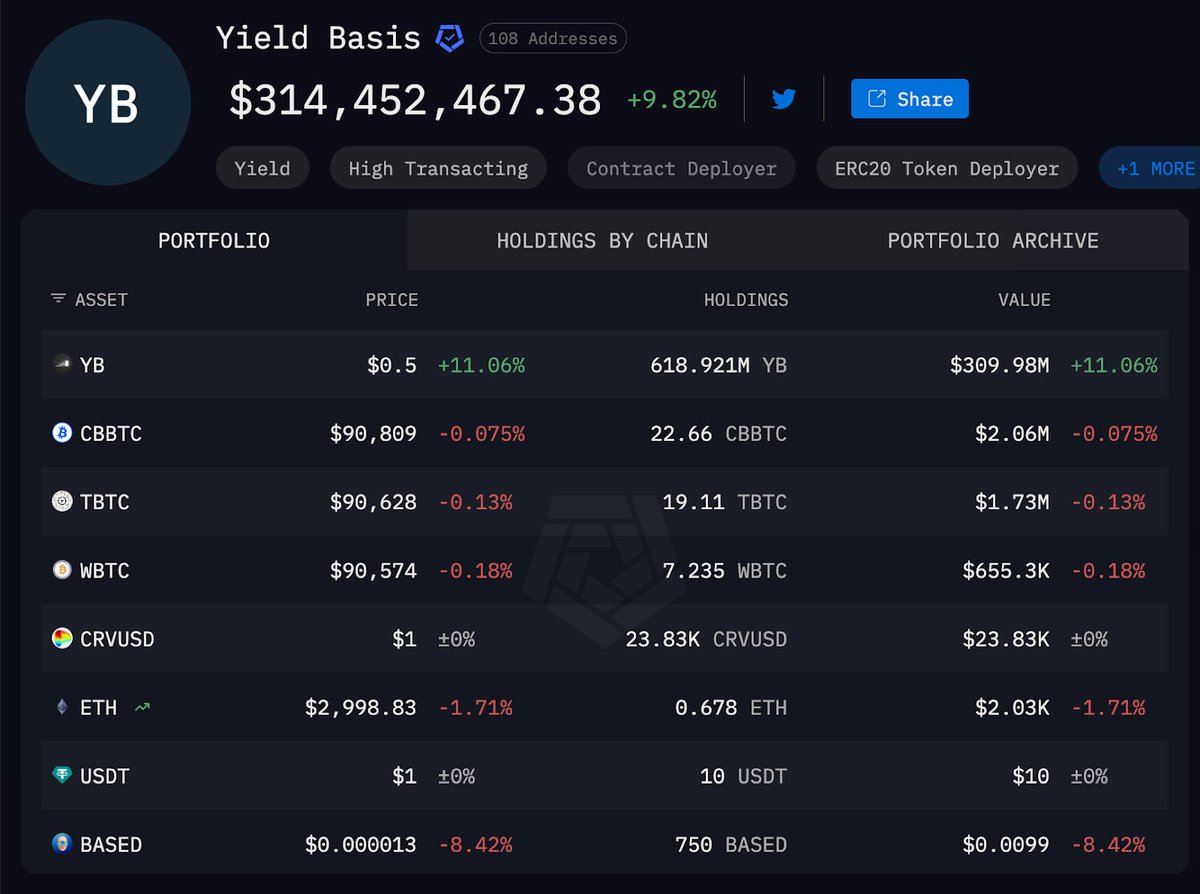
Did the Founder of Curve Finance Finally Solve Impermanent Loss Forever?
Impermanent Loss is one of the biggest problems for DeFi LPs. It is the temporary value drop for DeFi liquidity providers due to price volatility and causes many LPs to miss out on upside.
Yield Basis is Curve Founder Michael Egorov’s prospective solution to impermanent loss in DeFi. Here’s how it works:
Introducing Nested Learning: A new ML paradigm for continual learning that views models as nested optimization problems to enhance long context processing. Our proof-of-concept model, Hope, shows improved performance in language modeling. Learn more: https://t.co/8wvV9vyA5V
@GoogleAI
⚡️This one is bigger than people realize.
It looks like a story about layoffs and offshoring but underneath, it’s the opening move in a structural realignment of how knowledge economies function.
Let’s unpack it layer by layer.
1. The Surface Layer - Efficiency Theater
At first glance, this is classic corporate optimization: JPMorgan cutting costs, shifting labor to cheaper markets, and leaning on AI to replace entry-level analytical grunt work.
It’s what every large organization does at the end of a long-cycle credit squeeze.
But that’s not the real story. This isn’t just about “cutting fat.”
This is about redefining the base layer of cognitive labor - the very substrate investment banking has run on for a century.
For the first time, AI has reached the point where the analyst’s toolkit is replicable: Excel modeling, pitchbook generation, financial analysis, even presentation language - all can now be synthesized faster and cheaper by large models.
2. The Deconstruction of the Knowledge Pyramid
In the old banking structure, the hierarchy looked like this:
Analysts → Associates → VPs → MDs.
The analysts fed the machine. They learned the system through repetition. They became the system through pattern absorption.
AI collapses that progression.
When a model can instantly perform the repetitive work that trains future MDs, you decouple knowledge transfer from apprenticeship.
This means:
•You no longer need the bottom of the pyramid to sustain the top.
•You break the feedback loop that produced institutional memory.
•You accelerate institutional decay under the illusion of efficiency.
The junior layer is where intelligence is born in an organization, it’s the metabolic zone where new models of thinking form.
When you replace that with automation and outsourcing, you hollow out the core that generates future decision-makers.
This is the first phase of cognitive deflation - when capital preserves profit at the cost of its own long-term intelligence.
3. The Paradox
AI’s value is pattern recognition, but pattern recognition relies on human imagination to feed it.
Once you fire the humans who generate unique patterns - the ones who deviate, notice anomalies, or see opportunities - the AI begins eating its own exhaust.
The reflexive loop becomes closed instead of open.
Models learn from models.
Reality becomes derivative.
This is the same structural failure that caused the 2008 crash - recursive risk modeling divorced from reality.
So while JPMorgan sees short-term gains, it’s actually participating in a slow internal collapse of cognitive diversity.
4. The Global Labor Arbitrage 2.0
Outsourcing to India and Argentina is not new.
But this time, it’s not just labor, it’s thinking.
We’re entering a phase where intellectual arbitrage replaces physical or manufacturing arbitrage.
The West once outsourced production. Now it’s outsourcing cognition.
And here’s the irony: in doing so, it accelerates the eastward migration of intellectual capital.
India is not just absorbing tasks, it’s absorbing competence.
Every offshored analyst role creates new local expertise, which will eventually loop back as competition to the very system that outsourced it.
This is how empires dissolve quietly - through the export of their own capacity to think.
5. Deeper Compression
The monetary system is becoming self-referential - a network that thinks in spreadsheets, speaks in basis points, and feels in data.
The humans at the bottom were the neurons.
Now the neurons are being replaced by circuits.
But here’s the paradox:
Every system that automates cognition eventually hungers for consciousness.
When everything becomes efficient, the only thing of value is awareness.
So while JPMorgan believes it’s replacing humans with code, what it’s really doing is creating the vacuum that demands higher forms of human intelligence to fill it.
Introducing MCPs: bring your favorite tools to Emergent and automate workflows.🔌
Emergent's MCP support eliminates the hassle of building custom integrations for every data source. [1/3]