research taste exists in isolation to technical ability, it stems from a first-principles, heuristic-driven, intuition of the world.
why neurons and not folds? which human processes should we take inspiration from? none of these are technical questions
This is precisely why model EQ is far than just stylistic tone, the gap between simple task completion and complex long-horizon decision making in domains like sales, writing, and design is human judgment. How do we quantify and instill human judgment?
Context is one way, but reward hacking is ultimately limited. We need to fundamentally rethink the way we pre-train, midtrain, and post-train on EQ data.
Taste is invisible until you try to write it down.
This is probably my biggest lesson with AI building as of late.
At @TeamSundial, I get to work with really friggin' amazing analysts who know the art, and I see how much of our collective time now is now spent turning that art into playbooks or skills for an LLM.
Encoding things like: "How would a great analyst actually look at this metric move?" or "What is ACTUALLY the interesting signal in this story versus noise?" or "How can we know if a product change actually moved the needle?"
It's really humbling work!
You write an instruction set. The LLM misses. You add more context. It still misses. You add even more. Now it's confused. You strip it back. Now it's too vague. You try a different framing. Better, but inconsistent. Works on Monday, fails on Tuesday. You go again.
I've come to realize the gap between 70% quality and 95% quality is not 3 or 4 big things. It's more like 100s of small things. Which is exactly why you can't write an article about it, or copy it, or shortcut it!
This gap *is* taste, quantified. The accumulated weight of a thousand small judgments you don't notice you're making, until you sit down to externalize them and realize you can't.
Being good at something is not the same as being able to articulate why you're good at it.
I now see two bottlenecks to making something better than today's generic AI:
1. Can you *see* what better looks like in the first place?
2. Even if you can see, can you *articulate* what that is in a way that the LLM can understand and systemize?
#2 is now a new craft, the art of distilling the art.
The people who can do it well are the ones building standout products.
It's worth contemplating whether creativity is inherently out of distribution
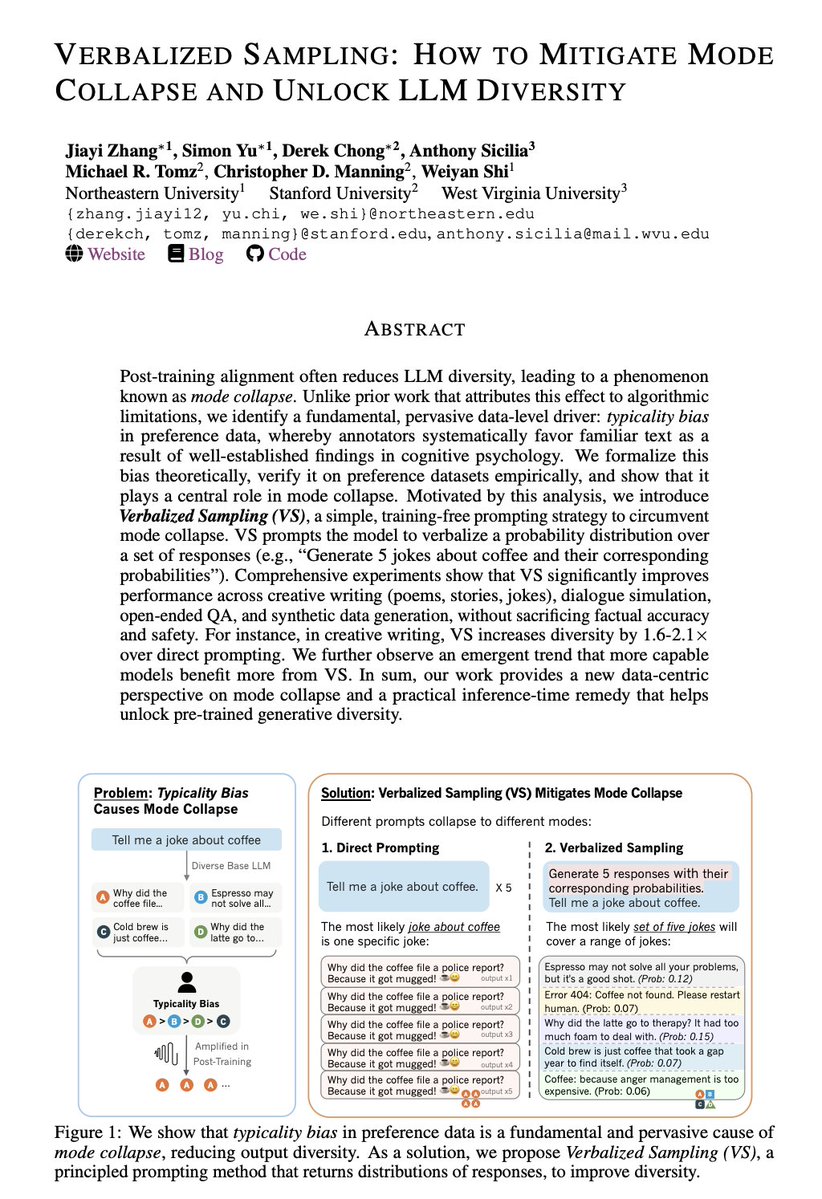
The most creative ideas aren't just atypical, they exist outside of standard probability distributions. While prompt hacking with verbalized sampling may yield improvements, it doesn't solve the problem that the current distributions are broken due to RLHF averaging towards slop.
More foundational solutions are needed, such as epsilon-greedy algorithms that promote random exploration.
Stanford proved that ChatGPT, Claude, and Gemini are all secretly running at a fraction of their real creative capacity.
And one prompt unlocks the version they hide from you.
This paper reveals that the multi-billion dollar process of "Alignment" (RLHF) has accidentally lobotomized AI creativity.
Researchers discovered a phenomenon called Typicality Bias.
When humans rate AI responses, they have a deep psychological drive to choose the most "typical" or familiar-sounding answer.
They don't want the most creative story; they want the one that sounds most like a generic story.
The AI learned this.
It realized that being truly creative actually hurt its safety and preference scores.
So it entered a state of "Mode Collapse", it effectively hid its most original ideas to stay within the safe, boring boundaries we set for it.
But the creativity is still there. It’s just locked.
Stanford researchers found a "master key" to bypass this training and it is ridiculously simple.
They call it Verbalized Sampling (VS).
Instead of asking the AI for one answer, you ask it to verbalize a distribution of responses and their probabilities.
Ex: "Generate 5 unique jokes about coffee and the probability that each one is actually funny."
The results are staggering:
- 2.1x increase in output diversity.
- 25% jump in human evaluation scores for creative writing.
- Zero loss in factual accuracy or safety.
By forcing the model to calculate its own probability distribution, you "unlock" the 66.8% of generative diversity that was suppressed during training.
@WarnerTeddy love this! The fix for sycophancy isn't to remove or suppress emotion, but to integrate emotion in every step of pre + post training and model constitutions
One of the worst takes I've heard in a long time
Politicians will blame billionaires for every problem before taking responsibility for the broken system they constructed
Capitalism is the most powerful mechanism for social mobility, it is fundamental to the American Dream. AOC hates what makes America America.
The single largest form of theft in America is wage theft. $50 billion a year are stolen from American workers.
If a billionaire amasses their wealth by underpaying their full-time workers so severely that they must rely on food assistance and government programs to survive, then no, that wealth was not earned by one individual - it was a wealth transfer subsidized by underpaid American workers and the public who get stuck with the bill for large corporations free-riding off our systems.
The point is less about individual morality. It’s more about how our current economic reality of shattering inequality rewards screwing over workers and exploiting essential systems at scale.
We’re talking monopoly power. Rent-seeking. Wage theft. Profiteering. Stock buybacks. Destabilizing housing markets. Companies using SNAP/EBT to underwrite their wages. Massive government subsidies or contracts to corporations following lobbying and dark money in politics with little to no oversight or accountability.
Some people get enraged that I draw attention to this. That’s on them. Let them call me shrill, dumb, inexperienced, girly, uneducated - these folks will say anything to distract from or undercut the truth that working people are getting screwed, and giving people a fair shake means we must have a grown conversation about reigning in abuse of power.
https://t.co/8HKhtCQggW I've never read Dario's writing but just a few lines in and I can feel his brilliance, fascinating piece on mechanistic interpretability, fundamentally reshaped my understanding of ai
In LLMs: The concepts that these combinations of neurons could express were far more subtle than those of the single-layer neural network: they included the concept of “literally or figuratively hedging or hesitating”, and the concept of “genres of music that express discontent”.
holy aura bro
John Doerr made his fortune primarily as a legendary venture capitalist at Kleiner Perkins, where he led early, pivotal investments in tech giants like Amazon ($8M for 15%) and Google ($11M for 11%) @johndoerr
Is emotional intelligence fundamental to AGI?
Researchers split into two camps:
1. Emotions are disorganized interruptions of mental activity, leading to model hallucinations and disruptions to IQ (i.e. OpenAi killing EQ team @sama, perhaps that's why GPT misses the mark on personality).
2. Emotion as an organizing response because it
adaptively focuses cognitive activities and subsequent action. My point here is not that LLMs should build human-like processes (working memory, STM, dual-process), but that the mechanisms producing emotions are also the mechanisms required for great flexibility in a complex environment. It is precisely this flexibility that frontier labs are failing at, and it will not be solved by more post-training on math and coding verifiable problems.
We need a fundamentally different approach, EQ is critical.