In love with Stella, Father of Cecilia, Ximena and Alexis. Maths & Computers passionate ! Working for Microsoft Corporation since 1996. Tech & Biz impact !
Outstanding, Look up. The sky is putting on a show you won't see again until 2028.
A rare Blue Moon is rising on May 30, peaking in the early hours of May 31 at 8:45 UTC.
It marks the second full moon of May and the first time two full moons have appeared within a single calendar month since August 2023.
But the Moon won’t have the stage to itself.
Venus and Jupiter will shine low in the western sky shortly after sunset, while Mars and Saturn rise in the east before dawn. Mercury will also join the western evening lineup, creating an impressive planetary display.
Four planets.
One Blue Moon.
One sky.
What makes this event even more special is that this Blue Moon is also a micromoon — the smallest full moon of the year, located about 252,360 miles from Earth near its farthest orbital distance.
A micromoon. A Blue Moon. A planet parade. All happening at the same time.
On May 30, the Moon will appear close to Antares, the bright red heart of Scorpius. For the best view of the planetary lineup, step outside 30–45 minutes after sunset and look toward the western horizon. If you want to catch Mars and Saturn, set your alarm before dawn and look east.
And despite its name, the Blue Moon won’t actually appear blue. The term comes from the calendar, not the Moon’s color.
The next event like this won’t arrive until December 2028.
Don’t miss it.
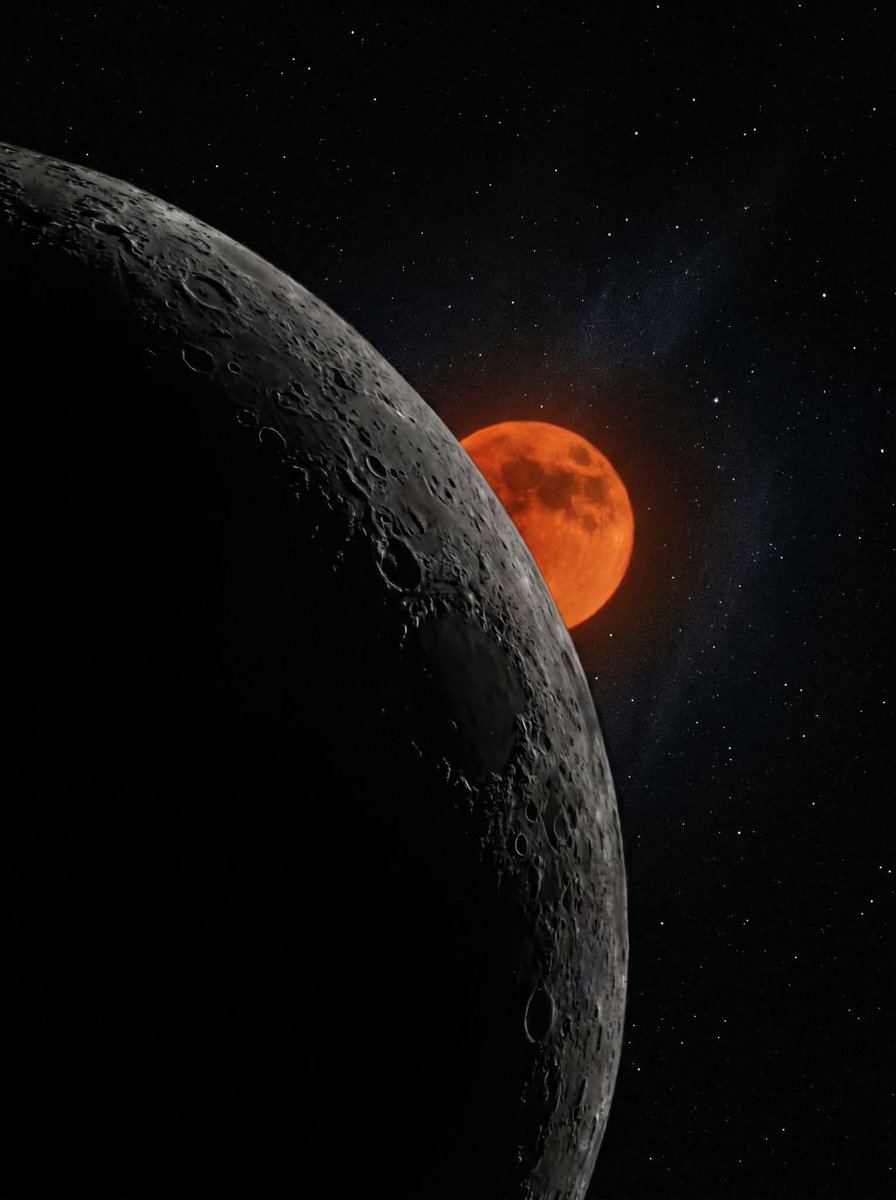
Prepare for the Ultimate Celestial Showdown on May 31 2026 When the Mesmerizing Blue Moon Reveals an Hidden Astronomical Secret in the Deep Night Sky -- An exceptional star passage passing directly behind the glowing lunar disk provides skywatchers with a highly compelling incentive to peer upward after dusk. This magnificent event beautifully illustrates how a solitary cosmic alignment can showcase several profound chapters of authentic space drama.
🚨: On May 31, 2026, skywatchers will see a rare calendrical Blue Moon the second full moon to appear within the same calendar month 🌕🔵
The first full moon of May 2026 occurs early in the month, while the second arrives on May 31, creating the timing needed for a Blue Moon.
On May 31, 2026, the Moon will shine in its full phase — marking the second Full Moon of the month. This rare occurrence is known as a calendrical Blue Moon, a celestial event that happens only once every few years.
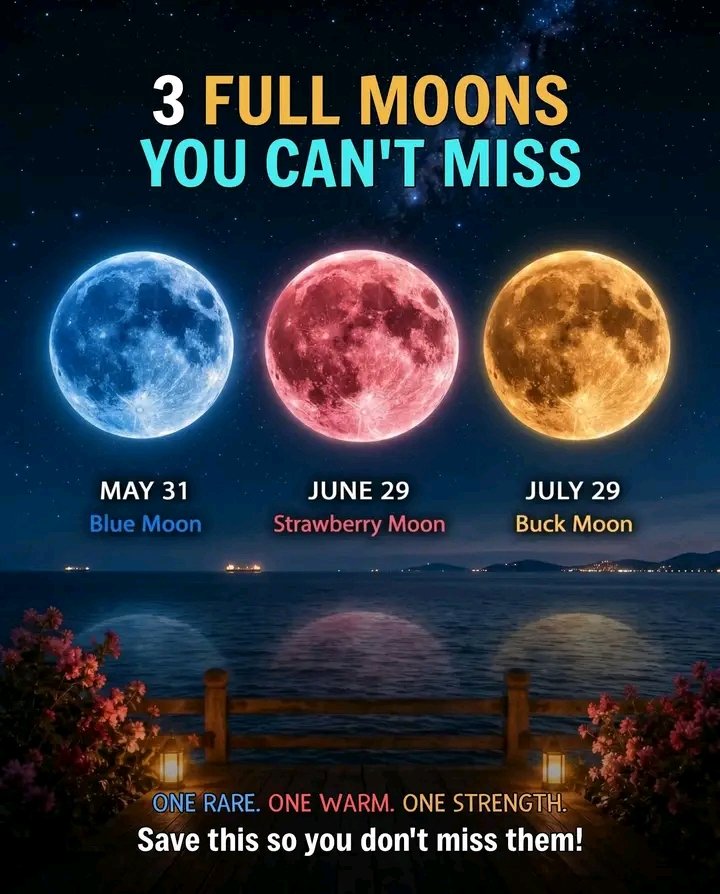
Three unforgettable moons are about to light up the night sky. 🌕✨
From glowing blue skies to warm summer moonlight, each full moon brings its own beauty and atmosphere. Rare, colorful, and breathtaking — these are celestial moments worth watching.
🔵 May 31 — Blue Moon
A rare second full moon in a single month!
🌸 June 29 — Strawberry Moon
Named for the ripening of wild strawberries.
🦌 July 29 — Buck Moon
Named for the time when new antlers begin to grow on deer.
Save these dates and don’t miss the magic above! 🌌
Look up tonight — the sky is putting on a rare show that won’t happen again until 2028. 🌌
A rare Blue Moon rises on May 30, while Venus, Jupiter, and Mercury glow in the western sky after sunset. Before dawn, Mars and Saturn appear in the east, creating an incredible planetary lineup. ✨
This full moon is also a micromoon — the smallest full moon of the year because it’s near its farthest distance from Earth.
One Blue Moon. Four planets. One unforgettable night sky.
And despite the name, the Moon won’t actually look blue. 🌕
🌕 On May 31, we'll have a second full Moon this month. That's what we call a Blue Moon but it won't be blue at all 😂
A Blue Moon is simply the second full Moon in the same calendar month, and it only happens about every 2 to 3 years.
🌕✨ Look up—this is no ordinary full Moon.
On May 30–31, a rare Blue Moon lights the sky alongside Venus, Jupiter, Mars, and Saturn, creating a stunning planetary display. 🌌
This Blue Moon is also a micromoon, occurring near the Moon’s farthest point from Earth, making it appear slightly smaller and dimmer than usual.
It won’t actually look blue—but with four planets and the bright red star Antares nearby, it’s a night sky worth remembering. ✨👀
Astronomy.
This Sunday, May 31, we get a rare "Blue Moon": the second full moon in May. This particular Blue Moon is special because it is also a micro-moon. Once in a blue moon, indeed!
I love lunar trivia. What’s your favorite Moon fact or memory?
Look up . The sky is putting on a show you won't see again until 2028.
A rare Blue Moon is rising on May 30, peaking in the early hours of May 31 at 8:45 UTC.
It's the second full moon of May, and the first time two full moons have shared a single calendar month since August 2023.
But the moon isn't doing this alone.
Venus and Jupiter are lining up low in the western sky just after sunset. Mars and Saturn are climbing in the east before dawn. Mercury joins the western evening lineup too.
Four planets. One Blue Moon. One sky.
Here's the kicker — this isn't just any full moon. It's the smallest full moon of the entire year, sitting roughly 252,360 miles away at its farthest point from Earth.
A micromoon. A Blue Moon. A planet parade. All at once.
The moon will glow right next to Antares, the red heart of Scorpius, on May 30. For the best view of the planetary lineup, step outside 30 to 45 minutes after sunset and look west. Set an alarm before dawn if you want to catch Mars and Saturn rising in the east.
And no, despite the name, the moon won't actually look blue. The name comes from the calendar quirk, not the color.
The next one like this won't happen until December 2028.
Don't blink.
The only blue moon of 2026 is rising on May 31st! 🌕
Although this is called a “Blue Moon”, it won't actually be blue. This celestial event occurs when a second full moon rises in a single calendar month. The lunar cycle runs about 29.5 days, so when we’re lucky a second full moon fits into the same month, and this one will be visible to the whole world. Be on the look out so you don’t miss it!
🚨: Tonight a rare Blue Moon will rise. Don't miss it!
The Moon will reach its full phase. It will be the second Full Moon of May, which makes it a calendrical Blue Moon
instead of watching 2 hours of Netflix tonight, watch this Stanford lecture
it's the clearest explanation I've seen of how ChatGPT and Claude actually work
useful whether you've never touched AI in your life or have been using it every day for the past year
I took the key ideas and turned them into a practical guide on how to actually get 100% out of Claude
everything in one place
Anthropic just paid millions to hire Andrej Karpathy.
He gave you the same knowledge for $0 the same week.
Co-founder of OpenAI. Former head of AI at Tesla. The man who coined vibe coding.
No recruitment fee. No exclusive access. Just a link and 29 minutes.
LLMs are ghosts not animals.
Vibe coding is dead.
Software 3.0 is here.
Watch it.
Then read this.
Because Karpathy tells you what Software 3.0 is.
This shows you how to build one - a software factory with Claude Code that ships features while you sleep.
The full build guide is below.
Forget the noise.
If you want a solid foundation in AI, this 9-part @Stanford series is still one the gold standards.
Just the core fundamentals explained by the people who teach this for a living.
Lecture 1 - Transformer:
→ https://t.co/BcPMBcIgBZ
Lecture 2 - Transformer-Based Models & Tricks:
→ https://t.co/NhRK4onWmM
Lecture 3 - Transformers & Large Language Models: → https://t.co/pQiLWGALZu
Lecture 4 - LLM Training:
→ https://t.co/pQiLWGALZu
Lecture 5 - LLM tuning:
→ https://t.co/EQrIIPeupI
Lecture 6 - LLM Reasoning:
→ https://t.co/ZNZY9QLzMQ
Lecture 7 - Agentic LLMs:
→ https://t.co/zKvdh6ogIs
Lecture 8 - LLM Evaluation:
→ https://t.co/eqM8i8VPVq
Lecture 9 - Recap & Current Trends:
→ https://t.co/BcPMBcIgBZ
Master the basics, and the rest gets easy.
math is the real engineering toolkit
what you actually need:
linear algebra → vectors, matrices, ML
calculus → change + motion
probability → uncertainty as numbers
graph theory → networks & connections
optimization → best use of limited resources
If Steve Jobs were still alive, he would have the moral authority to face and maybe even to solve this problem. But I doubt anyone in the phone business now does.
MasterClass CEO David Rogier has sat down with hundreds of successful people, from tennis star Serena Williams to former Walt Disney CEO Bob Iger, to learn what sets them apart from everyone else. Rogier’s top takeaway: Some common myths about success need dispelling.
“I think we have this myth that, if you just work hard, things will be OK [and] you’ll be successful,” says Rogier. “That’s not true.” Hard work, while essential, is just one necessary ingredient of success alongside pushing yourself out of your comfort zone, making mistakes and learning from those failures, he adds.
Find out what other common myth he believes are worth debunking: https://t.co/VIBecjr74J













![CNBC's tweet photo. MasterClass CEO David Rogier has sat down with hundreds of successful people, from tennis star Serena Williams to former Walt Disney CEO Bob Iger, to learn what sets them apart from everyone else. Rogier’s top takeaway: Some common myths about success need dispelling.
“I think we have this myth that, if you just work hard, things will be OK [and] you’ll be successful,” says Rogier. “That’s not true.” Hard work, while essential, is just one necessary ingredient of success alongside pushing yourself out of your comfort zone, making mistakes and learning from those failures, he adds.
Find out what other common myth he believes are worth debunking: https://t.co/VIBecjr74J](https://pbs.twimg.com/media/HIhCuB_XAAAVVgr.jpg)


