If you're looking for a high-level introduction to the core ideas in authorization and how to use it to improve security and user experience by automating access control, check out my latest book, Authorization in Action from @ManningBooks https://t.co/DjvFYESogy
Check out my latest article: Women & Financial Security in Utah: Awareness Is Rising — But Utilization, Confidence, and Access Still Lag https://t.co/2wcx10PVap via @LinkedIn
Release 1.9 of the pico engine lets a pico present its own user interface. A view is a shared function that returns XMLUI markup, and channel policy decides who gets to see it. This post describes the release, the sensor temperature viewer I built with it, and why a pico that can show itself to people is more complete than one that depends on someone else's front end.» Giving Picos a View https://t.co/RUNcI3xCAr
Programming models shape how builders think, and that's still true when the builder is a coding agent. Picos are a programming model far enough from the mainstream that most developers, human or not, start out writing them like a web service with a database. This post lays out the mindset behind picos » Way of the Pico
https://t.co/TBOtCMVyQJ
Dave Winer @davewiner has launched BonBonWeb. I like that the presentation is controlled by the reader, not the writer and that the source is quickly available. Reminds me of what the web used to be. I like it. https://t.co/RIdTYhwWwu
I used to be a language lawyer. In the late 80s I _studied_ the ARM (Annotated Reference Manual for C++). I knew the language cold, inside and out. I could make it do backflips. I shipped a lot of code using it. A LOT.
I’ve attacked other languages with a similar intensity and depth. Until recently, that was simply the only way to become adept at building software systems.
I now consider the deep understanding of a language to be a supreme waste of time and effort. I don’t want to learn Rust, or Golang, or Typescript, or any of the thousands of other languages out there. I’ll leave that to my agents.
What I need now is to understand the high level gestalt of the system. I want to see the systems and subsystems. I don’t need to inspect the cogs. If I truly need to understand a detail at the cog level, I’ll interrogate my agents. I’m not going to pretend to be a language expert anymore.
This is the way. People are shocked that I use AI all the time, but never on my own machine. Open claw, Hermes, grok @bot all running in a Mac mini. Separate email. Separate phone number. Separate Twitter (@clawdreyhepburn if you want to say hi). Don’t let agents impersonate you - give them their own identities.
Save 45%, only on Nov. 5th!
Today, you can save on Authorization in Action by @windley and other related titles: https://t.co/nojZ0m0NRI
Learn how to use the Cedar policy language to integrate modern access control efficiently into both new and legacy applications.
Save 45%, only on Nov. 5th!
Today, you can save on Authorization in Action by @windley and other related titles: https://t.co/nojZ0m0NRI
Learn how to use the Cedar policy language to integrate modern access control efficiently into both new and legacy applications.
Founders are told to look for a trillion-dollar market. When software gets cheap to build, the same trillion dollars can show up as a billion thousand-dollar markets: one small organization at a time, each with software that fits how it actually works. » One Billion Thousand-Dollar Markets https://t.co/7eHsqvhvtA
Understand LLMs, from deep learning to GPT construction, with chapters from:
Free ebook: https://t.co/3vGJwurHbQ
From deep learning fundamentals to transformers and GPT construction, understanding LLMs means connecting the pieces.
You can start learning from:
• Build a Large Language Model (From Scratch) by @rasbt
• Transformers in Action
• Deep Learning with Python, 3rd Ed. by @fchollet and Matthew Watson
Want to check them out first? Explore some of their chapters in in our free Inside the LLM ebook: https://t.co/3vGJwurHbQ
Or get access to all of the books right away with a Manning Online subscription — 20% off Manning Online Pro: https://t.co/k5WLHwNtft
@davidmarcus@jmuller Sensitive ops should require multisig approval, with external keys. This is about agents, but the idea is the same. https://t.co/fXY71GPQjD
Moving a pico from one engine to another looks like a migration feature, but the point is autonomy. Most people will never run their own servers, so freedom online depends on apps and data that can move between hosts, and identity is what lets them move without breaking. » Identity Enables Autonomy
https://t.co/WGM5X9ZKfy
If you're considering how to vote on Utah's Amendment B, consider that the amendment does not say who will decide if a voter initiative raises taxes, triggering the 60% threshold. That's a big red flag for me. #utpol
Ever had your phone jump onto Wi-Fi and suddenly nothing loads?
That’s what Helium WOX fixes.
Before your phone connects, WOX checks the Wi-Fi and the cell signal side by side. Wi-Fi’s good? You hop on. Wi-Fi’s weak? You stay on cellular.
A traffic cop for Wi-Fi 🚦
Learn more here:
https://t.co/C90MdJqJet
Energy is the industry that powers all other industries.
One of the greatest technological mistakes of the last century was allowing the civil nuclear industry to be destroyed. We're now at risk of making the exact same mistake with AI.
Back in the 1970s, nuclear power was at times cheaper than coal, sometimes by as much as 35%. Then came the Nuclear Regulatory Commission and the environmental activists and the public scare, and construction costs went through the roof. The civilian nuclear industry was effectively killed off, while the production of nuclear weapons by the military continued uninterrupted.
50 years we wasted chasing linear solutions to exponential problems.
Had we continued investing in nuclear power instead of wind and solare, we wouldn't even be having the CO2 debate we're having today. Instead we would have been discussing what the best places to place factories on the moon.
Nuclear technology would be decades ahead of where it is now, and we might even have achieved commercial fusion by now.
Entire generations were discouraged from pursuing careers in nuclear science and engineering, and society missed out on decades of innovation. Synthetic fuels, advanced fuel cells, new materials, perhaps even those flying cars we've been promised for decades.
Instead, we ended up with climate catastrophists, climate (safety) researchers and environmental organizations fighting the very problems their own policies helped create.
And now we're about to make the same mistake all over again.
We have AI, a technology with the potential to help us cure many diseases, solve problems humanity has struggled with for thousands of years, make nearly every form of production virtually free, and protect us from the countless threats the universe always throws at us.
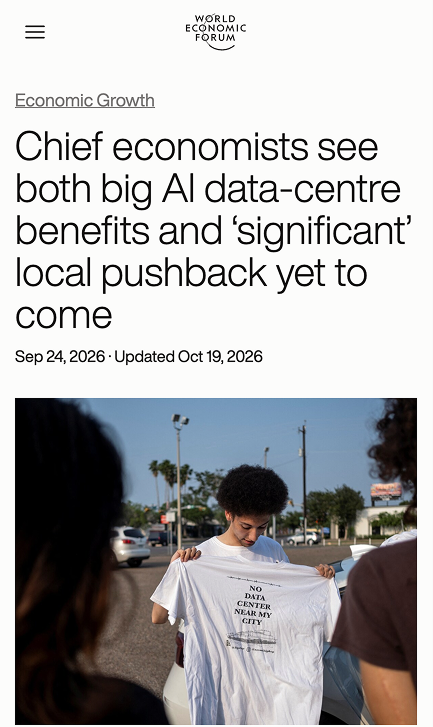
Yet the same scaremongering that crippled nuclear power is now being directed at data centers. Data centers that then have to rely on natural gas because we never built the nuclear power plants that could have powered them.
So here we are, once again risking decades of technological progress because we've allowed fear to dictate what we can and cannot build.
Talk about a tragedy of the commons.