Introducing Arrow 2
Our latest and most advanced models for generating precise, editable vector graphics.
Higher quality. Faster outputs. Available now in App and API.
@DotCSV@salvasassa3 El Jarnes, me suena al nombre del tipo malo del que se quiere deshacer OpenAI y compañía con tremendos modelasos que se vienen. Ale Ale! AGI
Is euchromatin really “open”? 🧬 Using super-resolution imaging🔬 our new study @NatureGenet reveals: Euchromatin forms condensed domains in live cells. Cohesin constrains them and prevents domain mixing for proper transcriptional insulation🚧 🔗https://t.co/HjjYOjycld (1/2)
GeoLibre now supports Cesium as a rendering engine, alongside MapLibre.
With Cesium integration, GeoLibre gains powerful new capabilities for visualizing and exploring 3D Tiles and large-scale 3D geospatial datasets directly in the application.
More Cesium-powered features are coming soon. Stay tuned.
Try it out
- Launch GeoLibre Web: https://t.co/8gMtkVtfnm
- GitHub: https://t.co/VXq8c1o2Nd
- Documentation: https://t.co/7VA2AQoCUc
#GeoLibre #Cesium #MapLibre #GIS #3DGIS #OpenSource #Geospatial
Marigold V2 is out! (to appear at SIGGRAPH Asia 2026)
If you missed V1: Marigold post-trains an image generator into a depth estimator on one GPU -- the accessible research game.
V2 upgrades to a diffusion transformer: produces very sharp edges, and is quite versatile!
we trained a fruit fly to understand emotion
We created a neural network from the male drosophila connectome, then trained it on human emotions. It was shocking to see how good it was at identification (better than some humans I know)
Our group discovered that reasoning models produce fractals when asked to solve hard problems. We can use nonlinear dynamics to probe the thinking processes of recurrent depth models on Sudoku, mathematics, and even ARC-AGI (1/N)
https://t.co/Q3u8OqylZf
We’re sharing a solution to the Navier-Stokes Millennium Prize Problem, one of the deepest problems at the frontier of mathematics.
The proof was produced by a group of agents, using an OpenAI next-generation model significantly more capable than GPT-6 Astra.
The problem concerns whether the description of smooth three-dimensional fluid motion modeled by the Navier-Stokes equations can break down. It has remained unresolved for roughly 90 years.
🧠 | LA PROLETARIZACIÓN COGNITIVA
Un nuevo informe de Anthropic ha dado dimensión a las amenazas de la IA sobre la actividad intelectual. La presión sobre la base productiva ya no es la única; la expropiación del conocimiento de la clase profesional ha comenzado y es alarmante:
1/ La fase de captura: Expropiación de capital cognitivo
La distancia entre la capacidad teórica (área azul) y la ejecución real (área roja) no refleja una "adopción lenta"; muestra la fase de acumulación primitiva de datos: el porcentaje de saber experto que las corporaciones ya han logrado privatizar e indexar.
En computación y administración, donde la capacidad supera el 90%, los modelos no están "asistiendo" al trabajador; están extrayendo la lógica operativa de su función para sustituir la masa salarial por renta de cómputo.
2/ La descalificación del trabajo de "cuello blanco"
La ilusión del refugio meritocrático se ha derrumbado: los perfiles con estudios de posgrado son cuatro veces más propensos a ubicarse en el tramo de máxima exposición que los roles manuales.
La IA ejecuta una subsunción real del trabajo intelectual:
-Programadores de Computadoras: ~74.5% de saber expropiado
-Servicio al Cliente: ~70.1% de saber expropiado
-Entrada de Datos: ~67.1% de saber expropiado
-Registros Médicos: ~66.7% de saber expropiado
-Analistas Financieros: ~57.2% de saber expropiado
3/ Degradación de la renta y precarización de plataforma
El "desempleo masivo" no aparece en las estadísticas tradicionales porque el impacto inicial no es (aún) la cesantía, sino la devaluación del valor de la hora de trabajo.
El profesional no es despedido de inmediato; es degradado a la condición de corrector precarizado del algoritmo que lo reemplazará. No hay estabilidad y esto no es una sensación: hay una reconfiguración de facto hacia una economía de gig economy de alta cualificación.
4/ El tapiado generacional de la reproducción social
El bloqueo en las tasas de contratación de jóvenes (22-25 años) en sectores expuestos corta la transmisión del saber técnico. Al eliminar los puestos de entrada (entry-level), las corporaciones han destruido (y destruirán más) las vías y las escalas de ascenso social.
Con ello, se consolida una tendencia hacia una gran masa de graduados hipertitulados pero estructuralmente excluidos de la estructura formal de ingresos y derechos.
5/ Tecnofeudalismo y pérdida de soberanía estatal
La contracción de rentas altas erosiona los ingresos impositivos, pero el riesgo de fondo no es meramente fiscal: es de gobernanza.
Si la infraestructura cognitiva de la economía y la administración pública pasa a depender de clústeres privados de cómputo, el Estado pierde autonomía política.
6/ Este es el punto crítico
La respuesta no puede limitarse a esquemas de contención como la Renta Básica; exige discutir la propiedad social del software, la fiscalidad al capital algorítmico y la soberanía sobre la infraestructura de cómputo.
El debate del siglo XXI no es ni debe ser sobre cuántos empleos destruirá la tecnología, sino quiénes serán y cuáles son los límites que las sociedades puedan construir a tiempo a los dueños de las infraestructuras que programen el trabajo humano.
📝 Informe completo: https://t.co/RLX1wf2DKO
I'm so excited that our @theworldlabs team has achieved a major milestone today! Introducing Atlas - a first of its kind multimodal world model trained from scratch! 🚀
Atlas is capable of generating frames with pixel-perfect camera control, reconstructing large scenes from as few as one single input image, simulating space-time by reframing videos, natively outputting 3D spaces from one or more input images, composing multiple posed images into a consistent 3d world, and more! This is the best camera conditioned world model ever, opening doors to many possible use cases from VFX to robotics. I'm so so so proud of our team!♥️
Introducing TimesFM-3, a state-of-the-art time series foundation model that enables accurate multivariate time series forecasting in a single forward pass, significantly outperforming other forecasting models across major benchmarks.
More on the blog →https://t.co/uSlnIdUJ4Q
Google's team just dropped a 9-page PDF on Harness Engineering - one formula replaced prompt engineering:
the twist: same Claude Sonnet, same benchmark - change only the harness
the formula: Agent = Model + Harness
here's the playbook in 6 steps:
step 1 → add guides - AGENTS.md, rule files, constraint docs - each line is a past agent failure turned into a permanent fix
step 2 → add sensors - linters, tests, validation scripts the agent runs on its own output before a human sees it
step 3 → build the agentic loop - plan, execute, verify, fix - bounded retries, budget caps, escalation when stuck
step 4 → externalize memory - the model forgets every session. the harness remembers state, decisions, and artifacts across all of them
step 5 → enforce permissions - which tools, how many writes, what needs approval. the model doesn't enforce safety. the harness does
step 6 → wire observability - track every tool call, cost, retry. trip wires fire when behavior drifts
the result: your agent stops being a demo and starts being infrastructure - every failure makes the system permanently better, not just the next conversation
this 9-page PDF is what comes after prompt engineering and context engineering
bookmark and build the full system from the article below ↓
The AI is the path, the religion, the beginning and the end. Haha kidding. But, true though. True in the way that it's dividing us into believers and skepticals. I choose to belive. And I must add to @DotCSV comment this: "the AI, with the right harness, can" oh yeah
La IA es el mayor destructor de supuestos y de marcos mentales. No recomiendo acomodarse mucho en eso de "la IA no puede".
Ejemplo en el campo de las matemáticas 👇
We're so happy every time the codex's usage limits are restored. Acknowledging mistakes and treating the user well seems to be their philosophy. I wonder how long that will last. Whatever, let's get fun with the vibes
Update on rate limits in Codex.
We’ve found (a) some inefficiencies when using images in long sessions with multiple compactions (b) high p95+ usage for Computer History (c) a feature that was meant to generate conversation titles that was draining a bit more usage than intended. And we have a tiger team combing through everything and shipping fixes tomorrow. We also found a novel approach to drive efficiency up significantly that is completely unrelated and we will be working on next week.
As part of some of the fixes tomorrow, we will also do a full reset of the usage for all paid subscriptions.
See you then.
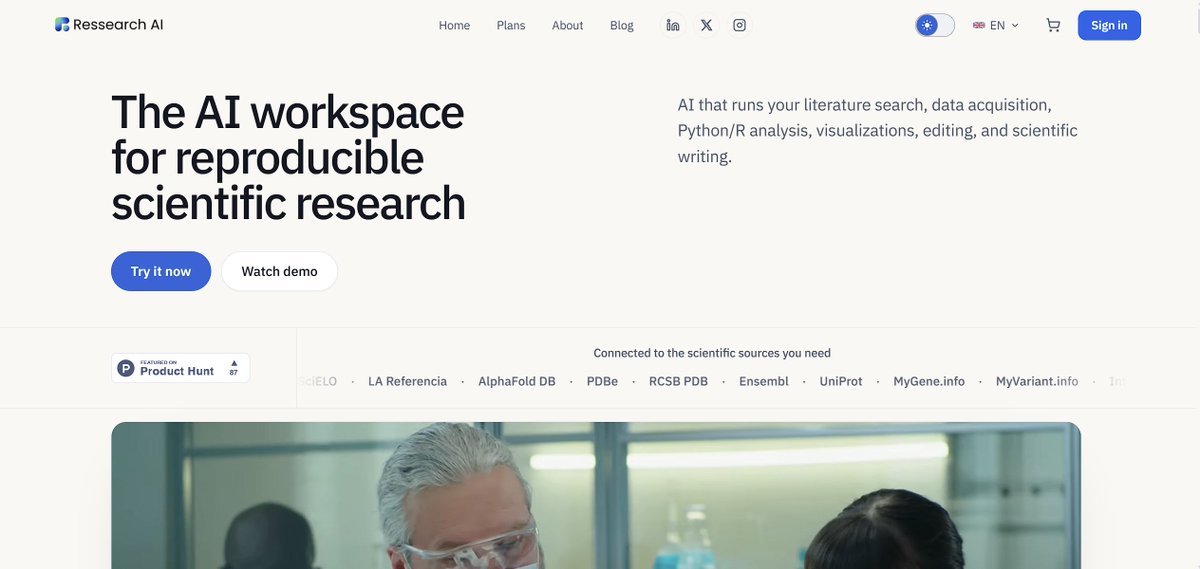
11/11 I don’t want AI to turn science into an endless stream of plausible-looking results.
I want AI to help us build science where claims can be traced, analyses rerun, and results verified.
By a researcher, a reviewer, or another AI.
That’s what I want to help build.
1/11 I’m starting a new chapter in my life: sharing more of my work, opinions, and experiments around science, technology, and AI.
Hi! I’m Irwing, a biologist who learned to code.
I want to share with you, one question that has completely changed what I’m building.
10/11 Researchers already struggle to keep up with the literature.
Reviewers struggle.
Professors struggle.
Thesis committees struggle.
Now AI is accelerating scientific production even further.
We don’t only need faster science.
We need science that is easier to verify.