I've never felt this much behind as a programmer. The profession is being dramatically refactored as the bits contributed by the programmer are increasingly sparse and between. I have a sense that I could be 10X more powerful if I just properly string together what has become available over the last ~year and a failure to claim the boost feels decidedly like skill issue. There's a new programmable layer of abstraction to master (in addition to the usual layers below) involving agents, subagents, their prompts, contexts, memory, modes, permissions, tools, plugins, skills, hooks, MCP, LSP, slash commands, workflows, IDE integrations, and a need to build an all-encompassing mental model for strengths and pitfalls of fundamentally stochastic, fallible, unintelligible and changing entities suddenly intermingled with what used to be good old fashioned engineering. Clearly some powerful alien tool was handed around except it comes with no manual and everyone has to figure out how to hold it and operate it, while the resulting magnitude 9 earthquake is rocking the profession. Roll up your sleeves to not fall behind.
Agency > Intelligence
I had this intuitively wrong for decades, I think due to a pervasive cultural veneration of intelligence, various entertainment/media, obsession with IQ etc. Agency is significantly more powerful and significantly more scarce. Are you hiring for agency? Are we educating for agency? Are you acting as if you had 10X agency?
Grok explanation is ~close:
“Agency, as a personality trait, refers to an individual's capacity to take initiative, make decisions, and exert control over their actions and environment. It’s about being proactive rather than reactive—someone with high agency doesn’t just let life happen to them; they shape it. Think of it as a blend of self-efficacy, determination, and a sense of ownership over one’s path.
People with strong agency tend to set goals and pursue them with confidence, even in the face of obstacles. They’re the type to say, “I’ll figure it out,” and then actually do it. On the flip side, someone low in agency might feel more like a passenger in their own life, waiting for external forces—like luck, other people, or circumstances—to dictate what happens next.
It’s not quite the same as assertiveness or ambition, though it can overlap. Agency is quieter, more internal—it’s the belief that you *can* act, paired with the will to follow through. Psychologists often tie it to concepts like locus of control: high-agency folks lean toward an internal locus, feeling they steer their fate, while low-agency folks might lean external, seeing life as something that happens *to* them.”
Our take on Google Agent Development Toolkit (ADK) after using it on a project:
+ Great for orchestrating multi-agent systems
+ Optimized for Gemini model but is model-agnostic
+ Easy to deploy to Google Cloud services & scale
+ Strong security & governance - identity, auth, guardrails and sandboxed execution
- Typical Google's naming of their similar/competing services can be confusing
- Still maturing and services will evolve as they're developed
- Agnostic but still better aligned with Gemini & GCP. Great if your infrastructure is already on GCP.
Why are pre-chatgpt workflow engines such as Make and N8N making a comeback with LLM? What used to require complex conditions and steps built into the workflow now only requires an AI node with a prompt. Simple & practical.
We'll be seeing more custom AI Agents as they get cheaper to build and maintain. They will hook into existing monolithic systems and disparate datastore to accomplish their goals.
Discovered the fascinating world of Internet and Server development back in 1998. Worked at several startups and at Electronic Arts. Eventually bootstrapped Hatch Innovations in 2011 creating custom software for leading Game Publishers and Startups.
I'm grateful to be alive in this lifetime where I was able to experience first hand the Internet boom; rise of social media; Steve Jobs introducing the iPhone; invention of the blockchain and birth of the crypto asset class.
Just when I thought I've seen it all... there comes ChatGPT unleashing a tsunami of AI innovations. The pace of advancement is nothing I've witnessed before. So much promise, hype and fear!
I'm excited to cut through the hype, find genuinely useful AI applications, and, crucially, implement them in a reliable and predictable way.
@FP_Champagne You announced the tax. Raked in a bunch of cap gains from people liquidating. Axed the tax and praised yourself for doing so. What a scam!
I have just been informed by the Liberal Party of Canada that I have been disqualified from the leadership race. This decision is both shocking and deeply disappointing, especially since it was leaked to the media.
The allegations that the party have used against me are false, & fabricated. The tactics used to remove me from this race only confirm what we already knew—our message was resonating, we were winning, and the establishment felt threatened.
One day it was foreign interference, one day it was campaign violations - all in an attempt to keep me from debating Carney and winning.
I will continue to stand up for Canadians & fight for Canada 🇨🇦
The Rally That Shook Canada—Poilievre Just Changed Everything
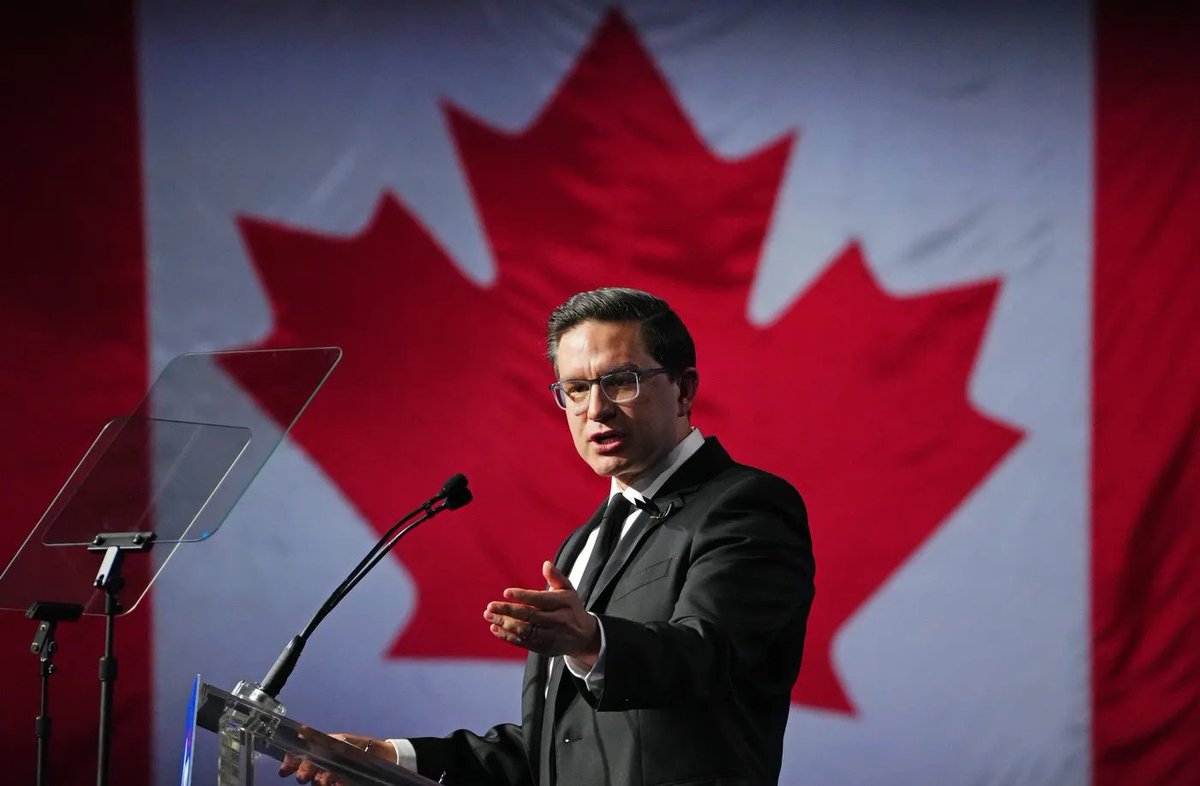
Ottawa—My fellow Canadians, Let’s talk about what just happened in Ottawa last night. Because, frankly, if you weren’t paying attention, you just missed one of the most important political moments in modern Canadian history.
Pierre Poilievre didn’t just hold a rally. He delivered a political earthquake. Thousands of Canadians braved the cold—minus eleven degrees, snow falling, streets covered in ice—to stand shoulder to shoulder, packed into an overflowing venue, with even more watching from spillover rooms.
And it wasn’t just a polite gathering of voters looking for a fresh face to replace Trudeau’s tired, corrupt regime. No, this was something else entirely. It was a moment where you could feel the momentum shifting. It was the kind of rally that terrifies political elites because it tells them one thing—this isn’t just a campaign anymore. It’s a movement.
Now, we’ve seen this before. Obama in 2008, Trump in 2016. The political class and their media lapdogs always pretend these moments don’t exist—right up until the moment they steamroll the establishment and change the country forever. That’s the kind of energy we saw in Ottawa. That’s the kind of political force Poilievre is sitting on.
And the real question is: does he understand just how big this is? Because right now, he is either going to ride this wave to an unstoppable victory, or he is going to let the media, the bureaucrats, and the Liberal swamp talk him into playing it safe and blowing the biggest opportunity of his life.
Let’s talk about what he got right—because he got a lot right.
First, Mark Carney got absolutely eviscerated. And not a moment too soon. For months, the Liberal establishment and their media servants have been parading this unelected banker around like some kind of messiah—as if Canadians have been crying out for a smug, carbon-tax-obsessed globalist to come and save us from ourselves.
Well, Poilievre wasn’t having it. He torched Carney��s entire phony image in a single speech.
This is a guy—let’s be very clear about who he is—who has spent his entire career making life more expensive for you while getting richer off it. A man who cheered for the carbon tax in Canada while personally investing in American coal. A man who killed pipelines here while his own company bought them in the Middle East. A man who spent years whispering in Trudeau’s ear, pushing policies that have already driven over $500 billion in investment out of this country—and now, somehow, wants you to believe he’s the guy to fix it.
It was devastating, brutal, and completely deserved. And the best part? Poilievre made it clear that if Carney wins, Canada loses.
But that wasn’t even the most important part of the speech.
The most important moment came when Poilievre didn’t just talk about the economy—he talked about Canada’s survival.
Because that’s what this is about.
And this is where Poilievre really flipped the script on the media’s latest nonsense.
For weeks now, Canada’s press has been running around like a bunch of headless chickens, shrieking that Trump’s tariffs are going to destroy us—as if the biggest economic threat to this country isn’t the people running it into the ground from within.
And instead of taking the bait, instead of playing defense, Poilievre turned the entire argument on its head.
The real problem isn’t Trump. The real problem is that Canada can’t even trade with itself.
Think about that. Canada’s biggest economic problem isn’t some tariff threat from Washington—it’s that we have more trade barriers between our own provinces than we do with the United States. That is insane. That is deliberate economic sabotage. That is the kind of bureaucratic lunacy that only a Liberal government could create.
So instead of cowering in fear about what Trump might do, Poilievre did what no Canadian politician has done in decades—he promised to tear down interprovincial trade barriers in his first 30 days in office.
And suddenly, the entire media narrative collapsed.
Why? Because if Canada is so fragile that one American president can destroy our economy with a tariff, then maybe the real problem isn’t Trump. Maybe the real problem is that Liberal policies have left us so pathetically weak that we can’t even function as a country without America’s permission.
Now that’s leadership. That’s the kind of offensive strategy Canada needs.
And then, Poilievre did it again.
He unleashed his strongest energy vision yet.
He vowed to repeal C-69, the anti-pipeline law, within 60 days. He promised to fast-track LNG projects, restart the Ring of Fire mining industry, and put an end to the foreign-funded radical environmentalists who have spent decades deliberately crippling Canada’s energy sector while collecting cash from foreign oil interests.
The crowd exploded. Because Canadians know what’s been done to them.
This country should be an energy powerhouse. Instead, under Liberal rule, we have entire provinces collapsing under green energy scams while we import oil from countries that hate us.
Poilievre knows it. Canadians know it.
And yet, for all the things he got right, there was one glaring failure.
China.
Yes, Poilievre called China a hostile power. Yes, he promised to strengthen Arctic defenses and build a new military base in Iqaluit. That’s good. That’s necessary.
But that’s not enough.
Because Trudeau didn’t just let China threaten Canada from the outside—he let them infiltrate our democracy from the inside.
And that’s where Poilievre should have gone further.
He should have hammered the Houge Inquiry—the investigation into Chinese election interference that was so damaging that Trudeau shut down Parliament to bury it.
He should have exposed how CSIS warned the Liberals about Chinese interference—and they did nothing.
He should have pledged to ban CCP-linked companies from buying Canadian land, businesses, and resources.
He should have said, plainly and directly, that Trudeau’s government was complicit in allowing a foreign dictatorship to interfere in Canada’s democracy.
But he didn’t. And that was a mistake.
Because when you are standing in front of a roaring crowd, a movement waiting for a leader to take the gloves off, that is the moment you go all in.
Poilievre is so close. He has the passion. He has the policies. He has the momentum.
But now, he has to finish the job.
That means stop holding back on China. That means stop treating this like a normal election. That means expose the entire corrupt system—not just Trudeau, but the elites who profit off Canada’s decline.
Because the crowd is ready. The movement is here. The moment is now.
The only question is: is Poilievre ready to go all the way?