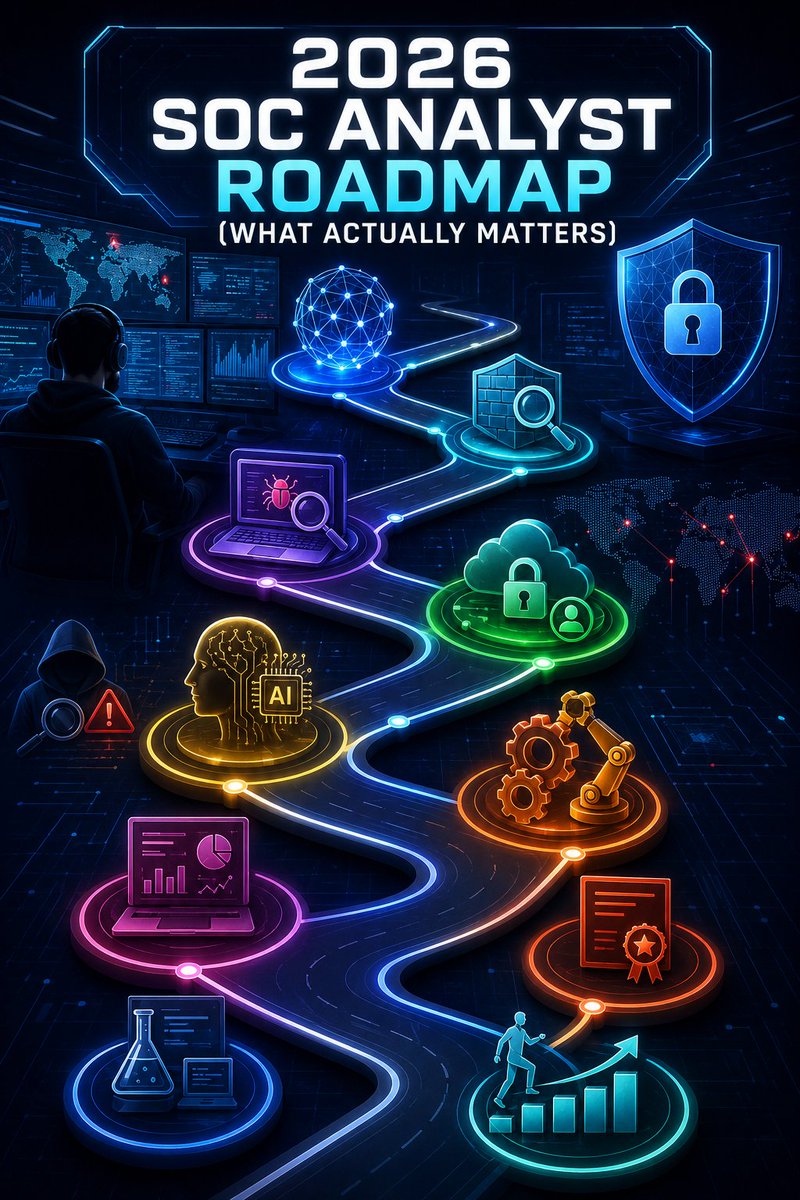
2026 SOC Analyst Roadmap (What Actually Matters)
The SOC Analyst role is evolving,
not disappearing. AI is increasingly handling routine alert triage, but human analysts are still needed to investigate, validate, hunt threats, and make critical decisions. Here's a roadmap that prepares you for today's SOC and tomorrow's.
1.
Step 1: Build Your Foundation
�� Networking: TCP/IP, DNS, HTTP/HTTPS, DHCP
• Linux & Windows administration
• Windows Event Logs & Linux (/var/log)
• Python & Bash/PowerShell basics
• Git fundamentals
• Build a home lab (Kali + Windows)
Logs are your source of truth. Learn to read them before learning security tools.
2.
Step 2: Master Core Blue Team Skills
• CIA Triad & security fundamentals
• Firewalls, IDS/IPS, VPNs & proxies
• SIEM (Choose ONE: Splunk or Microsoft Sentinel)
• Learn SPL or KQL deeply
• Alert triage (False Positive vs. True Positive)
• EDR/XDR investigation workflows
Don't just acknowledge alerts,
understand the story behind them.
3.
Step 3: Learn Incident Response & Detection
• NIST & SANS Incident Response frameworks
• MITRE ATT&CK mapping
• Detection Engineering (Sigma & YARA)
• Threat Hunting
• IOC & TTP analysis
• Basic Digital Forensics (memory, disk & timeline analysis)
Detection is about understanding attacker behavior,
not memorizing signatures.
4.
Step 4: Develop Cloud & Identity Security Skills
• AWS CloudTrail & Azure logs
• Microsoft Entra ID & Okta fundamentals
• IAM concepts (RBAC, MFA & Conditional Access)
• Microsoft 365 security monitoring
• Kubernetes & container security basics
Identity is the new security perimeter.
5.
Step 5: Make AI Your Assistant, Not Your Replacement
• Critically review AI-generated incident summaries
• Learn prompt engineering for SOC workflows
• Validate AI findings with logs and evidence
• Use AI to accelerate investigations,
not replace your judgment
Trust evidence. Verify AI.
6.
Step 6: Learn Security Automation
• SOAR fundamentals
• Shuffle, TheHive & Tines
• Python scripting with REST APIs
• Automate repetitive workflows
Automate repetitive tasks so you can focus on complex investigations.
7.
Step 7: Build a Portfolio Recruiters Will Notice
• Live SOC monitoring (LetsDefend)
• Blue Team investigations (CyberDefenders)
• Home SIEM with Wazuh
• Automated phishing response workflows
• Sigma detection rules
• Threat hunting reports
A strong portfolio speaks louder than a long list of certifications.
8.
Step 8: Practice on Real Platforms
• TryHackMe (Fundamentals)
• LetsDefend (SOC Operations)
• CyberDefenders (Blue Team Labs)
• DetectionLab (Build your own SOC)
• BTLO (Blue Team Level Up)
Spend more time in labs than watching videos.
9.
Step 9: Earn Certifications Strategically
Entry Level: • Security+
• Google Cybersecurity Certificate
• INE eJPT/eSOC
Intermediate: • CySA+
• SC-200
• Splunk or Microsoft Sentinel certification
Advanced: • GCIA / GCIH (when your experience matches)
Certifications may get you interviews. Skills earn the offer.
10.
Step 10: Grow Beyond the SOC
Career opportunities include: • Incident Responder
• Threat Hunter
• Detection Engineer
• Security Automation Engineer
• DFIR Analyst
• Cloud Security Engineer
• AI Security Analyst
Career paths are no longer linear. Keep learning.
Start Today:
✅ Master one SIEM
✅ Complete one hands-on lab every day
✅ Write your first Sigma rule this week
✅ Document your work on GitHub
✅ Keep learning, building, and sharing
The future belongs to analysts who combine technical depth, investigative thinking, automation, and AI, not those who rely on AI to do the thinking for them.
🔁 Repost to help someone begin their Blue Team journey.
15 things to do with your father while he is still alive. I lost mine 8 years ago.
1. Ask him what he was like at your age because once he was the same age you are right now & Watch his face light up as he tells you stories from when he was younger
2. Record his laugh when he tells one of his signature jokes. Someday you will replay the video over and over just to hear it again
3. Ask him about the proudest moment of his life. (Odds are he will say when you were born)
4. Ask him his favourite songs
Listen to them together, laugh, sing and be happy. These will become your most cherished memories in years to come
5. Take a picture of him doing something he loves. Watching tv, gardening, playing the guitar, anything. When you look back these will be the pictures that will make you smile the most
6. Tell him you love him even if it's something you don't normally do.
7. Tell him you are proud to be his son/daughter This will mean more to him than you realise (even if he doesn't show it)
8. Listen to music from his youth and watch him turn from dad into a young man again
9. Take a short video of him talking about something random sacred Someday even the ordinary things he said become
10. Bring up something you are thankful for from years ago
11. Ask him what it was like for him growing up
12. Call him for no reason
Don't take being able to do this for granted.
Someday you would give anything to hear his voice again.
13. Take a picture of just the 2 of you together
14. Ask him to show you an old photo of him because seeing him young will remind you that he wasn't always Dad
15. Tell him something you are struggling with, no matter what age you are Because even when your grown it means the world to him to feel like he can still help
Let him give you advice, even if you don't need it because one day you will give anything to hear his voice guiding you again
Values create value. And business is the greatest platform for change.
@Benioff reminds us that ‘trust’ must be #1 business core value. This means we cannot continue to expand fully unregulated AI technologies into society
Billionaire Paul Tudor Jones drops bombshell 💣
“Buying #Bitcoin is one of the BEST ways to fight inflation!" 💰
Join the crypto revolution as the big money piles in! 📈 $BTC
4. Crypto wallets are evolving into passports → Store digital identity → Hold health records → Sign contracts via AI agents
Forget usernames and passwords — trust lives on-chain now.
"BECAUSE A MAN SAID YES" — HAPPY BIRTHDAY APOSTLE JOSHUA SELMAN
"Let the elders that rule well be counted worthy of double honour, especially they who labour in the word and doctrine.” 1 Timothy 5:17 (KJV)
Because a man said yes, millions found language for their destinies. The weary found rest, the broken found healing, and the hungry encountered truth. He came not just with charisma, but with fire, depth, and a divine mandate for our generation.
In a world captivated by noise, he modeled the power of silence. In an age driven by platforms, he returned us to the altar. Amid the chase for relevance, he revealed the beauty of surrender. He taught us to seek Jesus Christ; not merely His gifts. To carry fire, not just titles. To build altars, not empires. To love deeply, pray fervently, and serve faithfully.
To some, he is a preacher. To others, a prophet, a mentor, an apostle. But to us, he is a Father. Apostle Joshua Selman, your life is proof that the price for all of God is all of us and that a man can truly walk with God. You've not just preached the Word; you have become it. Line upon line, precept upon precept, you've shaped lives, discipled nations, and built enduring legacies from the secret place.
You are not building followers, you are raising witnesses. You're not building a name, you're building a generation anchored in Christ. You are a divine portal - A voice to nations, a living witness to the Kingdom come mandate, a herald of kingdom truths. You are a move of God in motion.
Today, we rise in honour. We do not just say “Happy Birthday”. We say THANK YOU. Thank you for saying yes. Thank you for loving Jesus unapologetically. Thank you for pouring out yourself for a generation. You've become an answer to prayers we didn’t know how to pray. A fulfillment of prophecy. A divine gift to our time.
And so, we pray: May your days be long, your peace be deep, and your crown, weighty with souls. May the oil upon your life never run dry, may the heavens over you remain open, may your reward be eternal, and your strength multiplied.
We honour you. We celebrate you. We bless you.
HAPPY BIRTHDAY APOSTLE JOSHUA SELMAN
— From all of us at Koinonia Global
#AJSBirthday2025
#CelebratingAJS2025
#ApostleJoshuaSelman
#KoinoniaGlobal
1. When I talk about the lack of "national learning" being Ghana's problem, I want my Ghanaian compatriots to be honest with themselves.
2. How many important areas of national life - electricity, health, education, transport etc - have you seen improve steadily over time because we studied national failures and adopted new strategies?
3. If you can't point to an area and describe how the nation learnt from previous policy mistakes and which new methods were applied to cause which improvement, then you must agree with me.
4. But I also acknowledge that most citizens are very busy. They don't have time for the complex details. This is the case worldwide. Citizens want RESULTS. Politics, worldwide, is thus about results.
5. But results don't pop out from thin air. Careful plans and actions in MULTIPLE contexts and areas lead to the aggregate results that citizens care about. In short, POLICIES lead to the POLITICAL results that voters vote for.
6. No policy is perfect. Policy mistakes will always happen. In every serious society, therefore, there are groups of citizens who scrutinise, debate, and contest over policies to ensure that the nation learns about and from policy mistakes and gets better at delivering results that citizens care about.
7. The problem in Ghana is that there is no real link between policy and politics. I call this KATANOMICS. There is zero accountability for policy mistakes and near-zero social understanding of policy success. At the same time, there is intense political competition over results. So, politicians constantly cut corners (like borrow recklessly) to deliver what LOOKS LIKE RESULTS. (Sometimes, this is done in a "state enchantment" manner that also lines the pockets of their friends and cronies. But that's another story.)
8. Let me give you an example of our inability to learn from policy in Ghana: Zipline.
9. In 2018, a Californian startup from Half Moon Bay (just outside San Francisco) showed up in Ghana with a tech concept it had piloted on a very small scale in Rwanda. Drones carrying medicines and blood products will be catapulted from a depot. The drone will hover over a clinic, drop the products, and return to base.
10. The justification for this program was that there are clinics in places with such bad roads that this was either the only way or the best way to get products to them.
11. The delivery will be based on a "Just in Time Demand-Driven" model. When the nurse needs to administer an injection, blood infusion, or snake venom, it will send a message (mostly via WhatsApp) to the depot. The depot will then respond within a few hours by shooting the product over.
12. When this concept first came up, some think tanks like IMANI examined the concept very closely. We argued that this concept cannot replace the main national medicines distribution network and must be confined to a very small segment that genuinely can't be helped in any other way.
13. We based our argument on the following: a) the main national distribution system based on Central & Regional Medical Stores is falling apart. Many regional medical stores have no vans. The reason why many clinics don't have medicines in stock is due to this problem and others (such as underfunding) and not necessarily because of bad roads. b) drone delivery is very expensive. At that time, based on the contract we saw, we calculated the cost of delivery to be around $18 per kilo. Our analysis showed that drone delivery would be 10x more expensive than the use of tricycles (where there are bad roads) or vans. c) The Just in Time model would disrupt standard inventory planning. Etc.
14. Naturally, in an environment, where policy is never really debated properly and the results of the debate factored into what politicians do, IMANI was totally ignored. Instead of a small program, a large initiative involving, at one point, about 6 depots was rolled out. Dozens of drones started zipping about, dropping stuff.
15. The strategy of how exactly to stock the depots was never thought through. A kind of take-and-pay contract was devised. The Californian startup raised hundreds of millions of dollars based mainly on the juicy contract signed with Ghana, which, mind you, relinquished all rights to the emergent intellectual property even though the country was being used as a testbed.
16. Due to the standard poor planning, it didn't take long before the millions of dollars in unpaid bills to Zipline started to mount. The Ministry of Health had never incorporated drone delivery into any of its medium-term policy strategies. It hadn't budgeted for them properly. Clinic staff started to over-use the system. Instead of emergency deliveries, routine products costing a few cents per box were being catapulted by drones in small quantities.
17. Zipline, naturally frustrated by the failure of Ghana to pay its bills, complained to the American government and various senators who started to pressure the government of Ghana to start paying up.
18. The usual murkiness and opacity in which most serious policies are executed in Ghana means that no one outside a small group in government knows exactly how much Zipline charges per kilo today. Or how much the take-or-pay component is. Or how much arrears have piled up. Or even the full cost-benefit implications of the contract. There has been no official independent monitoring and evaluation. What studies there have been were commissioned by Zipline itself and did not cover the full cost-benefit matrix.
19. Then the government of the day changes. Given that the new government when it was in opposition in 2018 was very critical of the Zipline program, one can be forgiven for thinking that some transparency would be forthcoming. Wrong assumption. KATANOMICS is not a problem with one party or the other. It describes the policy-politics dysfunction in Ghana regardless of who is in government. Thus, even though the current govt is better at consulting and more open to feedback, the fundamental issues remain.
20. A few days ago, the Minister of Communications and Digital Innovation visited Zipline. Besides himself with joy at seeing the drones zip in and out, he immediately made policy on the spot. He now wants drones to deliver pesticides and fertilisers! To farmers in remote corners.
21. If medicines, that have a very high value-to-volume ratio can't be drone-transported cost-effectively, just imagine the costs for doing drone delivery of pesticides and fertilisers. How sustainable would it be to be dropping 1-kg NPK fertiliser bags costing $2 each in the bush at, say, $15 per flight? The most important point here, though, is not whether this is a good idea or not. It is about whether we are ever interested in NATIONAL LEARNING. It is about whether we are capable of dispassionately analysing the results of what we do and building on the insights in an open, transparent, and rigorous manner.
22. Question is: what was the Minister grounding his policy proposal to extend Zipline to agro-inputs on? It clearly isn't a careful assessment of any policy lessons. Is it? It isn't based on any well-debated pros and cons. Is it? Cost-benefit analysis? Forget it.
24. Until policy begins to have high-stakes political implications because there is a policy community large enough to make politicians think twice before they launch programs, they will keep going for shiny trophies that LOOK LIKE RESULTS. Pseudo-results that would be politically rewarded.
25. Then they will bill citizens for these shiny trophies, and collect votes on top.
PS:-
Read more about IMANI's 2018 Zipline analysis here:
https://t.co/QPXV3HTzRF