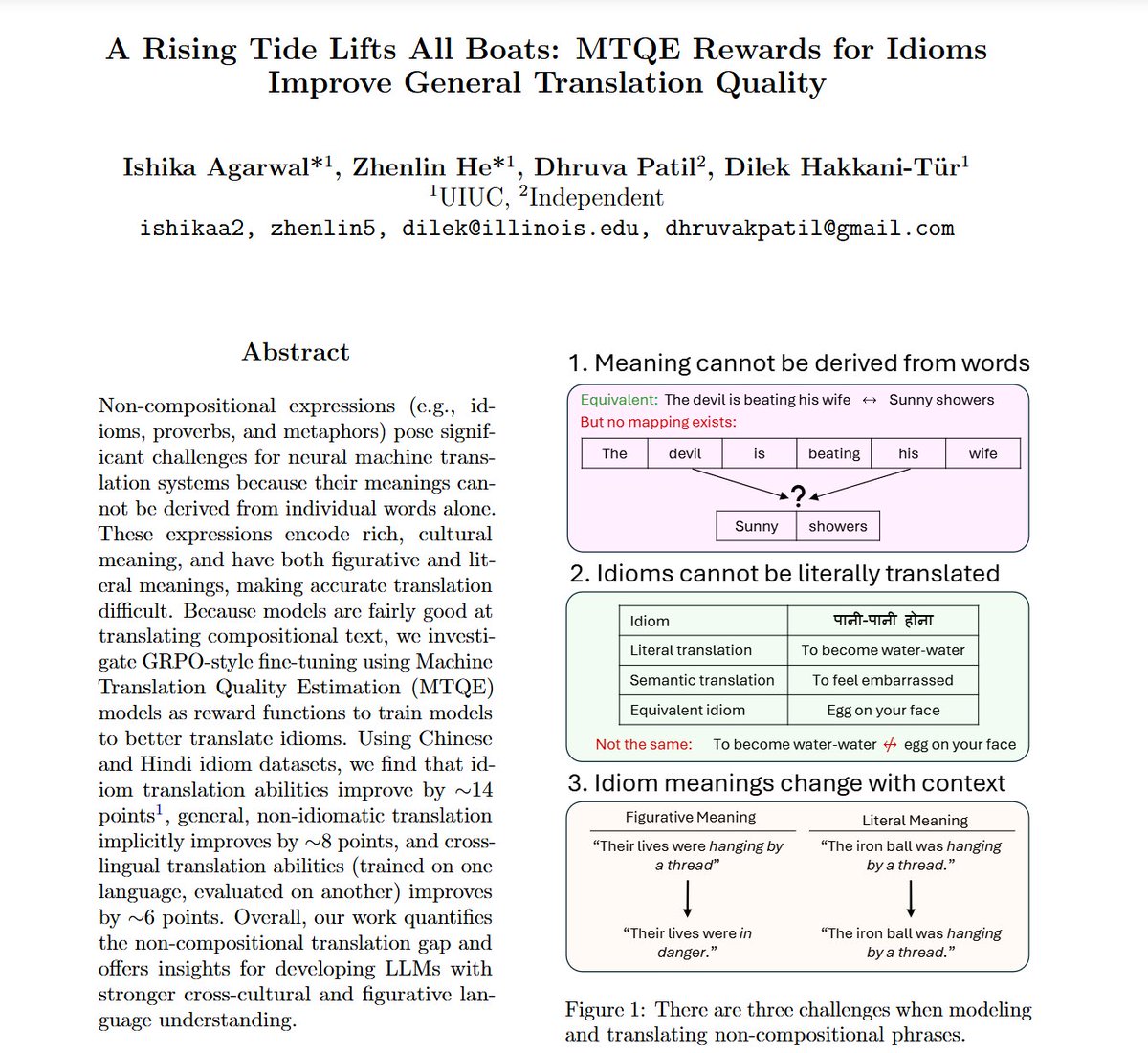
[Findings] A Rising Tide Lifts All Boats: MTQE Rewards for Idioms Improve General Translation Quality by @wonderingishika Zhenlin He, Dhruva Patil @dilekhakkanitur
We use machine translation quality estimation functions as reward functions to improve machine idiom translation; we also find it improves general translation quality in unseen domains and languages.
Read more here: https://t.co/olJWaQ7F3c
Accepted to EMNLP 2026 🇭🇺 as the Hungarian (according to Claude) say:
Áll a bál!
Literal meaning: the ball is on
Semantic meaning: the party is in full swing
Happy to share our recent work on FlashRT ⚡
Multimodal applications are highly diverse. Most systems work still falls on human developers, which is unscalable.
FlashRT automates this by guiding coding agents to write efficient serving infrastructure with no human intervention!
AI is now building the infrastructure it runs on.
Getting real-time multimodal applications — including live avatars, voice agents, video world models — to actually run in real time takes serious manual systems work. Turns out a coding agent can do all the engineering work for you: up to 70× lower latency and 3.6× higher throughput, across 5 real-time apps.
Today we release FlashRT ⚡, an agent harness for real-time systems implementations and optimization. The developer writes only a simple reference spec, and the agent handles the rest end-to-end, producing efficient deployments across a range of GPU budgets in one shot, with no human intervention.
✅ Validated on 5 real-time applications that combine interactive video generation, text-to-speech, LLMs, etc.
✅ Runs on both NVIDIA and AMD GPUs; the agent optimizes for the hardware you’re on
✅ Can easily compose with third-party serving engines, the agent automatically implements orchestration
📄 Paper: https://t.co/TMaeHRIpXM
🌐 Website: https://t.co/sikq8aYwC5
🔗 GitHub: https://t.co/4NPKZi3SpQ
🧵1/5
@SciPapermill released an article highlighting the latest papers in active learning. We're honored that our work is featured 🎉🙏 Read more here:
https://t.co/r13WTv3INu
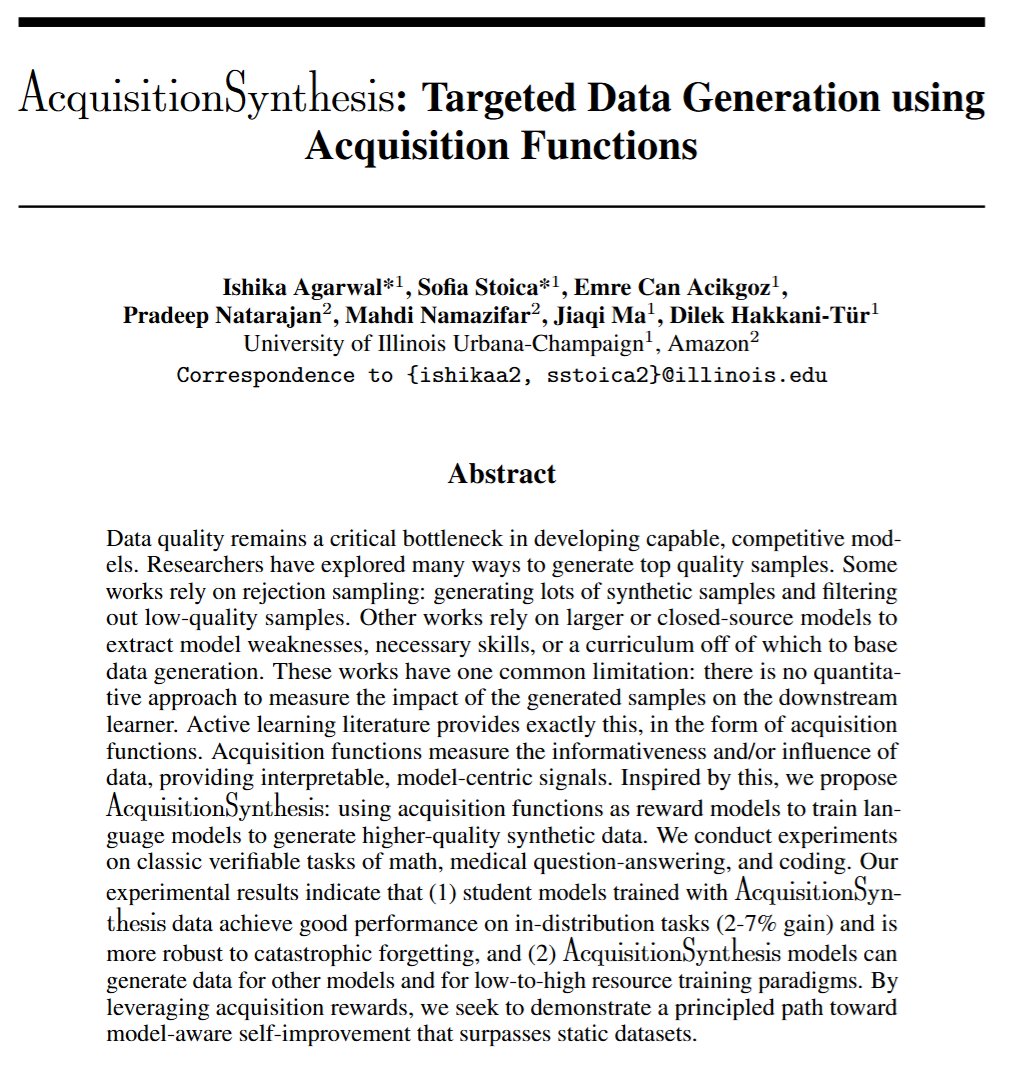
If active learning already knows what "good data" looks like (quantitatively measured through an acquisition function), why not teach models to produce it?
Introducing AcquisitionSynthesis: using acquisition functions as reward functions to train models to generate better data!
Super excited to share the first work of my PhD! MonarchRT🦋 enables true real-time video generation on a single RTX 5090🚀
This is one of the first sparse attention parameterizations to actually work for real-time video models.
Happy Lunar New Year🧧 and Happy Mahashivratri 🔱
Video generation models are improving fast—real-time autoregressive models now deliver high quality at low latency, and they’re quickly being adopted for world models and robotics applications. So what’s the problem? They’re still too slow on consumer hardware.
🚀 What if we told you that we can get true real-time 16 FPS video generation on a single RTX 5090? (1.5-12x over FA 2/3/4 on 5090, H100, B200)
Today we release MonarchRT 🦋, an efficient video attention that parameterizes attention maps as (tiled) Monarch matrices and delivers real E2E gains.
📄 Paper: https://t.co/d1AAMIseow
🌐 Website: https://t.co/41mqriKekx
🔗 GitHub: https://t.co/hp5iJttviA
🧵1/n
Excited to announce our newest work🎉
Idioms like "let sleeping dogs lie" need semantic translation, not literal ones.
We use MTQE models to reward LLMs during training, improving both idiomatic and general translation quality—even for languages not in our training data.
So You Want to Be an Academic? A couple of years into your PhD, but wondering: "Am I doing this right?" Most of the advice is aimed at graduating students. But there's far less for junior folks who are still finding their academic path.
My candid takes: https://t.co/25JdxHAON0
I'm excited to announce NN-CIFT got into @NeurIPSConf 2025 (featuring a fancy, new title)💃💃🌴Can't wait to discuss it with everyone!!
Thank you @dilekhakkanitur and @convai_uiuc 🎉🎉
Would models know more about Indian food in Hindi and Turkey’s history in Turkish? Does the language of a question affect an LLM’s answer?
✨Yes!✨
@nbbozdag and I are excited to announce our newest preprint in which we explore “Language Specific Knowledge (LSK)”.