Establishment of the scientific panel of independent experts under the AI Act – implementing regulation | Europäische Kommission https://t.co/22dw6opsQe
I just supported @ShawhinT on @buymeacoffee! 🎉
Shaw Talebi is writing blogs and making videos on data science entrepreneurship. You can support by buying a baguette 🥖 here — https://t.co/inHyzwEHa0
How to diagnose a mysterious process that is consuming too much CPU, memory, IO, etc.?
The diagram below illustrates helpful tools in a Linux system.
🔹‘vmstat’ - reports information about processes, memory, paging, block IO, traps, and CPU activity.
🔹‘iostat’ - reports CPU and input/output statistics of the system.
🔹‘netstat’ - displays statistical data related to IP, TCP, UDP, and ICMP protocols.
🔹‘lsof’ - lists open files of the current system.
🔹‘pidstat’ - monitors the utilization of system resources by all or specified processes, including CPU, memory, device IO, task switching, threads, etc.
Credit: Brendan Gregg, Linux Performance
--
Subscribe to our weekly newsletter to get a Free System Design PDF (158 pages): https://t.co/FIzCeaWsZV
A cheat sheet of various databases in cloud services, along with their corresponding open-source/3rd-party options.
Choosing the right database for your project is a complex task. The multitude of database options, each suited to distinct use cases, can quickly lead to decision fatigue.
We hope this cheat sheet provides the high level direction to pinpoint the right service that aligns with your project's needs and avoid potential pitfalls.
Note: Google has limited documentation for their database use cases. Even though we did our best to look at what was available and arrived at the best option, some of the entries may be not accurate.
Over to you: Which database have you used in the past, and for what use cases?
–
Subscribe to our weekly newsletter to get a Free System Design PDF (158 pages): https://t.co/FIzCeaWsZV
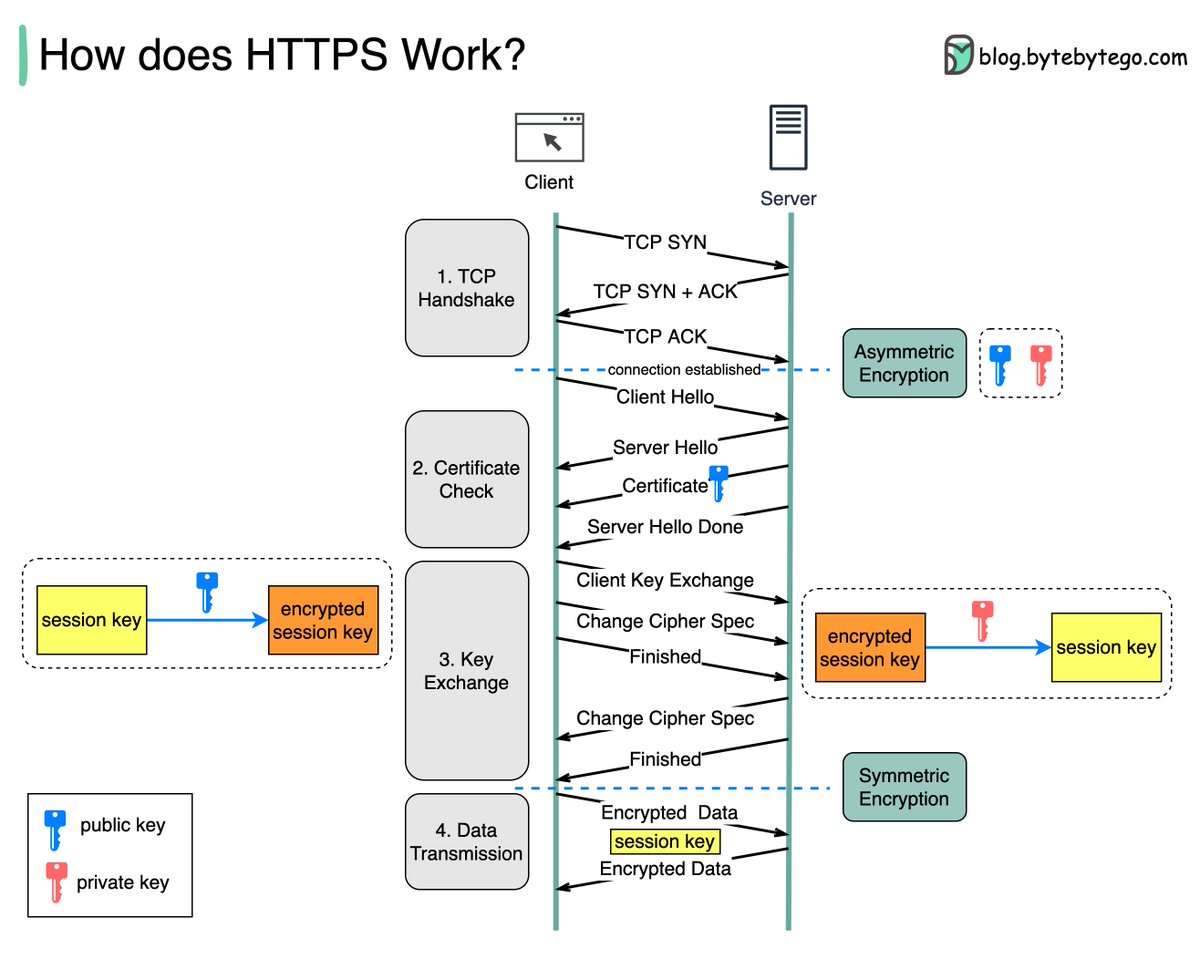
How does HTTPS work?
Hypertext Transfer Protocol Secure (HTTPS) is an extension of the Hypertext Transfer Protocol (HTTP.) HTTPS transmits encrypted data using Transport Layer Security (TLS.) If the data is hijacked online, all the hijacker gets is binary code.
How is the data encrypted and decrypted?
Step 1 - The client (browser) and the server establish a TCP connection.
Step 2 - The client sends a “client hello” to the server. The message contains a set of necessary encryption algorithms (cipher suites) and the latest TLS version it can support. The server responds with a “server hello” so the browser knows whether it can support the algorithms and TLS version.
The server then sends the SSL certificate to the client. The certificate contains the public key, host name, expiry dates, etc. The client validates the certificate.
Step 3 - After validating the SSL certificate, the client generates a session key and encrypts it using the public key. The server receives the encrypted session key and decrypts it with the private key.
Step 4 - Now that both the client and the server hold the same session key (symmetric encryption), the encrypted data is transmitted in a secure bi-directional channel.
Why does HTTPS switch to symmetric encryption during data transmission? There are two main reasons:
1. Security: The asymmetric encryption goes only one way. This means that if the server tries to send the encrypted data back to the client, anyone can decrypt the data using the public key.
2. Server resources: The asymmetric encryption adds quite a lot of mathematical overhead. It is not suitable for data transmissions in long sessions.
Over to you: how much performance overhead does HTTPS add, compared to HTTP?
–
Subscribe to our weekly newsletter to get a Free System Design PDF (158 pages): https://t.co/FIzCeaWsZV
Wir sind auf der it-sa in Nürnberg startklar! 🚀 Unsere Geschäftsführer sind vor Ort, um Gespräche über #Datenrettung bei Helium-Festplatten, Ransomware-Angriffen und Probleme nach Ausfällen in virtuellen Serversystemen zu führen. Besuchen Sie uns auf Stand 7-215 @wko_aw.
Published today: First report on the State of the Digital Decade - calls for collective action to shape the digital transition | Shaping Europe’s digital future https://t.co/wx1dqczkET
Good to meet Pres. member Becirovic today to discuss the political & security situation in 🇧🇦.
Thanked f the decision to move fwd w 2 Berlin Process agreements.
Highlighted the importance of political dialogue & work on reform agenda to move fwd more swiftly on the 🇪🇺 path.