#COVID19
In this paper @nigelmarks70 and @wordsongbee present a simple method for estimating the case fatality ratio of #COVID19 using a time-shifted distribution analysis requiring only publicly reported case and death data.
@CurtinUni
https://t.co/wpneOUqY2t
We use death data to backcast the likely number of true cases throughout the pandemic in the USA, showing that the third wave is only just surpassing the first and that around 16% of the population is likely to have contracted coronavirus so far.
The USA has been hammered continuously by the coronavirus since March, but variations in testing make it difficult to compare figures from early in the pandemic to more recent numbers. https://t.co/9daXFimzUG
@CaseyBriggs Nothing is usual about this year, so the baseline comparison is not really valid. June and July deaths are well below average, probably because other infectious disease rates have been reduced by distancing behaviours, yet COVID peak still shows in August.
And the bit that should say "The kingdom of this world is become the kingdom of our Lord and of his Christ" says something like, "the kingdom of this world is become the kingdom of this world, hallelujah" - WHAT?
Hey @johnpauldickson, I'm enjoying the "Discordant Religion" episode of Undeceptions, but what's the deal with the version of Handel's Messiah that's been sampled? The text seems very odd to me - intentional cognitive dissonance?!!
Examples: "king of kings and king of kings"??? (What happened to "lord of lords"?) and "For [him?] omnipotent reigneth" (definitely not, as it should be, "For the Lord God omnipotent reigneth").
@Thomas_Binder@AdamJKucharski @C_Althaus @Jarvis_Stats Don't know about asymptomatic super-spreaders, but surely early identification (through testing) and isolation of cases (symptomatic or otherwise) will stop spread.
@Thomas_Binder@AdamJKucharski @C_Althaus @Jarvis_Stats From this paper: "most studies demonstrated faster viral clearance in asymptomatic individuals, as also seen in MERS-CoV, suggesting a shorter infectious period but with similar potential transmissibility at the onset of infection."
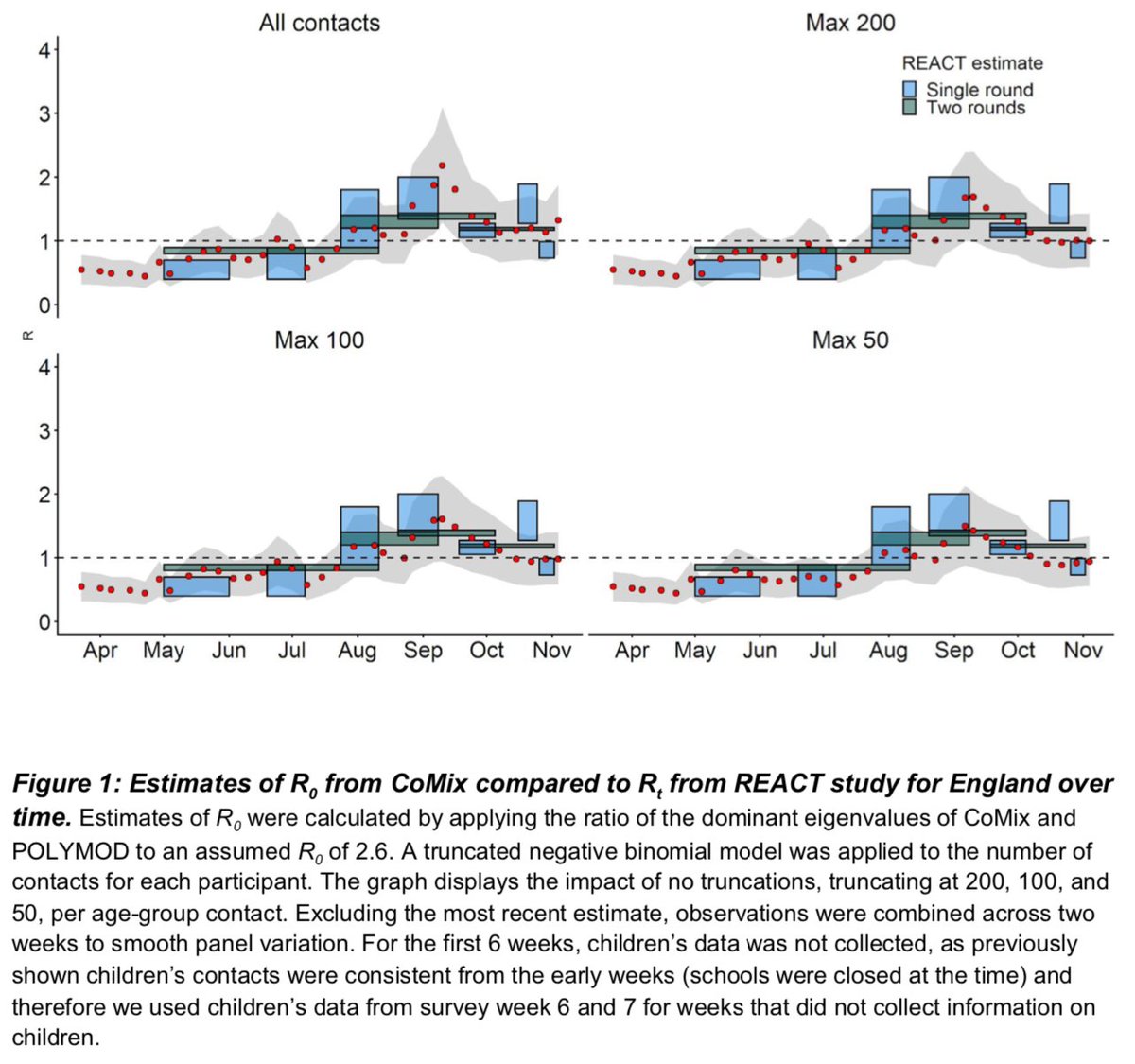
R estimated from social contact data (using R from early spring and pre-COVID contacts as baseline) vs R based on REACT-1 testing data. I.e. pretty much what we'd expect if changes in contacts were driving changes in transmission. By @Jarvis_Stats et al: https://t.co/R8YMf2W8f0
@trvrb We have done similar analysis for the first wave in various countries: https://t.co/d8iI76xmaf. Since July, I get a consistent 19-day shift and 1.7% CFR for the USA (varies between states), giving 2500 deaths per day at end of Nov and climbing.
Backcasting helps us appreciate just how bad the first COVID wave was. Here is data for the UK. Despite the huge number of daily cases, the infected fraction is still less than 10%. This pandemic has still got a long way to run. https://t.co/qhWWcZLhwt
Backcasting helps us appreciate just how bad the first COVID wave was. Here is data for the UK. Despite the huge number of daily cases, the infected fraction is still less than 10%. This pandemic has still got a long way to run. https://t.co/qhWWcZLhwt