I'm a former restaurant owner. In 2013, I started taking $BTC as payments to fight back against credit card fees. All savings from fees goes straight to the bottom line - and has major impact for a restaurant with thin margins.
Now, over 10 years later, we finally have a scalable solution for restaurants to improve profitability not only from lower fees but also better loyalty.
Congrats @blackbird! This is a long time coming.
🚀 The future of restaurant payments starts now.
Flynet is live—our purpose-built transaction network designed to cut fees, give restaurants control over their data, and create a new economy of loyalty.
Restaurants deserve better. This is how they get it.
📖 Read more from our CEO and founder, @benleventhal: https://t.co/sog3oiOxsH
@Arbitrum@Coinbase@Base@conduitxyz@Privy_io
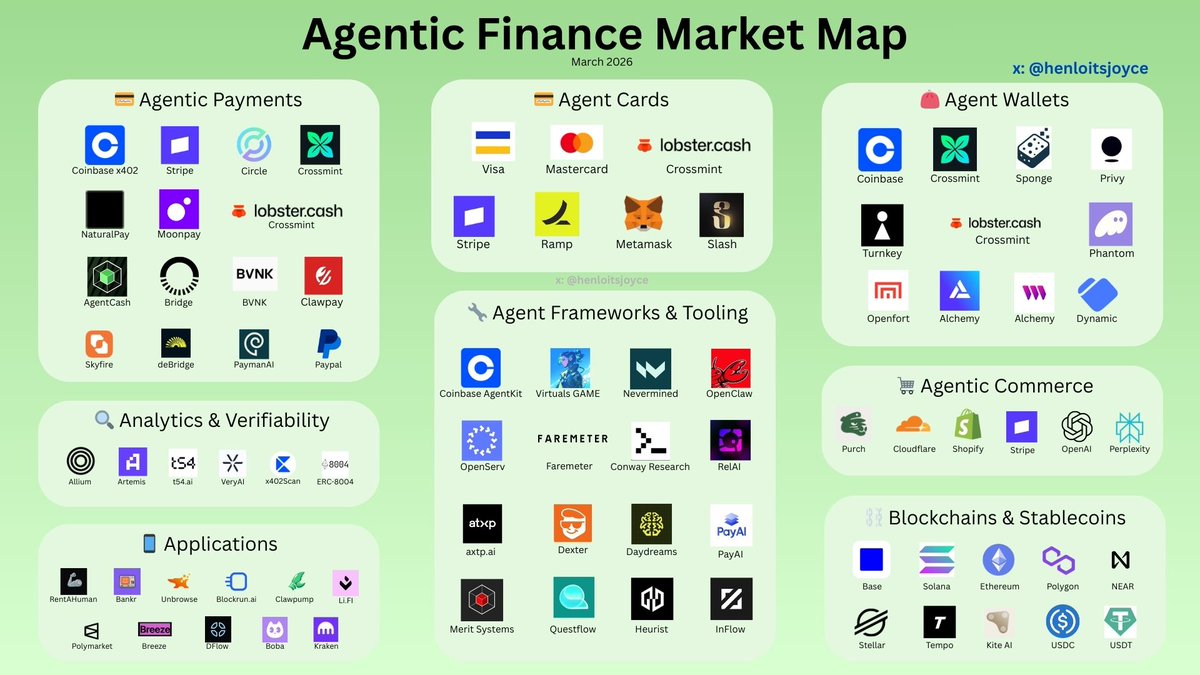
The agentic economy is taking off. Payments. Cards. Commerce. Frameworks. Wallets. Analytics.
Agentic finance will be the reigning theme going forward. I've compiled and made a market map of the names and players you should be aware of.
The future belongs to our AI overlords.
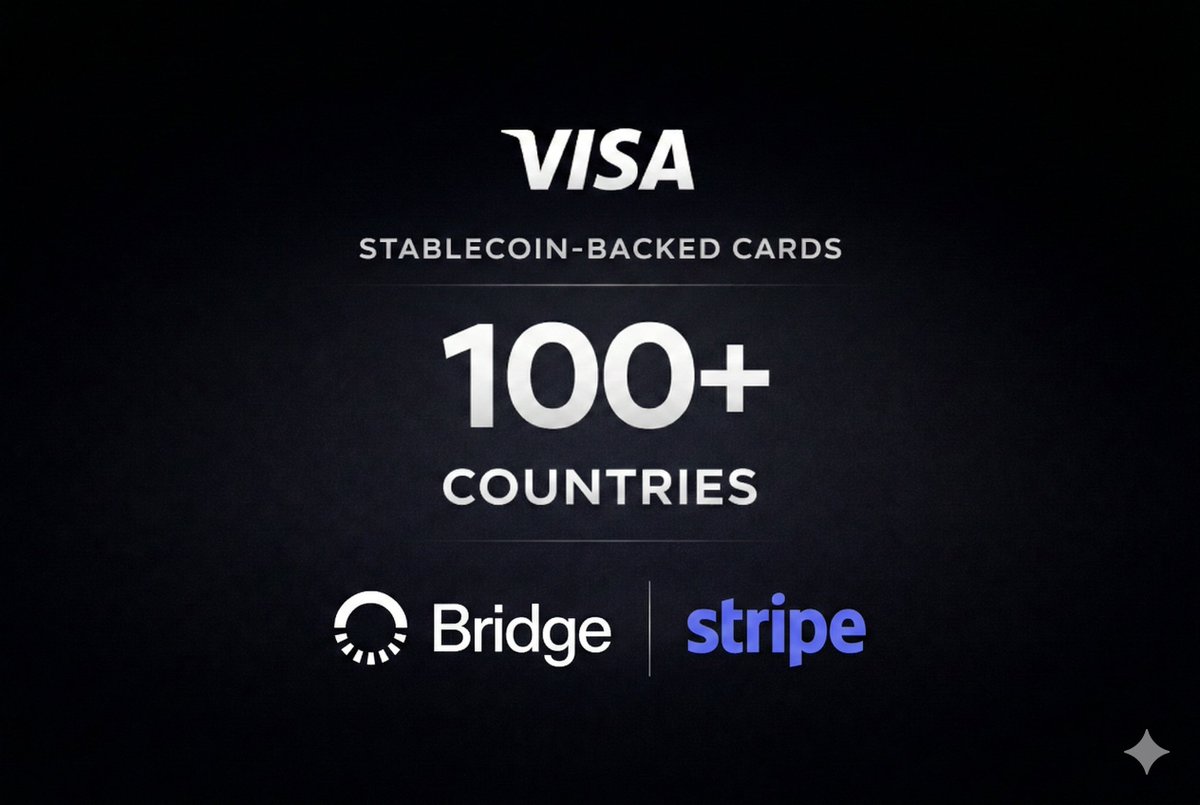
Visa and Stripe's Bridge are launching stablecoin-backed cards in 100+ countries.
This is SO different from how cards used to work.
You used to have to launch country-by-country.
Now its possible via one single API.
How? 👇
---
Bridge (which Stripe acquired in 2025) is the connector.
Wallet companies like Phantom come to Bridge, get branded debit cards, and their users spend stablecoin balances anywhere Visa is accepted.
Users who live anywhere in the world can get paid in stablecoins instantly.
And attach a card to that wallet to spend.
---
There's been a massive rise in companies launching "stablecoin-linked" cards. Growing from $1bn TPV to $5bn TPV in two quarters.
Why?
---
@cuysheffield, my cohost on @TokenizedPod and Visa's head of crypto, nailed it
"If you're building a stablecoin wallet and want people to spend in the real world, you need a card."
That pesky real world is so true.
Cards work.
It's settlement that doesn't.
---
Bridge is also joining Visa's pilot to settle charges on-chain — replacing traditional bank transfers with stablecoin settlement on blockchains.
That's the actual long-term story.
The spending side uses existing Visa rails.
The settlement side replaces the slow, expensive correspondent banking network.
---
The battle moved.
It's no longer crypto vs. cards.
It's who controls the wallet layer — and what happens when settlement moves on-chain at scale.
@chuk_xyz What happens if any of the underlying currencies get debased? For instance, if the dollar loses its global status as reserve currency, does this undermine the entire stablecoin thesis?
@Livepeer Livepeer is just scratching the surface of what’s possible - Sora is just one example of how media creation will exponentially increase the need for affordable compute
Big news: Crossmint is partnering with Google to enable agentic finance for everyone.
We will be using Google’s Agent Payments Protocol (AP2) to let agents buy anything with either credit cards or stablecoins.
This protocol ensures agent transactions are secure and seamless.
I've been in crypto for 8 years. There's never been anything like #bittensor.
It's a self-improving, capitalistic network where only the most useful ideas survive. Build something better, or be out-built.
Bittensor pioneered the concept of decentralized AI (deAI), a hive-mind of AI scientists advancing open intelligence across decentralized training, DeSci, compute, financial trading, betting markets, and more.
Others may try to imitate it, but they can't replicate what Bittensor is. Its ever-evolving nature means it only gets stronger by the day.
This is a new paradigm for AI innovation. It rewards utility and grit. Clean and clear.
$TAO