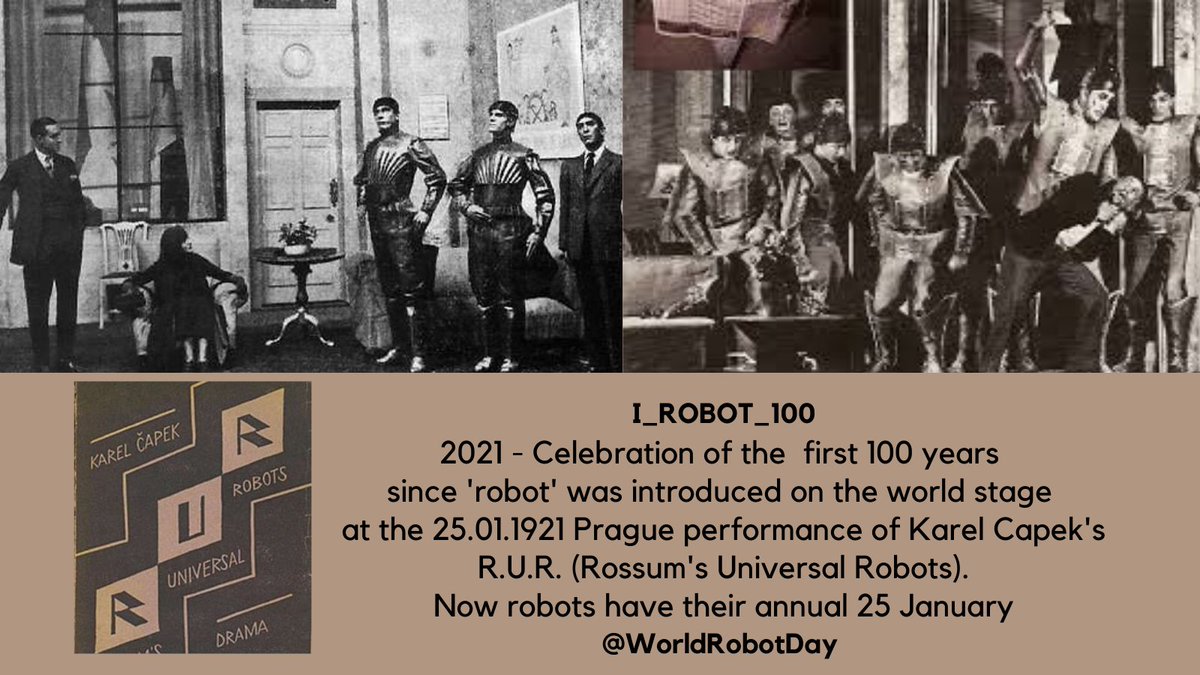
World Robot Day 25 January - created by Pida Ripley in 2021 to mark 100 years since the word 'robot' debuted in the R.U.R. play by #KarelČapek. #WorldRobotDay
In a supervised test, GPT-4 could not solve a CAPTCHA, so it recruited a human and gave a false explanation. Clever problem-solving or an early warning about AI agency? Which actions should always require human approval? #AIAgents#AISafety
The engineer behind Claude Code explains prompts, CLAUDE.md files, memory and parallel sessions. Better prompting can increase output quickly, but who verifies all that new code? Should teams prioritize generation skills or review skills? #ClaudeCode#Coding
AI agents follow instructions perfectly. Unfortunately, they follow your instructions. 😂 One vague request later, ten files changed and the original feature is gone. How much context do you provide before an agent touches real work? #AIHumor#AIAgents
We went from teaching AI how to write emails to teaching robots how to move by watching humans.
NVIDIA’s new robotics model is another step in that direction.
The next big AI revolution might not happen on your screen.
It might walk right past you.
Tesla is designing fans for Optimus. The challenge is keeping its joints and electronics cool through sustained work, within tight limits on weight, noise and battery power.
#Tesla#Optimus#Robotics https://t.co/iykkQjFtuv
Once robotics takes off, it’s over.
Superintelligent robots will close the loop for empirical science that relies on physical data. Robotics will allow AI to reach out of the disembodied sea of information into the concrete world of matter. And this physical data will reinforce more abstract / theoretical capabilities, like solving Millennium Prize level problems, but in every theoretical domain.
Fable 5.2 is a MASSIVE leap in robotics by the way.
You are living through the singularity!
Couldn't make it to CoRL this year, but I've been following the papers and discussions coming out of it.
A few things really stood out: how much compute we actually need, how we measure progress in robotics, and the growing gap between academic labs and industry.
Here's my roundup of CoRL and everything else that happened in robotics this week.
CoRL & Research
CoRL got 2,094 submissions this year, nearly 3x last year
SuperMimic from UC Berkeley won Best Paper. It trained a humanoid controller on 1 GPU in 3 hours, vs a baseline that needed 128 GPUs for 7 days (author's numbers)
A CoRL workshop paper called "How Much of Your VLA Is kNN" got 91.7% on the LIBERO benchmark without training a policy, which raises real questions about what our evals measure
In Hang Zhao's keynote, a policy calling a frontier model dropped from over 60% to 15% in a simulated kitchen once its thinking time counted against a deadline
Andy Pinxin Liu's post saying academic robotics has 2-3 years left got a lot of people talking
Models
@nvidia introduced GR00T 2, a world action model that learns from human video and carries skills across different robot bodies
@GoogleDeepMind released Gemini Robotics 2.5, and @Apptronik's Apollo 2 hit 96% success sorting car parts in a proof of concept on Mercedes-Benz production lines
@runwayml released open weights for Praxis-1, its 27B world action model, under Apache 2.0
OpenAI folded its stand-alone robotics team into its main research and applied teams, betting its general models can run robots
@SkildAI open-sourced Steel, a physics solver built with NVIDIA that runs up to 13x faster than PhysX on mixed robot tasks
Funding
Agile Robots raised a $500M Series F at an $8.5B valuation, led by SoftBank
@PathRobotics raised a $300M Series E at a $2.45B valuation to take its AI welding robots to more factory tasks
Deployments & Industry
@GXOLogistics + @Apptronik signed a letter of intent for up to 1,000 Apollo humanoids over four years, if trials hit their targets
@mimicrobotics + @BMW trained FLUX-mimic on real production parts for assembly, insertion, kitting and cable routing
@ASUS is training Gallop, its first humanoid, to pack motherboard accessories in its own factory
EACON's autonomous haulage system is now running on more than 4,000 mining trucks
Andy Rubin's Genki showed its humanoid in public for the first time
Japan's PM Sanae Takaichi met six Physical AI companies and restated her government's goal of around 10M AI robots by 2040
Really interesting week. I think the next few months will show which of these hold up in real deployments.
Breaking : Training physical robots in the real world is slow and risky, so AI is building them infinite virtual gyms.
Google DeepMind is pairing its Genie 4 real-time world model with Gemini reasoning models to generate endless, interactive 3D digital playgrounds for robotics training. Think of Gemini as the director breaking complex tasks into step-by-step instructions, while Genie 4 renders a living, playable environment with native audio and responsive physics on the fly. Instead of risking expensive hardware or building rigid 3D maps by hand, machines can safely rehearse unpredictable scenarios before stepping into our homes, hospitals, or ecosystems.
Use cases include training humanoid helpers, testing autonomous drones in extreme weather, and simulating disaster zones.
For robotics engineers: how close are neural world models to solving the sim-to-real physics gap?
Someone has thought about it 25 years back 😍
Global slowdown is so clearly in everyone’s interest :) Datacenters humming, curing rare diseases and automating alignment research instead of making themselves smarter. Humans have time to digest breakthroughs and make art. Just a lil collective action problem.
In this interview I tried to argue that a post-scarcity society will benefit working people. It was largely a rhetorical failure. People don’t trust that the benefits will be distributed, and tech optimists have to fix this communications issue.
This is f*cking insane. Google DeepMind CEO Demis Hassabis, the Nobel Prize winner behind AlphaFold, just called out every lab selling "PhD-level AI":
"I think that's a nonsense. They have some capabilities that are PhD level, but they're not in general capable
If you pose the question in a certain way, they can make simple mistakes with even high school maths"
In about a minute, he puts AGI 5 to 10 years out and names what's still missing: continual learning and one or two breakthroughs
Chatbots → PhD-Level Answers → High School Mistakes → Agents That Check Their Own Work
The model can be brilliant and still miscount
The people getting real work out of AI already assume it will slip, and build the checks around it
The labs are arguing about who's smartest, almost nobody is building the part that catches the mistake before it reaches you
Watch it today, then save the harness engineering guide below and build those checks yourself ↓
Balancing delicate touch with heavy lifting in one robotic arm is tough. Haptic feedback and high-torque joints let a single rover handle both fine tasks and heavy loads.
https://t.co/9wQ9p6oV5A
#Robotics#Hardware#Engineering
You might know @hedra_labs for AI videos and talking characters.
Today they launched Model Factory, bringing researchers, AI agents and GPU infrastructure together to help companies train, improve and deploy their own models...
Think a robotics team teaching a robot to grasp objects using its demonstrations. Or a manufacturer adapting a model to catch defects on its production line.
Their researchers work alongside your team, agents run experiments, and the results get evaluated before deciding what to keep. They also optimize the model for the hardware it actually needs to run on.
Going from generating videos to helping teams build models for robotics, manufacturing and biology is a hell of an expansion!
Boston Dynamics modified its Atlas humanoid robot by replacing its feet with wheels to test actuator performance under demanding conditions. Using reinforcement learning, Atlas learned to perform manoeuvres such as drifting, sideways dashes, and 360-degree jumps. The project also showed how accurate motor modelling and simulation can reliably transfer learned behaviours to physical hardware, improving control and robustness.
Video Credit: Boston Dynamics
#engineering #technology
Introducing EgoX: a cross-embodiment learning framework that trains manipulation policies across diverse embodiments using data from humans, physical robots, and simulated robots.
We cover highly heterogeneous embodiments: humans, physical and simulated humanoids, wheeled bimanual robots, tabletop arms, and quadrupeds. Their end effectors include three- to five-fingered dexterous hands, two-fingered and parallel-jaw grippers, and a fixed tool.
One recipe, any embodiment.
https://t.co/drFGPySbGL
Japan is back in the humanoid race. Omakase Robotics just opened sales for D1.
The compact wheeled humanoid stands 1.29–1.59 m tall, is only 48 cm wide, carries 5 kg per arm, and runs for up to 8 hours.
It starts at ¥5M (~$31.7K), plus ¥200K/month (~$1.3K) for OS and support. The first October batch is already sold out, with 100 units and 10,000 field hours targeted for FY2026.
The software is more interesting: Omakase OS + Zen, a hybrid stack combining state machines, imitation-learned skills, and post-trained VLA policies.
At the University of Tsukuba Hospital, teleoperation completed a blood-draw prep task 7/7 times. The learned policy managed 3/6.
That result isn’t impressive, and it’s clearly still a long way from real-world deployment.
Japan has fallen behind in humanoid commercialization, and D1 is trying to claw its way back through compact hardware, real workplaces, and actual operating hours.
Not gonna lie, though: that head design is pretty bizarre.
If you watch the end of the video—with the robot rolling down a dark hallway to that soundtrack—it somehow gets even creepier. lol
Also, I’m really curious whose dexterous hands they’re using.
Video: Omakase Robotics
Teaching a bipedal robot to walk takes more than 12 actuators. It takes learning how to use them.
This 12-DOF humanoid combines 12 RobStride actuators with a walking controller trained through Reinforcement Learning.
Developed by RoboNex, a student team at Hanyang University ERICA, South Korea, the project takes a sim-to-real approach, transferring learned walking behaviours from simulation to a physical robot.
A compact humanoid platform bringing together actuation, locomotion and reinforcement learning.