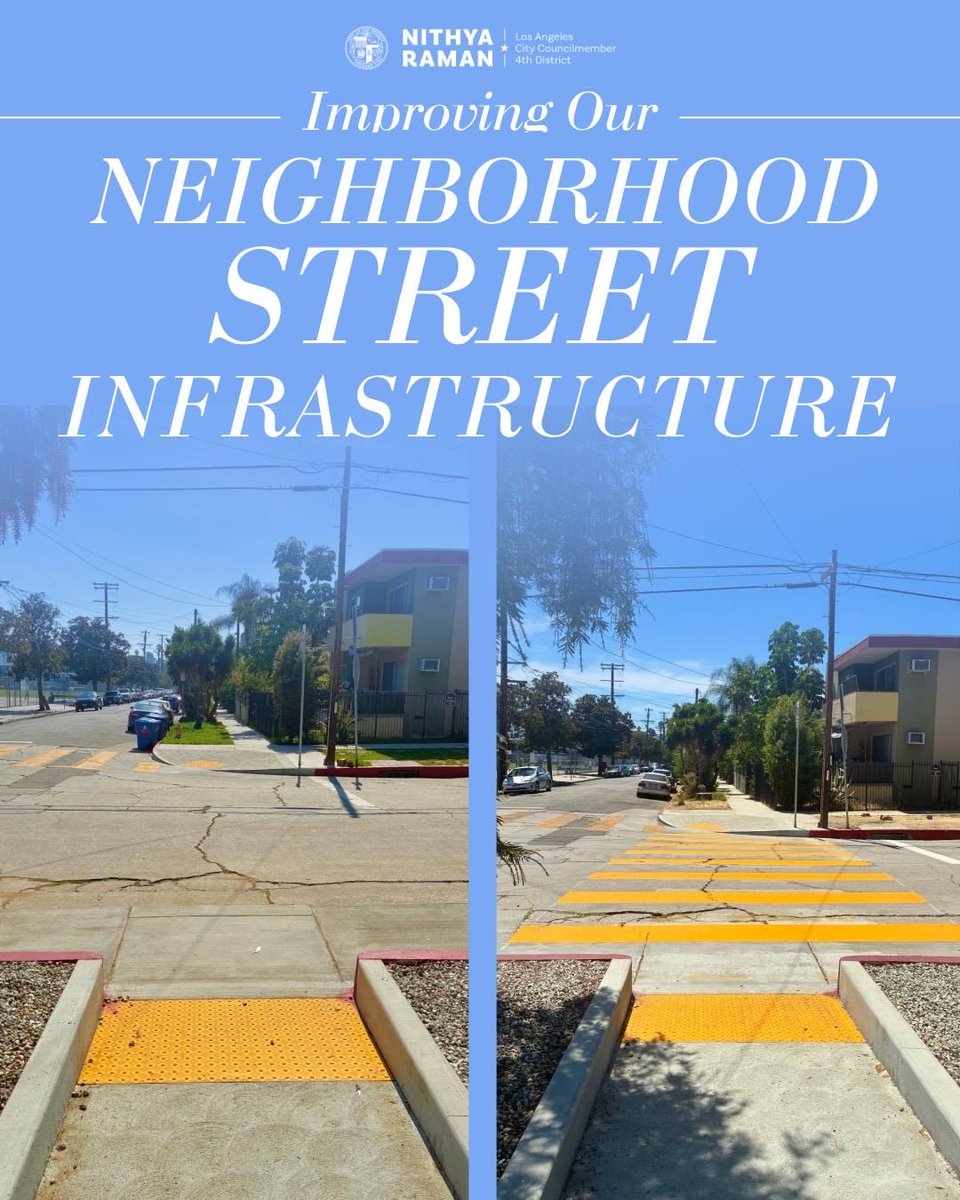
The Los Feliz Neighborhood Council alerted our office in late 2025 to the need for a crosswalk at Sunset Dr. and Bates St., which has just been completed!
Thank you to our incredible CD4 Field Team for continuing to problem-solve, push for solutions, and make our streets safer.
@BuildMonumental’s 3D print farm is every hardware nerds dream.
Their office is essentially one giant home.
Kinda reminds me of my favourite childhood show “Bear in the Big Blue House”. If you know you know!
#robotics#hardware#3Dprint
We built autonomous bricklaying robots and the thing contractors can't stop talking about is that they can click on any brick and watch videos of it getting laid.
Love this first ever inside look on Atrium our team put together. It's a proper deep dive into how to build the software layer for the physical world.
So many gems for founders in the Ben x Travis interview
IMO the rarest is hearing someone who is a generational fundraiser (+ company-builder) walk through in detail how he runs a round
Also a very candid convo on how rounds come together (or fall apart)
@Ekaeoq@noah_eacc We are working on solving exactly that problem at @BuildMonumental and have already finished more than 100 homes doing so
https://t.co/FNIKeXUTCM
Monumental’s robots have now built the brickwork for a 100 (!) homes, a school, a hotel, a community center, and hundreds of meters of Amsterdam's canal walls. Our pace is compounding: half of everything we've ever delivered went up in the last three months (!!!)
One of my hopes is that we can get the cost of housing construction down to the cost of materials, and the cost of materials down to energy+robot labour.
Underrated is that this will be incredible for the beauty of the buildings our civilisation can make
one of my most optimistic AI predictions is that it will allow us to build beautifully again.
the reason so much old architecture was beautiful is that construction was organized around craftsmanship, and people expected buildings to be beautiful.
stone, wood, and brick already had to be shaped and placed by hand, so the workers, tools, and supply chains capable of adding detail were built into the process.
then the 20th century changed the economics.
cities needed huge amounts of housing fast, skilled labor became expensive, and construction shifted toward standardized plans and mass-produced parts.
every unique arch, window, or facade became an expensive exception requiring custom drawings, parts, specialists, and time.
so the cheapest building became a simple box that was easy to repeat.
i mean just look at any modern skyline. it’s the same ugly glass skyscraper repeated from city to city, with very little detail, local character, or differentiation.
which explains why historic neighborhoods are still among the most sought-after parts of so many cities.
isn’t that backwards?
if the future is better, shouldn’t the newest neighborhoods be the ones everyone dreams of living in??
i think AI and robotics will finally reverse the economics.
> AI will make beautiful buildings cheap to design and engineer.
> robotics will make them cheap to physically build.
and the cost difference between a plain box and a detailed facade will collapse.
(the bricklaying robots below are an early version of this)
you've already seen the digital version of this.
building a beautiful website used to require expensive designers and developers. now one person can vibe one in an hour with AI.
the same will happen with buildings.
people just need to care about beauty again.
One of my hopes is that we can get the cost of housing construction down to the cost of materials, and the cost of materials down to energy+robot labour.
Underrated is that this will be incredible for the beauty of the buildings our civilisation can make
We're hiring across the board — software and hardware engineers, robot operators, operations, GTM — in the Netherlands, the UK, and the US.
https://t.co/xPMxBH697n
Join us and contribute to one of the most important and underrated missions, helping make construction and housing more affordable again, in one of the largest industries in the world.
Very few jobs in technology let you leave an enduring and tangible mark in the world. Everything we’ve built is now part of the permanent fabric of the Netherlands and the UK. The canal walls we built in Amsterdam's historic center will be there for centuries to come.
We solve this with Atrium, the operating system behind everything we do. Atrium takes architectural drawings and turns them into robot-executable plans, coordinates a fleet of robots on each site, localizes robots with millimeter accuracy, tracks every brick, and QAs the wall as it gets built.