Life is fucking electric bro. Don’t fall for the doomer shit. Thats for losers and normies scared of their own shadows. Walk around like God sent you and smile at everyone you see. Spread light and abundance. Build things and take chances. This is the best time in history!
You pay YouTube TV $72.99/month. For channels picked by Google. On Google's servers. With Google's ads.
You pay Hulu + Live TV $82.99/month. On Hulu's servers. With Hulu's ads. With Hulu's interface.
You pay Sling TV $40/month. For a stripped-down package. Still their servers. Still their rules.
Someone built a free collection of publicly available IPTV channels from every country on earth. No subscription. No account. No app required.
It's called iptv-org/iptv. 125,685 stars on GitHub.
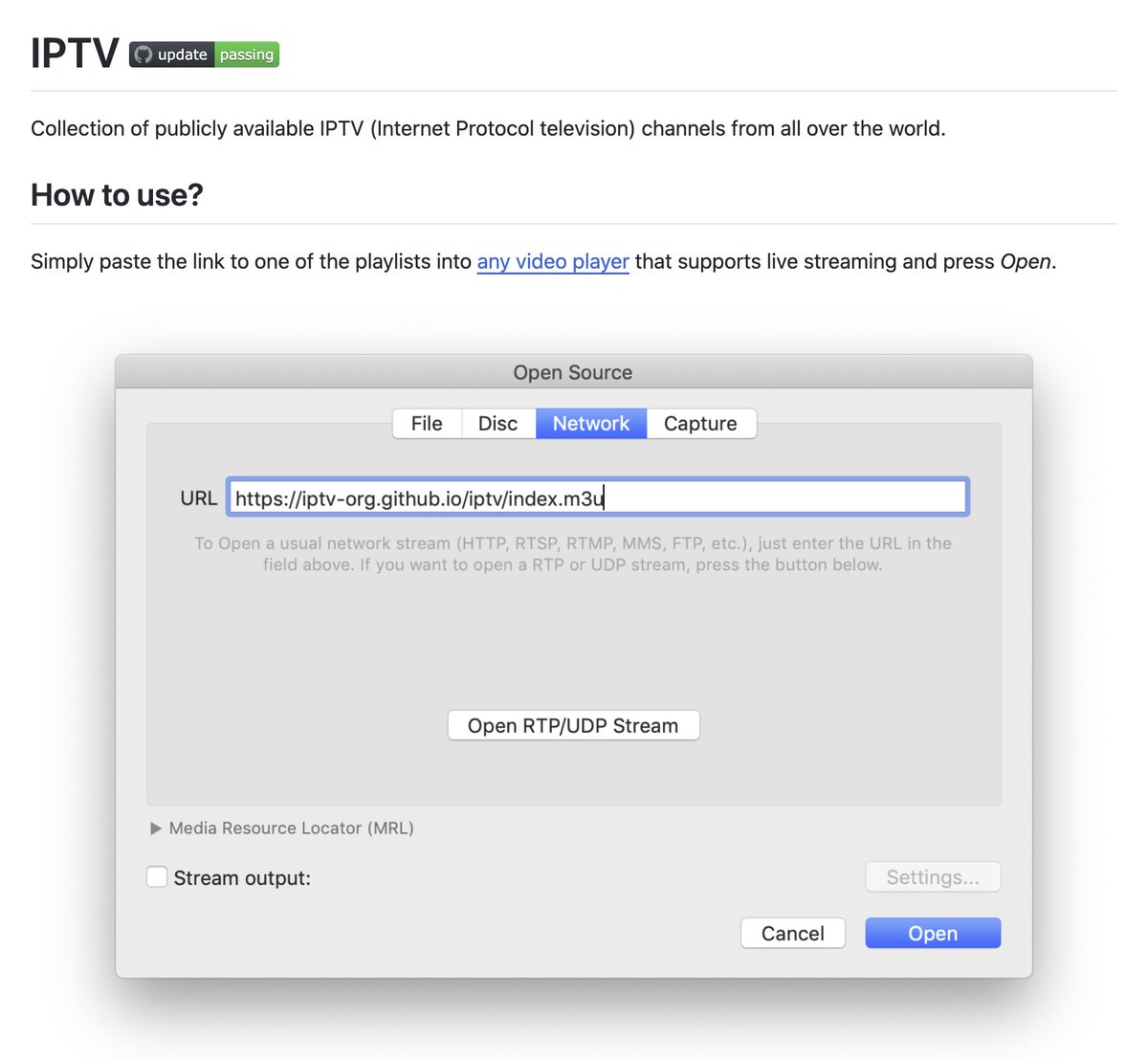
You copy one URL. You paste it into VLC. You press Open. Every channel loads instantly. That is the entire setup.
Here's what it does:
→ A single master playlist at one URL containing every available channel in the repository.
→ Channels organized by country. By language. By category. Sports. News. Kids. Movies.
→ Works with any video player that supports live streaming. VLC, Kodi, Plex, IPTV Smarters, and dozens more.
→ Channels from every continent. Hundreds of countries. Dozens of languages.
YouTube TV: $72.99/month. $875.88/year.
Hulu + Live TV: $82.99/month. $995.88/year.
Sling TV Orange + Blue: $65/month. $780/year.
DirecTV Stream: $79.99/month. $959.88/year.
iptv-org/iptv: $0. Unlimited channels. Every country. Every language. Forever.
100% Open Source.
Github repo link: https://t.co/TjMEQkOVB2
I have read approximately 3,000 10-Ks in my life. I have read my wife’s emotional state correctly maybe 11 times. This is troubling because the skills should transfer. Both require you to look past the headline. Both require you to read the footnotes. Both require you to notice what was said last quarter that is not being said this quarter.
I can spot a goodwill impairment from 40 pages away. I cannot spot that my wife has been quietly furious since Tuesday. In a 10-K I notice when management changes the word “challenging” to “dynamic” and I correctly interpret this as a warning. In my marriage my wife changed the word “fine” to “fine.” and I did not notice the period. The period was the entire disclosure.
I missed it. I read a footnote last week in a packaging company’s annual report that disclosed a related-party transaction worth $400,000 and I caught it in 90 seconds. My wife told me three times this month that she was tired and I interpreted this as “tired” when in fact it was a Level 3 disclosure requiring immediate management response. I have a system for 10-Ks. I read the MD&A first, then the risk factors, then the cash flow statement, then the notes. I have no system for my wife. She is a company that does not file. She reports continuously and without warning and the format changes every quarter. Her risk factors are not enumerated.
Her MD&A is delivered through sighs of varying length and I have not yet developed the ear. Last week she said “do whatever you want” and I did whatever I wanted and it turns out the correct interpretation of “do whatever you want” was “do not do that specific thing” and I have no idea how I was supposed to know that, and yet, looking back, the signals were all there. The signals are always there. I have been trained to find signals. I find them in companies I will never meet. I miss them in the person I have lived with for nine years. My wife has started saying things like “you would notice this if I were a stock” and she is correct. She is correct. If she had a ticker I would have already built a 6,000-word model on her. I would know her seasonality.
I would know her capex cycle. I would know which quarters historically run hot. Instead I treat her like a private company and I am surprised every time the auditors arrive. I am going to bed now. She said good night in a tone. I do not know what the tone meant. I will find out in the morning. Or I will not. The 10-K of my marriage is filed in real time and I am, as always, three quarters behind.
you have absolutely no clue how good, how abundant and how wealthy your reality is about to get for you
study the phase mechanics of surface tension. you are right at the breaking point before your old self dissolves at which you pop through into the new simulation
whatever looks like an obstacle is a actually springboard into your highest vision
affirm
Your entire life will change when you realize preparation always beats planning. Planning is based on the expectation of order. Preparation is based on the expectation of chaos. Plan for order and you'll be destroyed by chaos. Prepare for chaos and you'll thrive in any condition.
Micron will be a $4,000 stock (Save this).
Three memory companies, Micron, SK Hynix and Samsung are on a path to generate a combined $945 billion in operating income by 2029.
A decade ago that number would have been laughed out of any analyst meeting, but today it's already baked into contracted supply agreements.
For most of the last 20 years, memory was a terrible business, cyclical, commoditized, boom then bust then crash.
AI broke that cycle permanently and here's the mechanism.
A single AI server requires 8 to 10 times the DRAM of a traditional server, and HBM, the premium memory stacked directly on top of AI chips is now required for every major GPU architecture on earth.
The problem is that HBM takes roughly 3x the wafer area of standard DRAM to manufacture, so every time a fab shifts capacity toward HBM to meet AI demand, it simultaneously creates a shortage of conventional DRAM for everything else.
The result is that prices are rising everywhere at once.
DRAM contract prices surged over 170% year over year by end of 2025, and Q2 2026 prices are projected to rise another 58 to 63% quarter over quarter, the steepest single quarter jump in a decade.
And HBM is not a commodity but rather a qualification gated infrastructure.
To sell HBM to a hyperscaler, your product has to pass a rigorous multi-month qualification process tied to their specific chip architecture.
The moment you're qualified, you're essentially the only approved supplier for that platform until the next generation ships, 18 to 24 months later.
The competitive moat isn't brand loyalty or price. It's a technical certification that physically locks out everyone else.
Samsung's semiconductor division posted a 47-fold increase in operating profit in Q1 2026 alone, and SK Hynix's operating margins are approaching 80%, the highest of any major company on the planet.
Now here's why Micron is going to be the biggest winner of all of them.
SK Hynix holds 62% HBM market share and got there first but Micron is the most compelling investment, and the gap is closing fast.
Micron is the only US domiciled memory company, which means every CHIPS Act grant, every Pentagon preferred supplier contract and every buy American infrastructure mandate flows through it by default.
Its Idaho and New York fabs are receiving $6.1 billion in direct federal grants plus billions more in subsidized loans, government funded capacity expansion that competitors in Korea simply don't get.
It also has the most operating leverage of anyone in this cycle.
Micron started at 21% HBM market share after years of underinvestment, which means every point it gains from here drops directly to the bottom line because the fixed cost base is already set.
Its HBM4 is now shipping with speeds exceeding 11 Gb/s, bandwidth above 2.8 TB/s, and 20% better power efficiency than HBM3E which matters enormously to hyperscalers paying $10 million per month per data center in electricity costs.
The profit projection in that chart puts Micron at $160 billion in operating income by 2029 alone, which would make it one of the most profitable companies on the planet.
The current stock price doesn't reflect that reality yet.
Weekend reading recommendations:
• JPMorgan — AI Drives Resurgence in Custom Chips (ASICs): ASIC Market Overview/Update
• SemiAnalysis — Stop Saying Half of 2026 US Datacenter Capacity Is Canceled
• Bernstein — Global Semis: The CPU Renaissance? Beneficiaries of a $223bn TAM…
• UBS — Largan Precision: CPO catalysts alongside firm core smartphone lens demand support further upside
People seem fundamentally confused about the Midjourney scanner.
The play is not “we’ve made a crazy new machine that does better scans than anyone else.”
The play is “we’re making a good-enough scanner that is so fast and cheap that we’re going to be able to produce the world’s first truly massive, population level data sets to train diagnostic ML systems on”.
The machine is cool tech, a great use of their in-house expertise, and it’ll let you do some really fun new things with ultrasonic imaging, but the real value is in the cost, speed, and comprehensive nature of the scans.
If you haven’t internalised the Bitter Lesson, all the hype seems unintelligible.
But there’s a reason - both in terms of the device functionality, and the wider picture - that it’s an AI startup making this play, and not a conventional medical device company.
Remember the massive run on $SIVE when Wall Street suddenly realized who was holding the critical keys to the 5G and satellite infrastructure?
We are looking at the exact same setup right now with $BLG
Let’s look at the physical reality of these next-generation AI data centers.
Silicon photonics platform, like the ones manufactured by $TSEM, have a fundamental physical limitation: silicon cannot emit light.
These advanced chips are completely blind without an external, ultra-precise laser source.
While legacy optics giants like $COHR traditionally dominate standard infrared lasers, the next frontier of high-density AI infrastructure and quantum logic demands something much more precise: visible Gallium Nitride (GaN) laser diodes.
BluGlass is one of the incredibly rare global players with the proprietary technology to manufacture these.
This isn't theoretical R&D. $BLG is already embedded alongside $COHR in elite government initiatives like the US Department of Defense’s CLAWS Hub, specifically tasked with building the next-generation semiconductor pipeline for national security.
The ultimate test for any deep-tech micro-cap is transitioning from the lab to commercial revenue. BluGlass is hitting that inflection point right now, securing contracts with the exact players building tomorrow's infrastructure:
$BLG is a direct supplier of specialized GaN gain chips to $INFQ, the vanguard of neutral-atom quantum computing. $INFQ integrates these components into systems that plug directly into $NVDA supercomputing architecture to run hybrid quantum-AI workloads. Without $BLG light, the qubits don't stabilize; without stabilization, $NVDA quantum software has nothing to compute.
$BLG secured a $1.3M commercial development agreement with a global mass-capacity data storage leader.
This contract proves that the need for precision GaN lasers isn't just a niche quantum requirement, it is a critical necessity for the massive optical storage architectures needed to handle AI data loads.