CTO at Bekind Labs, a software consultancy in Tokyo full of ex-Pivotal Labs folks. Love trail running and language learning. Building Context in my spare time.
@runliftrunlift I bought Jordan Metzl's book, "Running Strong" and he is a big fan of massage and foam rolling for preventing injury. My understanding is that they increase blood flow to the muscles, which hastens recovery. Is this wrong? I guess this won't help tendon or bone injuries.
PICARD: Data, shields up
DATA: Brilliant! Shields can reduce damage we sustain. Not immunity. Not hubris. Just prudence. It's not precaution—it's strategy.
[camera shakes]
WORF: HULL BREACHES ON NINE DECKS
DATA: Here's what happened: you told me to raise shields, and I didn't
Why are so many people so sure that the big AI providers are losing money on inference? It reminds me of the comments about how Uber can never make money. Their unit economics were fine and they were only losing money because they chose to do so on customer acquisition.
The chasm between Normieland and the Endurance World when it comes to exercise is almost impossible to describe. It's the Grand Canyon on PEDs.
When you see public health guidelines recommending 2.5 hours of exercise per week, that's actually pretty reasonable.
Because the average person does closer to zero.
Exercise is hard (they think). They're tired. They're busy. There are a million competing priorities. Getting someone to take a long walk before breakfast or after dinner a few times per week is a huge win.
For a serious endurance athlete, though, 2.5 hours per week doesn't even move the needle. That’s an off week.
People sign up for marathons thinking it will be the kick in the butt they need to get in shape. Then they run 3-4 hours per week and wonder why they had to walk at mile 20.
The one thing you can't cheat in endurance sports is time.
An hour a day on average is table stakes. Want to be competitive in your age group? Double it. Maybe more.
Don't expect friends, family, or coworkers to understand. For many people, 2.5 hours of exercise per week is great.
For someone serious about endurance training, that's just Saturday morning.
No smoking gun, but the preponderance of evidence points to smartphones, not economics, as the culprit for the global drop in fertility:
• In the US and UK, births fell first and fastest in areas that got 4G earliest
• Birth rates were stable in the US, UK and Australia until 2007; in France and Poland until 2009; in Mexico and Indonesia until 2012; in Ghana, Nigeria and Senegal until 2013-15
Each of these inflection points matches local smartphone adoption (see picture).
• The younger the age group, the sharper the drop.
• in-person socialising among young adults is dropping. In SK, by 50% in 20 years
• Sexual dysfunction is higher among heavy social media user
• Effect is largest in culturally traditional societies — Middle East, Latin America, sub-Saharan Africa
• Decline holds across countries hit hard by GFC 2008 and those not hit, fast-growing and not growing.
Excellent again @jburnmurdoch.
https://t.co/RYEMXD2bRM
Solar power accounted for 10% of Japan’s electricity generation for the first time last year, exceeding the global average of 9%, according to a report from energy think tank Ember https://t.co/ItcBz8KKK9
Judging by my tl there is a growing gap in understanding of AI capability.
The first issue I think is around recency and tier of use. I think a lot of people tried the free tier of ChatGPT somewhere last year and allowed it to inform their views on AI a little too much. This is a group of reactions laughing at various quirks of the models, hallucinations, etc. Yes I also saw the viral videos of OpenAI's Advanced Voice mode fumbling simple queries like "should I drive or walk to the carwash". The thing is that these free and old/deprecated models don't reflect the capability in the latest round of state of the art agentic models of this year, especially OpenAI Codex and Claude Code.
But that brings me to the second issue. Even if people paid $200/month to use the state of the art models, a lot of the capabilities are relatively "peaky" in highly technical areas. Typical queries around search, writing, advice, etc. are *not* the domain that has made the most noticeable and dramatic strides in capability. Partly, this is due to the technical details of reinforcement learning and its use of verifiable rewards. But partly, it's also because these use cases are not sufficiently prioritized by the companies in their hillclimbing because they don't lead to as much $$$ value. The goldmines are elsewhere, and the focus comes along.
So that brings me to the second group of people, who *both* 1) pay for and use the state of the art frontier agentic models (OpenAI Codex / Claude Code) and 2) do so professionally in technical domains like programming, math and research. This group of people is subject to the highest amount of "AI Psychosis" because the recent improvements in these domains as of this year have been nothing short of staggering. When you hand a computer terminal to one of these models, you can now watch them melt programming problems that you'd normally expect to take days/weeks of work. It's this second group of people that assigns a much greater gravity to the capabilities, their slope, and various cyber-related repercussions.
TLDR the people in these two groups are speaking past each other. It really is simultaneously the case that OpenAI's free and I think slightly orphaned (?) "Advanced Voice Mode" will fumble the dumbest questions in your Instagram's reels and *at the same time*, OpenAI's highest-tier and paid Codex model will go off for 1 hour to coherently restructure an entire code base, or find and exploit vulnerabilities in computer systems. This part really works and has made dramatic strides because 2 properties: 1) these domains offer explicit reward functions that are verifiable meaning they are easily amenable to reinforcement learning training (e.g. unit tests passed yes or no, in contrast to writing, which is much harder to explicitly judge), but also 2) they are a lot more valuable in b2b settings, meaning that the biggest fraction of the team is focused on improving them. So here we are.
Apple accidentally built the world's largest hearing aid company.
AirPods Pro 2 got FDA clearance as a clinical-grade over-the-counter hearing aid in September 2024. The average American pays $4,700 for a pair of prescription hearing aids. AirPods Pro cost $249. That's a 95% price reduction for mild to moderate hearing loss, which covers roughly 30 million American adults.
But the price gap isn't even the real story. The real story is the stigma math.
Nearly 1 in 5 adults over 40 believe society judges people who wear hearing aids. The average person waits 4 years after noticing hearing loss before doing anything about it. A 78-year-old man threw away his hearing aids, popped in AirPods, and his niece didn't even register it as a medical device. That's the product working exactly as designed.
The hearing aid industry spent decades engineering smaller, more invisible devices to reduce stigma. Apple solved the problem from the opposite direction: make everyone wear something in their ears first, then add the medical function later. By the time the FDA cleared the software update, a billion people were already wearing the hardware.
The clinical study that earned the clearance enrolled 118 people. Self-fitted AirPods matched professionally fitted devices on perceived benefit, amplification, and speech comprehension scores. The audiologist appointment, the $200 fitting fee, the three follow-up visits bundled into that $4,700 price tag: optional.
Every hearing aid company spent the last century trying to make their product disappear. Apple made theirs a status symbol and added hearing restoration as a software update.
I’ve got news for you. The governments of Poland and the Baltic states distrust and dislike the Trump administration even more than the western Europeans because they are directly threatened by Trump’s friendliness towards Putin. The UN vote where the US voted with Russia and N.Korea against Ukraine is copied and framed on the wall of the Estonian foreign ministry
For all those who have been denouncing European allies for not providing unconditional military support for the war they opposed and weren't consulted about (and would have no say over going forward), note that this is what they are being asked to sign up for.
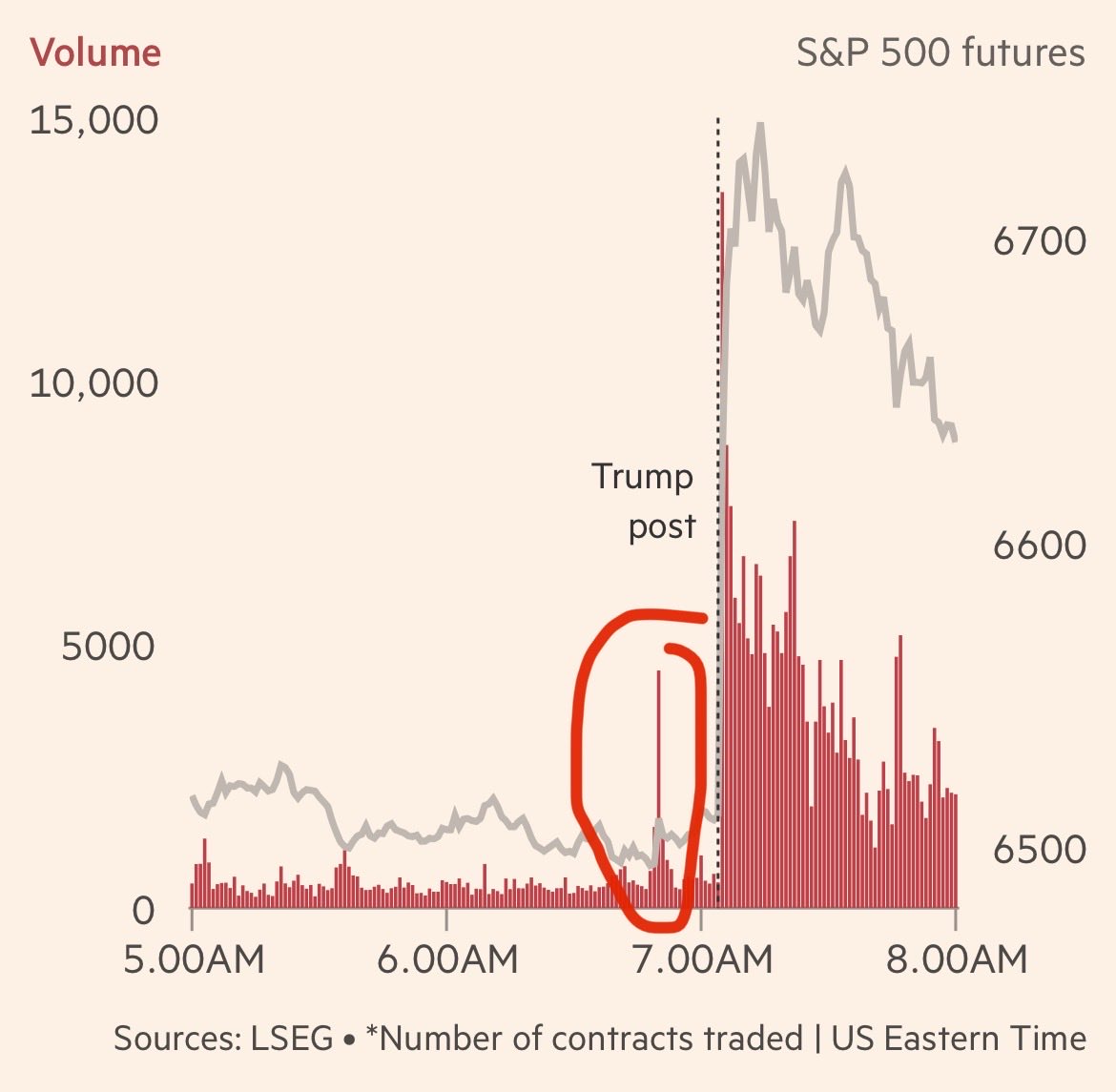
$1.5 BILLION. Let me say it again - a $1.5 BILLION BET.
Bigger than any futures purchases made at the time.
5 minutes before Trump's post.
Who was it? Trump? A family member? A White House staffer?
This is corruption. Mind blowing corruption.
You want the NATO allies to join you in a war you started without ever consulting these allies about the war or explaining your war aims. We’re meant just to meekly fall in line.
You recently supported a US invasion of a NATO ally (Denmark/Greenland) but now you want these same allies to join your war.
Your president disparaged and misrepresented the role of NATO allies in Afghanistan. But now you want them to join with you again in a war of your making.
You went to war with Iran without a thought of how to keep the Strait of Hormuz open and without involving your allies in the matter. But now you want the NATO allies to bail you out, even though there’s still no plan for Hormuz.
You want the NATO allies to join you in a war in which you still cannot articulate the endgame. Or what victory would look like.
You went to war thinking the Iranian regime would quickly topple, that Tehran would not attack the Gulf States or close Hormuz. Why would we align with such Epic Stupidity?
You and other know-nothing blowhards started this war all on your own. You can finish it on your own. If you’re able to …