526 year old manuscript of Regiomontanus’ Calendarium and Ephemerides.
Hand-written c. 1500 copy made in Lambach, Austria, of the 1474 printed edition.
It contains tables of lunar and solar eclipses, day lengths, zodiac signs, and daily planetary positions 1480–1506.
Still in its original blind-stamped leather binding over wooden boards.
Preserved at Penn’s Kislak Center.
The printed version of these tables is the one Columbus used to predict the lunar eclipse of 29 February 1504 while stranded in Jamaica.
⚡ This isn't a movie prop — it's being sold as footage from the actual Calvary, captured through what's called the "Vatican Cronovisor."
150,000 people already believe a novel just became a witness account. A scene humanity has only ever imagined, allegedly recorded in grainy black and white, decades after the technology to fake it convincingly existed.
If real, it rewrites everything we know about time. If fabricated, it's one of the most convincing hoaxes ever built.
Ya gerçekse? ✝️👁️
#VaticanCronovisor #ElProfeta #LostFootage #RealOrHoax #Calvary #Mystery #Paranormal #Viral #Trending #ForYou
Nobody profits from telling you the body heals itself. So nobody tells you.
Your taste buds are new every 10 to 14 days. The tongue reading this flavour is a fortnight old.
Your stomach lining rebuilds every 3 to 5 days. Last week's gut is already gone.
Your skin turns over every 4 weeks. You grew a whole new surface this month.
Your white blood cells renew in days. Tonight's immune army was not on watch last week.
Your red blood cells retire every 120 days. Four months, and the entire fleet is replaced.
The fat built into your cell membranes turns over too. Years of stored seed oil can slowly be walked back out.
Your liver just gets on with regenerating. It holds no grudge about the bad years.
Your skeleton rebuilds over roughly ten years. The bones made in the worst years are not the ones you finish with.
Every one of those rebuilds is made from what you feed it.
Feed it meat, fat, sunlight and sleep, and it builds you strong.
Feed it sugar, seed oil and the sofa, and it builds you soft.
The body you will have next year is under construction right now.
What you give it today is what it builds you into.
This video of Latvians singing The Lord's Prayer is so unbelievably moving and beautiful that I am going to pin it for a quick and easy timeline cleanse when needed. Bookmark this.
A Stanford neuroscientist warns high cortisol wrecks memory, enlarges your fear center, and makes your brain feel broken.
If I wanted to lower it naturally, I’d do these 8 things every day:
1. Walk barefoot on grass for 5–7 minutes.
Belly fat doesn't start with your diet.
It starts with cortisol cementing fat around your organs, a body locked in famine mode, and a nervous system stuck in survival mode.
Here are 7 science-backed ways to burn it for good:
1. No food 3 hours before bed.
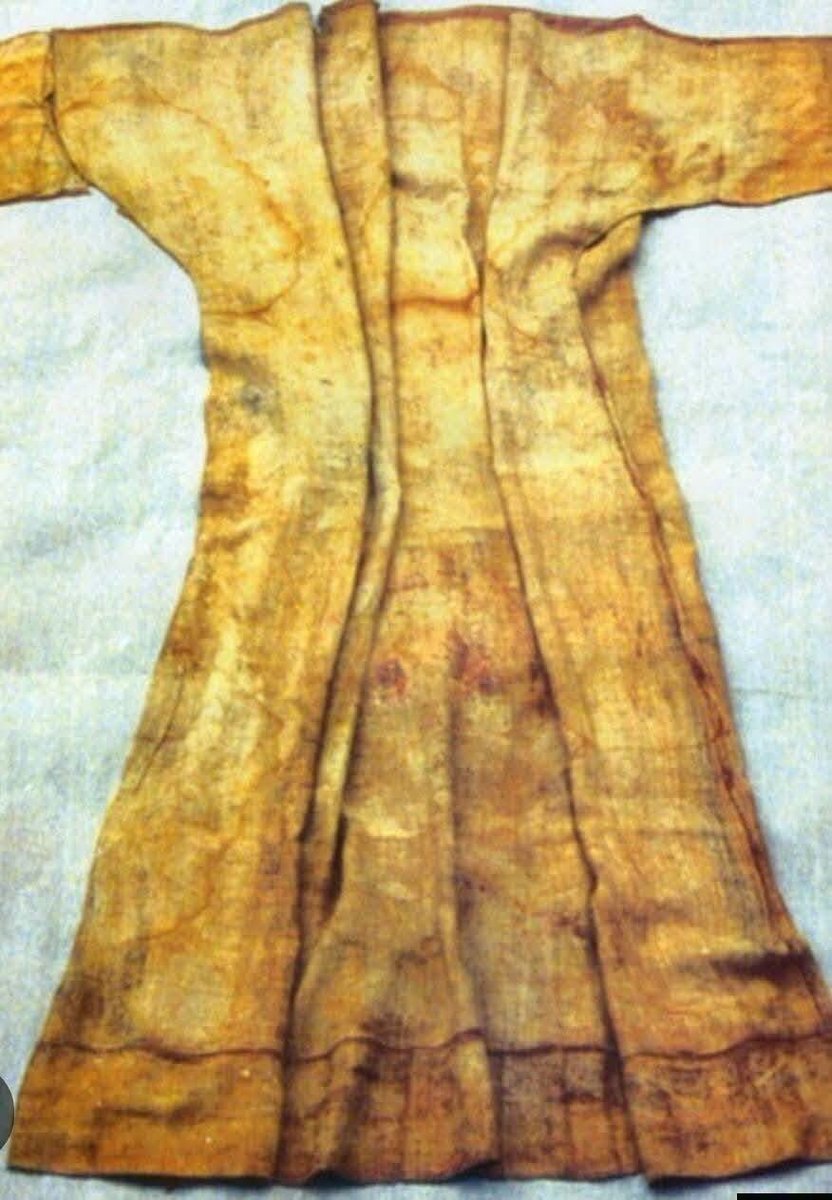
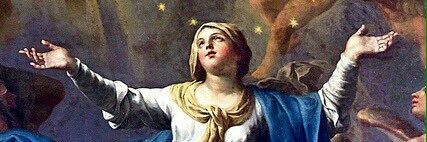
THE VESTMENT OF THE HOLY MOTHER OF GOD
According to Holy Tradition, the Mother of God gave this vestment (chiton) to the Orthodox Church as a pledge of her protection and intercession. The story of this great sanctuary in the Christian world is remarkable.
Before her Assumption, the Holy Virgin bequeathed the Holy Chiton to two poor widows in Nazareth who served her and received her help. One of these widows wished for this blessed gift to be passed down from one maiden to another. Thus, for three centuries, the Holy Chiton was reverently preserved in the Holy Land. Today, the sacred vestment is kept in the Zugdidi State Historical and Ethnographic Museum in Georgia.
In 2000, a miracle reportedly occurred when an image of Jesus Christ appeared on the chiton, which can only be seen through a telescope.
After the Assumption of the Holy Mother of God, this great treasure of Christianity was transferred to the Greek Church. Later, two brothers passing through Greece—Candide and Candide (the brothers of the Byzantine Emperor Leo the Great)—learned of the Virgin Mary's miraculous power from the locals and were healed by the relic. Wishing to secure the sacred garment for themselves, Candide and Candide made an exact replica of the casket upon their return from Palestine and secretly swapped the caskets at night.
The Byzantine Emperor treated the holy relic with great respect and placed it in the Blachernae Church, a sanctuary specifically built for this purpose in Constantinople. However, the chiton was later considered lost until it appeared in historical records in the 5th century. Until the 14th century, historical sources confirm that the chiton remained in Constantinople, the capital of the Byzantine Empire.
Following the fall of the Byzantine Empire, an archbishop brought the relic to the Mingrelia region of Georgia to save it from the Muslims. The middle part of the Virgin's belt—on which the Virgin Mary's image was embroidered by the Holy Mother herself—also came to Georgia. According to some historical sources, it was brought from Byzantium by Elena, the wife of Bagrat III, and placed in the Bedia Monastery.
The chiton itself later appeared in the Dadiani Palace before being transferred to the Hobi Monastery. In 1936, when religious artifacts were confiscated from churches and transferred to museums, the chiton returned to the Dadiani Palace.
In the Christian world, there are three non-man-made images of Christ: on the Holy Mandylion (Ubros), the Shroud of Turin, and the image of the Savior on the Chiton of the Mother of God in Zugdidi.
Many legends surround the miraculous power of the Chiton of the Mother of God, with the first miracle recorded in 632. It is known that the relic saved Constantinople twice from the invasions of the Saracens and Avars. During one siege, Patriarch Photius touched the violent sea waves with the chiton, and the resulting storm swallowed the enemy ships.
A miracle was also recorded in Georgia in 1891 when bandits stole the chiton from the Hobi Monastery. The entire population of Mingrelia and Hobi participated in the search, but in vain. Three days later, the chiton was miraculously found in the forest, glowing with an extraordinary light.
In the 17th century, the Antiochian Patriarch Macarius wrote: "I am happy to be in Mingrelia in the Calendzhik Monastery, and before me lies the Chiton of the Mother of God, and I look at it." Macarius placed a precious fabric over the chiton, cut a similar one, and consecrated it. A copy of this holy relic is still present in Constantinople.
Currently, the chiton is kept in Zugdidi, Georgia, in the Cathedral of the Blachernae Icon of the Mother of God. Every year, on the Feast of the Deposition of the Robe of the Mother of God (July 15), the relic is brought out for the faithful to worship.
Most Holy Mother of God save us🙏🏽☦️
your mind controls your health
joe dispenza completely healed his broken spine with visualization
john sarno cured 100k+ people's back pain by getting them to release anger
the placebo effect is more effective than most drugs
if you want to master your health you need to master your mind
Today. 10 July, AD 138.
Hadrian died at his villa in Baiae, after two years of an illness he couldn't survive and wasn't allowed to end.
In 137, he'd ordered the death of his ninety-two-year-old brother-in-law.
Servianus. Three-time consul, married to Hadrian's sister, groomed for decades as his likely successor. His own grandson was next in line after him.
Then Hadrian changed his mind and adopted someone else as heir. Servianus and his grandson pushed back. Hadrian called it a coup and ordered them both killed.
Before he died, the Historia Augusta records, Servianus asked the gods for one thing: that Hadrian would long for death, but be unable to die.
Cassius Dio and the Historia Augusta both describe what came after: failing health, and more than one attempt to end his own life. His household stopped him every time.
Nobody recorded whether he remembered the curse. 🏛️
"No one and nothing can take Christ out of our hearts. If you have received Communion even once in your life, He remains there.
For the Holy Bread which came down from Heaven - that is, Christ - gives life to those who partake of Him; and whoever eats of this Bread will live forever.
And this Blood, when received worthily, drives out the demons and removes them far from us, while calling to us the angels and the Master of the angels.
For when they see the Most Pure Blood, the demons flee, and the angels hasten to help us.”
St. Cyril of Alexandria
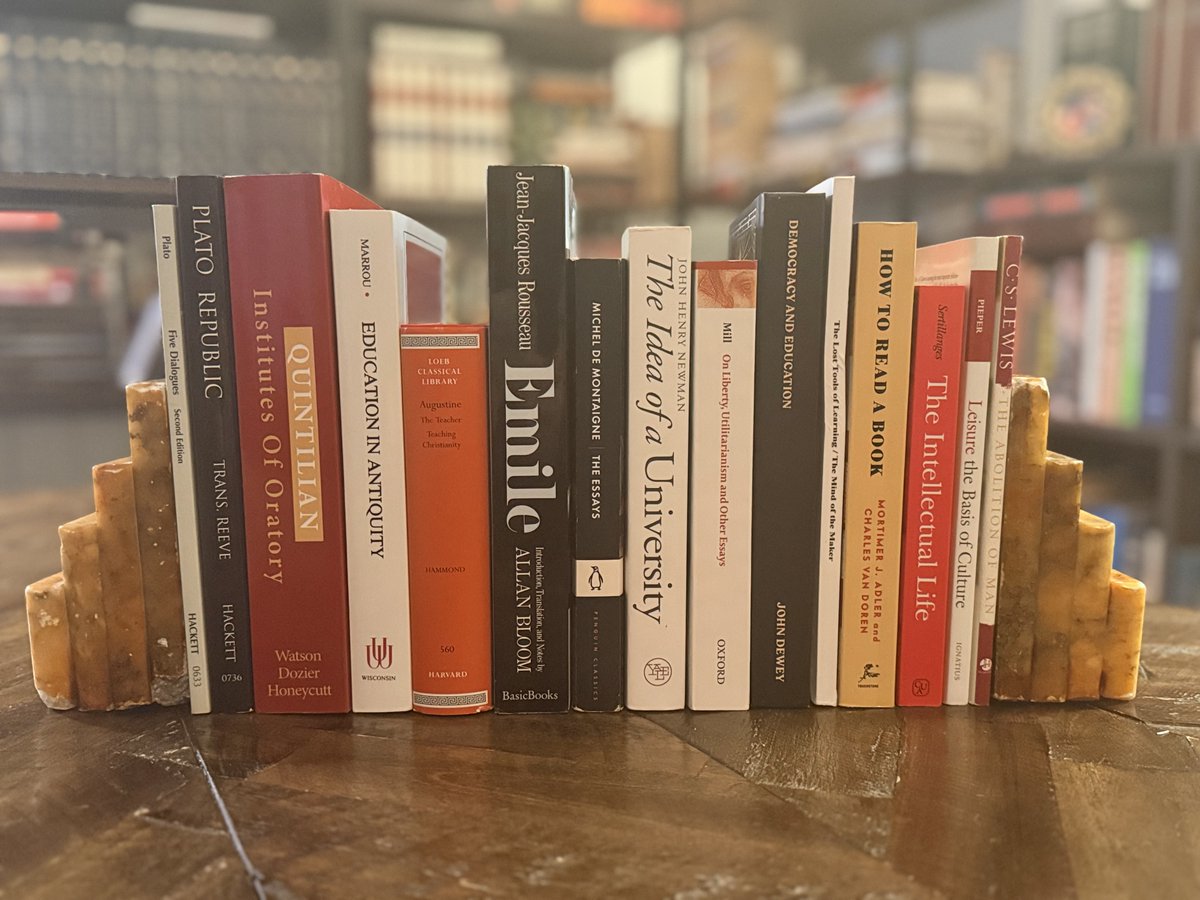
Some Books about Education
1. Plato, Meno
Can virtue be taught?
2. Plato, Republic (Books II–VII)
What should education aim at?
3. Quintilian, Institutes of Oratory
How is character formed?
4. H. I. Marrou, A History of Education in Antiquity
What did the Greeks and Romans mean by education?
5. Augustine, On Christian Teaching
What is the purpose of learning?
6. Rousseau, Émile
How should children be educated?
7. Michel de Montaigne, “On the Education of Children”
How does education form judgment?
8. John Henry Newman, The Idea of a University
What is higher education for?
9. John Stuart Mill, On Liberty
Why should education encourage independent thought?
10. John Dewey, Democracy and Education
What is the relation between education and society?
11. Dorothy Sayers, "The Lost Tools of Learning"
What skills should every student master?
12. Mortimer Adler, How to Read a Book
How do we become better readers?
13. A. G. Sertillanges, The Intellectual Life
How should a life of study be ordered?
14. Josef Pieper, Leisure: The Basis of Culture
Is education more than preparation for work?
15. C. S. Lewis, The Abolition of Man
What happens when education abandons objective values?
tolle lege
The Six Guys who Built The West
What those three little French dudes were trying to destroy (deconstruct), someone had to construct in the first place.
Everything of any value has to be built by someone.
Meet our civilizational founding fathers – actually three pairs of guys:
First came Socrates and Aristotle.
Socrates introduced something revolutionary: the idea that truth emerges through disciplined adversarial inquiry. Not through tribal instinct, not through force, not through revelation, but through rational confrontation between arguments. He taught Europe how to question. With Plato as the adversary, Aristotle then taught it how to think systematically. He transformed Greek philosophical brilliance into a usable civilizational framework: logic, ethics, political theory, biology, rhetoric. Above all, Aristotle established the conviction that reality is intelligible and that reason can genuinely know something about it. Modern science, legal reasoning, universities, and the entire Western confidence in rational inquiry descend from this foundation.
Then came Caesar and Augustus.
The Greeks discovered truth, but the Romans discovered continuity. Caesar shattered the exhausted paralysis of the late Republic and demonstrated that civilizations require decision, hierarchy, and political will. Augustus then performed the harder task: transforming raw power into durable order. He stabilized Rome into institutions capable of surviving generations – structure and infrastructure: roads, law, administration, military, citizenship, imperial governance. Rome gave the West its skeleton: the idea that civilization requires form, discipline, sovereignty, and institutions capable of transmitting order across time.
Finally Jesus and Thomas Aquinas.
The Greeks gave the West reason. The Romans gave it order. Christianity gave it the soul. The revolutionary claim introduced by Christianity was not theological; it was anthropological. Jesus transformed the moral imagination of the West by introducing an idea almost incomprehensible to the ancient world: that every human soul possesses intrinsic dignity. In a civilization where power determined value, Christianity elevated the weak, the poor, the suffering, the outcast. It placed moral limits on power and insisted that conscience transcends empire. But it was Aquinas who took this explosive spiritual vision and integrated it into a coherent intellectual edifice. He reconciled revelation with Aristotelian reason, faith with logic, theology with natural law. In doing so, he prevented Europe from collapsing into irrational mysticism on one side or sterile materialism on the other. Aquinas transformed Christianity from a spiritual revolution into a civilizational architecture capable of sustaining universities, legal systems, science, philosophy, and moral order simultaneously.
Everything else followed from there.
The university, the cathedral, the republic, the scientific revolution, constitutional government, individual liberty, the legal order, the pursuit of truth, the moral limitation of power – all of it emerged from the interaction of these foundations. Greek rational inquiry. Roman order and statecraft. Christian moral anthropology. Remove any one of them and the West becomes unintelligible.
Those little modern deconstructionists don’t get that civilization isn’t a spontaneous byproduct of power relations, but an extraordinarily delicate moral and intellectual achievement. The institutions built across millennia and the habits required to sustain it – truth-seeking, discipline, sacrifice, moral restraint, reverence for learning, transmission between generations.
The West survived because generation after generation believed there existed something higher than appetite, tribe, and power. Something worth seeking, building, defending, and transmitting.
That is what those men built.
We inherited it.
And civilizations that forget how they were built end up forgetting how to survive.
how to unrot your brain:
- read 20 pages a day (like 10,000 steps for your brain)
- don't use your phone for 2 hours every AM and 2 hours before bed
- leave home without your phone
- delete social media from your phone and only use it on your computer
- walk 10,000 steps with no phone
- ground barefoot
- meditate for 10 mins a day (silence grows new brain cells)
- get sunlight
- digital fast one day a week
- humming for your vagus nerve
- play and have a silly goose time
SAVE THIS WATER REMEDY. YOU MAY NEED THIS LATER!!!
1. If you drink moringa water for just 2 weeks, it will unclog fatty liver deposits and supercharge your detox enzymes.
2. If you drink cinnamon water for just 2 weeks, it will melt visceral belly fat by improving insulin sensitivity at the root.
3. If you drink ginger-lemon water every morning for 14 days, it will flush mucus from your gut and reset stomach acid.
4. If you drink cumin-seed water for 2 weeks, it will sweep out trapped gas pockets and shrink bloating dramatically.
5. If you drink clove-infused water daily for 10 days, it will paralyze hidden parasites and push them out naturally.
6. If you drink tulsi (holy basil) water for 2 weeks, it will clear inflammation from your lungs and boost oxygen flow.
7. If you drink fennel-seed water every night for 14 days, it will repair your gut lining and stop post-meal acidity.
8. If you drink fenugreek water for 2 weeks, it will dissolve sticky cholesterol sludge from your arteries.
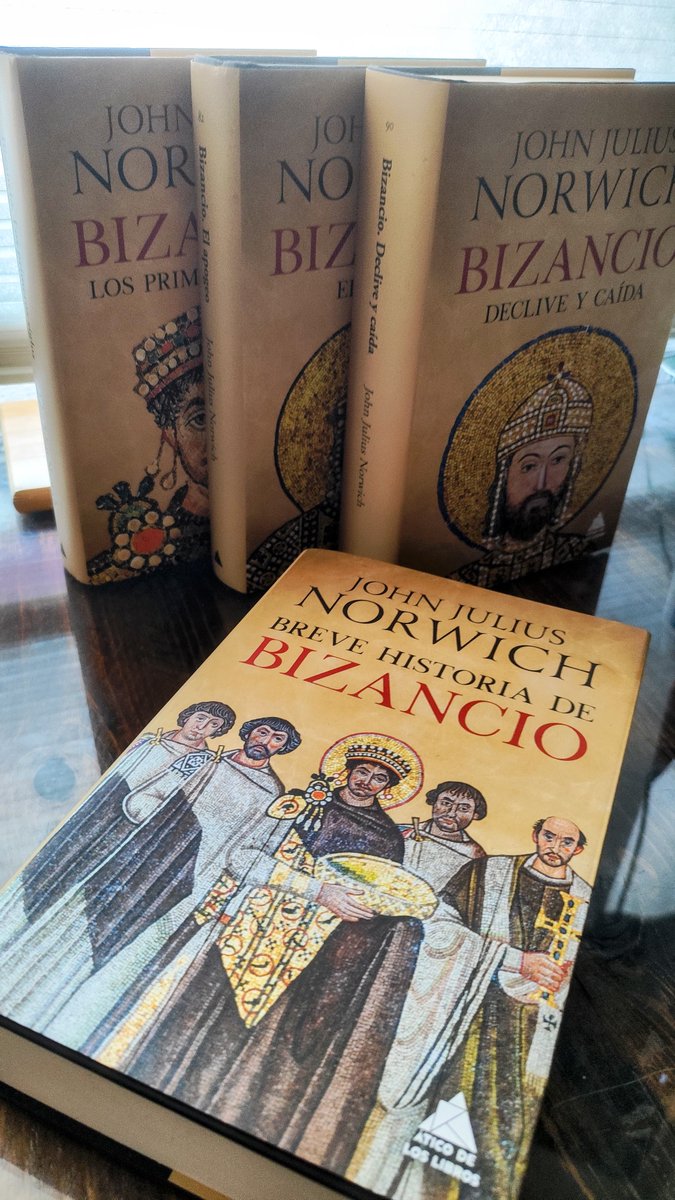
«Breve historia de Bizancio», de John Julius Norwich.
➡️ Consíguelo en https://t.co/jm1iV7KC5T ⬅️
John Julius Norwich pasó doce años escribiendo tres extensos volúmenes sobre el Imperio bizantino. Cuando terminó, hizo algo poco habitual: condensar más de 1.200 páginas en un solo libro pensando, precisamente, en quienes nunca se atreverían con la trilogía completa. Ese libro es «Breve historia de Bizancio».
Norwich no se limita a resumir once siglos de historia. Trata de quedarse con lo esencial. Desde Constantino y la fundación de su nueva Roma en el año 330 hasta la caída de Constantinopla en manos otomanas en 1453, asistimos a golpes de Estado, cismas religiosos, conspiraciones, emperatrices que gobernaron con mano de hierro y una capital que sobrevivió a asedio tras asedio. Durante siglos, Bizancio fue uno de los imperios más ricos, sofisticados y resistentes de su tiempo, y Norwich nos adentra en su historia con un capacidad narrativa sorprendente. Emperadores cegados por sus propios hijos, intrigas de palacio o concilios teológicos capaces de dividir un imperio pasan por sus páginas sin que la acumulación de nombres, fechas y dinastías termine sepultando al lector. Tratándose de Bizancio, no es poca cosa.
Si el libro engancha y uno quiere más, ahí está su trilogía completa: «Bizancio: los primeros siglos», «Bizancio: el apogeo» y «Bizancio: decadencia y caída», publicados por @AticoLibros. Pero «Breve historia de Bizancio» cumple perfectamente su función. La de ser una magnífica puerta de entrada a un imperio que en Occidente hemos relegado durante demasiado tiempo a los márgenes de la historia medieval.
«Breve historia de Bizancio», de John Julius Norwich.
➡️ Consíguelo en https://t.co/jm1iV7KC5T ⬅️
#librosdehistoria #leerhistoria #lahistoriamola #somoshistoria #historiaparatodos #Bizancio #ImperioBizantino
Did you know Aristotle thought friendship was more important than justice?
Near the end of the Nicomachean Ethics, he writes, "When men are friends, they have no need of justice, but when they are just, they still need friendship."
His point is simple. Laws exist because people don't always trust one another. Contracts, courts, and punishments become necessary when relationships begin to break down. A society can have excellent laws, but if its citizens don't genuinely care about one another, those laws can only accomplish so much.
Friendship works differently. A good friend doesn't help you because a law tells him to. He helps because he wants to. He keeps his promises because loyalty matters to him, not because he's afraid of punishment. In other words, friendship naturally accomplishes what justice has to enforce.
Aristotle believed this applied to entire societies as well. Families, neighborhoods, cities, and nations don't survive because everyone follows the law. They survive because enough people share bonds of trust, loyalty, and goodwill that make cooperation possible in the first place. Laws become necessary when those bonds weaken, but they can never fully replace them.
He also distinguishes between three kinds of friendship. Some friendships exist because they're useful. Others exist because they're enjoyable. Both are perfectly normal, but they're temporary. Business partnerships end, shared hobbies change, and circumstances move people apart.
The highest kind of friendship is built on something much deeper. It exists because each person genuinely admires the character of the other and wants the best for him. Those friendships endure because they're rooted in virtue rather than convenience.
More than two thousand years later, Aristotle's question still feels relevant.
Are we becoming the kind of people others would actually want as friends?
Because in his view, a society held together only by laws is already weaker than one held together by character.
To find a hidden tumour, they inject you with radioactive sugar and photograph where it goes.
It works, reliably, because the cancer drinks that glucose so greedily it flares up on the scan like a bonfire while the healthy tissue around it sits dark. The entire technology rests on one fact nobody says out loud in the room: the tumour runs on sugar, and it will outbid the rest of your body for every last gram of it.
We have known about this appetite for the better part of a century. We built a vast imaging industry on the back of it. We use it today, in every major hospital, to hunt the disease down.
Then, having located the cancer by following the sugar, they bring round the lunch trolley. White toast. Tinned fruit in syrup. A carton of juice, a biscuit, and a leaflet recommending plenty of wholesome carbohydrates to keep your strength up.
We spend a fortune using sugar to find the thing.
Then we sit the patient down and feed it.
Read that twice.