"Considerations For Drastic Changes Of Automobiles" @Medium Taku NAKAMINATO
can open 5+times/month:https://t.co/Nq6seAwRjb
amount of #metals..4-6 times.. not yet..#recycle.. consumption of🚰#water used for #smelting..also increase..though it has been said human beings will suffer
"I am one of the survivors of the atomic bombing of Nagasaki. At the time, I was 13 years old, at home, around 3 kilometers east of ground zero.
It was August 9, 1945. I suddenly heard the buzzing sound of a bomber jet, and was soon after engulfed in a bright, white light. Surprised, I ran downstairs and got down on the floor, covering my eyes and ears with my hands. The next moment, an intense shock wave passed through our entire house. I have no memory of that moment, but when I came to my senses, I found myself under a large, glass sliding door. It was a miracle that none of the glass was broken, and I was somehow spared injuries.
Three days later, I sought out the families of my two aunts who lived in the area near the hypocenter. It was then that I saw the full devastation of the bombing of Nagasaki. Walking with my mother, we went around a small mountain. Reaching a pass, we looked down in horror. Blackened ruins spread out as far as the port of Nagasaki, some three kilometers away. Urakami Cathedral, the largest brick church in the East, had collapsed to the ground, leaving no trace.
All the houses along the path, down to the foot of the mountain, were burnt to the ground and corpses lay scattered around them. Many people who were badly injured or burned, but still alive, were left unattended, with no help whatsoever. I became almost devoid of emotion, somehow closing off my sense of humanity, and simply headed intently for my destination.
I found the charred body of one aunt at the remains of her house, 400 meters from the hypocenter, along with the body of her grandson, a university student.
The other aunt’s house had collapsed and become a pile of wood. My grandfather was crouched down, on the brink of death, with severe burns all over his body. My aunt had been severely burned, and died just before we arrived. We then cremated her remains with our own hands. My uncle, who was initially mostly unharmed, had left the area to seek help. Yet we later learned that he had collapsed at a rescue station, and died after suffering from a high fever for a week. Thus, one single atomic bomb transformed five of my relatives, so mercilessly, taking all of their lives in one fell swoop.
The deaths I witnessed at that time could hardly be described as human deaths. There were hundreds of people suffering in agony, unable to receive any kind of medical attention. I strongly felt that even in war, such killing and maiming must never be allowed to happen."
80 years ago a nuclear bomb was dropped on Terumi Tanaka's city of Nagasaki, Japan, killing an estimated 70,000 people. Today Terumi is 93 years old but nuclear weapons still threaten our world. Terumi tells his story to remind us of the inhumane suffering survivors were forced to endure and to secure the abolition of nuclear weapons, which must not be allowed to coexist with humanity.
Watch Terumi Tanaka's full testimony at https://t.co/kmKf2dXVQv
Nagasaki Mayor Shiro Suzuki says ‘humanity and nuclear weapons cannot coexist’ as Japan marks the anniversary of the US atomic bombing. A memorial ceremony has been held in Nagasaki Peace Park, with ultraconservative prime minister Sanae Takaichi in attendance.
Marking 81 years since the atomic bombing of Nagasaki, @antonioguterres has stressed that the path to peace is built by strengthening trust and predictability.
“Together, we can ensure that the future is not defined by rivalry and risk, but by cooperation and stability.”
Le 9 août 1945, à 11h02, l’histoire de Nagasaki a basculé.
En ce jour de commémoration, la France salue la mémoire des victimes du bombardement atomique.
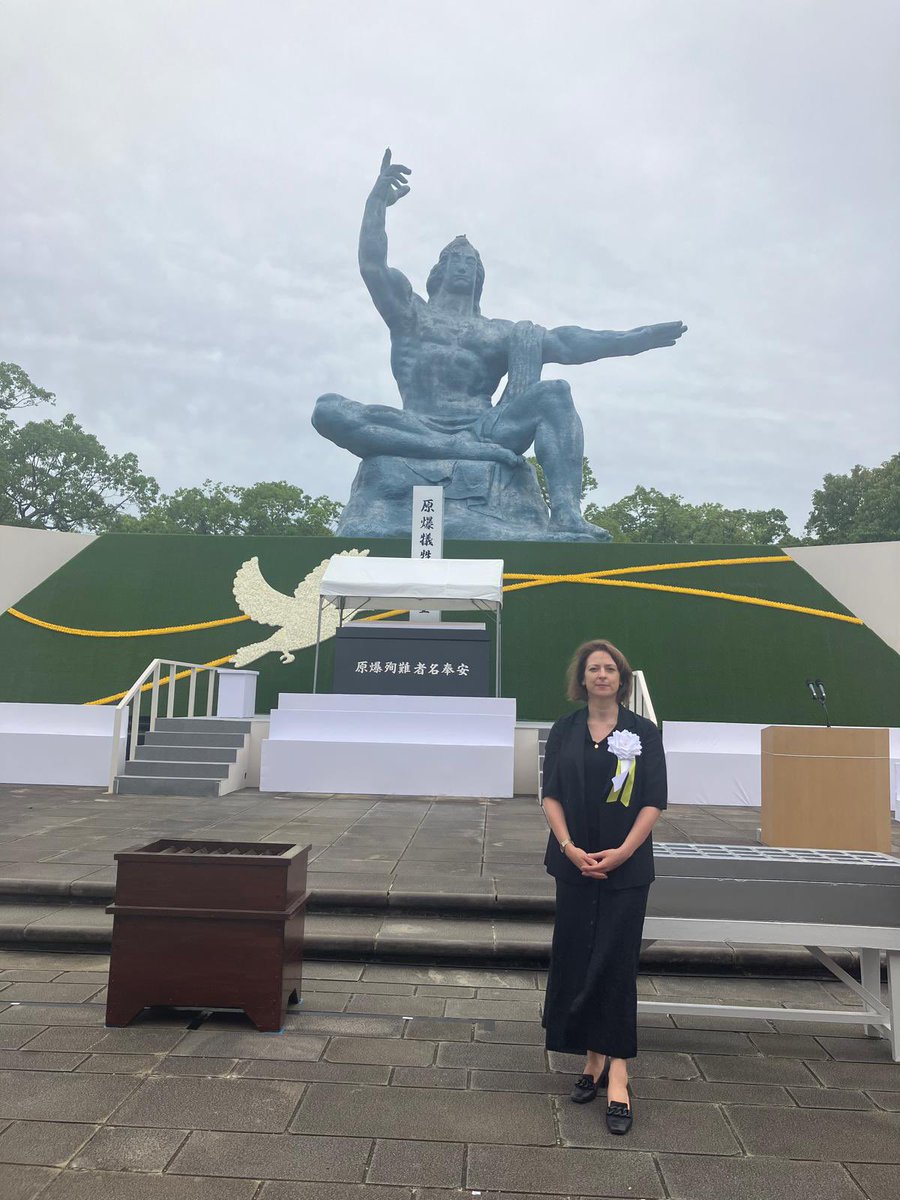
Today, at the Nagasaki Peace Memorial Ceremony, I remembered those killed by the atomic bombing and those who survived only to endure terrible injuries and illness.
Nagasaki was the last city to suffer a nuclear attack. It must remain the last.
9 sierpnia 1945 roku na miasto Nagasaki zrzucono bombę atomową. Aby takie tragedie nie powtórzyły się w przyszłości, musimy pamiętać o historii i wyciągać z niej wnioski.
Zdjęcie: Instytut Polski w Tokio
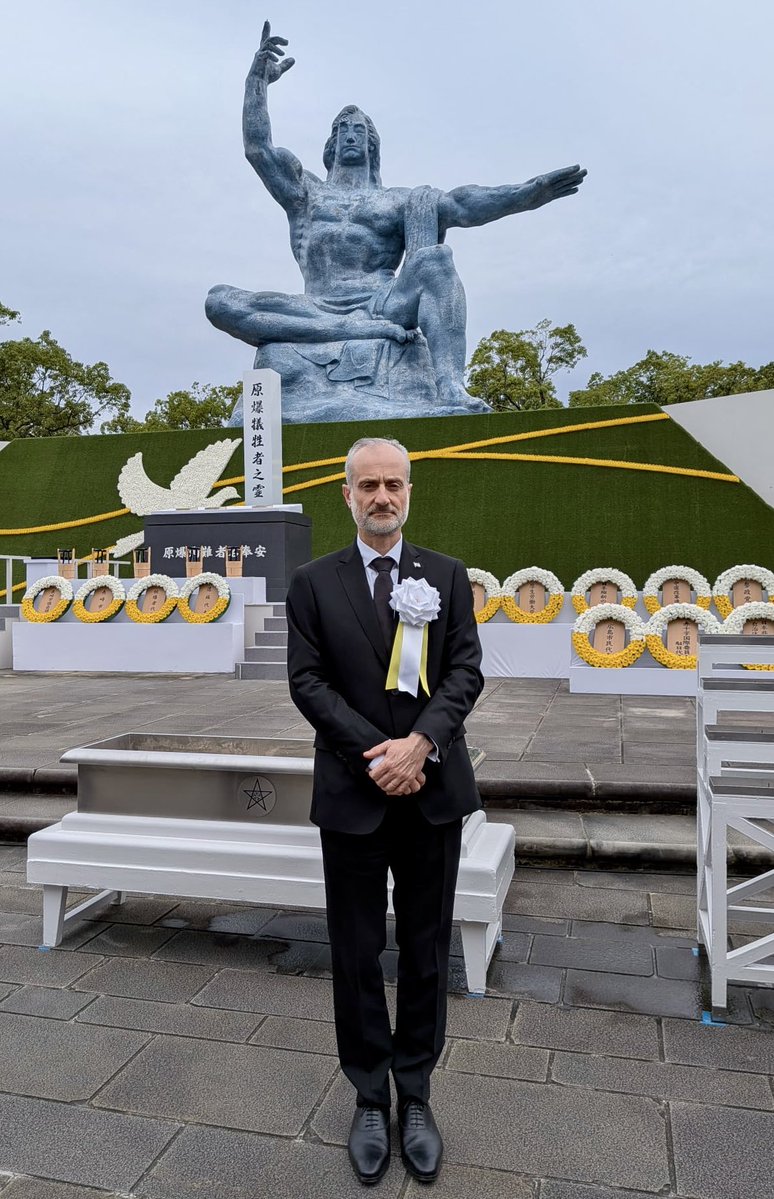
The Nagasaki Atomic Bomb Museum is a place of quiet solemnity and contemplation. Writing in the museum's guest book, Deputy Chief of Mission Aaron Snipe reflected on the lessons of Nagasaki and expressed his hope that they would continue to guide the U.S.-Japan partnership's shared pursuit of peace.
State Minister for Foreign Affairs KUNIMITSU attended the 81st Nagasaki Peace Ceremony and expressed her prayers for the repose of the souls of the victims. After the ceremony, she visited the Nagasaki Atomic Bomb Museum and then attended a meeting to listen to requests from groups of atomic bomb survivors and exchanged views with them.
https://t.co/PTUN9NMMSa
Taiwan's representative to Japan said Sunday that he decided not to attend an annual atomic bombing memorial ceremony in the Japanese city of Nagasaki to protest the labeling of his delegation as an "international nongovernmental organization." https://t.co/WvhliH9u0m
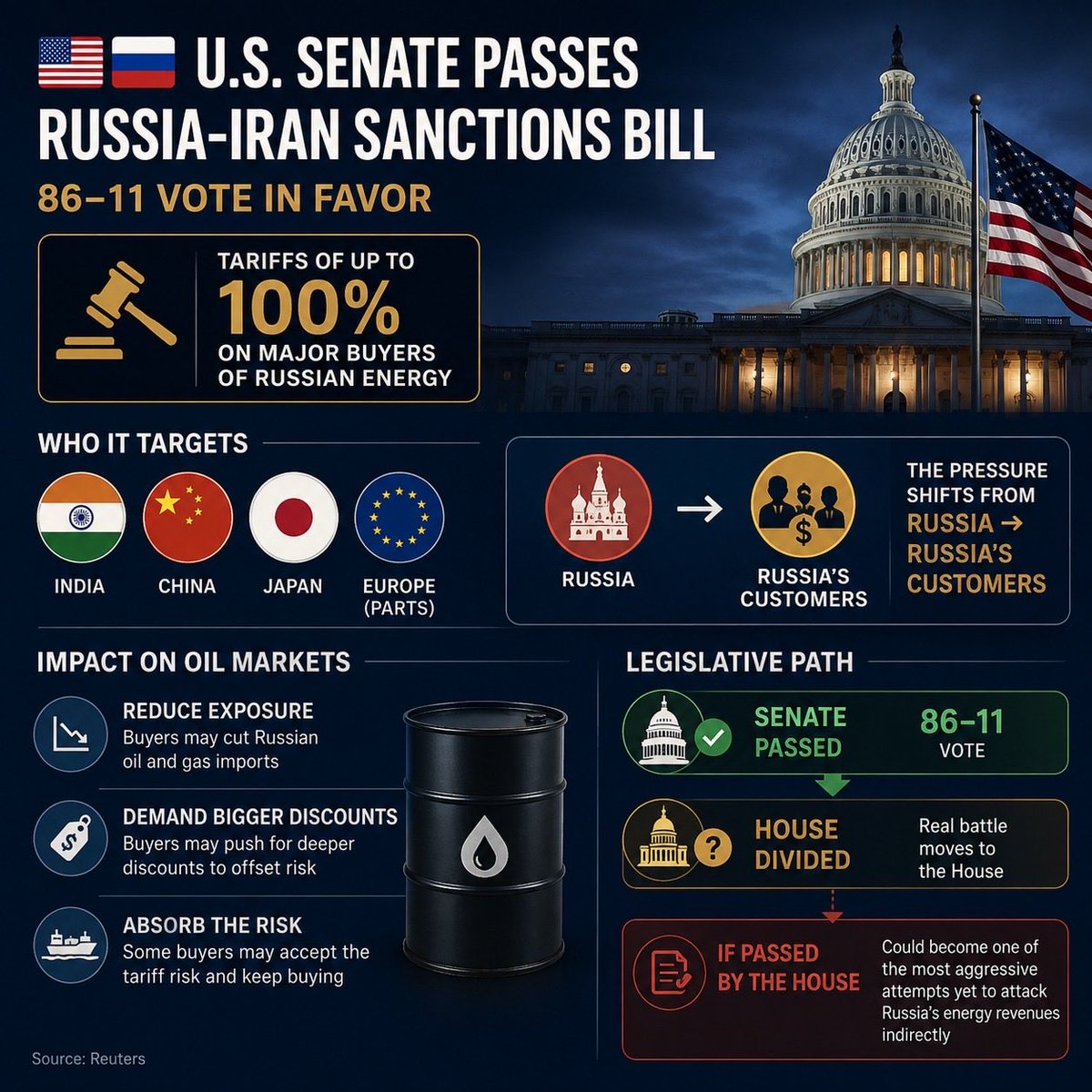
🇺🇸🇷🇺 The U.S. Senate just passed the Russia-Iran sanctions bill 86–11, opening the door to tariffs of up to 100% on major buyers of Russian energy.
That is the part markets should focus on.
The bill does not just sanction Moscow directly. It gives Trump the power to raise the cost of buying Russian oil and gas for countries such as India, China, Japan and parts of Europe.
In practice:
Russian barrels may still find buyers.
But those buyers could face a much bigger penalty for taking them.
⚡ That shifts the pressure from Russia → Russia’s customers.
For oil markets, the question is whether buyers reduce Russian exposure, demand steeper discounts, or simply absorb the tariff risk and keep purchasing.
The Senate vote was overwhelming.
The real battle now moves to the House, where lawmakers are much more divided over giving Trump additional tariff powers.
If it passes there too, this could become one of the most aggressive attempts yet to attack Russia’s energy revenues indirectly.
Source: Reuters
India should keep buying Russian crude if it makes economic sense, says GTRI | The Global Trade Research Initiative said New Delhi must not let the threat of higher US tariffs shape its energy policy and should continue purchasing Russian oil as long as it remains commercially attractive, as Washington moves to expand President Donald Trump’s powers to penalise buyers of Russian energy
📑 FULL STORY ➠ https://t.co/A43j90SUMa
#India #Russia #USA #Energy #CrudeOil #GlobalTrade
On 29 August 1945, ICRC delegate Fritz Bilfinger arrived in Hiroshima and was the first outsider to witness the devastation wrought by the atomic bomb.
The next day, he sent a telegram to @ICRC_jp describing the horrific conditions and calling for immediate relief action; this action was subsequently organized by Dr Marcel Junod, who had arrived in Japan as the ICRC’s head of delegation on 9 August 1945. Dr Junod would later travel to Hiroshima to witness for himself the scale of the destruction there.
The day after the disaster, several medical teams from the Japanese Red Cross Society arrived in Hiroshima from neighboring towns. Two of these teams helped the staff at the Japanese Red Cross hospital, while the others worked in improvised dispensaries set up in tents in different parts of the devastated city.
A total of 792 staff members and volunteer workers from the Japanese Red Cross Society treated some 31,000 patients during the three weeks following the cataclysm.
Soon after the destruction of Hiroshima, we unequivocally stated our position on the legal and ethical implications of the destructive power which mankind had just acquired.
This is what ICRC delegate Fritz Bilfinger shared after arriving in Hiroshima 👇🏽
Thousands gathered Thursday at Peace Memorial Park in Hiroshima on the 81st anniversary of the world's first atomic bombing.
Mourners remembered the victims and made a renewed appeal for peace to prevail in global conflicts. With the survivor population dwindling, those remaining called on communities to take up the task of sharing their stories.
"People need to know," said 87-year-old survivor Amano Kokichi.
📷: @AkifumiIshikawa
Read more about the ceremony from @AlexMNWilson here: https://t.co/EmYQk5AE8U
08:15 AM, Hiroshima.
People observe a minute of silence on the Aioi Bridge, which is said to have been the target of the atomic bomb, 81 years ago Today.