How can agriculture adapt to climate change? 🌍🌾 @_HannahRitchie provides a great overview of strategies to ensure resilient food production systems: https://t.co/o7nBEjRz8c #ClimateChange#FoodSystems
Really a pleasure to launch our DiGES project today. DiGES supports fruit and vegetables production and consumption via climate adaptation. Support from @SciforAfrica. Led by @AlcadeCS, @wtocarr and Aziz from @nana_gambia. Thanks to all our stakeholders.
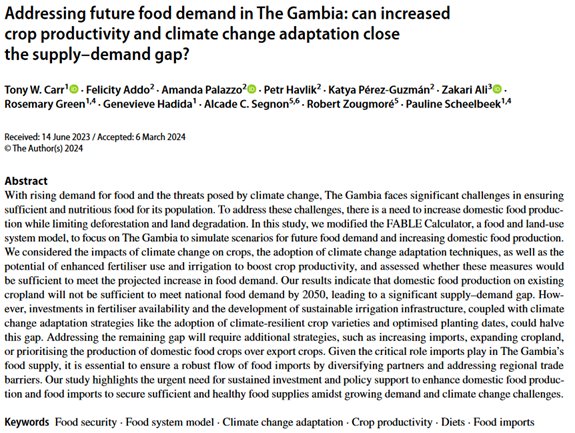
· This requires better access to fertilisers and irrigation, organic farming, climate-resilient crops and optimised planting dates.
· Diversifying import sources and reducing trade barriers are also needed for improving food supply.
📢New paper alert. Our study from The Gambia highlights the challenges many countries face in meeting rising food demand as the climate changes. 🌱📈
Read the full paper here: https://t.co/WeGwRuZNWg
@LSHTM_Planet@mrcunitgambia@IIASAVienna@BiovIntCIAT_eng
Key points:
· The Gambia needs a significant boost in food supply by 2050 to meet rising demand.
· Realising the country's crop yield potential would substantially reduce the gap between supply and demand.
📢🗣️Come study with us! We have a new (fully funded) PhD opportunity to study #sustainablefoodsystems at @LSHTM and @RoyalVetCollege. Check it out on: https://t.co/Mbp40iyoBr 📅Closing date: 17 March 2024 📅Starting date between April & October 2024 @LSHTM_Planet
Learning Lab 6 of 25
Innovative methods & metrics for overcoming research #Data deficits in
🟡#Climatechange
🟡#Agriculture
🟡#FoodSystems
🟡#Health
➡️Read https://t.co/jJidV4hYBY
➡️Register https://t.co/WtCADQrT2y
🧵#ANH2023 countdown - 12 days to go
Want to expand your knowledge of the complex systems that link the environment & human health?
We're delighted to have opened applications for our new MSc in #ClimateChange & #PlanetaryHealth🌍
Apply now or find out more at our open evening on 16 May⬇️
https://t.co/J3JFVSYaw2
"Young people are strong supporters of action to change the trajectory on climate change. It is time their voices are heeded by those in power."
@mrcunitgambia@LSHTM researchers share learnings from a Climate Change Solutions Festival in The Gambia.
https://t.co/aEPJ3PrbfI
🌱Join 'Impact of #ClimateChange on food systems", the IAP-ASSAf-NASAC side event at the @FAO Science & Innovation Forum!
📌13 Oct 2PM CEST
🟢You can find more info and the link to register here https://t.co/uYkvXgLUKi
It is important to note that the successful use of these methods is very site and context specific and depends on access to resources and information. This is even more important as climate change worsens, as higher yield losses need to be mitigated. 3/3
I am happy to share our first paper since I joined @LSHTM. https://t.co/J1L5B857Yk
Our systematic review shows that farming methods used in West Africa can largely mitigate and even offset the negative impacts of climate change on important crops. 1/3
Modified sowing dates and climate-resilient varieties are most effective. Increasing the amount of fertiliser is not really an adaptation to climate change, but will be important to increase yields now and in the future due to the low soil productivity in this region. 2/3
Registration for the @IIASAVienna Young Scientists Summer Program 2022 is now open! If you are a PhD student looking to explore the policy implications of your work, find out more and apply here: https://t.co/GbNooxn25X
Soil loss in EU and UK to soar 22.5% by 2050. Researchers are urging stronger soil conservation strategies to cover this gap.⛈️Climate change is a threat for our #soils and food production🌽. @EU_ScienceHub publication and data: https://t.co/2XswMBN6Wn
one more step closer to achieving a better understanding of
🌍 land degradation patterns. Just out the study led by Remus Prăvălie assessing the arable lands under the pressure of multiple land degradation processes.
https://t.co/dFK7c7UqDB