I've been wanting to do this for a long time: write a comprehensive article on why Mearsheimer is wrong on China.
I actually had a debate with John via message 2 years ago on this very question but we sort of left it in in limbo, with him doubling down on his call that the US should "contain" China, and me replying that although it might make sense from a selfish US standpoint (even though I even highly doubt that), a true realist theorist shouldn't base his theories on the passport he happens to be born with.
My article goes much further, demonstrating that Mearsheimer is wrong on China in 4 key ways:
1) He promotes what he condemns. He is one of the fiercest critics of U.S. behavior on the world stage and he has brilliantly demonstrated that the more power the U.S. holds, the more destructive and reckless it gets. Yet his position on China calls for preserving and expanding the very power he shows consistently produces strategic disasters and immense human suffering.
2) For a realist, he’s not realistic. His theory predicts that America will inevitably contain China's rise, but the actual evidence not only shows that the opposite is true, but that containing China is now structurally impossible.
3) Why would this time be different? His most accurate predictions ironically come from understanding that America consistently acts against his own realist logic - getting bogged down in Ukraine, Gaza, and Iraq. So why would the country he consistently says ignores his realist framework suddenly do so when it comes to China?
4) If America doesn't act 'offensive realist', why would China? If his theories, by his own admission, consistently fail to predict his own country's behavior, why trust them to predict China's - especially given China's completely different cultural context that he's unfamiliar with?
You can find the link to my article in the next tweet.
@AshaLogos Here're some of the posts in case you are interested
https://t.co/gl4NMOkBza
https://t.co/JuGNfQBvLB
https://t.co/EyMM17bsKn
https://t.co/WBYEPJGQLn
https://t.co/YnhwOuXQTD
Forks and Knives: An Unexpected Chinese Origin, and Qin Dynasty Dining Revelations
When you picture a Western dining table, the image of shiny knives and forks probably springs to mind. But hold on to your chopsticks, because these utensils actually have their roots in China!
Archaeological evidence shows that the Chinese were using knives and forks as far back as the Neolithic period. In the Hemudu site in Zhejiang, a bone - made table knife dating back about 7,000 years was unearthed. Also, in the Qijia Culture site, which is around 4,000 years old, a set of bone - made knives and forks was discovered. During the Shang Dynasty, two - toothed forks were in use, and they were likely used for handling tough food.
As time went on, the use of knives and forks evolved. They were not only practical but also symbols of status in many banquets. However, as Chinese cooking techniques advanced and food was cut into smaller pieces during preparation, the popularity of knives and forks waned, gradually giving way to the more convenient chopsticks.
Now, let's journey back to the Qin Dynasty. Have you ever wondered what the Qin people used to eat with? It turns out that Qin Dynasty folks used a variety of utensils. They had low - height tables called "ji" or "an", and they sat on the floor, practicing a form of the "dining - separately" system.
Chopsticks, usually made of bamboo, were in use for picking up vegetables. These simple yet effective tools had already become popular by the Qin Dynasty, as archaeologists have found objects similar to chopsticks in Qin - related excavations. Spoons, often made of wood, were used for eating grains. The nobles used bronze cookware and tableware, while the common people made do with earthenware.
If you're fascinated by these historical tidbits, you might want to follow a Xi'an tour guide like Jiemo. These experts can bring history to life, vividly describing the past as if you're right there in the Qin Dynasty, witnessing Emperor Qin Shi Huang's dining scene with your own eyes!
So, the next time you pick up a fork or a pair of chopsticks, remember the long and rich history behind these simple dining tools. They're not just for eating; they're a window into thousands of years of cultural evolution.
🇨🇳💊 China’s biopharma isn’t just catching up - it’s exporting innovation.
🇺🇸 Pfizer just signed a $6 billion licensing deal with Chinese firm 3SBio to develop a China-invented cancer immunotherapy drug for global markets.
Let that sink in:
Western Big Pharma is now paying China for breakthrough medicine.
For decades, China imported IP and paid license fees.
Now? It’s collecting them.
This isn’t a story about globalization.
It’s a story about the rise of Chinese science.
Yet another book on China by someone who doesn't understand China (and, based on the below, is sensationalist to an insane degree).
I was listening to the author on another podcast (https://t.co/MJ5Vw6YzSt) and he was saying that "the most fascinating part of [his] book" was the story of how "yellow cows" (黄牛, "huang niu") - which he describes as "quasi-gangsters linked up with the Chinese mafia, the triad organizations" - were back in 2013 doing arbitrage by buying iPhone 4 in the U.S. to resell them in China at a time when Apple didn't have a lot of stores there, and taking a cut in the process.
The problem was that U.S. iPhones couldn't function in China because they were configured for U.S. operators so these "yellow cows" would zap the processor and, as per Apple's warranty policy at the time, would get a brand new Chinese iPhone if they brought it to one of the few Apple stores in China.
So in effect they were able to get a new iPhone configured for China at the price of a U.S. iPhone (which was cheaper). That was the arbitrage opportunity.
Apple caught wind of the scheme and decided to change their warranty policy, specifically for China, whereby Chinese consumers who brought a defective iPhone within the warranty period would get a refurbished iPhone with the back cover from the original phone. Unlike the rest of the world, for a new back cover, they needed to pay an extra 580 yuan (US$92).
Furthermore, Apple also put in place a policy that violated Chinese law whereby they didn't offer consumers the full warranty period upon fixing the phone, instead choosing to follow the original warranty timeframe. And given that refurbishing the phone would take time, these "yellow cows" would get the phone back with a much shorter warranty period.
This ended the scheme because these "yellow cows" couldn't then claim the phone was a brand new Chinese iPhone given it had a back cover that was from the U.S., and furthermore the phones had a much shortened warranty period compared to new iPhones, which decreased their value.
This led to a scandal in China (article from back then: https://t.co/V7uXA7aqtJ) because this effectively meant that Apple was being discriminatory in its warranty policies: Chinese consumers, unlike consumers from anywhere else in the world, couldn't get a brand new phone if theirs was defective within the warranty period; they'd get their old phone back but refurbished. And all Chinese consumers were affected by the shortened warranty timeframe policy too.
This isn't that big a deal in and of itself and there are frankly good arguments on both sides. It was pretty fair for Apple to seek to stop this "yellow cow" scheme, and it was also fair for general Chinese consumers to be annoyed at facing warranty policies worse than the rest of the world.
The issue is with the way McGee frames it, making it one-sided, political and sinister. As he puts it, the scandal broke "within 36 hours of Xi Jinping becoming president" after the "yellow cow gangsters" started "complaining to various officials" and the issue "made its way up the political channels".
He frames it as Apple being in the right, and China complaining illegitimately, only for the purpose of the government protecting "gangsters" who are "linked up with the Chinese mafia".
When the truth is that:
a) The notion that "yellow cows" are "gangsters" is laughable to anyone who's spent a bit of time in China. They're essentially poor people who find arbitrage opportunities to make a bit of money.
For instance, they're the guys who will buy concert tickets in bulk when they're originally sold and sell them back to you at a profit if you're late to the party.
You can even hire them: if for instance you can't be bothered to queue at a restaurant, train station or a theater show, you hire a "yellow cow" who will queue for you and call you when your time is up, or buy the ticket for you.
They're anything but Al Capone types 😅
Plus it's not like they're an organization. "Yellow cows" is the name of an occupation, basically a mix between a scalper and a TaskRabbit worker if you will.
b) The complaints weren't about protecting "gangsters" at all - they came from regular Chinese consumers who realized they were getting inferior warranty treatment compared to customers worldwide.
When you buy an expensive iPhone (which at the time, back in 2013, was extremely expensive for the average Chinese person) and discover that Apple's warranty policy in China violates local consumer protection laws and gives you less coverage than someone buying the same phone in New York or London, that's a legitimate grievance, not some mafia/political conspiracy.
c) Most tellingly, Apple itself quickly apologized for the issue (https://t.co/DHJPlD4b9v) and changed its policies to match international standards - offering full iPhone replacements with new one-year warranties, which goes to show they recognized the complaints as legitimate.
And they did extraordinarily well in China afterwards: by 2015 Apple was selling more iPhones in China than in the US (https://t.co/d5aov4bbYP) and China became 29% of Apple's total global sales, compared to just 21% the year before (https://t.co/d5aov4bbYP).
If this really was some nefarious conspiracy by "gangster yellow cows" manipulating the political system to harm Apple (as McGee frames it), how exactly do we explain Apple doing so well afterwards?
Maybe, just maybe, the simplest explanation is the correct one: Chinese consumers had legitimate grievances, Apple acknowledged this and fixed the problem, and everyone won - but that boring reality doesn't fit McGee's preferred narrative of sinister "CCP-mafia" plots.
All in all, McGee's framing is unfortunately extremely typical of "China bad" style books, where mundane issues get twisted into evidence of some broader authoritarian conspiracy, all because the author lacks the cultural context to understand what they're actually observing.
So, as is all too often the case, buy this book if you want to reinforce your existing 'China bad' biases with sensationalized tales of authoritarian conspiracies lurking behind everything that happens in China, but look elsewhere if you're actually seeking nuanced and factual analysis.
An international research team including Chinese scientists have developed a new polyurethane inspired by the red sea star starfish that can rapidly self-heal underwater, offering potential applications in robotics and medical implants. The study was recently published in the journal Macromolecules.
A Canadian in Chongqing picks up a Canadian hitchhiker, traveling from China to South Africa.
I interviewed Courtney, who has been traveling the world by hitchhiking through it, bit by bit. She's on her way to Russia next.
Full interview here: https://t.co/2JH59fawQc
Here's a fact that the media won't give us
There are no licencing delays on any rare earths for fighter jets
There are no delays, because there will never be a licence issued - that's the entire point that morons in the FT aren't getting
Step into Hu Jiazhang’s Sixteen Courtyards in Qinshui, Shanxi, and you’re instantly transported back in time! These Ming and Qing - era buildings, hugging the hillsides, create a picture - perfect village layout. Four hundred years ago, this place was a bustling hub of wealth. Every stone, every archway whispers tales of prosperity from the past. It’s not just a village; it’s a living museum of ancient architecture and rich history. #AncientVillageScenery #HuJiazhangSixteenCourtyards #ExploreShanxi
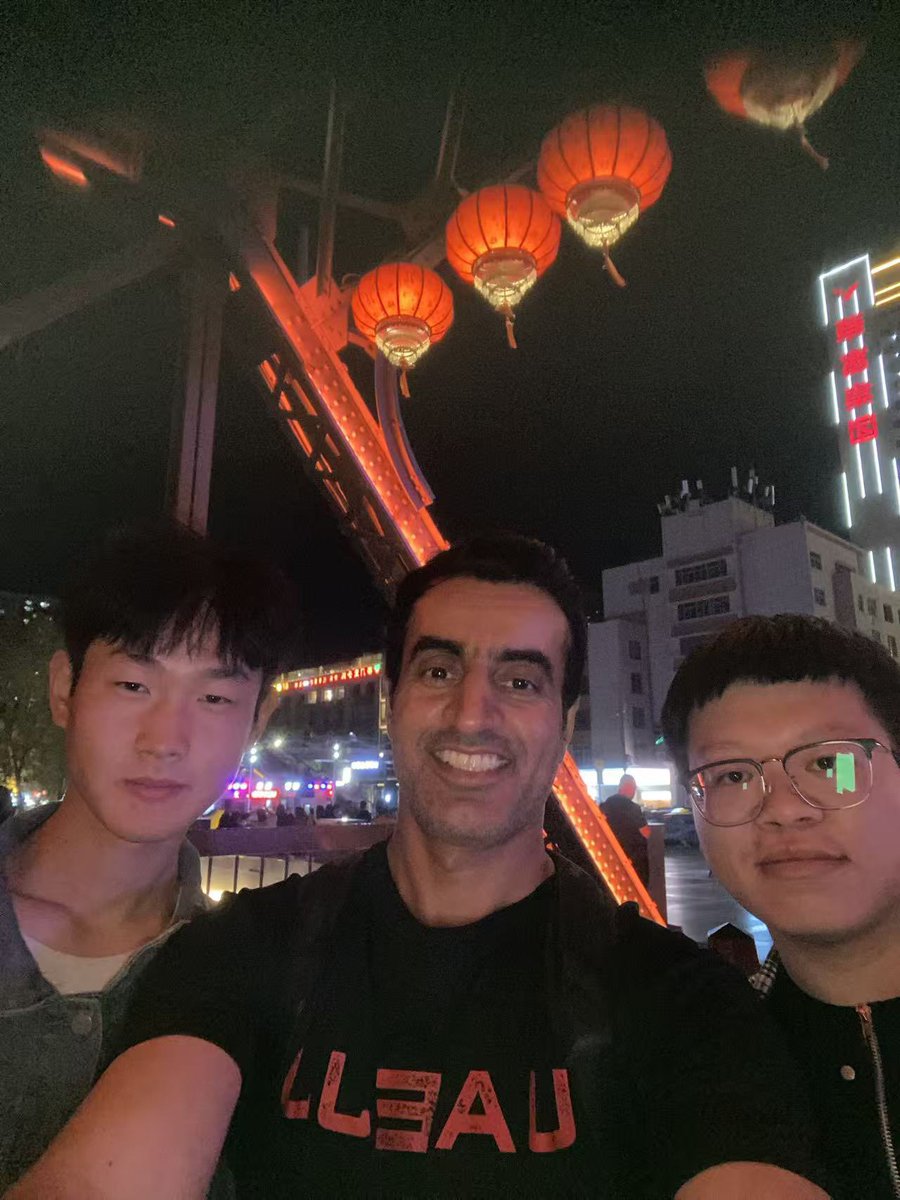
In the last two and a half weeks (from May 1 to May 18), I had the chance to intensely travel within China’s central, northwestern and southwestern areas, including:
A-Longshan County (龙山县)
B-Zhangjiajie (张家界)
C-Changsha (长沙市)
D-Wuhan (武汉市)
E-Xi'an (西安市)
F-Lanzhou (兰州市)
G-Xining (西宁市)
H-Chengdu (成都市)
I-Chongqing (重庆)
Along the way, I came across marvellous places, discovered wonderful facts and met amazing people.
What I experienced during those travels is really breath-taking.
I believe that, currently, no other society can match the grandeur, vitality, vibrancy and energy of the Chinese society.
Knowing this fact is one thing, but repeatedly living it in various cities and regions is a completely different thing.
My latest travels have reinforced my previous convictions from past travels in other cities and regions about the Chinese people, society, culture and history.
My mind was blown away by the vastness and the far reaching development of China.
I was deeply touched by the generosity, hospitality, kindness and friendliness of the Chinese people.
In China, there is a carefully crafted balance between modernisation on the one hand and preservation of heritage and traditions on the other hand.
This is not only visible in major cities such as Beijing, Shanghai, Shenzhen and Guangzhou, but also in other cities that are relatively less developed and less known internationally.
The country is truly a melting pot of many ethnicities and various mini-cultures within the grand culture of China.
Chinese people’s patriotic love for the motherland, their visible sense of pride and their relentless pursuit of self-reliance are really inspiring, boding well for the future of China, the world and humanity.
In the coming days, I will post a summary of main observations, photos and videos taken during those travels.
HIGHLY RECOMMEND:
"The Wumao Handbook, 20 Anti-China Lies Debunked" (AKA "How to Defeat an Anti-China Troll")
by @AndyBxxx.
It's packed with facts, which I love, and also good humor.
Buy it now on Amazon:
https://t.co/iudxr10J2Y
Sadly, if you've never witnessed the Dragon Boat Races during the Dragon Boat Festival, you can't possibly understand how crazy the Chinese can get about them! Take the dragon boat races in Tongren, Guizhou, for example. As soon as the drums start pounding, it's like a fire is lit in everyone's heart. Each team member paddles with all their might, their muscles bulging, and the splashing water adding to the excitement. It's not just a race; it's a display of passion, unity, and the indomitable Chinese spirit. The cheers from the crowds on the banks are deafening, making the atmosphere even more electric. Once you see it, you'll be bewitched by the charm of dragon boat races!
Wow, they actually achieved it, and 6 years ahead of target.
It's now confirmed that China's CO2 emissions have been declining for a year now, since 2024, when their official target was to reach peak emissions by 2030 (and carbon neutrality by 2060).
You can say what you want about China but there's no denying that this is an impressive achievement and excellent news for the whole world.
@Amockx2022@IndianTechGuide By the same extension, why the US companies hire Americans for the IT jobs. Why is Google spending billions of US money on constructing campus in India and hiring 20k+ Indian?
@Natie2Natie The Roman Empire is now dressed up in black robes, perhaps unknowingly it is an act of cultural invasion. This needs to stop, we don’t need another Boxer movement.