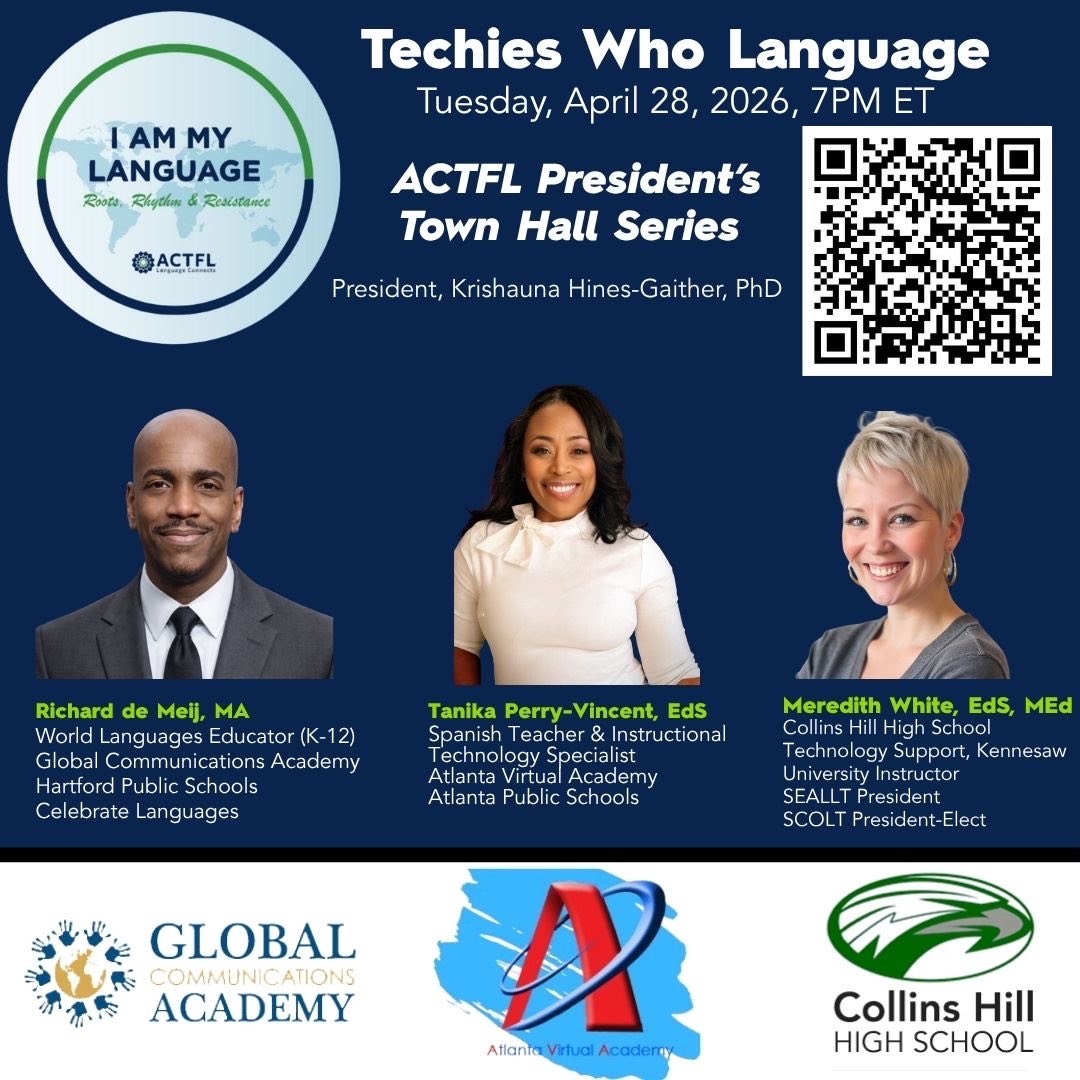
Celebrate Languages, by Richard de Meij, 2019 CT Language Teacher of the Year, provides FREE resources for learners & teachers of world languages. @CT_COLT
Aspiring language teachers: the ABLE Institute (ACTFL Black Language Educators) is a four-day immersive experience focused on mentorship, leadership, and community. Practicing educators are welcome.
📍 Howard University | July 13–16
📆 Apply by May 15 at https://t.co/PPQ2CXla0w
We’re excited to welcome our #ACTFL2026 keynote speakers, including legendary director, choreographer, actress, & producer Debbie Allen and humanitarian & National Honor Society Scholar Mychal-Bella Rayne Bowman to San Antonio this November! REGISTER NOW: https://t.co/c3BMjqHBeL
On Memorial Day, honor those who served & sacrificed their lives. Their missions often depended on multilingual communication & global cooperation. Language saves lives. Let’s honor their legacy by promoting language education in our schools. Multilingualism builds bridges!
Foreign Language Annals is on fire 🔥 168K+ article views, 428 submissions, and a growing global readership across 30+ countries. Language education research is thriving. See the impact and momentum below. Check out the latest FLA at: https://t.co/umuNSMeduX #FridayFLA
What does it take to build a language test for #ASL?
Hear ACTFL assessment experts and ASL specialists discuss adapting AAPPL for ASL and why it matters.
April 29, 6 pm ET (interpretation provided)
Register here: https://t.co/KTGm0SdoBc
Low test scores aren’t instructional—they’re biological.
The key to mastering literacy & math isn’t more drills, but a structural “brain upgrade” via language learning.
Discover why multilingualism is the missing blueprint for K-12 success:
https://t.co/xXNSsweCit
This teacher-turned-cognitive scientist shared a disturbing reality that left the room stunned.
“Our kids are LESS cognitively capable than we were at their age.”
Every previous generation outperformed its parents since we began recording in the late 1800s.
So, what happened?
Screens.
Dr. Jared Horvath explained:
“Gen Z is the first generation in modern history to underperform us on basically every cognitive measure we have, from basic attention to memory, to literacy, to numeracy, to executive functioning, to EVEN GENERAL IQ, even though they go to more school than we did.”
“So why? … The answer appears to be the tools we are using within schools to drive that learning (screens).”
“If you look at the data, once countries adopt digital technology widely in schools, performance goes down significantly, to the point where kids who use computers about five hours per day in school for learning purposes will score over two-thirds of a standard deviation LESS than kids who rarely or never touch tech at school. And that’s across 80 countries.”
But screens aren’t just decimating learning and making new generations less intelligent than the ones before them.