Bon j'ai peut être profité d'un nom de domaine qui dormait pour essayer Codex: https://t.co/f6ipubSzjV
La next step techno c'est de digérer le RPPS pour orienter la prise de rendez vous.
Pourquoi bloquer le prix des loyers ne fonctionne jamais 🏠
L'encadrement des prix semble être la solution logique pour protéger les locataires. Pourtant, Matthias Baccino rappelle que cette mesure n'a jamais fonctionné dans l'histoire économique.
C'est bien ce que je pensais et c'est affligeant 🤦🏽♂️ !
La ministre des sports et de la jeunesse Marina Ferrari, ancienne ministre du Numérique et de l'intelligence artificielle, n'a absolument rien à faire des fuites de données concernant les fédérations françaises sportives !
Je vous rappelle quand même qu'on parle de +60 fédérations françaises sportives qui ont été piratées en 18 mois et rien, zéro, wallou, nada !
Mais heureusement on l'entend sur le piratage IPTV !
Regarder un match piraté est bien plus grave que vos données personnelles à jamais diffusées sur le darkweb ! Après tout c'est que des données, donc faites pas ch*er et surtout circulez bande de gueux !
Par contre, si vous Regarder un match piraté avec IPTV là on vous défonce !
🌖Je ne sais pas si tout le monde se rend bien compte mais on a un équipage autour de la Lune EN CE MOMENT MÊME 🤩, un truc que beaucoup d’entre nous ne pensait peut-être pas voir de leur vivant. Oh et puis juste en passant : ils battent le record d’apollo 8 de distance depuis la Terre en volant loin derrière la Lune !! 😎
Alors oubliez tout ce que vous aviez prévu pour ce soir, les chocolats etc, parce ce sont à présent LES HUMAINS QUI SONT ALLÉS LE PLUS LOIN DANS L’HISTOIRE DE L’HUMANITÉ 🤯, c’est une dinguerie absolue et c’est streamé en live.
@NASAArtemis@NASA@astro_reid@AstroVicGlover@Astro_Christina@Astro_Jeremy@esa@ESA_fr #Lune #Moon
@gouaig C'est le steelbook de chez Best Buy mais il faut acheter dans une liste précise de jeux en neuf.
Target a un autre steelbook mais il faut prendre 100$ de eShop git card https://t.co/8FPLgSaEbT
C'est pas bien compliqué mais ce truc a l'air de vraiment transformer le taff des artistes de TOUS les jeux en grosse daube bien shiny sans âme.
Mention spéciale pour Grace qui se fait atomiser son aura et sa personnalité par cette horreur.
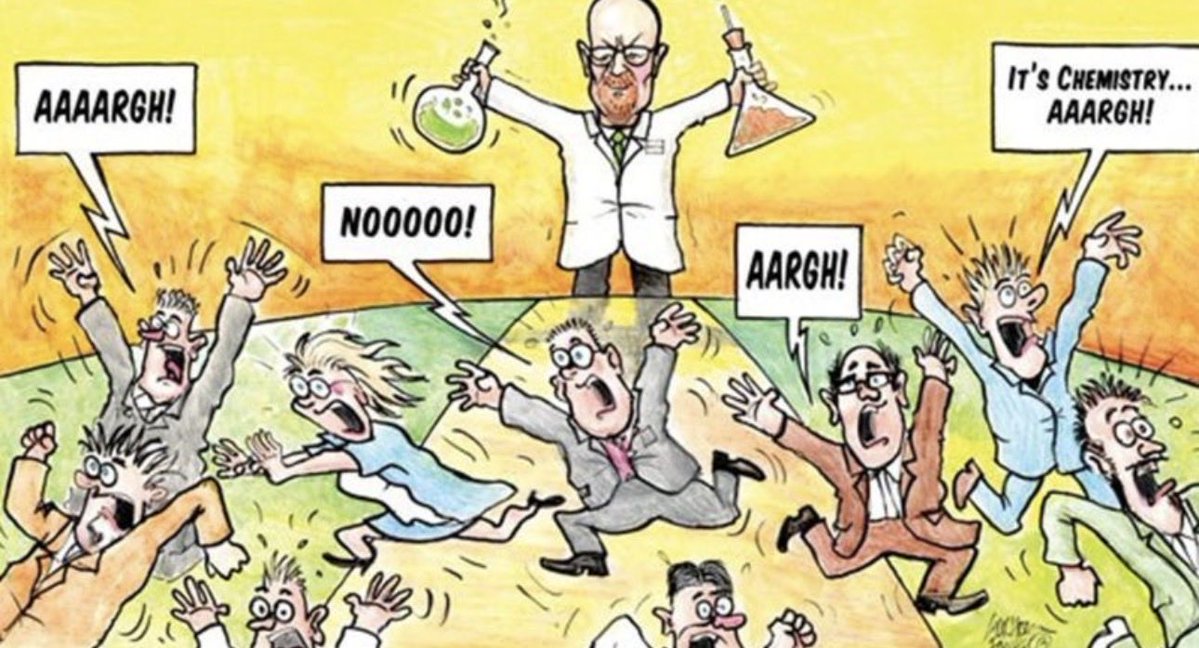
I’m a chemist. I need to say this - because it’s getting dangerous out there. The biggest health myth in the world isn’t about vaccines.
Or GMOs. Or fluoride.
It’s the root of all of them.
It’s called chemophobia - and it’s killing science.
Fear of “chemicals” now drives vaccine rejection, GMO bans, food hysteria, and entire political movements.
From tampons to tap water, people have been taught to fear chemistry - the very thing that keeps us alive.
Chemophobia tells us:
“Natural is good.”
“Synthetic is bad.”
That’s a lie.
Botulinum toxin is 100% natural and one of the deadliest molecules known.
Aspirin is synthetic and life-saving.
We’ve gone from banning harmful substances for good reason…to banning safe, well-tested molecules for emotional reasons.
You’ve seen the slogans:
“If you can’t pronounce it, don’t eat it.”
“Paraben-free.”
“Clean beauty.”
They sound empowering. But they’re not science - they’re marketing.
And they’re making the world dumber, poorer, and sicker.
Your body doesn’t care if a molecule comes from a plant or a lab.
Vitamin C is vitamin C.
Formaldehyde is formaldehyde and your body makes more of it every day than any vaccine ever could.
Dose matters. Source doesn’t.
This fear isn’t harmless.
It shapes public policy.
It blocks innovation.
It raises food prices.
It slows down cancer treatments.
Chemophobia is now mainstream and it’s costing lives.
Scientists aren’t losing because we’re wrong. We’re losing because fear spreads faster than facts.
Because influencers sell fear for clicks. Because lawyers monetize doubt.
And because scientists are too tired to fight back. So here’s my message, as a chemist and as a citizen:
Learn how toxicology works.
Call out chemical fear-mongering.
Support policies based on evidence, not emotion.
Chemistry isn’t the enemy.
It’s the reason you have clean water, safe food, and modern medicine.
If we let fear win, we lose all of it.
Just found out our "carbon neutral" initiative is complete bullshit.
We bought carbon offsets from a company that plants trees in Madagascar.
Sounds good until you read the fine print: the trees won't actually offset our carbon for 30 years. Because that's how long it takes trees to grow.
So we're carbon neutral... in 2055.
But the press release says we're carbon neutral now.
The CEO knows this. The sustainability consultant knows this. Everyone involved knows this.
But nobody cares because the headline works and that's all that matters.
We get to put "Carbon Neutral" in our marketing. Our competitors have to respond by buying their own fake offsets. The offset company makes money. The trees might get planted eventually.
Everyone wins except the actual environment.
I brought this up in the meeting. Got told I'm "missing the bigger picture of corporate responsibility."
The bigger picture is we're lying and calling it leadership.
And it's working. We already got positive press from three industry publications.
Nobody fact-checks the carbon math. They just report that we're "taking bold action on climate."
This is how greenwashing works. You don't actually change anything. You just buy the right to say you did.
Our intern just asked me why we don't use Kubernetes.
I said because we don't need Kubernetes.
He said everyone uses Kubernetes.
I said everyone TALKS about using Kubernetes. Most companies are running Docker containers on three servers and calling it a day.
We have 40 employees. Our entire infrastructure runs on AWS with auto-scaling groups. It works fine.
Kubernetes is designed for companies running thousands of services across hundreds of servers. We have twelve services.
But he read that Kubernetes is "industry standard" so now he thinks we're behind.
This is what happens when people learn from tech Twitter instead of actual experience.
They think every company is Google-scale and needs Google-scale solutions.
We don't need Kubernetes. We need our MySQL database to stop running out of connections because someone wrote a query that doesn't close properly.
But that's not exciting. Nobody writes blog posts about "I fixed a connection leak."
They write about "How we migrated to Kubernetes and saved millions" even though the migration cost more than they saved.
I told the intern he should learn why tools exist before learning the tools themselves.
He looked disappointed. He wanted to put Kubernetes on his resume.
The ‘great’ thing with AI coding tools is that any kid can write 10,000 lines of code that appear to work. Could be Python, C++, Go, Java… doesn’t matter. And there won’t be any English typos in the comments.
Well, when I say « write », I should say « have a tool write ».
And you can even get a novel-length description of the work.
Every open source project can get multiple 10,000-line pull requests a week.
The intern you just hired can generate 50,000 lines of code in his first three weeks.
Brilliant.
Now, who wants to read all that?
The cost of 10,000 lines of C++ that can compile and run some tests just went to the floor. Nobody cares about it.
You can replicate the problem in other domains such as science. It has become trivial to generate a 12-page scientific paper, complete with graphs, using AI. A little bit of prompting and off you go.
Want to write a 250-page PhD thesis? A few days of prompting and ChatGPT will get it done. Just make sure to pay for your subscription.
Who wants to read all that?
Sure, we can use AI to read the work but… what you learn in mathematics is that not all iterative processes converge. Adding more layers of AI increases the latency, but it may not get you where you want to be.
In the world of generative AI: producing content is cheap… but producing content that is well above the quality of ChatGPT, well, that’s something else.
Take this post that you are reading. I could have prompted Grok to write it. Just one request, and I get Grok to write tens of paragraphs. Done.
The cost of an English post written in correct English and making reasonable statements… just went to the floor. It is now effectively free.
But, you see, I write my posts myself because I think I can be clearly more insightful and deeper than ChatGPT or Grok.
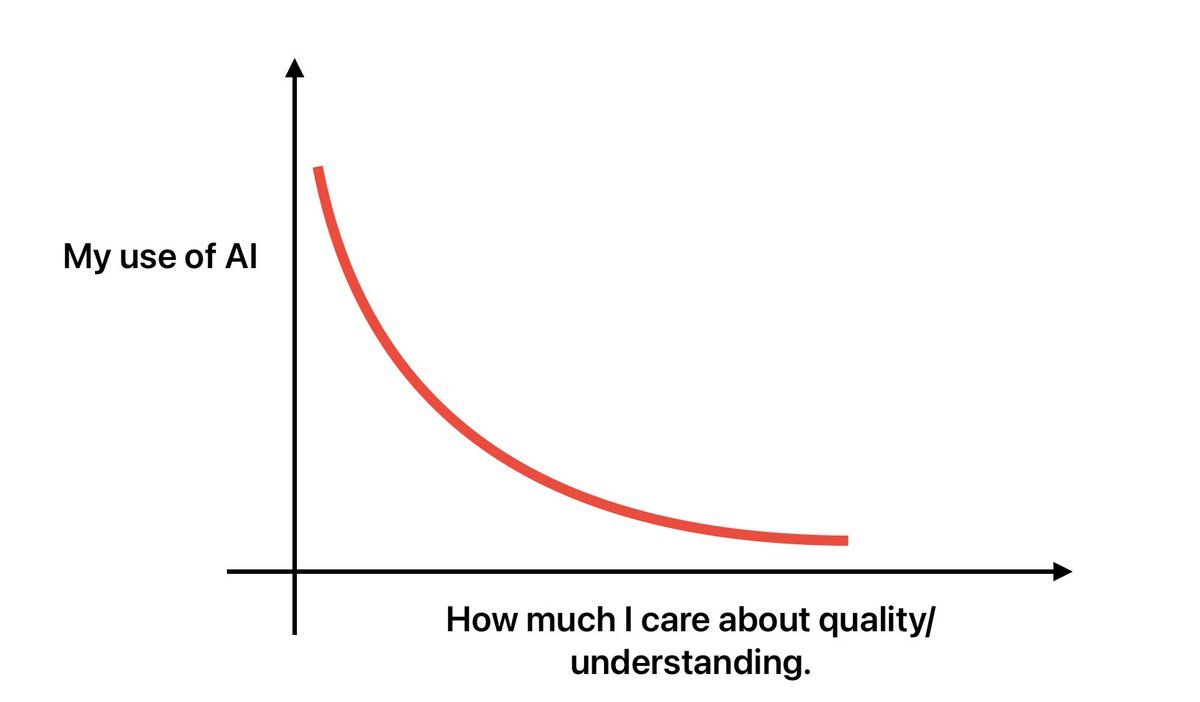
And similarly for software. I spend several days a week coding, and though I have been an early adopter of copilot, I mostly code by hand because I often want to maximize quality, not volume.
I do enjoy using AI. For example, we recently added a C API to our simdutf library. It was boring work, mapping C++ functions to C functions, so I had this part of the code done by AI (I could also have scripted it).
There is a lot of boring work in programming that I am really happy to delegate. But for high-quality work, I'll mostly write my own code. I am happy to use AI as a fancy autocomplete, but I won't rely on agents.
It is not just about quality. Besides quality, I also care about understanding. To really understand what is going on, you often need to spend a lot of time thinking, trying things and so forth.
To be fair, AI can help you understand what is going on better. You can interact with AI to check your understanding. But if you delegate to your AI, your understanding will be shallow.
I was listening to someone from Anthropic this summer. She was saying that, unavoidably, we are going to end up with more software of lesser quality. Maybe it is already what we are getting today.
So here is what I am doing. Here is what I am going to keep doing. I am going to keep typing my own words, my own code. I am no luddite and I love cool toys. But I believe that the tools should enhance my voice, not replace it.
🚨 GIVEAWAY 🚨
Avec l’arrivée du pré-patch de Burning Crusade sur les serveurs anniversaire, je vous fais gagner une OUTLAND EPIC EDITION grâce à @Warcraft_FR 🔥
📌Pour participer :
1⃣Follow @kusa_alex
2⃣RT ce tweet
📅T.A.S : 18/01/2026
#WoW_Partner
Open source isn't dying because of AI.
It's dying because we all fucking suck.
Users. Maintainers. The whole ecosystem. All of us.
We fucking suck as users.
We use OSS to do our jobs. To build products. To make money. Our employers depend on it. Our startups run on it.
But the second a maintainer mentions compensation? We lose our fucking minds. "It should be free." "That's not the open source way."
Meanwhile we're extracting value from someone's unpaid labor every single day.
We file issues like we paid for a support contract. We demand timelines. We get snippy when our bug isn't the priority.
We're not customers. We're guests. Start acting like it.
We fucking suck as maintainers.
We wanted the GitHub stars. The conference talks. The Twitter followers. We wanted to be the person who "owns" that thing everyone depends on.
But now people actually depend on it and we're annoyed.
"Talk is cheap, show me the code."
So someone does. They spend hours on a PR. We ignore it for months. Close it with no explanation. Or we screenshot their issue and mock them publicly for not reading our minds about what we actually wanted.
We invited contributions then punished people for contributing.
We don't want to maintain projects. We want to be admired for maintaining them. Not the same thing.
We suck at this together.
Both sides want the benefits without the responsibilities.
As users we want free, maintained, high quality software but won't contribute a damn thing. Not money. Not code. Not even basic respect.
As maintainers we want the status of running critical infrastructure but won't communicate, won't collaborate, won't treat people like humans.
We all know this shit doesn't work. And yet here we are.
Okay Josh, what do you suggest then?
If we use OSS and profit from it, we contribute something. Anything. Money, docs, triage, kindness. We stop expecting infinite free labor.
If we maintain OSS and we're burnt out, we say so. Archive it. Hand it off. Ghosting is worse than walking away.
And if we can't treat each other with basic respect? We don't get to participate. Full stop.
Open source runs on people. On us.
None of us owe each other a god damn thing. But we could choose to stop being assholes and do better anyway.
A quelques jours d'intervalles, les médecins et les agriculteurs perdent leur calme.
Un pays qui réussit à faire manifester ceux qui le nourrisse et ceux qui le soigne ne va pas bien.
Thinking that a subscription to the best AI models for coding turns you into a professional programming machine… is like thinking that a subscription to Mathematica 20 years ago turned you into a professional mathematician.
Good luck trying to solve problems you don’t understand with code and algorithms that you don’t understand.
I started programming decades ago when I was 12 years old. At first, it was just a game to me. Over time, as I acquired more skills, it became part of my identity. While others played basketball or the violin, I wrote code.
It is so deeply ingrained in my identity that when I once stopped programming regularly, I became depressed. Shamefully, it took me years to realize that I need to program weekly to stay happy.
Today, the best AI models can write C++ code better than most computer science professors. They are certainly better programmers than my teenage self, who learned without access to the internet.
Why play the violin when anyone can find a recording of a great violinist with little effort?
This is not a new problem for human beings. What happened to bowmen when the musket became standard military issue?
Do you keep showing up on the battlefield with your bow? A bow has advantages over a musket—and bows continued to improve even after the musket’s invention. Yet the writing was on the wall: the future of the battlefield did not belong to the bow.
I could also recount the story of portrait painters who struggled with the rise of photography.
Programmers are not alone in facing a transformation of their craft. Graphic designers, lawyers, writers, and nearly everyone in the laptop class are impacted. Some do not mind, because their craft was always primarily about achieving professional success. Others are more troubled.
Let us be fair. For the last 30 years, the West pursued globalist policies that continually moved industrial jobs elsewhere, leaving many young men without much-needed opportunities. We told them not to worry—their economic losses were more than offset by government checks.
And this gets to the core of the issue. Getting the job done is only part of what we care about. Perhaps more importantly, we want meaningful lives, which often come through skill development and its fruitful application. Money alone is not enough—it never was. We also crave status, recognition, and a sense of empowerment.
As I look at software programming today, I can accomplish in five hours what would once have taken me three days. Sometimes I can do in 15 minutes what used to take three hours. Other times—especially when tackling something difficult that plays to my strengths—I do like Luke Skywalker: I turn off the targeting computer and code without AI for the best results.
At the same time, I see many people (including some of my students) trapped in an illusion of competence. They prompt an AI and generate low-quality code—not because the models are bad, but because a tool is only as good as the person wielding it.
What is coming? I cannot predict the future with certainty, but the following seems possible:
1. We may end up with the equivalent of a laptop-class rust belt. People who used to write reports and PowerPoint decks for a living could become obsolete. Teachers might find students turning to AI instead, reducing them to little more than relatively useless bureaucrats. IT specialists might see their entire purpose wiped out by a new AI model. They may still earn a decent living, but their social status could crater—just as it did for factory workers in the West from 1980 to today. What goes around comes around.
2. During the globalization era, the financial industry boomed in the West, and to this day some of the most prestigious and highly paid jobs are in finance. A similar phenomenon is likely unfolding in this AI era. Many of those benefiting will have a background in programming. The people who can build in a month what once took a year will be able to automate tasks that previously weren’t worth automating.
What about the sense of purpose and competence? Speaking for myself, it is not gone. If anything, I feel I can leverage my hard-earned skills even more effectively than before. More importantly: I am still having a lot of fun programming.