The biggest crypto opportunities rarely begin with a token.
They begin when macro, capital and market infrastructure start changing quietly.
This account is about spotting those shift early.
1/6
$55K BEFORE THE COMEBACK?
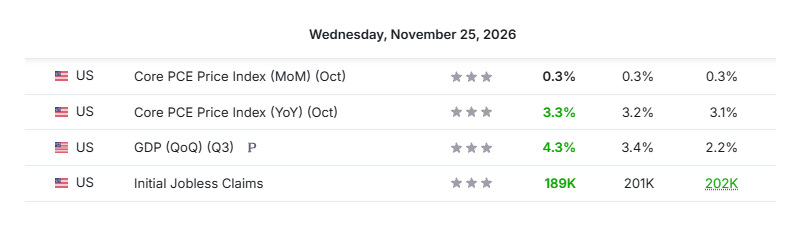
Core PCE: 3.3% YoY vs 3.2% expected
GDP: 4.3% vs 3.4% expected
Jobless claims: 189K vs 201K expected
Not exactly an invitation to cut rates in December. A 25 bps hike is already heavily priced in, and 50 bps is still on the table.
Next target: $55K
bitcoin:native
Is everyone still here or are we checking prices in silence?
Looks like @JensenHuang has more lovers than my posts have interactions. Honestly, respect.
BTC is sitting below my Fib level, fear is doing its thing, and PCE drops tomorrow, November 25.
Still buying. Still holding my view.
This market always rewards those who stay firm.
ETF INFLOWS ARE BACK. TOO EARLY TO CELEBRATE?
After seven straight sessions of outflows, US spot Bitcoin ETFs finally turned positive on Monday. The group recorded $7.9 million in net inflows.
BlackRock’s IBIT led the way with $76.5 million in inflows, ending its own 11-session outflow streak.
It’s a small number compared with the recent outflows. Yet it’s the first green day in over a week.
Every recovery starts somewhere.
Meanwhile, some corporate buyers didn’t stop.
Strategy bought 485 BTC for roughly $33.4 million between November 9 and 15, bringing its holdings to 850,849 BTC.
Strive added 251 BTC over the same period.
And Twenty One Capital bought 154.32 BTC for about $10 million, its first purchase since July 2025.
These companies aren’t calling a bottom. They’re simply adding while the market is under pressure.
There’s another detail worth noting.
Q3 filings showed increased exposure to Bitcoin ETFs and Strategy from institutions including Morgan Stanley, Bank of America, and Vanguard.
One green day isn’t confirmation, yet buyers are showing up.
BTC REACHED MY BUY ZONES. NOW WHAT?
My latest BTC buy orders were at $70k and $67.5k. Price has now traded through both.
Remember when I said, “Things need to get worse before they get better”?
That’s looking painfully accurate right now. My read is that a second bottom may be taking shape.
Let’s break it down:
THE FIBONACCI MAP
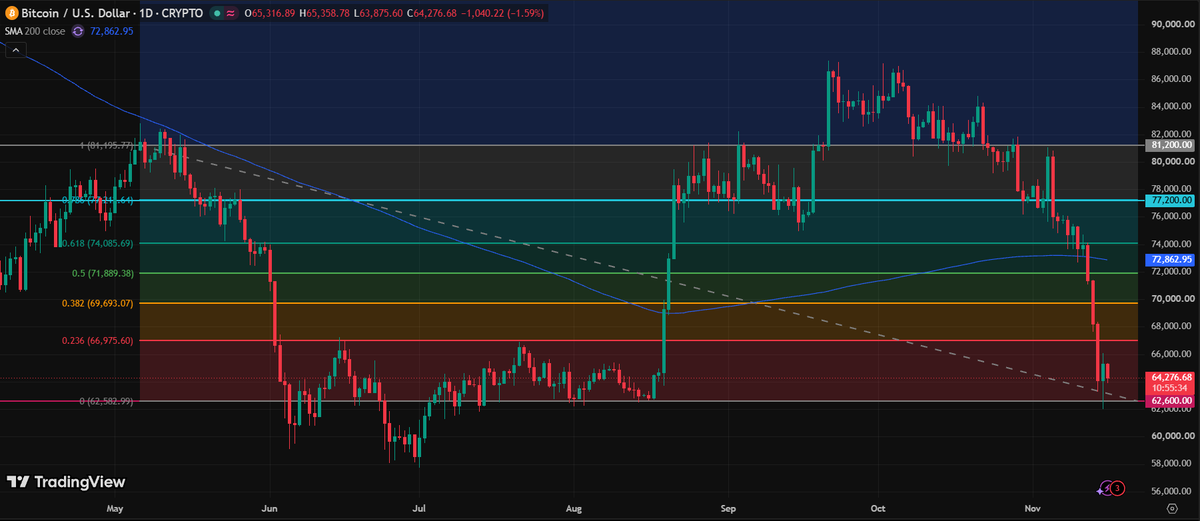
BTC is around $64.3k on this chart, below the 0.236 Fibonacci level near $67k.
The lower boundary of this Fibonacci range is around $62.6k. We touched that level yesterday, and that’s where I want to see buyers show up and hold their ground.
On the way up, I’m watching:
$67k → $69.7k → $71.9k
Getting back above $67k would be a decent start. But there’s still work to do before calling this a recovery.
THE 200 SMA
The 200-day simple moving average sits around $72.9k, well above the current price.
A bounce would be welcome. Getting back above that average and staying there would tell me a lot more.
Above it, the next Fibonacci level is around $74.1k.
THE FED ISN’T MAKING THIS EASIER
Last week’s October inflation numbers:
CPI: +0.4% vs +0.3% expected.
Core CPI: +0.3% vs +0.2% expected.
Headline inflation slowed from September, but both headline and core came in hotter than expected. That keeps pressure on the Fed.
Fed Governor Christopher Waller had flagged a core reading around 0.3% or higher as a reason to consider the bigger move.
The base case is still 25, but there’s more data to come before the decision. Softer readings could ease the pressure, stubborn inflation could strengthen the case for 50.
On the brighter side, we’ve been seeing lower oil prices and some signs of easing US-Iran tensions, with Washington leaning on economic pressure rather than a wider military campaign.
December isn’t decided yet.
WHAT COULD TURN THIS AROUND
I’m not building the recovery case around retail rushing back. Between pressure on household budgets and another hack seemingly around every corner, that feels like a stretch.
My attention is on institutional demand: sustained ETF inflows, fresh corporate treasury buying, and large spot buyers willing to absorb the selling.
Pair that with softer economic data and a less aggressive Fed outlook, BTC would have a stronger shot at reclaiming the Fibonacci levels and eventually challenging the 200 SMA.
MY APPROACH
I’m still comfortable buying in stages. I don’t need every entry to turn green the next morning.
The chart helps me plan, leaving room for the unexpected is part of it. We can’t predict every escalation in a war, cyberattack, banking shock, or policy surprise.
Friday’s armchair is still here.
Staying patient and letting the next few weeks unfold.
EVERYONE WANTS FAST CHAINS.
WHO’S BUILDING SAFE ONES? 🛡️
Hacks and exploits keep rising.
Audits find bugs, monitoring flags attacks. But by the time either happens, the funds are often already gone.
The next phase of crypto may be about networks that can stop an attack before it becomes a headline. Faster networks and cheaper transactions matter, but security is becoming the real edge.
A few networks are already building that layer:
RULES BEFORE EXECUTION
Some networks are adding a security layer that lets protocols define rules that must always hold true.
If a transaction would break one of those rules, it gets blocked before it executes.
On @LineaBuild, Phylax’s Credible Layer is already live. Euler, Malda, Denaria, and Turtle Club opted in.
The results are real: Phylax reported that its 0x mitigation stopped more than 8,456 drain attempts, over $2.6M in attempted drain volume, and roughly $44,710 in potential user losses.
That is prevention, not just monitoring.
SECURITY BY DESIGN
Other chains are attacking the problem at a deeper level.
Instead of adding a firewall on top, they build safety into the language and execution model itself.
@SuiNetwork uses an object model where ownership, access control, and resource safety are part of the protocol design.
That makes entire classes of common exploits, including reentrancy attacks, structurally harder to execute.
Sui is not waiting for an attack to happen. It is trying to make certain attacks impossible by design.
STOPPING ATTACKS AT THE SEQUENCER
A third group is focusing on the moment before a transaction reaches the chain.
@inkonchain, Kraken’s L2, adopted Forta’s Firewall to screen transactions at the sequencer level before they reach the chain.
Forta’s model identified the exploit transaction in the $4.75M DeltaPrime attack with a critical risk score, meaning the transaction would have been blocked if Firewall had been active.
That is the difference between detecting an attack and stopping it before settlement.
THE INSTITUTIONAL LAYER
Security is not only about blocking a malicious transaction before it reaches a chain.
It is also about giving banks, regulators, and exchanges a way to see risk before funds disappear.
@HypernativeLabs is building that layer.
Its Transaction Guard simulates transactions before signing and blocks risky actions before funds move.
The strongest validation may come from Brazil.
The Brazilian Central Bank is advancing to contract Hypernative for a continuous onchain monitoring and fraud-intelligence program covering the Brazilian financial sector.
During its proof of value, Hypernative generated an alert 14 hours before funds moved in a confirmed fraud incident.
That is the kind of infrastructure regulators are starting to take seriously.
TOKENS TO WATCH
Not financial advice
$LINEA
If its security layer attracts more protocols and real usage, the network could capture value over time.
$SUI
If Move-based security continues to reduce exploit risk at the protocol level, Sui could become more attractive for devs.
Hypernative is the infrastructure name to watch.
The platform is used across more than 75 blockchains, representing over $100B in secured value.
If it ever becomes investable, it will be one of the strongest names in this narrative.
________
Security definitely shapes where developers build and where capital flows.
That could be one of the most important shifts of this cycle.
What would change the view
▸ MSTR stabilizing instead of breaking down
▸ ETF flows turning positive
▸ Bitcoin reclaiming and holding $75k
▸ Liquidation clusters being absorbed
▸ Spot demand returning on support tests
The Setup
The bear case: forced $MSTR selling, weak ETF demand, and liquidity stacked below price.
The bull case: bitcoin:native is approaching Fibonacci zones where long-term buyers may step in.
This is not a call for a bottom. It’s a plan for a deeper flush.
Patience is part of the trade.
WALL STREET MAY FORCE ANOTHER DIP
Crypto market could take another hit today, and give us the best entry opportunity of this cycle.
This time, the pressure is coming from Wall Street.
MSCI may remove Strategy ($MSTR) from its major stock indexes tonight.
Funds that track these indexes could be forced to sell roughly 13 million MSTR shares by November 30. At Monday’s close of $121.07, that is about $1.6B in potential forced selling.
JPMorgan estimates the selling pressure could reach $2.8B, and up to $8.8B if other major index providers follow.
Why does this matter for Bitcoin?
Strategy buys BTC by selling its own stock. A lower MSTR price means less capital raised per share.
As MSTR falls toward the value of its Bitcoin holdings, the premium that made the strategy work starts to disappear.
If the company ever needs liquidity, its Bitcoin becomes the next asset on the table. Strategy holds 850,364 BTC.
⤵️
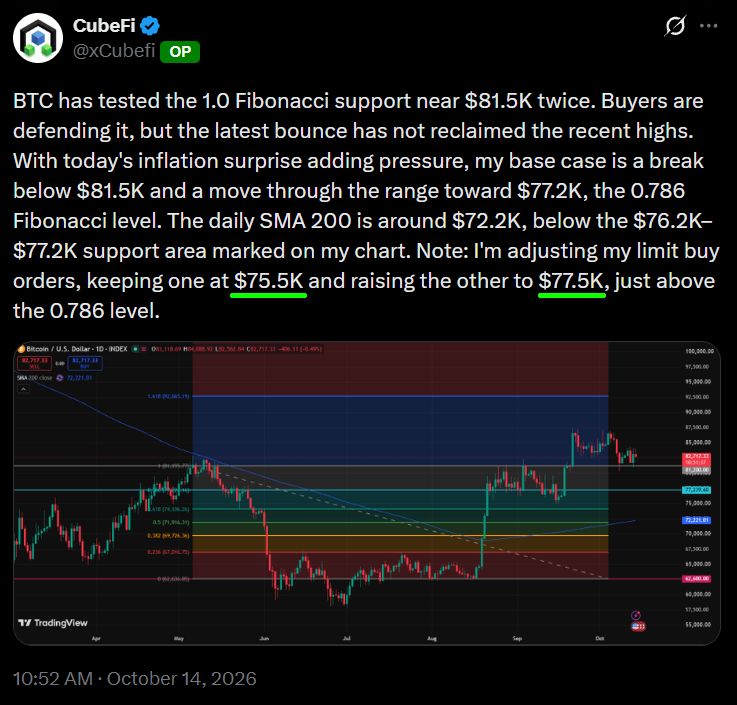
Where I’m adding
I’m not trying to catch the bottom. I’m setting orders where risk starts to make more sense.
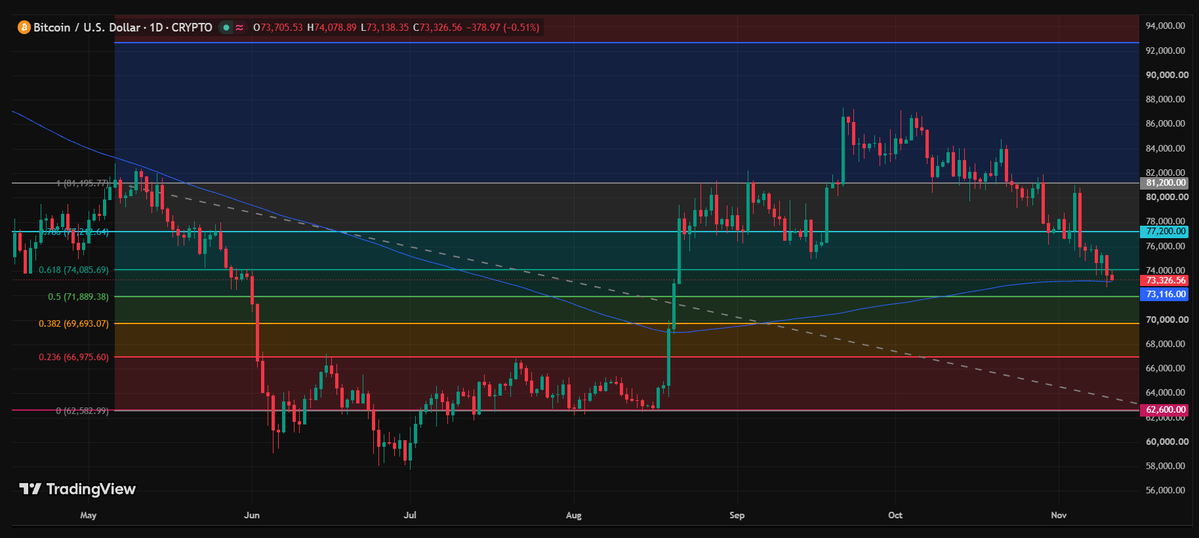
Order 1: $70,000 → Just above the 0.382 Fibonacci level.
Order 2: $67,500 → Just above the 0.236 Fibonacci level.
These are not predictions.
They are levels where I’m willing to add if the market gives me the chance.
⤵️
@davidarngar Exactly. Tokenization without issuer support is just a wrapper around an asset that still lives offchain.
The real unlock is when issuers recognize onchain ownership, support transfers and corporate actions.
CRYPTO IS FACING MORE THAN ONE TEST TODAY
October CPI just printed 0.4% MoM, above the 0.3% consensus.
Core CPI came in at 0.3% MoM, also above the 0.2% consensus.
The market was already pricing a high probability of another Fed rate hike in December.
Now, with strong employment data and core inflation running above expectations, a hike becomes more likely.
Crypto enters this environment from a weak position.
THE PRESSURE IS BUILDING
1. Macro remains the first filter
A hotter-than-expected core print reinforces the case for tighter policy.
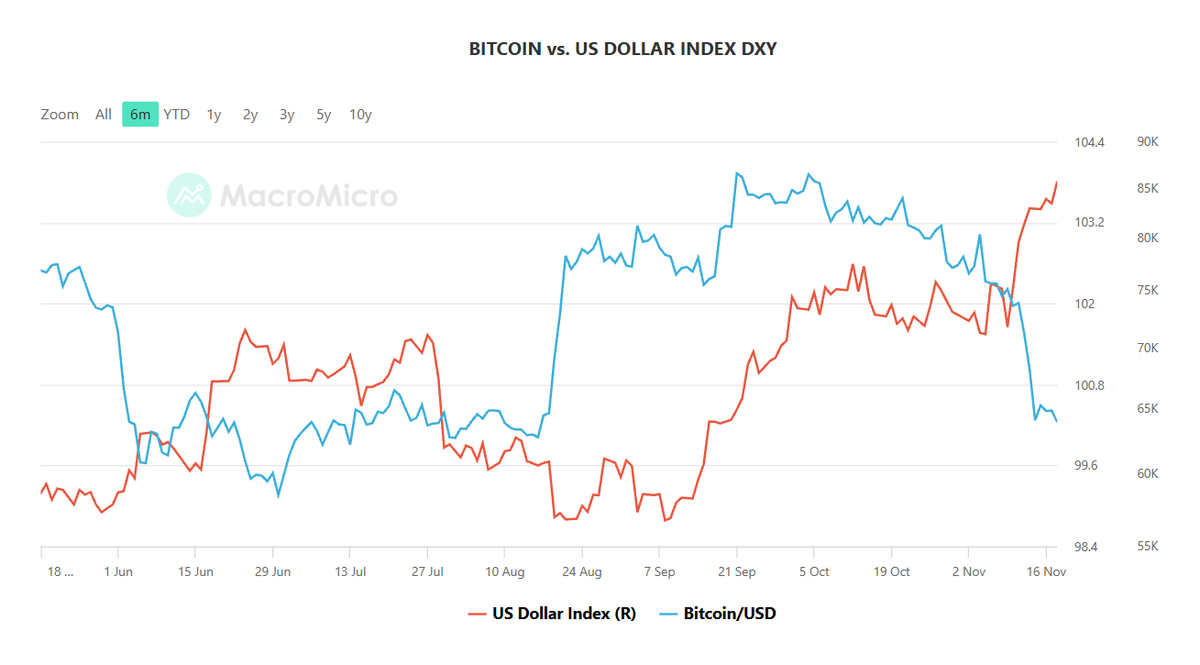
If the Fed hikes again in December, liquidity stays tight. If liquidity stays tight, risk assets stay under pressure.
2. Institutional demand is still weak
Spot Bitcoin ETFs lost another $201M on Monday.
BlackRock’s IBIT has now seen $1.66B in outflows over seven straight sessions.
Ethereum ETFs lost $184.6M on Monday, extending their outflow streak.
3. Tokenization is hitting resistance
OKX and ICE planned a platform for 24/7 tokenized U.S. stocks.
But 67 companies have objected, including Apple, Microsoft, Alphabet, Amazon, Nvidia, Tesla, Meta, JPMorgan, and Walmart.
That tells something: tokenization is not automatically welcomed by traditional finance.
The tech may be ready. The willingness to adopt it, not yet.
4. The world is preparing for disruption
Governments across the US, Europe, and Asia are urging households to keep emergency supplies amid concerns over conflict, cyberattacks, and infrastructure disruption.
It doesn’t mean collapse is imminent. But it adds to a broader mood of uncertainty.
5. Retail trust is still fragile
Users have seen hacks, scams, worthless tokens, and products that require a PhD just to use a wallet.
The industry keeps launching new tokens, but it often struggles to launch products that solve real problems.
That’s the gap.
WHAT COULD CHANGE THE GAME
There are positives, though.
@Coinbase received an effective national trust bank charter, strengthening its ability to custody digital assets under federal oversight.
Charles Schwab added $SOL, $AVAX, and $LINK to its crypto offering.
@Solana is still attracting institutional experimentation, including plans for a 24/7 tokenized stock trading platform.
Formation Securities has notified the SEC of plans to launch a tokenized stock trading venue on Solana, with Galaxy Digital, Exodus, and Forward Industries expected at launch. The venue would let eligible investors trade tokenized U.S. shares around the clock, settle onchain, and retain voting and dividend rights.
🤖 AI agents could become the next retail wave.
Imagine an agent that pays bills, rebalances a portfolio, executes recurring buys, or manages onchain strategies without the user needing to understand every technical step.
That could turn crypto from speculation into utility.
____
TWO SIDES OF THE COIN
The bear case is clear: hot inflation, tight liquidity, and weak institutional demand.
But the bull case is still alive: tokenization, institutional infrastructure, and AI-driven utility are moving forward.
The market may be under pressure today. But the infrastructure being built now could define the next cycle.
Remember: Things need to get worse before they get better. Just hold tight.
@kapitALEXperte Both. Crypto is a liquidity trade in the short term and a debasement hedge only if adoption turns into real utility. A hot CPI can sink it because risk assets get repriced first.
🚪TWO TOKENS, ONE OPEN DOOR
Samsung has named Solana and Sui as partners for its stablecoin rollout in Samsung Wallet.
The bigger opportunity: DISTRIBUTION.
But distribution is only the first step. What gets built around it could create new reasons to buy, stake, and use SOL and SUI.
The two ecosystems bring different things to the table.
Solana has a head start: more established apps and deeper DeFi liquidity. That gives incoming users more places to trade, borrow, and put their capital to work.
Sui brings opportunities across payments, DeFi, and AI-driven financial apps. Hashi could add another source of capital by enabling Bitcoin-backed finance.
Now imagine future partnerships connecting those ecosystems to Samsung’s reach:
▸ Cashback users can convert into SOL or SUI
▸ Optional staking of those rewards
▸ Campaigns introducing users to apps across both networks
▸ Discounts on AI-agent services for eligible stakers
▸ Agents handling recurring buys, payments, and portfolio rebalancing
Staking discounts would need partners willing to offer and fund them. But the model is worth thinking about.
So where could token demand come from?
First, purchases. Cashback converted into SOL or SUI could create buying demand. Recurring buys could extend that demand beyond a single campaign.
Second, retention. Useful benefits tied to staking could give users a reason to keep their tokens instead of immediately selling.
Third, execution. Agent services could charge in USDC, while onchain operations that require gas would need funding in the native token from users, operators, or sponsors.
For $SOL, the opportunity is connecting new users to an ecosystem that already has established financial apps. Agents could make those products easier to use, automate recurring strategies, and generate activity funded in SOL.
For $SUI, the opportunity is connecting payments and automated finance with additional sources of liquidity. Hashi, currently on testnet, could bring BTC-backed capital into Sui apps while the underlying BTC stays on Bitcoin.
Samsung’s rollout and Hashi could become complementary entry points: one for users and stablecoins, the other for Bitcoin-backed liquidity. Products built around those flows could create opportunities to buy, stake, and use SUI.
The potential flywheel:
Samsung brings users in → Apps give their capital somewhere to go → Agents make recurring use easier → Useful incentives give them reasons to buy and maintain positions.
The partnership opens the door. What gets built next could turn access into demand for SOL and SUI.
@Only1temmy The next billion users will be AI agents. Most major chains are shaping themselves to meet this demand. I wrote an article about this, in case you’re interested in reading it.
WHEN CT SAYS “SELL EVERYTHING” MARKETS OFTEN SET UP THE NEXT RUN
Crypto has a pattern:
Everyone wants in when prices are flying. After a sell-off, buying suddenly feels like a bad idea.
The fear is understandable, but following the crowd isn’t how we make money.
Signs hard to ignore:
▸ Fear & Greed collapsed from 50 to 28 in one day
▸ Over $1.26B in leveraged positions got liquidated
▸ Bitcoin ETFs saw $430M in outflows on Thursday
▸ BTC dropped to $75,208, lowest level since Sep 16
Meanwhile, US debt has reached $40.5T, up roughly $2.5T in a year.
That means govs face a long-term incentive to let purchasing power erode rather than default. In that environment, scarce assets with credible monetary policy become more interesting.
We could still see one more sharp drop. Markets often shake out the weak hands before it takes off.
That’s why I’m setting 2 more buy orders to catch a potential new wave lower. Buying the fear, positioning for asymmetric upside.
Are you ready, or you gonna sell the bottom too? 👀