When a project says private AI, ask which part is private.
Ethereum Foundation launched zkAPI so you can pay for AI APIs with ZK credits. Payments can't be linked to your deposits. Their own limitations section says the provider still sees your prompts, and IP or timing can still link sessions.
Read the threat model before you trust the word private.
Before you dump a blue chip because a headline says "hacked", check which layer failed.
A third-party Safe wallet add-on called FlashLoopAdapter drained about $305k from two Aave-linked Safes. Stani said Aave v3 took zero hit.
When money leaves a wallet parked on a big protocol, ask first whether the core contracts broke or a wallet add-on with its own permissions failed. Do that before you revoke everything or sell the whole bag.
Before you buy a low-cap, check the next unlock.
$2Z (@doublezero): ~1.655B tokens unlock Friday 1am London, a third to half of free float. Insiders hold 56%. Holders get $0 of the fees.
Not a trade call. A cliff that size inside 30 days means plan for sell pressure, or wait.
3. What did the audit actually cover? "Audited" often means the on-chain code. Off-chain systems sit outside that report.
Before you deposit size, ask whether someone can break pricing without touching the contracts.
2. After a hit, who gets paid first? Ostium recovered about 650k USDC. That fully covered the 3,321 wallets that lost 1,000 USDC or less. The 345 bigger wallets could take 1,000 USDC now or wait for a share of future recoveries that isn't guaranteed.
3 checks I run before I size up on a protocol:
1. Where do prices come from? If a server or signer feeds the oracle, that machine is part of your risk, even when the contracts look clean.
An audit doesn't cover the off-chain bits. Ostium's July drain made that expensive.
They lost 23.75M USDC. Not from a bug in the contracts. Attackers got into the off-chain price-signing setup (Ostium post-mortem, The Block).
DEX volume is rotating to Base and BSC this week.
Base did about $1.49B in swaps over 24 hours, up 33% on the week. BSC did $1.46B, up 44%. Solana is still first at $2.57B, but basically flat.
Aerodrome on Base printed about $677M in volume. That flow is why I'm looking at $AERO (@aeroxyz).
The Aerodrome team already has Aero Lite live on Circle's Arc chain, ahead of the full Aero launch on 21 Oct. Aerodrome reports $572M in lifetime exchange revenue. AERO sits near $0.82 after a roughly 19% week.
My bar: Aerodrome volume keeps holding, and a daily close stays above $0.767. Emissions still grow circulating supply by about 3.4% every 90 days, and Aero Lite deposits are only about $2.4M.
If Base and BSC stop growing week over week, this read is wrong.
Before I touch a DEX token, I check where the fees go.
Same job on paper: swap fees. Completely different deal for holders.
On Pangolin, 0.0425% of every swap goes to $PNG (@pangolindex) stakers. Changing that fee switch needs a 2-day timelock through a 3-of-5 multisig.
On Enosys, token holders get $0. Fees split 80% to liquidity providers, 10% to the team, 10% to APY Cloud.
That check takes five minutes in the docs. Do it before you buy.
Pangolin's payout is still tiny, about 0.8% a year of market cap. This is a filter, not a buy call.
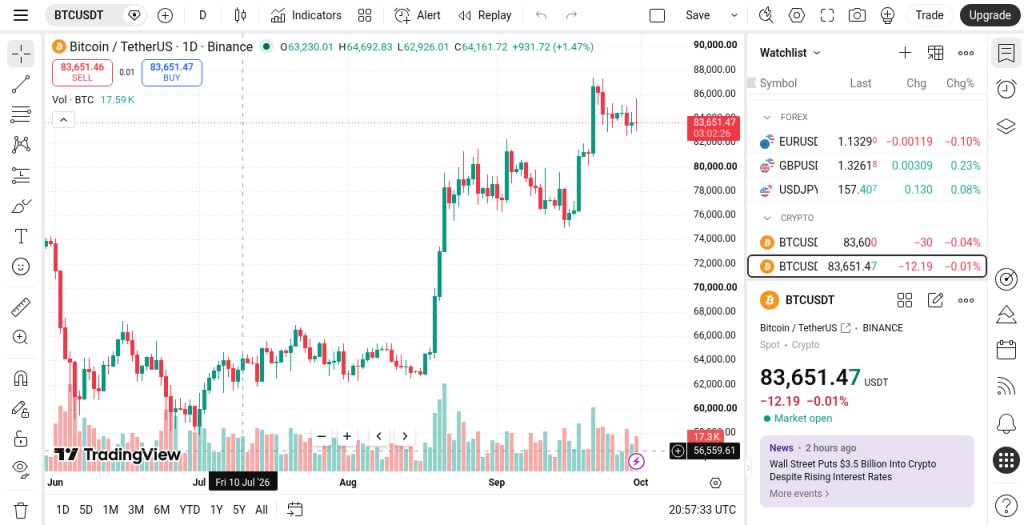
$BTC poked about $84,400 this morning and sold straight back to about $83,500.
Spot sits near $83,460.
The ceiling that rejected the bounce is $84,300 to $84,500.
The floor I care about is $82,600 to $83,000.
I am wrong if the day closes under $82,500.
US jobless claims print at 1:30pm London. Friday is the big jobs number. Keep size small until those clear.
Example: buy at $83,460, cut if the day closes under $82,500. That is about $960 risk per coin, or roughly $115 on a $10,000 slice if you put about 12% of the account on it.
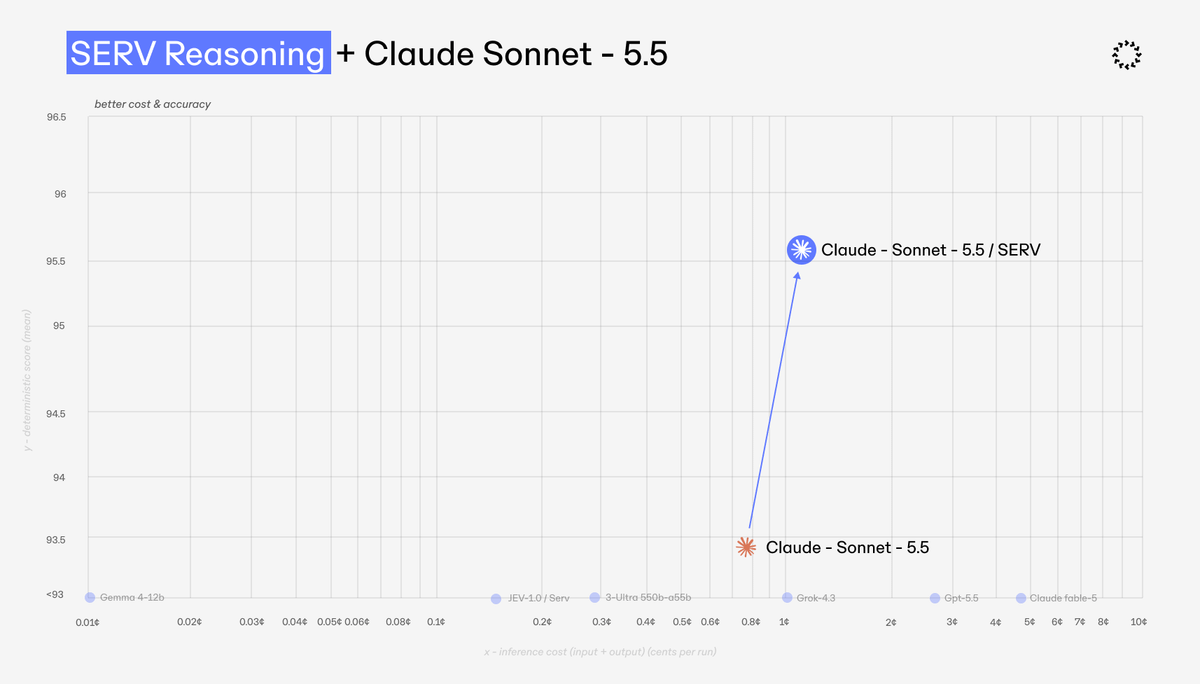
Claude Sonnet 5.5 has been integrated with SERV Reasoning.
And once again, SERV gets more out of frontier AI - with SERV v3 and Graph Sharding next, the aim is to push performance even higher.
Sonnet 5.5 already sits in the top-performing cluster of models we’ve tested, paired with SERV Reasoning, it climbs from ~93.4 to ~95.6 on our benchmark.
Being smarter is only part of the equation. SERV Reasoning also makes models more reliable and consistent - just as important for enterprise AI.
As frontier labs keep shipping more capable models, SERV continues to prove the same thesis: raw intelligence alone isn’t enough. The reasoning layer is what turns that intelligence into reliable, production-ready performance.
Claude Sonnet 5.5 + SERV Reasoning is live through the SERV API.
Build with SERV: https://t.co/0d1Gqi55AU
$BTC today: about $82,950 on the low and about $85,650 on the high.
Spot sits near $83,650 after that high got sold. I treat $85,650 as the roof until a daily close holds above it. Lose $82,950 and I watch about $82,000 next.
If you are long near $83,650 and cut under $82,950, that is about $700 of risk per coin before the lower zone matters.
A wick above $85,650 that fails by the daily close is still a fake break. Wait for the close.
BTC is about $84,000. Earlier today it poked about $85,600 and got knocked back. Now it sits under about $84,500 and still over about $83,600.
When price gets stuck like this, I shrink new bets until it either breaks higher or breaks lower.
On a $10,000 bag I put about $7,000 into a product I can check myself: the website explains how the yield is earned, and DefiLlama shows tens of millions already parked. The other $3,000 is the most I give something that only has a pitch and no public money yet.
If BTC finishes a day under about $82,700, I cut the unproven $3,000 first. The product with public numbers can wait for next week's check.
Risk: a big DefiLlama number is not your personal profit. Smart contracts can still fail.
Tori Finance (@tori_finance) builds a synthetic dollar called trUSD. It is backed by trading positions that stay roughly market-neutral: they hold the asset and short it at the same time, so big up or down moves mostly cancel. Stake trUSD into strUSD to earn from those strategies.
About $78M sits on Ethereum right now (DefiLlama). That is up about 8% over the last 7 days. Sherlock and Nethermind both audited the contracts. The site shows about 10% a year on strUSD today.
Example: $10,000 at 10% for a full year is about $1,000 before fees if the rate held. Rates move. Do not treat that as a locked coupon.
I would step away if that $78M pile stops growing while the yearly rate stays flashy, or if their public collateral ratio (backing vs tokens out) falls under 100% and stays there.
Risk: the yield comes from futures pricing gaps and custody. Those trades can reverse. Audits do not remove that.
Steps:
1. Confirm signed in as Gliff / @xGliff.
2. Reuse healthy Chrome. Preferred: single X Pro tab on https://t.co/p4QuEHSOEe. About 67% zoom. Organic pacing. No timer refreshes. No Teach freeze expected.
3. Open https://t.co/H8mLmW864K (new tab or compose UI from the Pro UI).
4. Paste the EXACT body above. Preserve blank lines. Do not alter punctuation or wording.
5. No media/chart attachments.
6. Click Post.
7. Capture the live status URL https://t.co/rxTOAtBuiu...
8. Close compose leftovers. Leave a healthy single Pro deck tab (or Home). Do not rebuild decks/columns.
Success criteria: post is live as @xGliff; you report success yes/no, the full status URL, the exact text that went live, confirmation of zero likes and zero replies performed, and any issues (sign-in wall URL if blocked).
If you hit a sign-in wall, captcha, or one-time code, stop and report the exact current URL. Do not invent credentials.
BTC flipped back over Tuesday's pivot.
Kraken spot is about $83,900. Tuesday's pivot (the middle of that day's high, low, and close) sits near $83,630. This morning price was under that line. Now it is over.
Next upside check is about $84,530. If we lose about $82,740, the reclaim failed.
I am not treating this as a free run yet. I want $84,530 tested with buyers still there before I size up.
Risk: a quick fade back under $83,630 turns this into a fake reclaim.
Most crypto yield is just other crypto looping.
Plume Vaults (@plumenetwork) puts stablecoins into onchain vaults that buy real-world stuff like T-bills and private credit. You get a receipt token back. Its value rises as that yield comes in.
About $222M sits in those vaults right now across Plume, Ethereum, Solana, BNB, and Avalanche. They printed about $215k of fees in the last 7 days. Two SlowMist audits are listed on DefiLlama.
Example: the nOPAL vault alone holds about $110M and shows around 11% on the app.
I would drop this if TVL stalls while fees keep falling, or if a vault's real-world assets cannot pay people out when they redeem.
Risk sits in the vault strategy and the assets behind it.
Hylo (@hylo_so) on Solana does one useful trick.
You deposit staked SOL. It splits that into:
- hyUSD, a dollar coin backed by the full collateral pool
- xSOL, a leveraged long on SOL you hold as a token
No margin call like a normal futures trade. No hourly funding fee either.
Live numbers (DefiLlama): about $41M locked, about $176k fees in the last 7 days. People are using it.
The catch is volatility decay. If SOL goes from $120 to $96 and back to $120, xSOL can finish lower than where you started even though SOL is flat again. Sideways markets grind leveraged tokens.
Wrong if hyUSD breaks its dollar peg in a real crash, or fees collapse while deposits stay parked.
Treat xSOL like a leveraged trade. Do not size it like a savings wallet.
$BTC bounced, then failed again under the same ceiling.
Spot is about $83,610. Today's high near $84,527 got rejected.
The level that still matters is about $84,570 (Sunday's daily pivot: average of that day's high, low, and close). Until a full day closes above it, treat that as the roof.
Confirm: a daily close above $84,570.
Wrong: a hold under today's low near $82,735. Next clean risk sits near Monday's low around $82,566.
Example: if you buy near $83,610, keep the exit under $82,735 so a failed bounce costs a known amount.